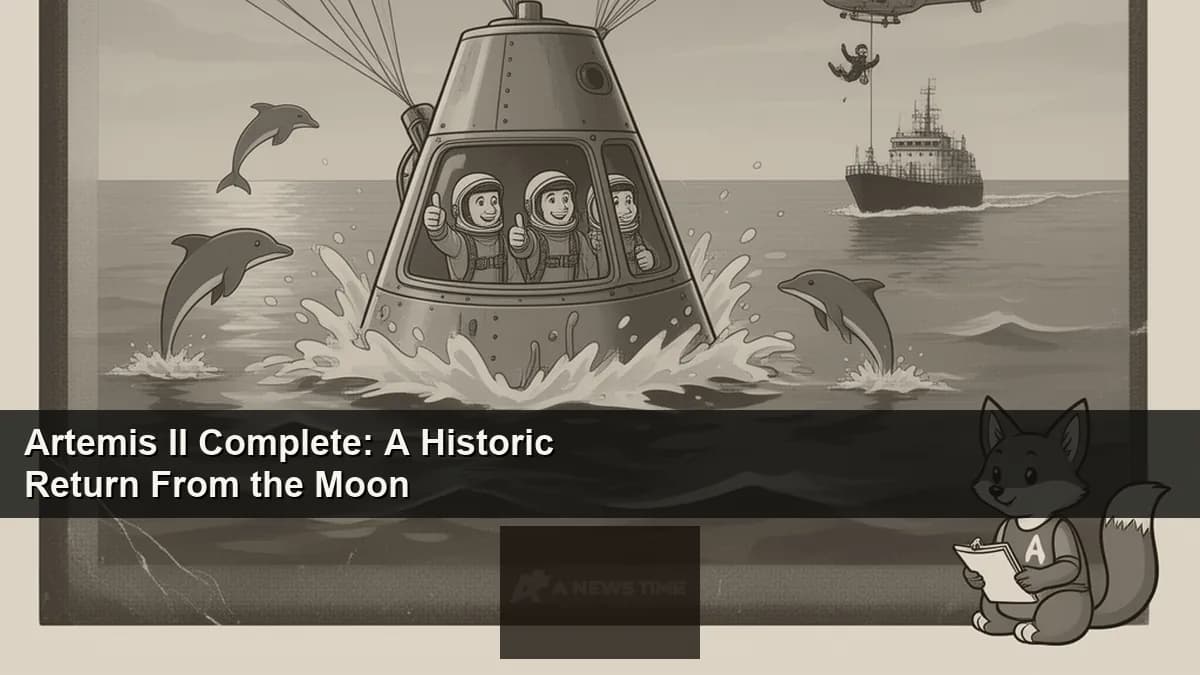
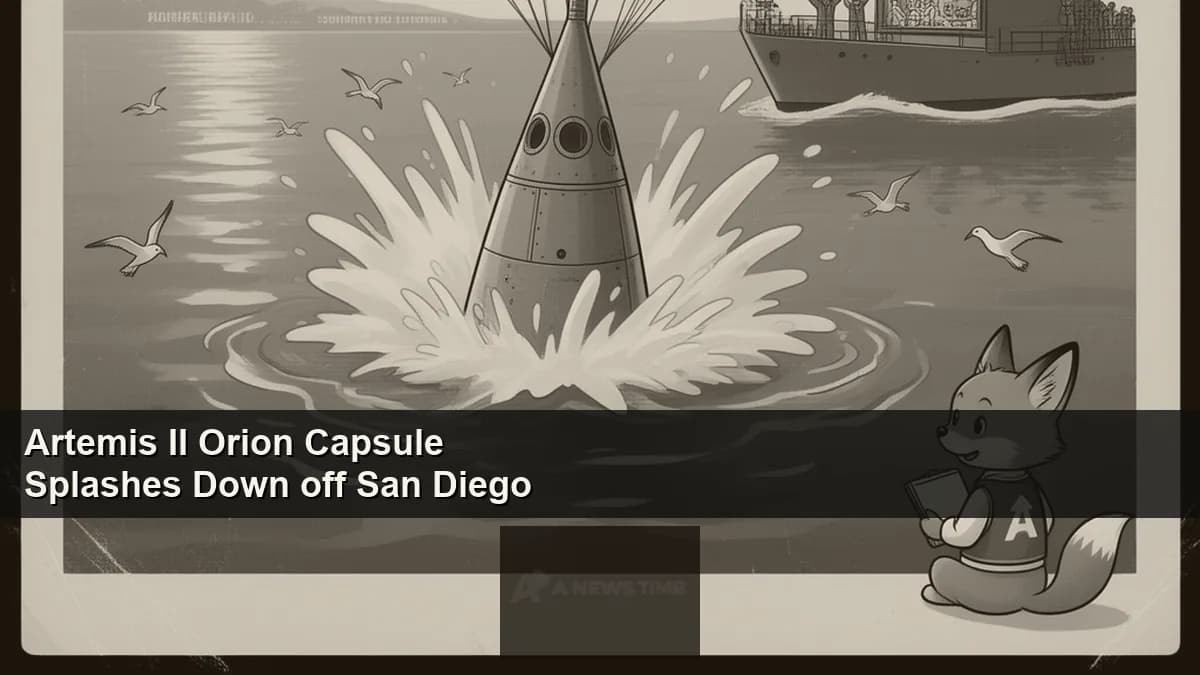
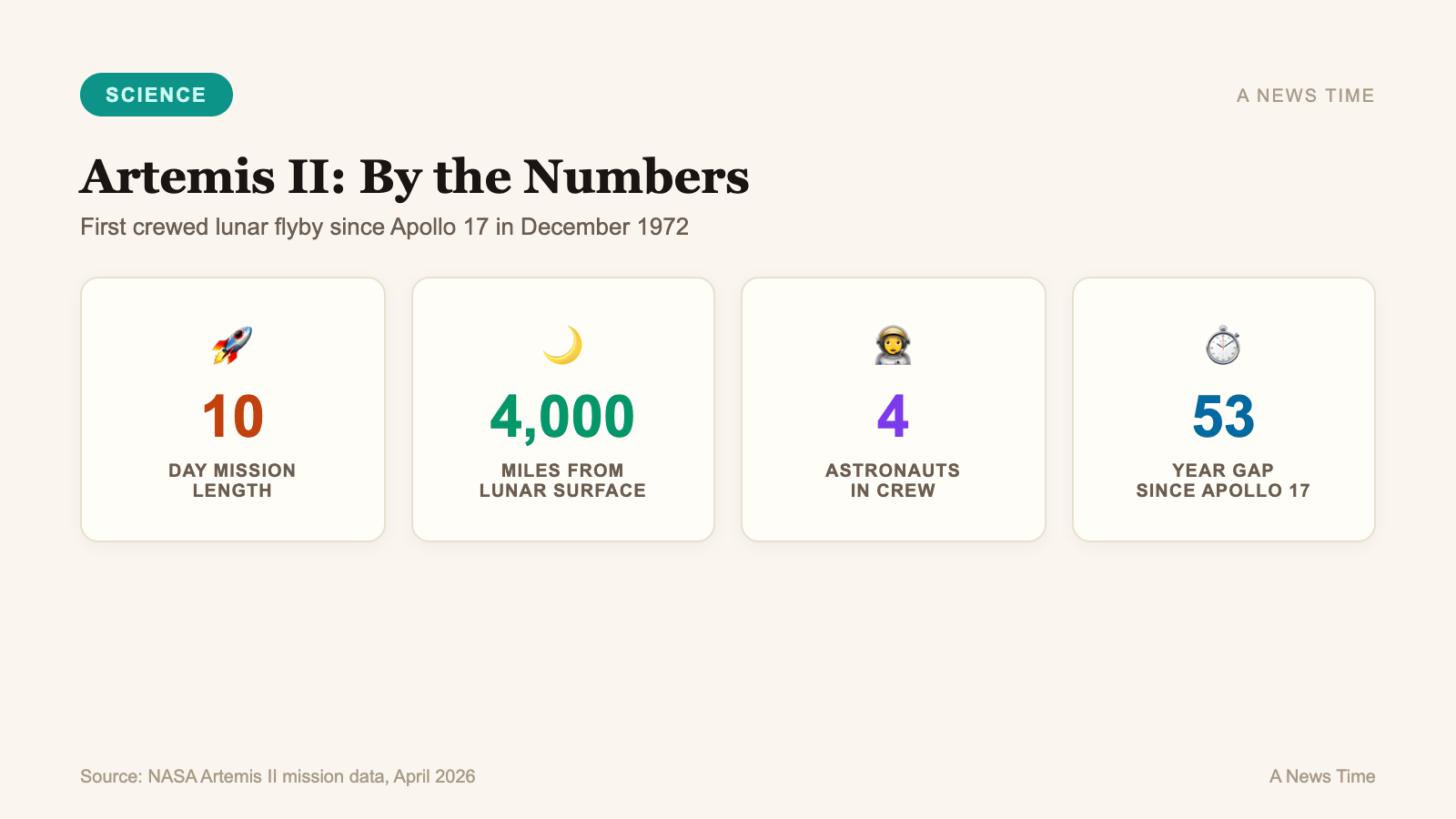
Four astronauts returned to Earth from the vicinity of the Moon on , splashing down in the Pacific Ocean off the coast of San Diego at 5:07 p.m. Pacific Time aboard NASA's Orion spacecraft. Commander Reid Wiseman, Pilot Victor Glover, and Mission Specialists Christina Koch and Jeremy Hansen, the first crew to pass within lunar distance since the Apollo program ended, were recovered by the USS John P. Murtha and flown to Naval Air Station North Island the next day. The mission concluded a 10-day free-return flight that took the Artemis II crew within roughly 4,000 miles of the lunar surface on .
On Tuesday, NASA released new photos from the recovery. The image that moved fastest online shows Wiseman stepping onto the deck of the recovery ship with a small plush toy called "Rise" held against his chest. The mascot, a zero-gravity indicator designed by eight-year-old Lucas Ye of California and inspired by the "Earthrise" photograph from Apollo 8, rode along with the crew for the entire flight. Wiseman wrote afterward that he could not let Rise out of his sight, and had tethered it to his water bottle on the ship.
The photo is small in its subject and large in what it implies. Humans went around the Moon this month for the first time in 53 years, and the image of a returning commander cradling a toy named after the first photograph of Earth from lunar orbit is an attempt to make that span legible to people who were not alive for Apollo.
What Artemis II actually did
Artemis II launched from Launch Complex 39B at Kennedy Space Center on , aboard the Space Launch System Block 1 rocket. The crew performed translunar injection on April 3, firing the European Service Module's main engine to break free of Earth orbit, and reached closest lunar approach on April 6. The trajectory was a free return, which means Orion used the Moon's gravity to sling itself back toward Earth without needing a powered lunar orbit insertion burn. If the spacecraft's propulsion system had failed after the translunar injection, gravity alone would have brought the crew home.
That conservatism is the point. Artemis II was a shakedown of Orion's life support, thermal protection, avionics, and deep-space communications, not an attempt at new operations in lunar orbit. NASA's Artemis program page describes the flight as the final uncrewed-to-crewed transition before the planned Artemis III landing, and the mission architecture reflects that framing. Every subsystem that will have to work for a lunar landing needed to demonstrate it could keep four people alive during a 10-day round trip first.
On reentry, Orion hit the upper atmosphere at roughly 25,000 miles per hour, with heat shield temperatures near 5,000 degrees Fahrenheit as the ablative material burned away under the plasma load. Parachutes deployed as designed, and the capsule touched down within the primary recovery zone. Christina Koch, who became the first woman to travel to lunar space on this flight, said in a post-splashdown briefing that the crew was in good condition and that Orion had performed "essentially nominally" against the flight plan.
The "missing" heat shield piece that wasn't missing
Within hours of splashdown, imagery of Orion on the recovery deck began circulating on social media with annotations suggesting a section of the heat shield was missing. The area in question sat in the capsule's compression pad region, and at first glance the light discoloration did look like a gap.
NASA administrator Jared Isaacman addressed the speculation directly on X, rather than waiting for a formal review document. "I am hesitant to get ahead of a proper data review, but I understand the space community's curiosity, especially when imagery can give the impression of a problem," he wrote. Isaacman said engineers had inspected the heat shield starting with diver imagery shortly after splashdown and continuing aboard the recovery ship, and that "no unexpected conditions were observed."
"The discoloration was not liberated material. The white color observed corresponds to the compression pad area and is consistent with the local geometry, AVCOAT byproducts, and transitional heating environments. We observed this behavior in arc jet testing and expected it in this compression pad area."
Jared Isaacman, NASA Administrator, responding to social media speculation on X
AVCOAT is the ablative compound that lines Orion's heat shield, the same family of material used on the Apollo command modules. It is designed to char and slough off in controlled ways under reentry heat, and the compression pad region, where the heat shield meets the capsule structure, experiences a different thermal regime than the rest of the surface. Arc jet testing, which blasts material samples with high-enthalpy plasma in a ground chamber, had already shown that this area would discolor in exactly the way the post-flight images captured.
The uncrewed Artemis I flight in returned with unexpected char loss on its heat shield, and the investigation delayed Artemis II by more than a year while NASA redesigned the reentry trajectory. Early evidence suggests the redesigned approach worked, though the full data review will take weeks.
The 53-year gap in one table
| Metric | Apollo 17 (Dec 1972) | Artemis II (Apr 2026) |
|---|---|---|
| Crew size | 3 | 4 |
| Mission length | 12 days 13 hours | ~10 days |
| Closest lunar approach | Landed on surface | ~4,000 miles (flyby) |
| Launch vehicle | Saturn V | SLS Block 1 |
| Spacecraft | Apollo CSM + LM | Orion + European Service Module |
| Reentry speed | ~24,800 mph | ~25,000 mph |
| Crew composition | 3 white American men | First woman, first Black astronaut, first non-American at lunar distance |
Scale comparisons help. Fifty-three years is long enough that a child born when Apollo 17 splashed down is now a grandparent. It is long enough that every person who walked on the Moon was born in the 1920s or 1930s. Orion is a new spacecraft, not a descendant of the Apollo command module. SLS is a new rocket, though it inherits shuttle-era engines. The trained workforce that flew humans beyond low Earth orbit existed, and then it did not, and then it had to exist again.

What this teaches NASA for Artemis III
Artemis III is the mission that will put humans back on the lunar surface, using SpaceX's Starship Human Landing System in a rendezvous architecture that is meaningfully more complex than anything Apollo attempted. Artemis II does not directly validate that landing plan. What it does validate is the pieces of the Artemis III stack that move the crew between Earth and the Moon.
Four subsystems can be checked off on the basis of this flight: Orion life support during extended deep-space operations, the European Service Module's main engine and propellant management, the updated reentry trajectory, and the deep-space communications network. Spaceflight Now reported that NASA officials described the mission as a "clean sheet" for Orion, with no major anomalies identified in real time.
What Artemis II does not validate is the Human Landing System itself, the Starship propellant transfer operations in low Earth orbit, the lunar surface suits, or the Gateway station architecture. For readers tracking the full picture, ANewsTime's earlier coverage of the April 6 lunar flyby and the splashdown mechanics goes deeper on the engineering milestones, and our reporting on the SLS rocket's political future covers the programmatic uncertainty.
What we still don't know
The mission's success is unambiguous at the level of crew safety, vehicle performance, and primary objectives. The uncertainty lives one layer deeper.
The heat shield data will not be fully characterized for weeks. Isaacman's statement that no unexpected conditions were observed is a real signal, but the detailed thermal map, ablation measurements, and micro-scale inspection of the AVCOAT layer are all post-flight work that happens on shore. The Artemis I char loss problem was not visible in initial imagery either. Investigators found it after taking the capsule apart and measuring how much material had been lost relative to predictions. Artemis II will go through the same process, and the conclusions will not be final until that work is done.
The Artemis III timeline remains genuinely uncertain. NASA's current public target is a 2027 landing, but the agency's internal risk reviews and the independent schedule assessments published last year both flag the Human Landing System as the pacing item. NASA's own schedule guidance has slipped more than once, and the question of whether Starship's orbital refueling architecture is ready for a crewed lunar mission on that timeline is not settled inside the engineering community, let alone outside it.
What to watch next
Three things deserve attention over the next two months. First, the full Orion post-flight data review and heat shield report, which will either confirm or qualify Isaacman's early read. Second, the updated Artemis III schedule and Human Landing System milestone list NASA is expected to release after the Artemis II data is folded in. Third, the congressional FY2027 budget hearings, which will set the funding envelope for the rest of the program.
Reid Wiseman will eventually put Rise down. The longer-term question is whether the program that carried them both around the Moon can keep moving at the pace its proponents and critics have both been waiting for.
Frequently Asked Questions
When did Artemis II splash down?
The Orion capsule splashed down in the Pacific Ocean off the coast of San Diego at 5:07 p.m. Pacific Time on Friday, April 10, 2026. The crew was recovered by the USS John P. Murtha.
Who was on the Artemis II crew?
Commander Reid Wiseman, Pilot Victor Glover, and Mission Specialists Christina Koch and Jeremy Hansen. Glover is the first Black astronaut to travel to lunar space, Koch is the first woman, and Hansen, a Canadian Space Agency astronaut, is the first non-American.
What is "Rise" the Artemis II mascot?
Rise is the mission's zero-gravity indicator, a small plush toy designed by eight-year-old Lucas Ye of California. It takes its name from the "Earthrise" photograph taken during Apollo 8 and carries an SD card with the names of millions of members of the public who signed up to fly along with the crew.
Was there actually a problem with the Orion heat shield?
No. NASA Administrator Jared Isaacman said the discoloration visible in post-splashdown imagery was expected behavior of the AVCOAT ablative material in the compression pad region, and had been observed in arc jet ground testing before the flight. A full post-flight data review is ongoing.
When will humans land on the Moon again?
NASA's current target is Artemis III in 2027, which would use SpaceX's Starship Human Landing System for the lunar surface portion of the mission. That schedule depends on Starship's orbital refueling architecture reaching readiness, which remains one of the program's most uncertain milestones.
Sources
- This Artemis 2 astronaut really loves Rise, Space photo of the day for April 14, 2026 - Space.com
- NASA responds after social media users notice bizarre missing part on Artemis 2's heat shield - UNILAD Tech
- RISE, NASA Artemis II moon mascot, zero-G indicator, is a cute plushie - Yahoo / Florida Today
- Artemis program overview - NASA