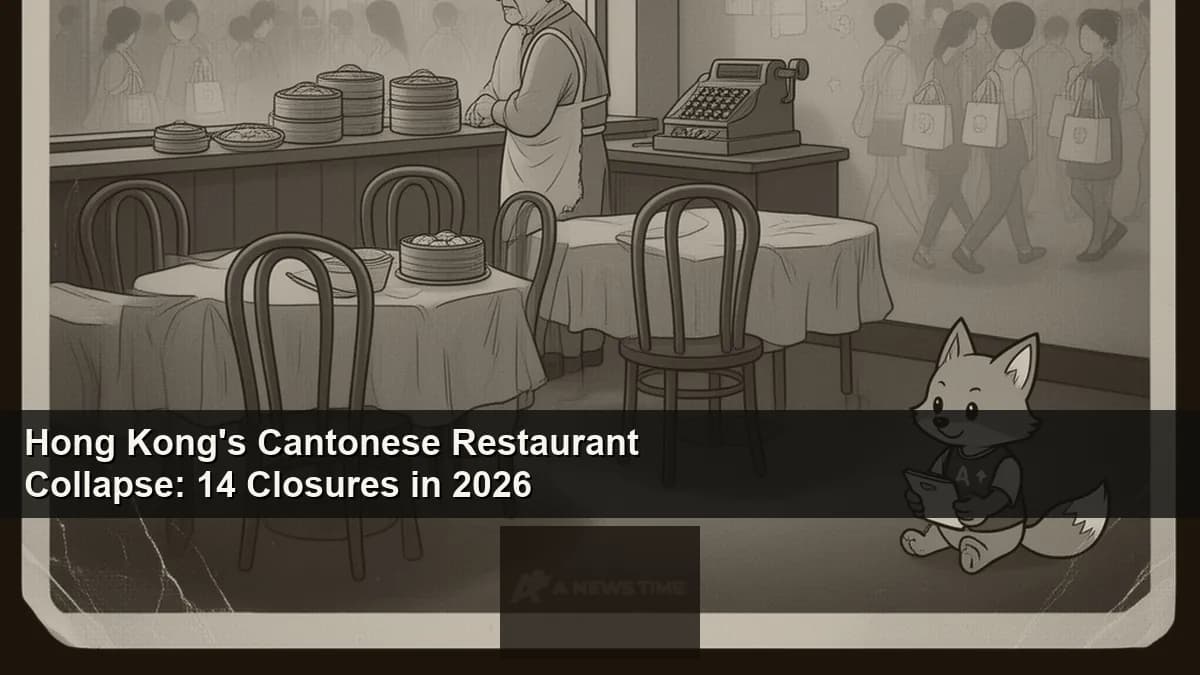
Hong Kong's Cantonese restaurant industry has lost at least 14 long-running establishments in the first four months of 2026, a wave of closures that includes 40-year-old fine dining institutions, 60-year-old neighborhood holdouts, and a teahouse where elderly residents still brought caged songbirds for morning tea, a tradition that may now disappear from the city entirely. The breadth of the closures, first compiled by Hong Kong's Sing Tao Daily and reported in detail by Vision Times on , signals something deeper than a normal restaurant cycle. It is the unraveling of a culinary culture that defined the city for generations.
The corner of Taikoo Shing Centre that the House of Canton occupied for more than 40 years now sits dark. The restaurant, known in Cantonese as Hanteng Ge, closed quietly in late February 2026, ending the brand's presence in Hong Kong entirely. Its sister restaurant, Tin Yat at Pacific Place in Admiralty, closed in March. Both belonged to the Elegant Dining Group, which has now exited the Hong Kong restaurant market completely. Maxim's Group, one of the city's largest catering conglomerates, will take over the Taikoo Shing site for a new outlet under its Eight brand later this summer.
The 40-year fine dining names that did not survive the first quarter
House of Canton built its reputation on high-end Cantonese cooking across three locations in Taikoo Shing, Tsuen Wan, and Festival Walk in Kowloon Tong. For Hong Kong families, it was the restaurant of choice for celebrations that demanded something more formal than a neighborhood teahouse. Tin Yat occupied a similar slot in the Admiralty financial district. Both were the kind of establishments that anchored the social calendar of the city's Cantonese middle class for decades.
Their closures matter because they tell the story of demand collapse at the top end of the market. Fine dining is the first segment to suffer when consumer confidence falls and the last to recover. Tin Yat managed reasonable lunch trade but could not sustain its evening business. The owners did not blame any single factor. They blamed the math of running a high-end Cantonese restaurant in a city where the patrons who used to fill it on Saturday evenings have either emigrated, are eating across the border in Shenzhen, or have simply stopped going out for celebrations the way they used to.
The neighborhood institutions that survived for decades but not this year
The fine dining closures are easier to explain than the neighborhood ones. Several Cantonese restaurants that had served their communities for 30, 60, or even 67 years closed in the same window, and the cumulative effect is harder to read as anything other than a structural shift.
Good Luck Seafood Restaurant in Kowloon City Plaza had operated for 30 years before closing on March 22. It was a holdout in an era of cost-cutting, insisting on making all its dim sum by hand each day and refusing to use pre-made or frozen items. Its closure announcement thanked the neighborhood for three decades of support.
Sun Lung Shing Teahouse in Ngau Chi Wan, in the eastern part of Kowloon, carried a history of nearly 67 years. Housed in a corrugated iron structure typical of Hong Kong's older village buildings, it was one of the last remaining teahouses in the city where patrons could bring caged songbirds, a practice once common in Cantonese teahouse culture, in which elderly men would carry their birds to morning tea as a form of companionship and social display. The Hong Kong actor Luo Jiaying publicly praised the teahouse before its closure was announced. It is closing at the end of April 2026, forced out by the Hong Kong government's redevelopment of the surrounding area.
Longbao Restaurant in Kwai Fong, with 60 years of history, announced its closure at the end of last month after 14 years at its current location. The owners cited three factors: sudden shifts in global trading conditions, weak consumer spending in Hong Kong, and a failure to reach agreement with their landlord on a rent reduction. The owners were unusually direct about which of the three actually pushed them over the edge.
The world trading environment had shifted, consumer spending in Hong Kong was weak, and the landlord refused to negotiate a rent reduction.Longbao Restaurant, closure announcement
The chain restaurants are collapsing faster than independent ones
The closures are not limited to family-run institutions. Two of Hong Kong's mid-tier Cantonese chains have shrunk to skeleton operations. The Star Seafood Restaurant chain, which recently operated six branches across Kowloon and the New Territories, now has only two locations remaining. Its San Po Kong outlet on Duke Street, which had operated for more than 20 years originally under the name Duke Restaurant, closed on . The Kwun Tong location on Yian Street closed earlier this year.
The Eastern Harbour Court brand, run by Eastern Harbour Catering Group, has shrunk to a single surviving restaurant after its branch at HomeSquare shopping mall in Sha Tin closed in March. Only the location at Tsing Yi City mall in the western New Territories remains open.
The Jade Garden brand, founded in 1971 and the first Cantonese restaurant ever opened by Maxim's Group, has also been retreating. Following the closure of its Mong Kok branch last year, the Tseung Kwan O location at New Town Plaza closed on when its lease ran out and was not renewed. Jade Garden holds an iconic position in the city's culinary history as Maxim's flagship Cantonese concept. Its slow disappearance is a symbolic moment for a brand that has been part of how the company defined Hong Kong dining for more than 50 years.
The economics behind the unraveling
Three forces are operating simultaneously, and the closures are happening at the intersection of all three. The first is rent. Hong Kong commercial real estate prices have not fallen far enough to reflect the new reality of restaurant economics, and most of the closures cite landlords refusing to negotiate as the deciding factor. Several leases simply expired and were not renewed at any price the operators could afford.
The second is consumer demand. The middle-class Cantonese families who used to fill these restaurants on Sunday mornings have been shrinking as a market for two reasons. Tens of thousands emigrated during and after the political upheaval of 2019, mostly to the United Kingdom, Canada, and Australia, taking their dining habits with them. Those who remain have been spending less on restaurants, partly because of the broader economic anxiety hanging over the city and partly because the alternatives have become unbeatable on price.
The third is Shenzhen. A growing proportion of Hong Kong residents now cross the border into Shenzhen, the mainland city just north of the boundary, for weekend meals. Shenzhen restaurants offer comparable Cantonese cooking at significantly lower prices, and the high-speed rail connection has made the trip easy enough that families think nothing of crossing for lunch and back. The cumulative effect is that Hong Kong's Cantonese restaurants are competing not just with each other but with an entire mainland city that they cannot match on cost.
The rest of the closures, in one place
The full list of Cantonese closures since the start of 2026, compiled from Sing Tao Daily reporting, includes Tsui Wan Fishing Port Restaurant in Chai Wan, Houyuan Seafood Restaurant in Lam Tin, Baihui Restaurant in Lam Tin (closed April 4), Palace Restaurant on Cheung Hong Estate in Tsing Yi, and Shing Cheong Chiu Chow Seafood Restaurant in Tai Wai. Several of these served neighborhoods on the outskirts of Kowloon and the New Territories, the parts of the city where everyday dim sum culture has been thickest for decades.
Almost every closure tells a similar story. A long lease ran out. A landlord declined to negotiate. The numbers stopped working. The owners thanked their customers and locked the doors.
What is actually being lost
The closure of a 67-year-old teahouse where elderly men once brought their songbirds on Sunday mornings, or a 30-year-old restaurant that refused to use pre-made dim sum, is not just the disappearance of a business. It is the erasure of social infrastructure that held working-class and middle-class Hong Kong communities together. Cantonese teahouse culture is one of the most distinctive folk traditions in the Chinese-speaking world, and the institutions that carried it forward are not coming back once they close.
Maxim's Group taking over the House of Canton site under its Eight brand is the kind of detail that captures the new economics. The conglomerate operators can absorb the rents and the consolidation. The independent operators cannot. What replaces a 40-year-old restaurant is rarely another 40-year-old restaurant. It is usually a chain concept built to amortize costs across multiple locations.
For broader context on how restaurant industry economics are reshaping major cities, our coverage of London's 2026 restaurant closures and the hottest new LA restaurants this month show how very different markets are responding to the same set of pressures.
What to watch over the rest of the year
Two things to track. The first is whether Maxim's Group, Cafe de Coral, and the other large Hong Kong catering conglomerates continue to absorb the spaces that independents are vacating. Their willingness to pay current commercial rents is what will determine whether the closure wave plateaus or accelerates. The second is whether the Hong Kong government introduces any rent relief or tax abatement aimed specifically at long-tenured restaurants, which several industry groups have been requesting since late last year.
For now, the picture is clear enough. Hong Kong is losing the restaurants that defined what eating in Hong Kong meant. Whatever replaces them will not be Cantonese fine dining as the city's grandparents knew it.