NASA's Space Launch System is, by nearly any engineering measure, an extraordinary machine. It stands 98 meters tall, produces 8.8 million pounds of thrust at liftoff, and on April 1, 2026, it pushed four human beings farther from Earth than any crew had traveled since Apollo 17 in December 1972. Ten days later, those four astronauts splashed down safely off San Diego after completing the most successful crewed deep-space mission in half a century.
It is therefore something of an irony that within a week of that triumph, the Trump administration had already begun the process of replacing it.
According to a Bloomberg report published April 11, 2026, NASA issued a Request for Information to commercial launch providers roughly one week before Artemis II's April 1 launch date, asking what alternatives they could offer for the agency's future lunar missions. That request was followed almost immediately by a White House budget proposal that placed the SLS's future in explicit doubt, according to people familiar with the document cited by Bloomberg.
What the SLS actually costs
The Space Launch System has cost approximately $24 billion in development funds since its authorization by Congress in 2010. That number does not include the cost of Orion, the crew capsule it carries, which has absorbed another $20-plus billion in development funding. Each launch of the SLS is estimated to cost between $2 billion and $4 billion, depending on how costs are allocated. By comparison, a Falcon Heavy launch from SpaceX is priced at approximately $100 million for commercial customers. SpaceX's Starship, which has been performing uncrewed test flights and is now flying routinely in operational configurations, is projected to cost in the range of $10 million per launch once fully reusable operations are established, though that number remains unverified in operational practice.
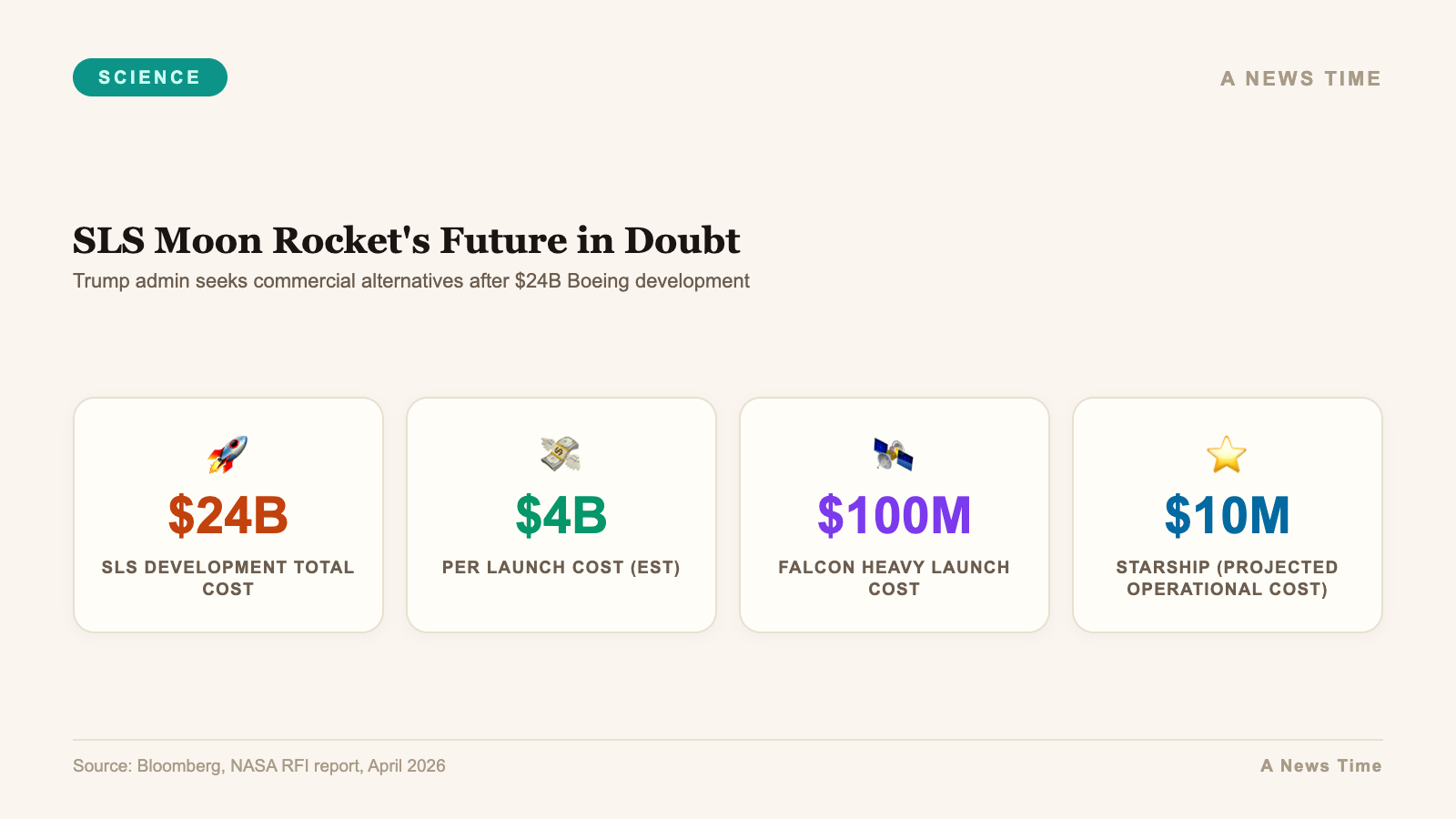
The cost disparity is the central fact around which every discussion of SLS's future orbits. NASA's Artemis program has been politically durable precisely because it spread manufacturing contracts across dozens of congressional districts, creating a constituency for the program that transcended its actual technical performance. Boeing is the prime contractor for the SLS core stage. Northrop Grumman builds the solid rocket boosters. Aerojet Rocketdyne supplies the RS-25 engines. Each of those companies employs thousands of workers in politically important states.
But the fiscal math has become increasingly difficult to defend in a budget environment defined by deficit reduction and competing priorities. The SLS has flown once successfully on Artemis I in November 2022 (uncrewed) and once on Artemis II (crewed). The program was originally designed to fly at least once per year. It has instead averaged one flight every 2.5 years.
What Jared Isaacman's NASA actually wants
NASA Administrator Jared Isaacman, confirmed to the role in early 2025 after a nomination process that drew on his background as a commercial astronaut who flew on SpaceX's Inspiration4 and Polaris Dawn missions, has been characteristically direct about his commercial-first instincts. Isaacman has spoken publicly about the importance of transitioning NASA from a builder of hardware to a buyer of services, a philosophy that aligns closely with the Trump administration's broader approach to government contracting.
The Request for Information sent to commercial providers asked specifically about the ability to launch crew and cargo on trajectories that could support lunar orbit rendezvous and lunar surface operations, the two core mission profiles needed for Artemis III through Artemis V. SpaceX's Starship, which is designed to carry more mass to the Moon's surface than the entire Apollo Lunar Module and its descent propellant combined, is the obvious candidate. United Launch Alliance's Vulcan Centaur is a secondary option for certain mission profiles. Blue Origin's New Glenn could potentially be relevant in a few years.
The Bloomberg report noted that the White House budget proposal, which was not yet public as of the report's publication date, would "put a big question mark on the future of Boeing's beleaguered rocket." The word "beleaguered" is doing some work in that sentence. Boeing has faced years of challenges across its commercial aviation and defense businesses, and the SLS contract, despite its cost overruns, has been one of the company's more stable revenue streams.
The political arithmetic of killing a rocket
Canceling the SLS is not as simple as announcing a policy change. The program was authorized by Congress, which has a history of protecting large aerospace programs even when administrations attempt to eliminate them. The Constellation program, which was SLS's predecessor, was canceled by the Obama administration in 2010, which directly led Congress to mandate the creation of SLS in the NASA Authorization Act of that same year. Politicians do not easily give up the jobs and economic activity that rocket programs bring to their districts.
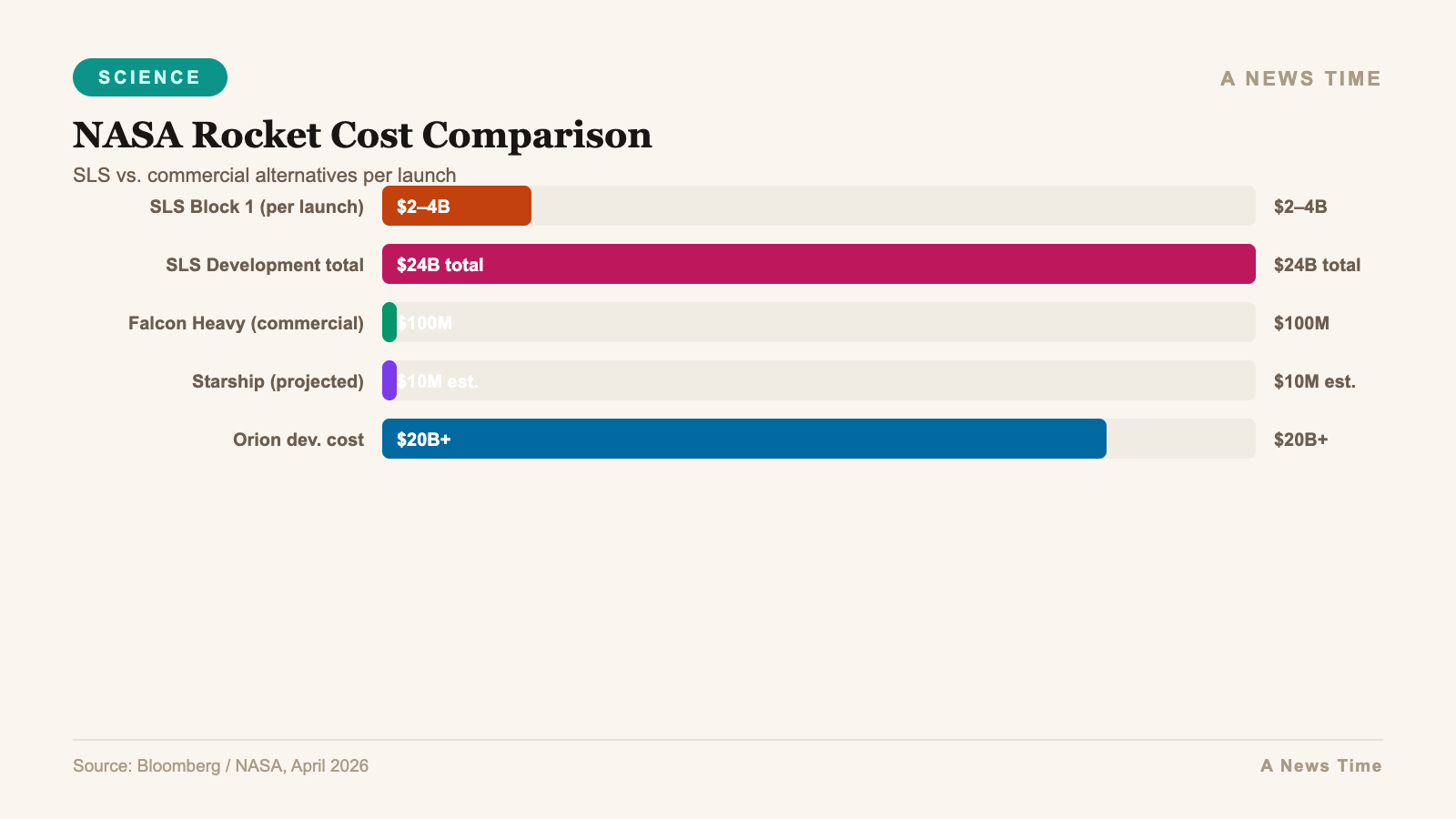
The current political environment may be different. The Trump administration has shown a willingness to make sharp cuts to government programs that previous administrations left intact, and the relationship between the White House and SpaceX is unusually close. Elon Musk's role in the Department of Government Efficiency, though separate from his commercial activities, has given SpaceX an informal presence in budget deliberations that no other aerospace contractor can match.
There is also the question of what killing SLS would mean for Artemis III, the first mission planned to land astronauts on the Moon's surface. That mission's launch readiness date has slipped several times and is currently targeted for late 2027 at the earliest. If SLS is deprioritized in favor of Starship for the crewed lander mission, the timeline could be compressed or extended depending on how quickly Starship's human-rating certification advances. NASA has already awarded SpaceX a contract for the Human Landing System that will carry astronauts from lunar orbit to the surface.
What Artemis II actually proved
Before considering SLS's future, it is worth being clear about what the Artemis II mission demonstrated. The SLS and Orion combination performed essentially flawlessly. The crew reached a maximum distance of 252,755 miles from Earth, exceeding the Apollo 13 record set in 1970. The Orion capsule's life support, navigation, and abort systems all performed within specifications. The crew conducted more than 700 individual tests during the 10-day mission, generating engineering data that will inform Orion's design for years.
The people who built and flew Artemis II are justifiably proud of what they accomplished. The engineers at Marshall Space Flight Center who designed the SLS core stage, the technicians at Michoud Assembly Facility in New Orleans who welded it together, the Aerojet Rocketdyne workers who tested the RS-25 engines, and the Northrop Grumman teams who built the solid rocket boosters all contributed to a genuine milestone in human spaceflight. That achievement does not disappear because an administration decides the architecture is too expensive to continue.
The question, as Bloomberg's reporting frames it, is whether the SLS's proven performance is worth its ongoing cost in a world where commercial alternatives are advancing rapidly. That is not a question with an obvious answer. Starship has not yet carried humans. The Falcon Heavy, which SpaceX has offered as a potential SLS alternative for some mission profiles, cannot match SLS's payload capacity to the Moon. The gap between "promising commercial vehicle" and "certified human-rated lunar transport" is measured not just in engineering milestones but in regulatory processes that take years.
The China factor
One argument that SLS's defenders will certainly deploy in any cancellation fight is the pace of China's lunar program. China's Chang'e program has delivered rovers to the Moon's surface and returned samples from the far side, feats that were beyond any space agency's capability for decades. China has announced plans for a crewed lunar landing before 2030 and is developing a super-heavy launch vehicle, the Long March 10, to enable it.
A US decision to abandon SLS and rely entirely on Starship for crewed lunar missions would represent a bet that SpaceX can certify and fly its human-rated lunar architecture faster than China can reach the surface. That bet may well be correct. But it introduces a risk dependency that does not exist today, where NASA has a demonstrated crewed lunar transport system in Orion and a proven heavy-lift vehicle in SLS.
The geopolitical argument is likely to be the most durable one in any congressional debate over SLS's future. Members from states with SLS manufacturing facilities will argue that maintaining American leadership in space requires maintaining American-built heavy-lift capability. Administrations that have tried to leverage commercial arguments against that position have historically found congressional resistance difficult to overcome.
Boeing's position
Boeing declined to comment substantively on the Bloomberg report, issuing a brief statement that it was committed to the Artemis program and to working with NASA on mission priorities. That is about as much as a contractor can say when its largest government customer is openly soliciting alternatives.
The broader context for Boeing is that the company is simultaneously working through challenges on its 737 Max aircraft, its KC-46 tanker program, and its Starliner crew capsule, which had its own troubled test flight history in 2024 before its recertification for cargo operations. Boeing's defense and space business has been under financial pressure, and while SLS is profitable as a cost-plus contract, the program's future uncertainty adds another layer of uncertainty to a company already navigating a complex recovery.
The decision on SLS's future will not be made quickly. Budget proposals must pass Congress. Request for Information responses from commercial providers must be evaluated. The technical and certification requirements for alternative architectures must be assessed. But the process has now clearly begun, and its initiation days after the greatest achievement of the SLS program tells you something about how the administration sees the future of government-built rockets in an age of commercial spaceflight.
What we still don't know
The exact contents of the White House budget proposal have not been publicly released as of this writing. The specific mission profiles being considered for commercial alternatives, the timeline for any transition, and whether Artemis III would still fly on SLS or be reconfigured for a different architecture are all open questions. Congressional reaction to any formal proposal to reduce or eliminate SLS funding will be a crucial variable that is genuinely difficult to predict.
What is clear is that the Artemis II mission, whatever it represents as a human achievement, did not resolve the debate about American space architecture. It may, paradoxically, have accelerated it. A rocket that has just demonstrated its capability is paradoxically easier to retire than one that never worked. The administration can now point to a successful mission and argue, with at least some credibility, that the job is done and cheaper tools exist for what comes next.
Whether that argument wins in the halls of Congress, where rocket jobs have historically been among the most protected items in any federal budget, is the real question. The answer will shape American space policy for the next decade.