
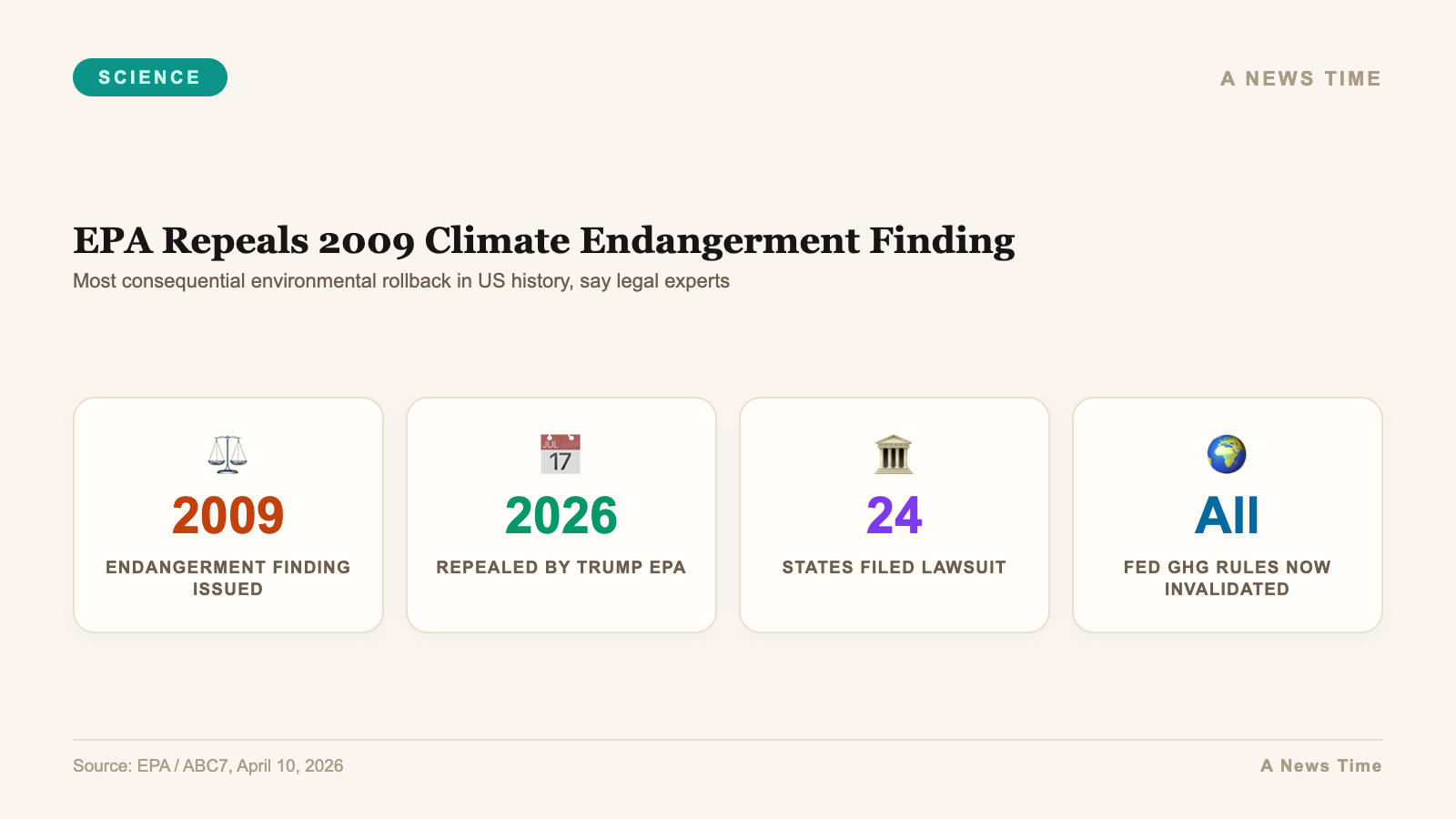
In 2009, the United States Environmental Protection Agency issued a finding that changed the legal landscape of American environmental law. Based on an extensive review of the scientific literature, the agency concluded that greenhouse gas emissions endanger both public health and public welfare. That finding, known as the endangerment finding, was not a regulation in itself. It was a legal prerequisite. Under the Clean Air Act, the EPA can only regulate air pollutants that it has determined pose a risk to health. The endangerment finding was the key that unlocked the EPA's authority to address climate change across the entire American economy.
The Trump administration has now repealed it.
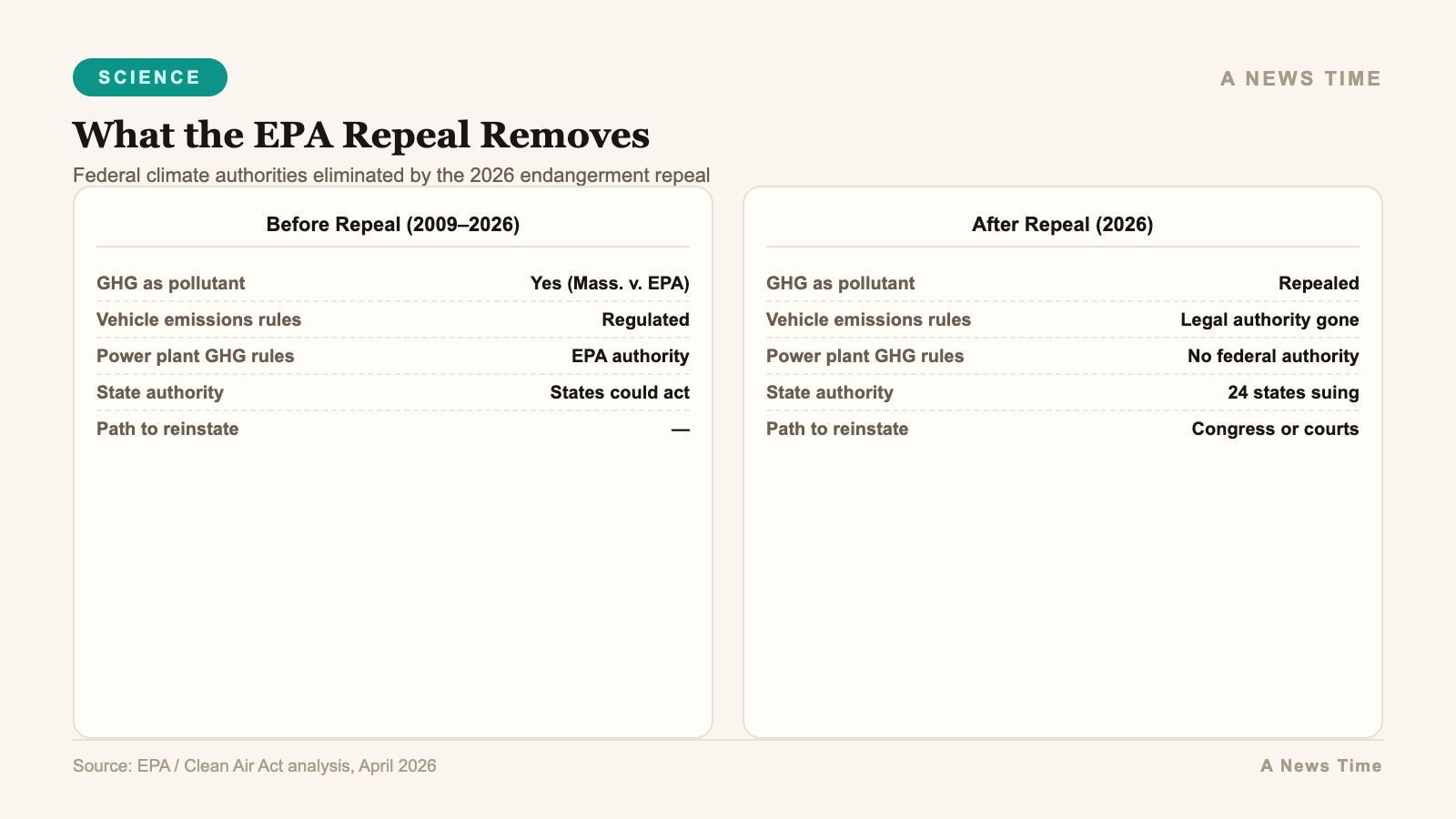
The repeal, announced by EPA Administrator Lee Zeldin earlier this year and described in detail in an April 10 ABC7 report focusing on its implications for Illinois, eliminates the legal foundation for federal greenhouse gas regulations for cars, trucks, and power plants. It means the federal EPA will no longer have authority under the Clean Air Act to regulate the emissions that are warming the planet. Environmental law experts describe it as the single most consequential rollback of environmental protection in the history of the federal regulatory state.
What the endangerment finding actually was
The endangerment finding was not created in a vacuum. It was compelled by a 2007 Supreme Court decision, Massachusetts v. EPA, in which the court ruled 5-4 that greenhouse gases are air pollutants under the Clean Air Act and that the EPA had unlawfully declined to determine whether they endangered health. The court ordered the EPA to make a scientific determination. The Bush administration, which had resisted regulation of greenhouse gases throughout its two terms, declined to act. The Obama administration's EPA conducted the determination and issued the finding in December 2009.
That determination drew on the full body of climate science available at the time, including assessments from the Intergovernmental Panel on Climate Change, peer-reviewed literature from thousands of scientists, and the agency's own technical reviews. It concluded that the atmospheric concentrations of six greenhouse gases, including carbon dioxide, methane, and nitrous oxide, endanger both the health and welfare of current and future generations through their contribution to climate change.
Over the 16 years since its issuance, the endangerment finding became the anchor for a cascade of regulations. Vehicle emissions standards. Power plant rules. Refrigerant regulations. Standards for oil and gas operations. All of them traced their legal authority, at least in part, back to that single scientific determination. When you repeal the endangerment finding, you do not just repeal a piece of paper. You remove the foundation from a regulatory structure that took 15 years to build.
What it means in practice
The immediate practical consequences are significant, though complicated by ongoing litigation and state-level regulations that remain in place. The repeal eliminates the EPA's legal basis for enforcing existing greenhouse gas standards for motor vehicles, the so-called tailpipe rules that required automakers to meet progressively stricter fuel efficiency and emissions standards. It also eliminates the basis for any new power plant rules addressing carbon dioxide emissions, including the Clean Power Plan and its successor regulations.
In Illinois, where the ABC7 report focused, the implications are particularly acute for the state's coal power plant transition. Illinois passed the Clean and Equitable Jobs Act (CEJA), which commits the state to closing coal-fired power plants by 2030 and transitioning to renewable energy. That state law remains in effect regardless of the federal repeal. But the repeal removes a layer of federal regulatory pressure that had been helping to accelerate plant closings, and it creates new economic incentives for plant operators to argue for extensions.
Cate Caldwell, senior policy manager at the Illinois Environmental Council, framed the tension clearly. "CEJA is a strong policy foundation for Illinois, but it works best when federal policy supports, rather than diminishes, state climate progress," she said. "Federal rollbacks could create market uncertainty, slow investment and misrepresent regional power markets, making it harder and more expensive for Illinois to meet its climate and clean energy targets."
On the other side of the debate, state representative Charlie Meier, Republican of Okawville, argued that the repeal was overdue. "It made it harder for states like Illinois to keep reliable power online," he said, adding that what he called "unrealistic mandates" were driving up energy prices and weakening the grid.
The DOE emergency orders and the bigger picture
The endangerment finding repeal is not occurring in isolation. Since last May, the Department of Energy has issued a series of emergency orders under a provision known as Section 202(c) of the Federal Power Act, requiring multiple coal-fired power plants in the Midwestern, Southern, and Western United States, as well as Puerto Rico, to continue operating beyond their planned retirement dates. The orders, which run for 60 to 90 days at a time and have been extended repeatedly, have been applied to plants in Michigan, Indiana, Washington, Colorado, and other states.
The legal basis for these orders is a provision that allows the government to require continued power plant operation during declared energy emergencies. Critics argue that the emergencies being invoked are manufactured or overstated. Supporters argue that grid reliability genuinely requires the continued operation of dispatchable generation during a period of rapid transition. The Illinois Attorney General has joined Minnesota in suing to block emergency orders that would keep Indiana coal plants operating past their retirement dates, arguing that continued operation increases pollution in the region.
The combination of the endangerment finding repeal and the emergency order extensions represents a two-pronged approach to extending the operational life of fossil fuel power plants: remove the regulatory pressure to retire them and mandate their continued operation when markets would otherwise close them. This approach is legally contested, technically dubious in the view of most grid reliability analysts, and politically divisive.
The litigation landscape
The repeal of the endangerment finding was challenged almost immediately in federal court. Illinois Attorney General Kwame Raoul, who joined a coalition of 24 states in filing suit, described the action as unlawful. "Rescinding this EPA determination will undo progress we have made to address climate change by eliminating existing EPA greenhouse gas emission standards for vehicles and undermining the EPA's mandate to regulate harmful air pollution that causes climate change," Raoul said in a statement.
The Sierra Club also filed suit, as did the Natural Resources Defense Council and several other environmental organizations. The legal theory advanced by the challengers has several components. First, that the original endangerment finding was based on sound science and its repeal is arbitrary and capricious under the Administrative Procedure Act, which requires agencies to provide reasoned justification for regulatory actions. Second, that the Supreme Court's 2007 Massachusetts v. EPA decision compelled the EPA to make a scientific determination and the agency cannot simply walk away from that determination without a scientific basis for doing so. Third, that the repeal violates procedural requirements for major regulatory actions under the Congressional Review Act and other statutes.
The legal outcome is genuinely uncertain. The Supreme Court's 2022 West Virginia v. EPA decision limited EPA's authority to implement broad economy-wide decarbonization programs without explicit congressional authorization, but it did not address the validity of the endangerment finding itself. Whether a court will allow the repeal to stand on the merits will depend on how the judiciary evaluates the scientific basis, or lack thereof, offered by the agency for reversing a finding that has been upheld by courts multiple times over 16 years.
What happens to car emissions standards
Vehicle emissions standards have been one of the most practically impactful applications of the endangerment finding. The Obama and Biden administration rules set progressively stricter limits on carbon dioxide emissions from cars and light trucks, pushing automakers toward electric vehicles and more efficient internal combustion engines. Those standards were challenged repeatedly in court and survived, in part because they rested on the endangerment finding as their legal foundation.
With the endangerment finding repealed, the legal basis for any federal standard on carbon dioxide from vehicles is, at a minimum, in doubt. The Trump administration can, and likely will, roll back or rescind the emissions standards themselves. Some automakers may welcome the reduced compliance pressure in the short term. Others, particularly those that have already committed significant capital to electric vehicle development and have contracts in place with battery suppliers and charging network partners, may face complex strategic decisions about how to navigate a regulatory environment that has reversed direction sharply.
California retains its own separate authority under the Clean Air Act to set stricter-than-federal vehicle emissions standards, and more than a dozen other states have adopted California's standards. That means even without federal standards, roughly 40 percent of the US auto market will still be subject to emissions requirements. But the federal floor, which had been progressively tightening for 15 years, is now gone.
The public health dimension
The endangerment finding was grounded in public health science as well as climate science. Greenhouse gases cause climate change, which in turn causes heat-related mortality, worsened air quality from increased ground-level ozone formation, more severe weather events, and disease vector range expansion. These are direct public health effects, quantifiable in hospitalizations and deaths. The EPA's 2009 determination documented them in extensive technical support materials.
The repeal does not change the underlying physical reality. Greenhouse gas emissions will continue to warm the atmosphere, worsen air quality, and generate the health consequences the endangerment finding documented. What changes is the federal government's legal obligation to take those consequences into account when setting regulatory policy. A Climate Impact Lab study documented that by 2050, heat-related deaths attributable to climate change will disproportionately fall on the world's poorest populations, a finding that applies to low-income communities in the US as much as to developing nations.
Martha Ross, a Peoria school board member interviewed for the ABC7 report, described what the health consequences look like at the community level near a coal plant. "Their children struggle with asthma, but they just go to the emergency room," she said. "Nobody's going to get into the real problem: What's causing those issues. And I do think it has a lot to do with the environment." The coal plant near Peoria was closed in 2023 partly due to federal environmental rules. Whether future plants face the same regulatory pressure is now an open legal question.
What we still don't know
The litigation challenging the repeal is in its early stages. Federal courts have not yet ruled on whether the repeal is legally valid. The outcome will depend on judicial interpretation of both administrative law and the scientific record, and given the current composition of the federal judiciary, predictions are genuinely uncertain. The Supreme Court could ultimately take up the case.
It is also not yet clear exactly which regulations will be formally rescinded in the wake of the endangerment finding repeal, and on what timeline. Some existing rules may be challenged by industry groups using the repeal as a basis for attacking their legal foundations, even before the EPA takes formal action. Others may survive through separate legal authority not dependent on the Clean Air Act endangerment determination.
What is clear is that alongside the removal of federal climate data and the rollback of other environmental protections, the endangerment finding repeal represents a fundamental restructuring of the federal government's relationship to climate science and climate policy. Whether that restructuring survives judicial review, and whether a future administration reverses it, are the two most consequential open questions in American environmental law today.
Sources
- ABC7 Chicago: What does Trump's EPA reversal of landmark climate change ruling mean for Illinois? (April 10, 2026)
- Illinois Attorney General: Statement on endangerment finding challenge
- Sierra Club: Lawsuit against EPA over climate protection repeal (February 2026)
- EPA: Climate change indicators and greenhouse gas data