
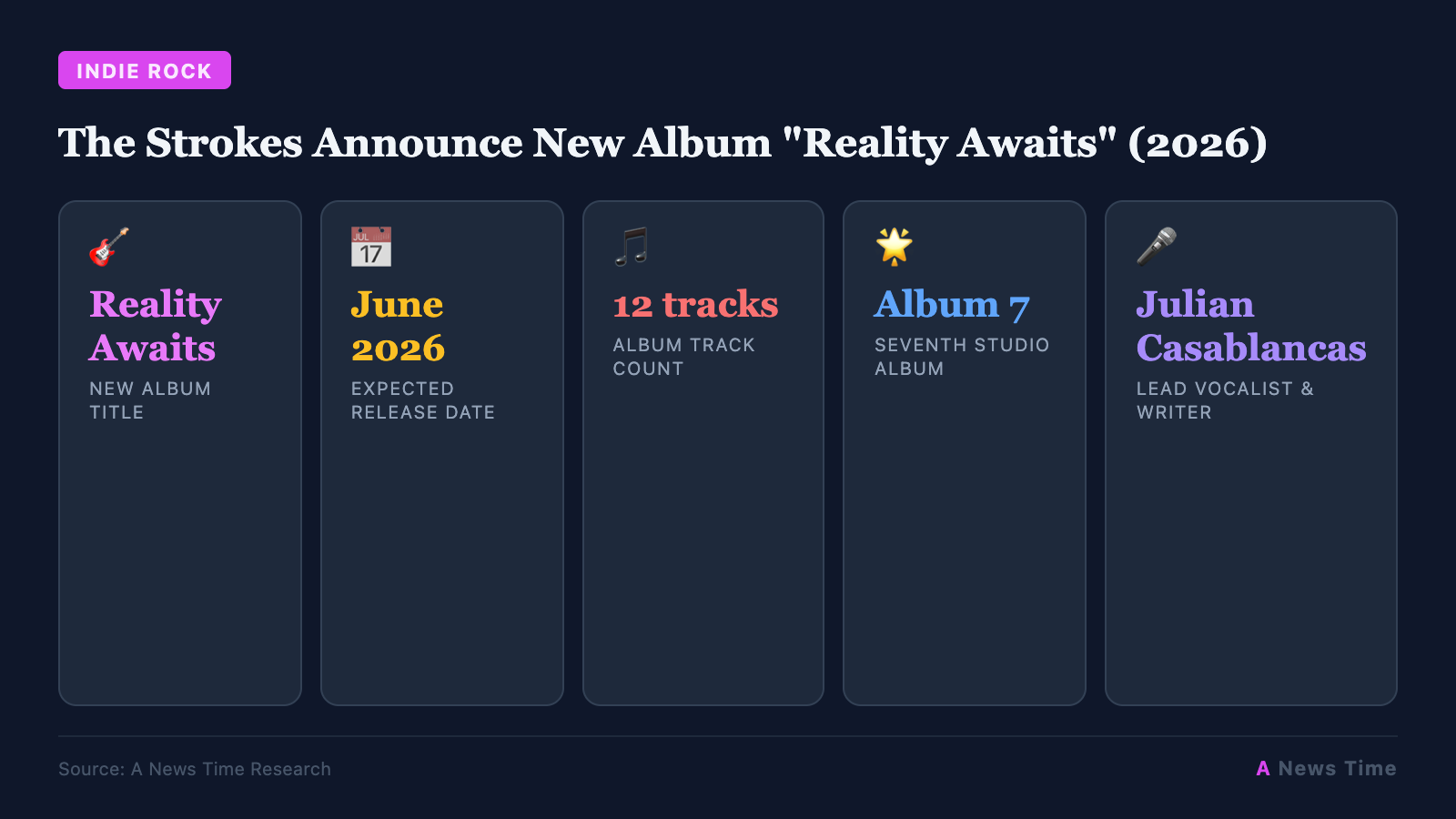
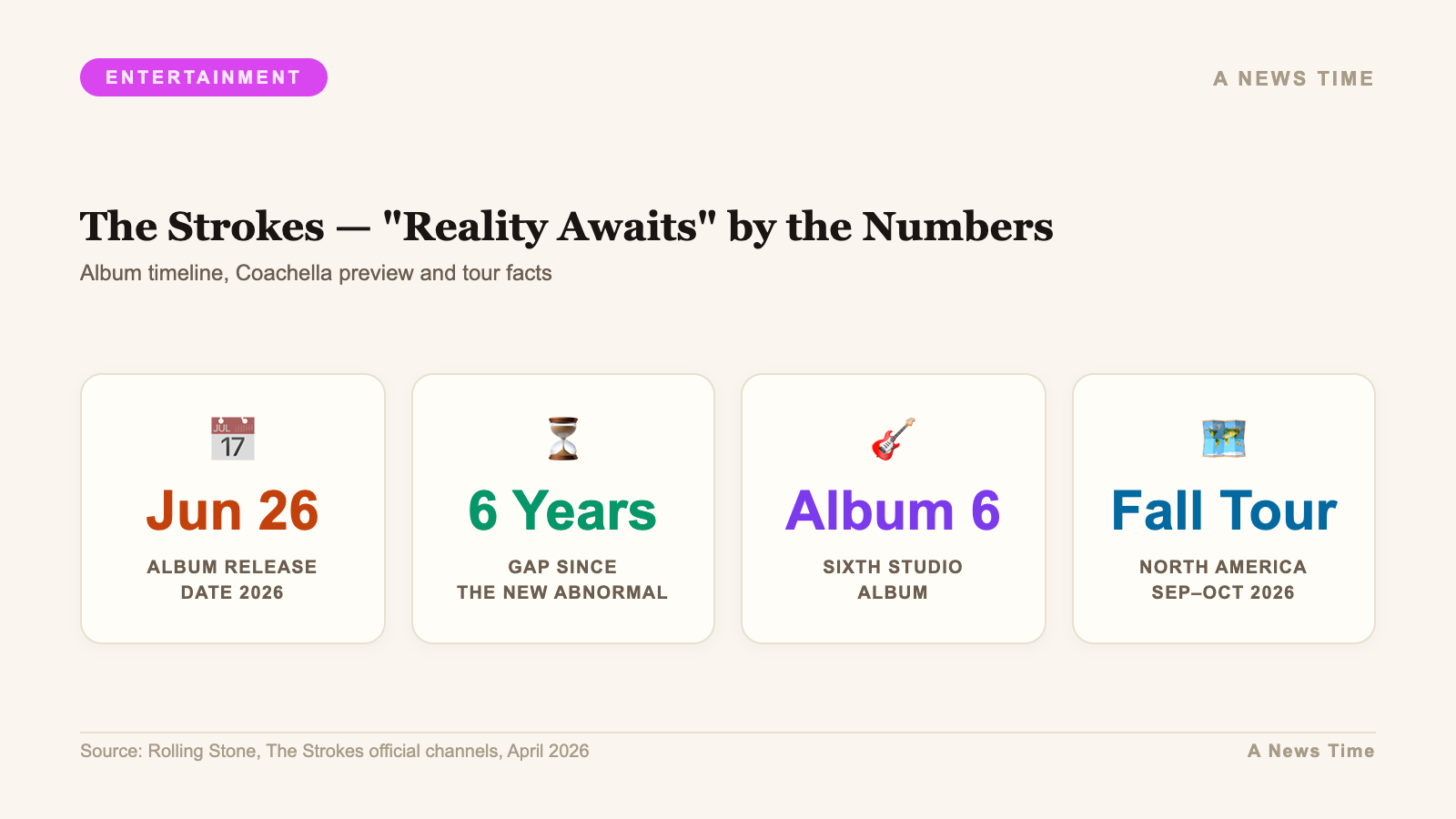
The Strokes announced their sixth studio album on , the morning after they played Coachella's Day 2. The album is called Reality Awaits. It releases June 26, 2026. The last time the band put out a full studio record was The New Abnormal in April 2020, which arrived in the first month of a global pandemic and performed the useful function of giving a significant portion of the world something to listen to while they processed the shock of sudden isolation. This one arrives into a different cultural moment, but the Strokes have always been better at arriving into moments than at trying to create them.
The announcement came via the band's official channels with a brief statement and artwork, and was confirmed by Rolling Stone and other outlets through label sources shortly after. The timing, the day after Coachella, was deliberate: Saturday's set included at least one track that was not part of the existing catalog, and the announcement contextualized what some audience members had already clocked.
Six Years Between Albums
Six years is a long gap by the standards of a band that released three albums between 2001 and 2006, then went quiet for stretches that felt longer than they were given the volume of speculation that accompanied every rumor of new activity. The Strokes have never operated on a predictable timeline, but their silences have consistently produced the kind of fan anxiety that only attaches to bands people actually care about. If nobody missed them during the quiet periods, nobody would notice the announcements.
The New Abnormal was their most critically received album since Is This It. That is not a lukewarm compliment. Is This It is one of the most consequential guitar albums of the 21st century, and The New Abnormal demonstrated that the band's creative core, specifically the Julian Casablancas writing voice and Nick Valensi's guitar sensibility, was still producing work that could withstand serious attention. The Pitchfork 8.0. The Grammy nomination. The renewed critical conversation about where the band stood in the broader landscape of rock music that had, in their absence, reorganized itself around entirely different terms.
Six years after that, Reality Awaits arrives carrying expectations shaped by a recent critical high point rather than a recent commercial one. That is a good position for a band that has always operated most confidently at the intersection of critical credibility and cult commercial standing.
What the Coachella Preview Suggested
The track performed Saturday at Coachella provided approximately three to four minutes of evidence about the album's direction, which is not enough evidence to draw confident conclusions but is enough to sketch a preliminary impression.
The song was built on a guitar figure that had the interval relationships characteristic of Valensi's writing: not quite major, not quite minor, deliberately unresolved in a way that generates harmonic tension without tipping into darkness. The rhythm section, Nikolai Fraiture on bass and Fabrizio Moretti on drums, played at a tempo that was faster than the band's more deliberate mid-period work but not as urgent as their debut. Casablancas sang at the back of the beat rather than on top of it, which has been a consistent marker of his vocal approach when the material is built for live performance rather than recorded precision.
What the preview did not suggest was a significant stylistic departure. This is not a band that has historically used album transitions to reinvent itself. The Strokes' evolution across records is gradual and largely tonal: Room on Fire was denser than Is This It, First Impressions of Earth was more experimental, Angles and Comedown Machine incorporated more electronic influence, The New Abnormal pulled back toward core elements with more compositional confidence than the preceding two records. Reality Awaits sounds, from one song, like the logical continuation of where The New Abnormal ended.
The June 26 Release Date and What It Means
June 26 is a strategically interesting release date. It puts the album approximately two weeks after the end of Coachella Weekend 2, which gives any Coachella momentum time to develop into streaming interest and radio familiarity before the record drops. It also positions Reality Awaits as a summer release, which is slightly unusual for the Strokes: most of their albums have come out in spring or fall, and summer releases carry different commercial and critical dynamics.
The summer release timing suggests confidence that the album can compete in a more crowded commercial environment. Spring and fall are when labels typically schedule their most prestigious releases, the ones they expect to generate end-of-year awards consideration. Summer releases are either blockbusters with the commercial infrastructure to dominate or mid-sized releases that benefit from reduced critical competition. The Strokes occupy a specific lane in which neither of those frames fully applies, which may be exactly why June 26 works for them.
The six-week gap between the Coachella announcement and the release date also suggests a promotional strategy built around slow revelation rather than immediate saturation. Single releases before June 26 are expected, and the advance listening campaign for the Coachella track means the band's promotional team is building awareness in stages rather than flooding the market with material all at once. For an album that arrives with existing critical goodwill, that approach makes sense: let the anticipation accumulate rather than spending it all at once.
The Fall 2026 Tour
The fall 2026 North American tour announcement accompanied the album reveal. Specific dates and cities were not all confirmed in the initial statement, but the tour is expected to run through September and October with venues in the arena-to-large-theater range. This is consistent with where the band plays when they are in an active album cycle: they are not a stadium band, have never particularly aspired to be one, and have historically performed best in rooms where the density of the crowd and the physical proximity to the stage create the kind of compressed energy that translates their recorded sound into something live music can uniquely provide.
The Strokes playing smaller venues relative to their critical stature is a choice rather than a limitation. The rooms they play are full. Choosing the room where you know you can fill every seat and generate a specific atmosphere is strategically different from playing a larger room to a dispersed crowd, and the Strokes have consistently made the former choice across their career.
The fall timing means the album will have had summer to circulate before the tour brings the band into direct contact with that audience. That circulation period, three to four months between release and major touring, is long enough for listeners to develop real relationships with the material rather than showing up to a tour for songs they have heard once or twice. It is a patient approach for a band with a fanbase patient enough to wait six years between records.
The New Abnormal as Context
The New Abnormal was produced by Rick Rubin, who has historically been most effective with artists he takes back to fundamentals rather than artists he pushes toward experimentation. For the Strokes in 2020, the Rubin collaboration produced an album that was more spacious and more confident than their preceding work, which had sometimes felt like the band negotiating with its own legacy rather than simply being itself.
The production credit for Reality Awaits has not been confirmed in the initial announcement materials, which could mean Rubin is back or could mean the band worked with someone new. The Coachella preview track did not immediately suggest a production signature consistent with Rubin's approach, though a single live performance is insufficient evidence for production analysis. The album will answer that question when it arrives.
What The New Abnormal established is that the band is capable of a specific kind of late-career creative confidence: making music that is recognizably the Strokes without being a nostalgic reconstruction of earlier Strokes. That quality is rarer than it sounds, and it is the quality Reality Awaits will be assessed against first.
Where the Strokes Sit in 2026
The Strokes announced their album on the same weekend that Coachella was using them as part of a bill that included current pop figures and experimental electronic projects. That proximity is telling. The festival's programming team does not book acts as nostalgia draws unless it is explicitly booking a reunion or anniversary set. The Strokes at Coachella in 2026 were there because the team believed they had something current to offer, and the album announcement the following morning confirmed that belief was not misplaced.
A band that can generate genuine festival excitement in their late career, announce a new album on a Sunday morning and have it land as news rather than as content, and have a touring market sufficient to support a full fall run is a band that has maintained something most bands lose after two or three albums. The Strokes have maintained it across six records and twenty-five years, which is the kind of career durability that the current music landscape, with its emphasis on immediate turnover and constant new activity, tends to obscure rather than celebrate.
Reality Awaits is out June 26. The announcement is the first news worth having about the Strokes in six years, and it landed like it. For more on the Coachella weekend that preceded the announcement, see our pieces on Justin Bieber's Saturday headline and Nine Inch Noize's Coachella debut.