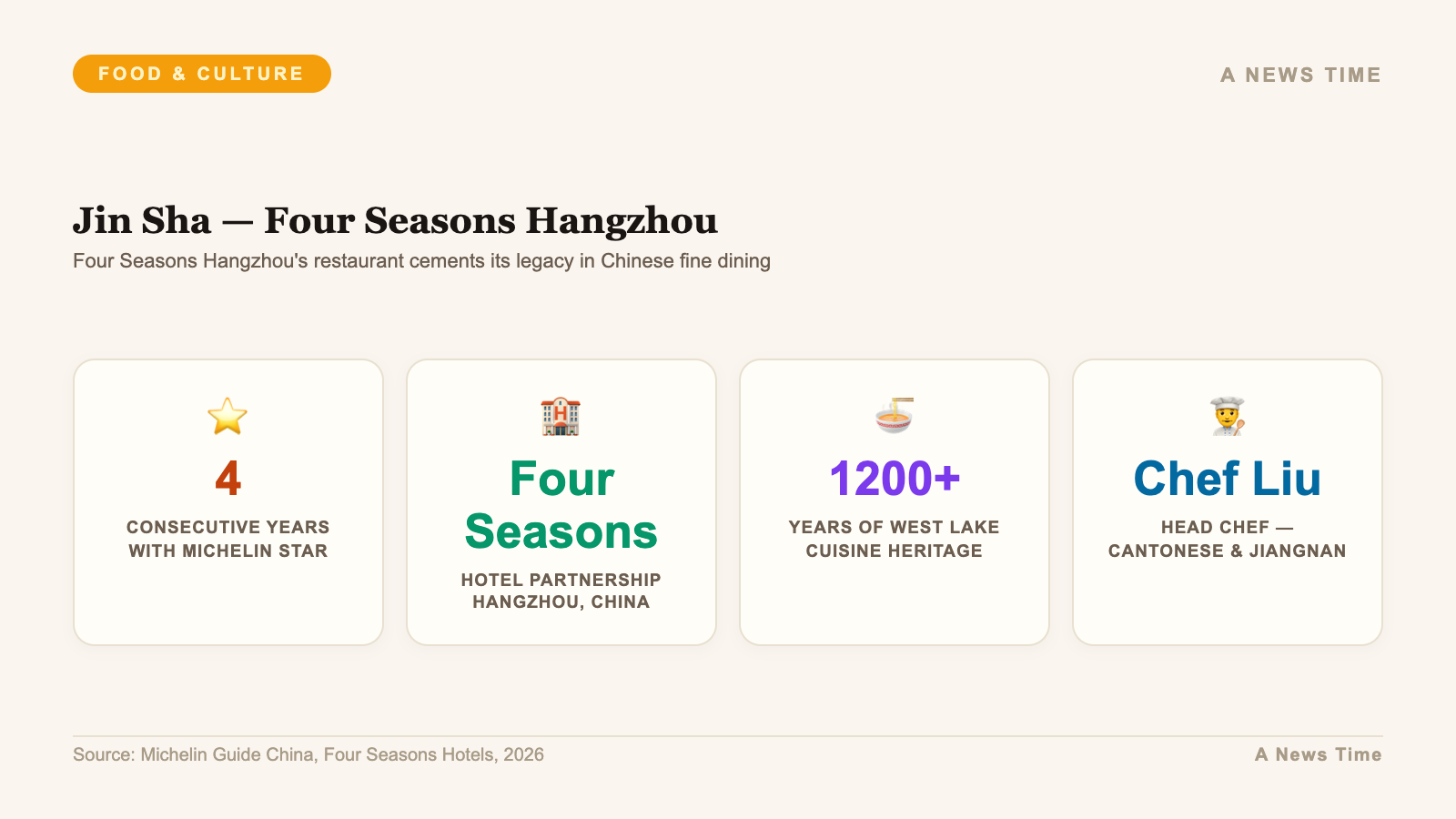
There is a particular kind of pressure that comes with earning a Michelin star. There is a different kind entirely that comes with earning it a fourth time in a row. Jin Sha, the signature Chinese restaurant at Four Seasons Hotel Hangzhou at West Lake, has met that second test, retaining its Michelin star for 2026 in what the Michelin Guide's China edition describes as a sustained demonstration of culinary excellence rooted in seasonal discipline and regional identity.
The announcement, made as part of Michelin's updated China regional guide in early April, was notable not just for the outcome but for the language used to describe it. The inspectors' notes specifically called out Jin Sha's "unwavering commitment to the ingredients and techniques of classical Hangzhou cuisine" at a time when many luxury hotel restaurants in China have tilted toward fusion menus and international culinary crossover programming. Jin Sha has gone in the opposite direction, doubling down on place.
A Kitchen Defined by West Lake
Hangzhou sits on the western shore of West Lake, one of China's most storied landscapes and a UNESCO World Heritage Site since 2011. For Chef Peng Feng and his kitchen team, the lake is not a backdrop -- it is a sourcing partner. Lotus roots pulled from the lake's shallow margins, fresh-water fish supplied by a network of licensed local fishermen, and the season's first longjing tea leaves from the Longjing village hillsides directly to the west of the city: these are the defining inputs of Jin Sha's cooking calendar.
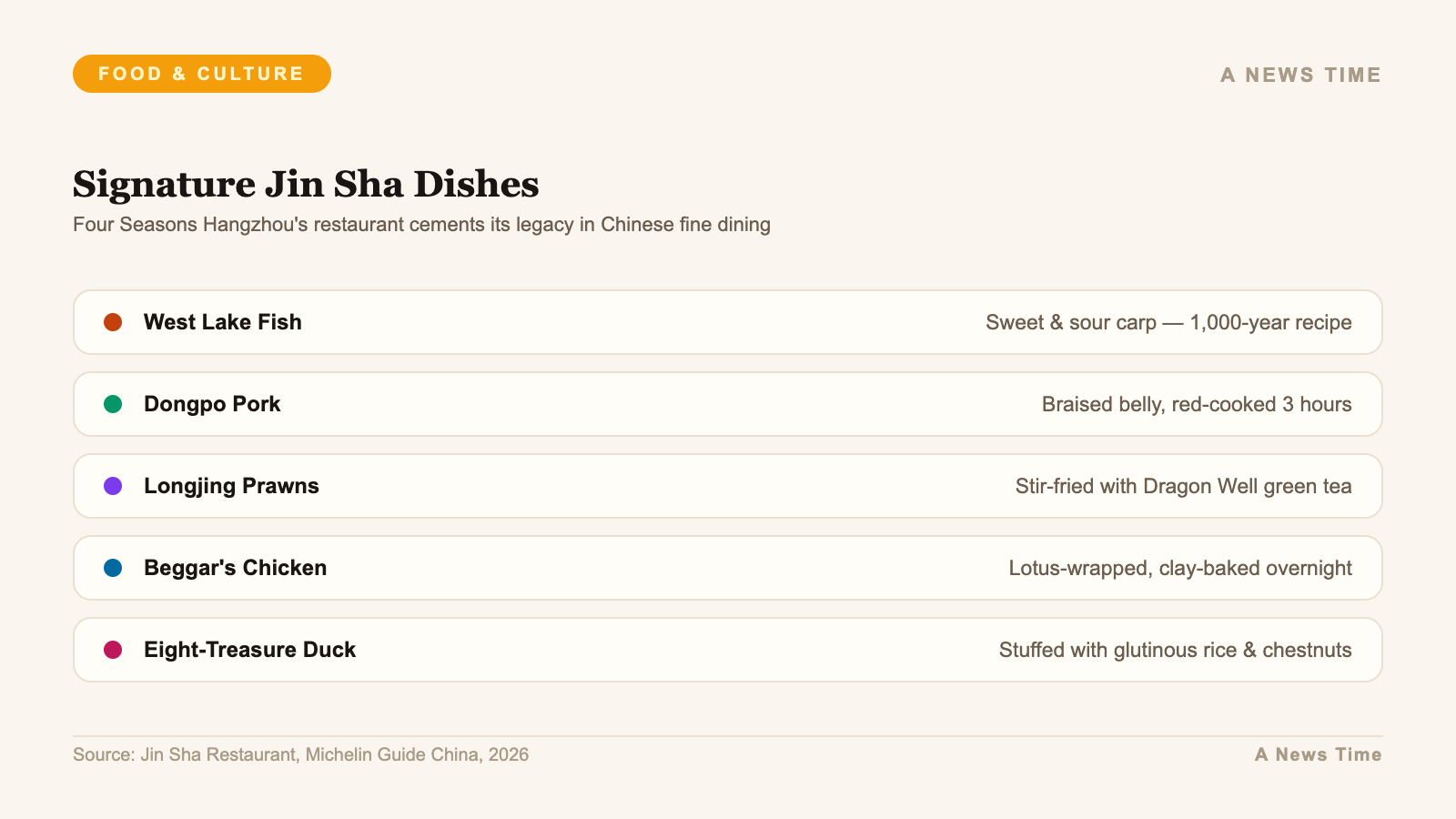
Hangzhou cuisine -- sometimes categorized under the broader Zhejiang culinary tradition -- is one of China's Eight Great Cuisines but has historically been overshadowed by the international profiles of Cantonese and Sichuan cooking. The food is lighter than either, favoring freshness over complexity, with a characteristic sweetness that distinguishes it from the soy-heavy profiles of Shanghai's neighboring traditions. Braised pork belly -- dongpo rou -- is probably the dish most Western diners have encountered, but it represents only one register of a cuisine that ranges from delicate steamed fish to the famous beggar's chicken buried and slow-cooked in clay.
Peng Feng came to Jin Sha via a career arc that included time in the kitchens of China's most acclaimed hotel restaurants in Shanghai and Beijing, but he has spoken repeatedly in interviews about Hangzhou as the place where his cooking philosophy finally settled into focus. "The lake gives you a calendar," he told a Chinese hospitality publication in 2024. "You cook what the lake offers. When it stops offering something, the season for that dish is over." It is the kind of simplicity that sounds easy until you try to build a Michelin-starred restaurant around it.
What Four Consecutive Stars Actually Mean
Within China's luxury hospitality sector, Michelin recognition has a specific kind of weight. The Michelin Guide entered mainland China's restaurant evaluation in 2016, starting with Shanghai, and has expanded coverage carefully, adding Guangzhou, Beijing, and eventually broader regional guides that now include Hangzhou. A single star earns a restaurant significant domestic and international press attention. Four consecutive stars is a different proposition entirely -- it places Jin Sha in a category that includes only a handful of hotel restaurants across China.
The competitive significance matters because the luxury hospitality market in China is currently navigating a complex correction. Inbound international travel has recovered unevenly following the pandemic years, domestic luxury travel spending has remained strong but become more discerning, and the restaurant landscape in major Chinese cities has grown increasingly sophisticated. Earning a fourth star in this environment -- rather than a first star in a softer market -- carries real credibility.
For Four Seasons Hotels and Resorts, the retention of Jin Sha's star anchors the Hangzhou property's identity in a competitive luxury hospitality market where hotel restaurants at the Rosewood, Aman, and Raffles properties in the city are all competing for the same domestic and international clientele. A Michelin-starred restaurant is a tangible differentiator in a segment where most amenities can be replicated by any sufficiently capitalized competitor.
The Sustainable Sourcing Architecture
Jin Sha's approach to ingredient sourcing has evolved considerably since the restaurant opened with the hotel in 2010. What began as an informal preference for local suppliers has become a structured procurement system that Peng Feng's team updates seasonally and publishes internally as a sourcing calendar. The kitchen works with approximately 23 regular local suppliers, including three West Lake fishing families who provide freshwater catches on a scheduled basis, two longjing tea farms that supply both culinary and beverage-grade leaves, and a network of small-scale vegetable growers in the lake's agricultural perimeter who receive advance planting guidance from the kitchen based on projected menu needs.
This level of supply chain integration is common in Europe's top farm-to-table restaurants but remains relatively unusual in China's luxury dining sector, where kitchen teams have more commonly relied on established hotel group procurement systems. Jin Sha's model has attracted attention from other hotel restaurant groups looking to improve their sustainability credentials in response to growing demand from corporate and MICE clients who now regularly include F&B sustainability as a factor in venue selection.
Four Seasons Hotel Hangzhou has positioned the sourcing model as part of its broader sustainability reporting, incorporating Jin Sha's locally sourced ingredient percentages into the property's annual ESG disclosure. The restaurant achieved a figure of 74 percent locally or regionally sourced ingredients by value in 2025, up from 61 percent in 2022, according to figures shared with travel trade media at the time of the Michelin announcement.
The Menu in 2026
For 2026, Jin Sha is operating across three primary service formats. The a la carte menu, available at both lunch and dinner, offers the widest range of classical Hangzhou dishes with approximately 40 percent of the selection rotating seasonally. A six-course tasting menu, introduced in 2023 and expanded for 2026, is the format that Michelin inspectors have most consistently highlighted in their visit notes, allowing Peng Feng to present a structured narrative of the current season's best ingredients rather than deferring to diner selection.
A third format -- the private dining experience in Jin Sha's newly expanded pavilion, which seats up to 12 guests and opened in January 2026 -- is positioned as the restaurant's most immersive offering. Private dining clients receive a menu developed specifically for their visit based on what is available from the lake and the surrounding agricultural calendar that week, with an optional market tour component that takes guests to the West Lake fishing pier before the meal. Pricing for the private experience starts at CNY 6,800 per person and has reportedly achieved near-full occupancy through June.
The wine and tea pairing program is another area where Jin Sha has distinguished itself. Rather than defaulting to a wine-forward pairing structure -- the standard in most luxury Chinese restaurants catering to international clientele -- the restaurant offers a parallel tea pairing using exclusively Zhejiang-produced teas. The longjing, biluochun, and aged pu-erh pairings are presented by a dedicated tea sommelier, a role that remains unusual enough in Western-operated luxury hotels to generate consistent media attention.
Hangzhou as a Culinary Destination
The broader context for Jin Sha's fourth star is Hangzhou's emergence as one of China's most compelling culinary destinations for both domestic and international food tourism. The city already attracts significant visitor numbers as a leisure and cultural destination -- West Lake alone draws over 40 million visitors annually -- but its food scene has historically played second fiddle to Shanghai's cosmopolitan restaurant landscape and the international profile of Cantonese cuisine in Guangzhou and Hong Kong.
That is changing. The 2022 Michelin Guide expansion into the Zhejiang region placed a formal international spotlight on Hangzhou's restaurants for the first time, and the subsequent growth in starred establishments -- Jin Sha remains the most consistently recognized property, but the region now has multiple bib gourmand and star-level designations -- has begun to shift dining tourism patterns. Travel advisors speaking to outlets covering China hospitality report meaningful increases in requests for Hangzhou dining itineraries among high-net-worth clients who had previously limited their China food travel to Shanghai and Chengdu.
The city's role as a tech hub -- home to Alibaba's headquarters and a growing ecosystem of AI and e-commerce companies -- has also altered the restaurant landscape. A highly paid, internationally mobile workforce employed by Alibaba, NetEase, and their supply chain creates demand for both high-end experiential dining and a more casual, ingredient-focused middle market that has been growing rapidly in Hangzhou's older neighborhoods around the lake perimeter.
China's Evolving Michelin Relationship
The Michelin Guide's relationship with China's restaurant scene has been complicated from the beginning. When the Shanghai edition launched in 2016, it was greeted with significant skepticism from Chinese food critics and culinary professionals who questioned whether a European evaluation framework -- built around French fine dining sensibilities -- could meaningfully assess a culinary tradition as different as Chinese cooking. The guide's initial star allocations in Shanghai drew criticism for appearing to over-index on Western-influenced fine dining and hotel restaurants at the expense of neighborhood institutions beloved by local diners.
Those criticisms have moderated over subsequent years as Michelin has made visible efforts to adjust its China-specific evaluation criteria. The 2026 edition of the regional guides covering Shanghai, Beijing, Guangzhou, and the Zhejiang region show a more diverse distribution of recognition across price points and culinary styles than the early guides did. Jin Sha's fourth star, coming in a guide edition that also recognized several high-end street food specialists and traditional tea house restaurants with bib gourmand designations, reflects a broader calibration of how Michelin thinks about Chinese culinary excellence.
For more on how Michelin recognition is reshaping dining scenes in major Asian cities, see our coverage of Michelin's Great Lakes expansion and how Minneapolis joined the Michelin conversation for the first time.
What Comes Next for Jin Sha
Retaining a Michelin star for a fourth consecutive year creates its own set of expectations and pressures. Peng Feng has spoken about the temptation to expand the menu or introduce new format events as a response to the recognition, and about resisting that temptation as a matter of culinary discipline. "The star is a recognition of what we are already doing," he said in a statement accompanying the Michelin announcement. "The answer is to keep doing it better, not differently."
Four Seasons' plans for the property in 2026 and beyond include a renovation of Jin Sha's private dining wing, expansion of the seasonal cooking class program that has proven popular with both hotel guests and local food enthusiasts, and the launch of a private label longjing tea product developed in collaboration with the restaurant's tea farm suppliers. The latter will be available through Four Seasons' online store and selected retail channels in Hong Kong and Singapore.
The bigger question is whether Jin Sha can eventually reach the two-star level, which would place it among an exclusive group of hotel restaurants in China at that recognition tier. Industry observers suggest the path to two stars runs through increasingly consistent execution rather than dramatic reinvention -- a judgment that aligns closely with Peng Feng's own stated philosophy. The West Lake, for its part, will keep providing the seasonal calendar that the kitchen follows. The inspectors will keep returning. And for the fourth year in a row, they apparently liked what they found.