Artificial intelligence is simultaneously propping up and slowly dismantling the American office market, according to an analysis published by CoStar News on April 14, 2026, based on leasing data from CoStar, CBRE, and Avison Young. A small number of frontier AI companies have become the single largest pursuers of commercial office space in the country, absorbing record levels of vacancy left over from the pandemic. At the same time, a much longer list of non-AI corporate tenants has started citing AI productivity gains as the reason for meaningful workforce reductions that will eventually show up in smaller real estate footprints.
The net effect, for now, is a record-high concentration of the office recovery in a single industry. That is a precarious position for any asset class, and it is one commercial landlords are now openly describing on earnings calls and at investor conferences. Whether 2027 looks like a durable recovery or a late-cycle boom depends almost entirely on whether AI hiring outpaces AI-driven layoffs across the broader economy.
How one industry took over the leasing market
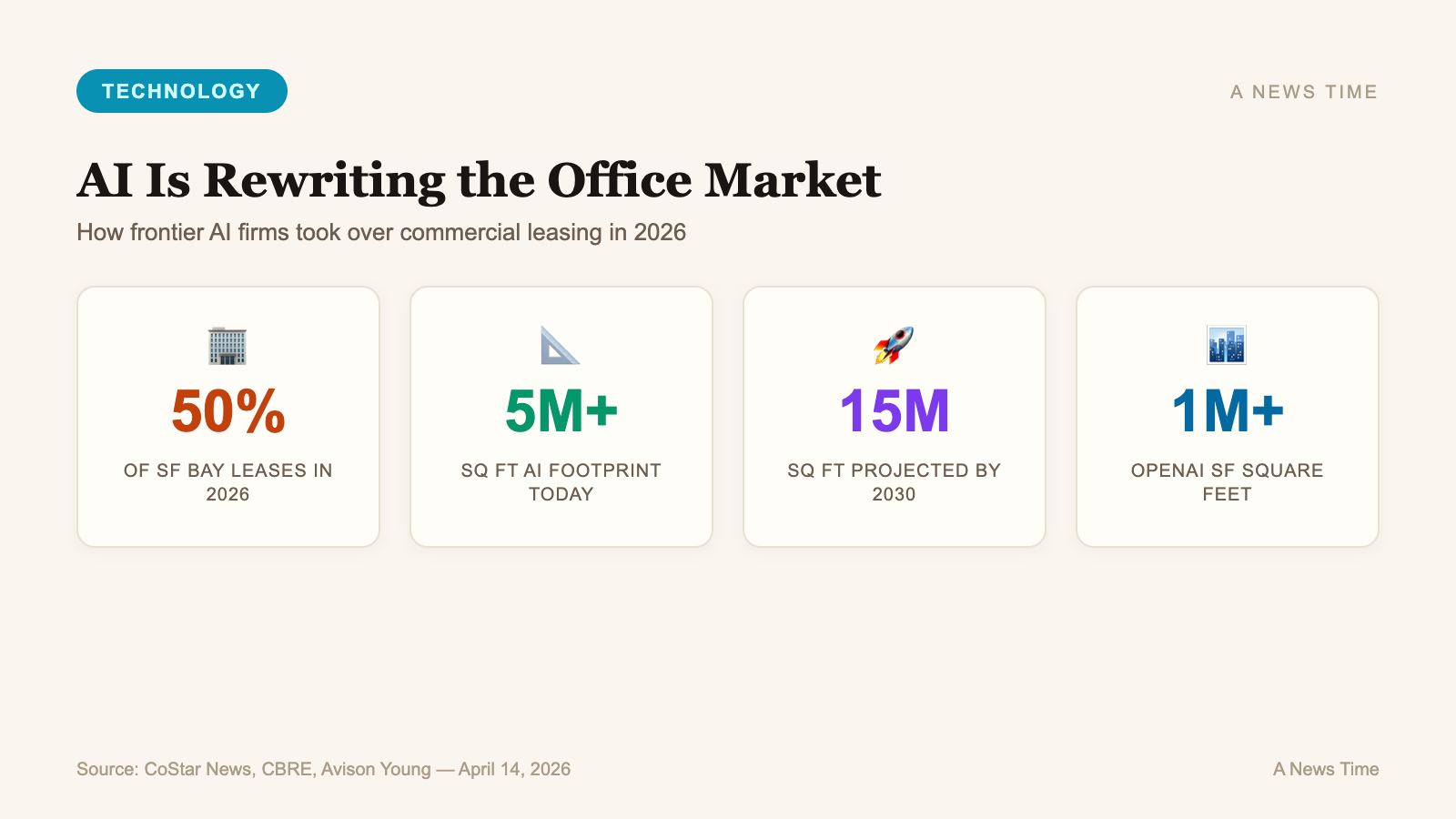
The headline figure in the CoStar report is that commercial leasing generated by AI and broader tech companies accounted for about 20 percent of total leasing volume last year across the country's largest cities, the most of any industry. In the San Francisco Bay Area, the concentration is much sharper. AI firms have accounted for half of all major leases signed since the start of 2026, according to CoStar and CBRE data. Their collective footprint is now well beyond 5 million square feet and is expected to surge to at least 15 million square feet over the next four years.
Those numbers are historic. To put them in context, a 15 million square foot footprint for a single industry cluster in one metro area is roughly the size of the biotech cluster in Cambridge, Massachusetts, which took three decades to build. The AI cluster in San Francisco is projected to hit that number inside a four-year window that has already started. That pace is not a normal leasing recovery. It is a land grab.
The mechanics of how AI companies absorb space are different from the previous technology boom. In earlier cycles, the sequence was hire engineers, then lease space to house them. In the current AI cycle, companies raise a large round, lease space immediately at a size that implies a future workforce, and then fill the space behind the lease. That changes how landlords underwrite the deal and how quickly square footage gets taken off the market.
"In previous tech booms, most of the capital companies raised went to hiring and expanding their workforce, but the big difference this time around with the AI sector is that they're spending a large amount of funding on infrastructure. The AI industry is in the office five, six days a week, and many are already starting to open additional offices in cities like Seattle, Boston, and London."
Colin Yasukochi, head of CBRE's Tech Insights Center, speaking to CoStar News
Broker reporting in the CoStar piece adds a useful operational detail. Transwestern broker Mike McCarthy told the publication that AI firms and startups typically open with a small office of 3,000 to 5,000 square feet, then tack on additional space within months as each funding round closes, frequently escalating to 20,000, 40,000, or in some recent cases entire buildings. That escalation pattern is now familiar to brokers covering the Mission Bay and SoMa corridors of San Francisco, where OpenAI alone recently finalized a sublease of the former Dropbox footprint that pushed its San Francisco total past 1 million square feet.
The other half of the tension: layoffs framed as AI productivity
The reason the picture is not straightforwardly bullish is what is happening in the non-AI corporate tenant base, which is where most office square footage actually lives. Over the last several months, Salesforce, Meta, Workday, and Pinterest have all announced workforce reductions, and in each case the public explanation has attributed at least part of the cut to increased use of AI tools internally. Those cuts have moved out of the tech sector as well.
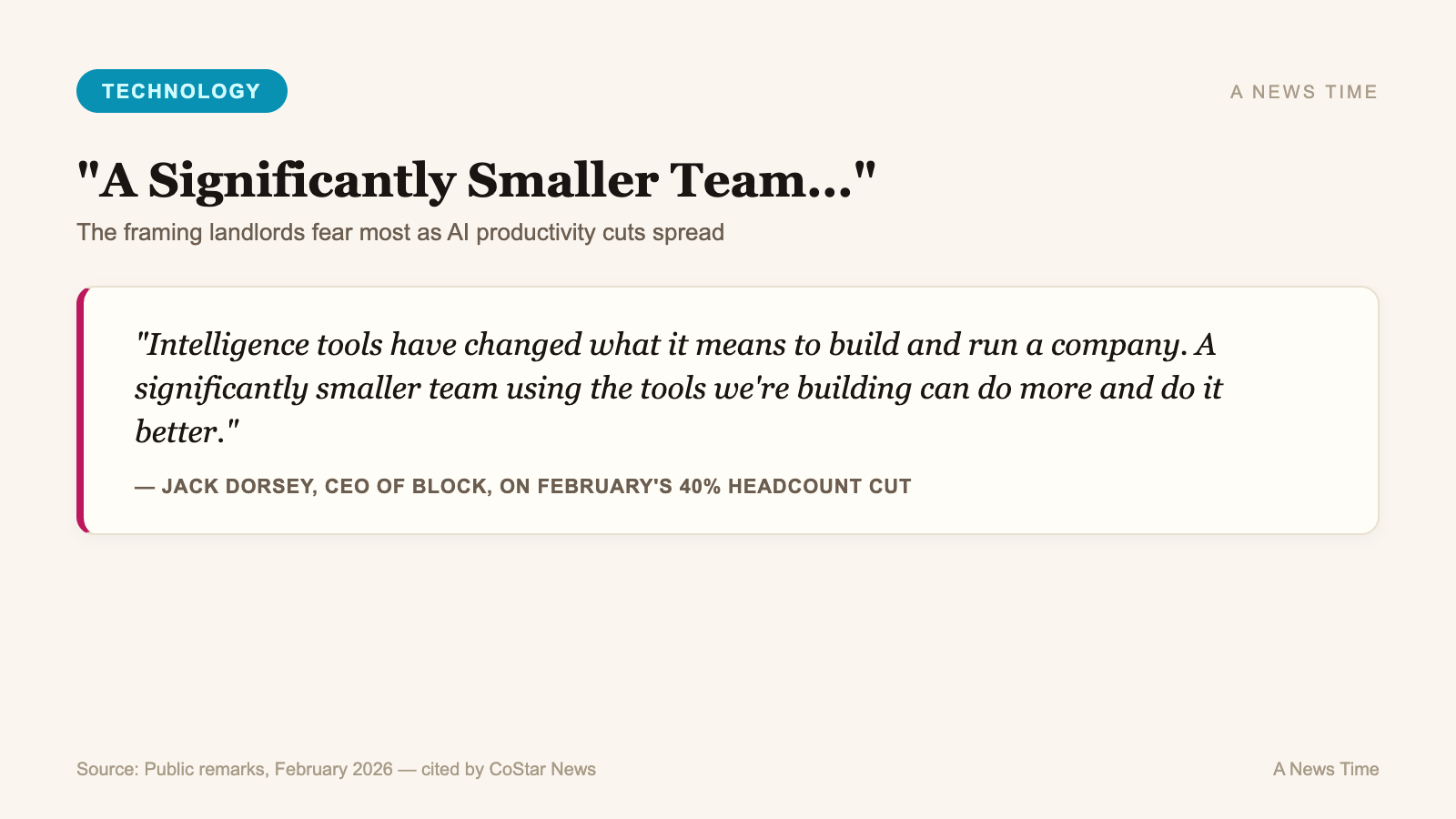
The clearest statement on record came from Block CEO Jack Dorsey in February, when the payments company announced plans to reduce headcount by at least 40 percent.
"Intelligence tools have changed what it means to build and run a company. A significantly smaller team using the tools we're building can do more and do it better."
Jack Dorsey, CEO of Block, in public remarks accompanying February's layoff announcement
That framing matters for landlords because it is the first time in the current cycle that a major CEO has explicitly tied the size of a company to the capabilities of its internal AI stack. Every corporate tenant listening to that language is reading it as permission to do the same thing with their own headcount, and eventually with their own leases.
The open question inside the brokerage community is whether the AI-citing layoffs are real productivity-driven cuts or whether AI is being used as political cover for cost reductions that companies wanted to make anyway. Louis Thibault, manager of market intelligence at Avison Young, told CoStar that at least some of the connection is genuine and at least some of it is convenient cover. That uncertainty is exactly what is keeping landlords on edge, because the two scenarios have very different implications for renewal economics over the next three years.
The bifurcation landlords are already pricing in
The response from the largest public office landlords has been to tilt even harder toward Class A and trophy product while writing off older, commodity inventory. That approach is sometimes described in the industry as flight to quality, and it predates AI, but the AI story is accelerating it.
| Office Segment | 2024-2025 Trend | 2026 Outlook (AI Impact) |
|---|---|---|
| Trophy / Class A, gateway cities | Recovering, rents firming | Outperforming; AI tenants driving longer terms |
| New-build Class A, tech corridors | Leasing above pro forma in SF, Boston, Seattle | Highest demand band; AI firms absorbing blocks |
| Older Class B, central business districts | Softening, repricing downward | Under pressure; AI-cited layoffs hitting back-office tenants |
| Commodity Class C, non-prime submarkets | Record-high availability, conversions accelerating | Net negative; most exposed to AI productivity cuts |
| Single-industry suburban campuses | Mixed; Amazon hibernating some hubs | Negative; non-AI tenants retreating first |
BXP, the largest public office landlord in the country, put the bifurcation in explicit terms at the Citi Global Property CEO Conference in March. CEO Owen Thomas described his portfolio as geared toward the employee group that AI is creating rather than the group it is automating, and pointed to average lease term lengths as evidence that tenants are still committing to space. For related coverage of the investor environment driving those commitments, see our reporting on the $470 billion 2026 AI infrastructure spend and the March 2026 housing market forecast.
"If a company was worried about AI, why are they in 2025 signing 10-year leases with us? These are major financial commitments, and they're signing long-term leases, so I don't think they're forecasting big impacts AI will have on their space demand."
Owen Thomas, CEO of BXP, at Citi's Global Property CEO Conference in March 2026
Thomas's argument is directionally correct but incomplete. A tenant signing a ten-year lease in 2025 is making a decision with the information available at that moment. The same tenant in 2028 or 2029, facing a renewal conversation after three more years of AI adoption inside the business, is a different decision-maker with different information. The long-term lease commitments landlords are currently pointing to as evidence of resilience are also the commitments that will come up for renewal right as the AI productivity numbers start to land.
What Amazon is doing, and why it is the bearish data point
The counterweight to the landlord optimism is what the largest corporate tenant in the United States is quietly doing with its own footprint. Amazon, according to the CoStar report, is allowing leases to expire, temporarily suspending activities at some offices, and subleasing or terminating deals for hubs that have become largely vacant. Senior Real Estate Manager Martha Schwarzkopf Doyle described the posture at an internal team meeting earlier this year using the word "hibernating" for some suspended locations.
Amazon has two things going on at once. It is building out its own AI infrastructure, including the Anthropic partnership and the custom chip work tied to Google and Broadcom, and it is also the first of the trillion-dollar tech employers to openly shrink its office footprint post-pandemic. That dual position makes Amazon a useful data point. If the company most exposed to the upside of AI adoption is still reducing office space, the net effect of AI on its own real estate portfolio is negative, not positive.
The CoStar analysis also noted that for the first time in years the rate of office demolitions and conversions has overtaken new development, citing CBRE and CoStar research. That is a market that is rebalancing supply downward, not building into demand. The AI leasing wave is absorbing space, but the reason the absorption looks so strong on the charts is that supply is shrinking at the same time.
The 2027-2028 scenario matrix
The useful exercise, for investors and tenants trying to plan around this, is to lay out the three scenarios that could define the office market in 2027 and 2028 and see how each one stresses the current recovery.
Scenario one is the durable boom. AI hiring continues to accelerate, the frontier model companies keep raising, and their white-collar hiring offsets the AI-cited layoffs happening elsewhere. Trophy office rents climb, Class C inventory keeps converting to residential or demolition, and the bifurcated market settles into a permanent two-tier structure. This is the story BXP, Kilroy, and Cousins Properties are telling their investors.
Scenario two is the concentrated crash. The AI capex cycle plateaus, frontier model companies hit a revenue ceiling that makes further workforce expansion hard to justify, and the hiring growth that is currently filling San Francisco office blocks reverses. Meanwhile, the non-AI corporate base continues to cite AI productivity gains as justification for ongoing cuts. The leasing recovery narrative then depends on a much smaller pool of tenants than the one landlords are currently marketing to.
Scenario three is the split outcome, which is probably the likeliest. AI companies keep leasing in a handful of hubs (San Francisco, Austin, Boston, Seattle, a smaller set of international cities) while the rest of the national office market continues to soften under the weight of headcount reductions elsewhere. In that world, the office market does not recover as a category. A small number of submarkets recover sharply, everyone else keeps repricing down, and the index-level numbers blend the two into something that looks stable on the surface but reflects very different realities underneath.
That scenario, for what it is worth, is also the one most consistent with the AI job-posting data Avison Young flagged in the CoStar piece. AI-related job postings have outpaced those for traditional tech roles, which is a leading indicator for where hiring is going. Those postings are concentrated in the same metros where the leasing activity is concentrated, which reinforces the split-outcome path rather than a broad recovery.
What investors and tenants are watching
The near-term data points to watch are the April 2026 earnings calls from BXP, Kilroy, Vornado, and Cousins Properties, all of which will provide updated leasing figures for the first quarter. If those figures show continued concentration in AI tenants, the story holds. If they show softening in the broader renewal pipeline, the concentration story becomes a risk rather than a strength.
The other data points are non-AI corporate earnings calls, where tenants will either extend the AI-as-layoff-rationale language or pull back from it. The Dorsey framing at Block was specific, and whether other CEOs copy it verbatim will tell brokers a lot about how ingrained the productivity argument has become inside corporate finance.
For now, the office market is holding together on the back of a single industry, and the single industry is simultaneously the one reshaping how every other industry sizes its own workforce. That is a lot of weight to put on a cohort of companies that were almost entirely unrecognizable as office tenants three years ago. Whether the weight holds up is going to decide what commercial real estate looks like in 2028.
Frequently Asked Questions
How much of the current office leasing recovery is being driven by AI companies?
According to CoStar and CBRE data cited in the April 14, 2026 CoStar News analysis, AI and broader tech tenants accounted for roughly 20 percent of major commercial leasing volume across large U.S. cities in 2025. In the San Francisco Bay Area specifically, AI firms alone have accounted for about half of all major leases signed since the start of 2026.
Which AI companies are the largest office tenants?
OpenAI, Anthropic, NVIDIA, and Databricks are the most frequently cited, with OpenAI having recently pushed its San Francisco footprint past 1 million square feet through a sublease of former Dropbox space in Mission Bay. The CoStar analysis notes that these firms are also opening offices in Seattle, Boston, and London as they scale.
Are layoffs really being caused by AI or is AI a cover story?
Both. Louis Thibault of Avison Young told CoStar News that some AI-cited layoffs reflect real productivity gains while others are business restructuring decisions that companies wanted to make anyway and are now framing in AI language. The distinction matters because the two categories have different implications for long-term office demand.
What is happening to older, non-trophy office buildings?
They are under sustained pressure. The CoStar and CBRE data shows that the rate of office demolitions and conversions has overtaken new development for the first time in years, and older Class B and Class C buildings in non-prime submarkets are the most exposed to both the AI-cited layoff wave and the broader flight-to-quality trend that predates it.
What is the biggest risk to the current office market recovery narrative?
A slowdown in AI hiring by the cohort of frontier model companies currently driving leasing, combined with a continuation of AI-framed workforce reductions across the non-AI corporate base. Those two dynamics together would leave the office market supported by a smaller pool of tenants than landlords are currently marketing to.