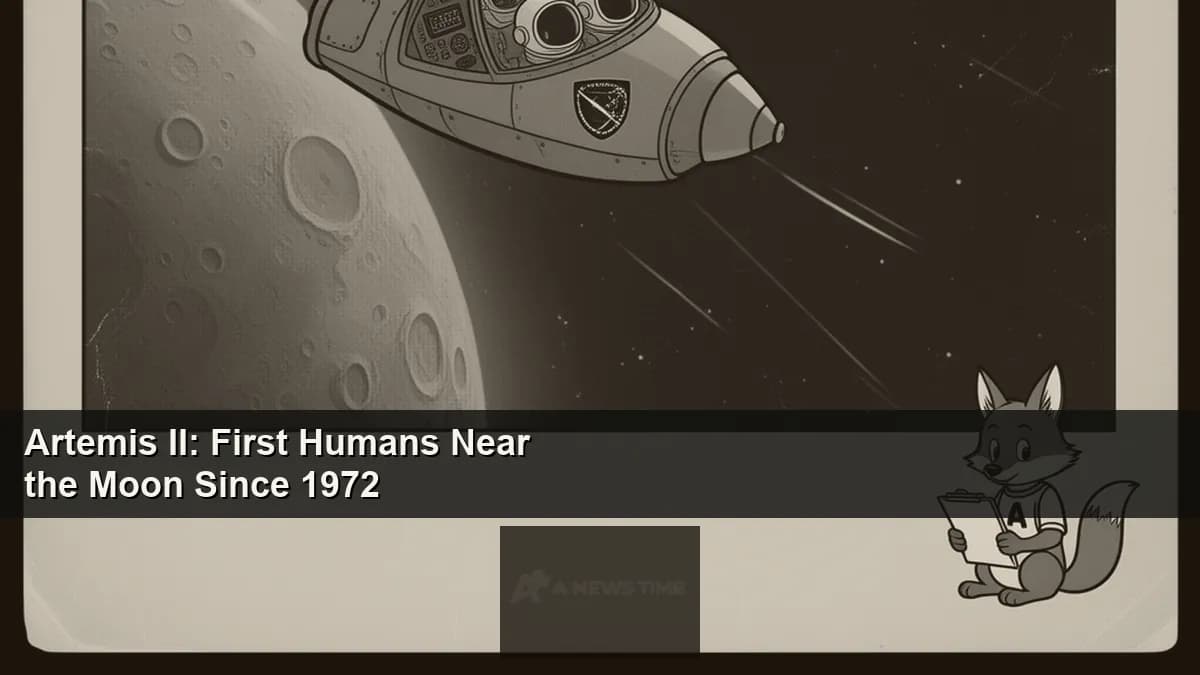
Fifty-three years, five months, and fifteen days after Apollo 17 astronauts last made a crewed pass around the Moon, four people crossed that threshold again. On , the Artemis II crew reached the point of closest lunar approach, passing within approximately 6,400 miles of the lunar surface at speeds exceeding 5,000 miles per hour. The event marks the farthest humans have traveled from Earth since , and the first time a crewed spacecraft has been in lunar space since the Apollo era ended.
The four astronauts aboard Orion are Commander Reid Wiseman, NASA Pilot Victor Glover, Mission Specialist Christina Koch, and Canadian Space Agency Mission Specialist Jeremy Hansen. Glover is the first Black person to travel to the vicinity of the Moon. Koch is the first woman. Hansen is the first person from outside the United States. Those distinctions are not ceremonial: they represent a half-century of accumulated demographic change in who NASA trains, selects, and flies, and they land with particular weight at a milestone of this historical significance.
Five Days That Changed Everything
The sequence from launch to lunar flyby unfolded across five days:
- at 6:35 PM EDT: Artemis II lifted off from Kennedy Space Center's Launch Complex 39B aboard the Space Launch System Block 1 vehicle.
- : The crew performed translunar injection, firing the Orion spacecraft's European Service Module engine to break free from Earth orbit. This maneuver was the first time any crewed spacecraft had been placed on a translunar trajectory since Apollo 17.
- : Closest lunar approach. The crew executed the free-return trajectory's perilune maneuver and began the long arc back toward Earth.
The mission is a free-return trajectory, which means Orion uses the Moon's gravity to slingshot the spacecraft back toward Earth without requiring a powered lunar orbit insertion burn. This design choice is conservative and appropriate for a test mission: if the spacecraft's propulsion system had a failure after the translunar injection burn, gravity alone would bring the crew back home. The architecture sacrifices the flexibility of orbital operations for the safety guarantee of a passive return path.
The 10-day total mission duration includes the return transit and reentry. Splashdown is currently targeted for in the Pacific Ocean, with recovery operations managed by the USS San Diego.
What the Crew Is Testing and Why It Matters
Artemis II is not a sightseeing mission. It is an engineering test campaign with specific objectives that feed directly into the ability to land on the Moon in Artemis III.
| Test Objective | System Being Validated | Artemis III Relevance |
|---|---|---|
| Life support performance in deep space radiation environment | Orion Environmental Control and Life Support System | Required for 30-day lunar surface stays |
| Communication latency and bandwidth at lunar distance | Near Space Network, Orion comms stack | Surface crew operations depend on reliable comms |
| Crew performance and adaptation over multi-day deep space transit | Human factors, sleep, cognition under stress | Understanding physiological demands before surface ops |
| Orion reentry thermal protection at lunar return speeds | Heat shield at 25,000+ mph atmospheric entry | Every crewed lunar mission ends with this reentry profile |
The heat shield test on reentry is particularly consequential. Orion enters Earth's atmosphere at approximately 25,000 miles per hour after returning from the Moon, considerably faster than the 17,500 mph reentry speed of a spacecraft returning from low Earth orbit. The thermal loads are proportionally higher, and the heat shield design has been validated only on the uncrewed Artemis I mission in late 2022. Artemis II will be the first time human lives have depended on that shield's performance at lunar return speeds since Apollo.
The Historical Weight of the Moment
The last crew to see the Moon this closely was Gene Cernan, Harrison Schmitt, and Ronald Evans aboard Apollo 17 in December 1972. Cernan was the last person to walk on the Moon. When Apollo ended, the expectation in much of the space community was that lunar return was a decade away at most. The half-century gap that actually elapsed reflects the political and budgetary realities of human spaceflight programs, where ambition consistently outpaces sustained commitment.
Victor Glover's position on this crew carries specific historical resonance. The integration of Black Americans into NASA's astronaut corps was a decades-long process that began with Ed Dwight's 1963 rejection, continued through Guion Bluford's first spaceflight in 1983, and has produced a diverse astronaut class that now routinely includes members of communities that were explicitly excluded from the program's founding years. Glover's flyby is a measurable milestone in that arc.
"We're not just testing a spacecraft. We're proving that the infrastructure and the team that will take humans back to the surface are ready. Every system that works today is one more system we won't have to worry about on Artemis III."
Reid Wiseman, Artemis II Commander, NASA pre-mission briefing
Christina Koch's position is similarly grounded in a specific history. Women have been part of NASA's astronaut corps since 1978, flew their first shuttle mission in 1983 with Sally Ride, and have contributed to the ISS program for decades. The lunar gap meant that no woman had ever traveled beyond low Earth orbit. Koch changes that today. The observation is not about symbolic firsts for their own sake: it is about who gets to do the most consequential things in human exploration, and the answer matters for who aspires to those roles in future generations.
The Gateway to Artemis III
A successful Artemis II validates the end-to-end architecture for crewed deep space flight: launch, translunar injection, deep space operations, lunar approach, and high-speed reentry. Each element that works as designed is a data point that de-risks Artemis III, which is planned to land two astronauts on the lunar South Pole region, where permanently shadowed craters are believed to contain water ice deposits that could support long-term human presence.
The Artemis III lander will be a human-rated variant of SpaceX's Starship, which adds another layer of complexity to the program: the first time a crew has transferred from an Orion spacecraft to a Starship lander in lunar orbit, performed a landing, and then rendezvoused again for the return trip will also be the first time all of those things have been done. The margin for error is why Artemis II, which does none of those landing-specific elements, is so important: it removes the Orion and SLS variables from the equation so Artemis III can focus on the new challenges.
The mission is also directly connected to the broader commercial space ecosystem. As we reported in our coverage of NASA's nuclear propulsion program, the agency's long-term Mars ambitions depend on the human deep-space operations experience that only missions like Artemis II can provide. Operating a crew in deep space, managing communications delays, and maintaining physiological health far from Earth are skills that cannot be fully trained in low Earth orbit simulations. Every Artemis mission builds the institutional knowledge NASA will need for the considerably longer duration of a Mars transit.
What We Still Don't Know
The mission has proceeded without publicly announced anomalies, but several open questions will be answered only after splashdown and data analysis. The heat shield performance will be assessed through post-reentry inspection and the thermal measurement data collected during the return. The crew's biological and cognitive data, including sleep quality, radiation dosimetry, and performance on cognitive tasks throughout the transit, will feed into the planning for longer-duration Artemis missions.
The radiation environment in deep space is qualitatively different from what ISS crews experience in low Earth orbit, where Earth's magnetic field provides partial shielding. Artemis II is the first time NASA will have direct measurements of crewed radiation exposure outside that magnetic protection in more than 50 years. The results will inform shielding design decisions for future spacecraft and will contribute to the radiation risk models used to plan mission durations.
Splashdown on will complete the data collection phase. What the mission has already confirmed, beyond any data that remains to be analyzed, is that the infrastructure exists and that a crew can successfully navigate from Earth to the Moon's vicinity and back. The question now is whether Artemis III can build on that foundation quickly enough to meet its planned 2028 timeline, and whether the political will to sustain the program through the technical and budgetary challenges that remain will hold.