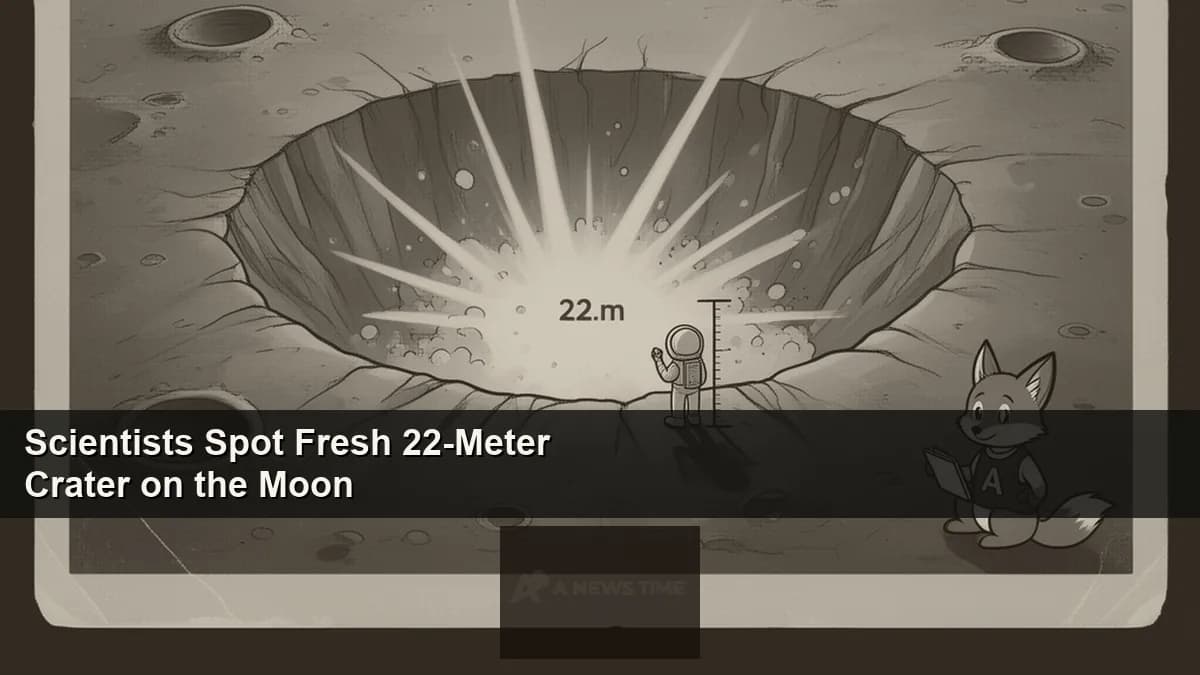
Scientists have identified a fresh 22-meter-wide crater on the Moon's surface by comparing photographs taken years apart by NASA's LROC instrument, according to a paper published on . The crater, located at 26.1941° N, 36.1212° E on the lunar surface, formed sometime between and . No one witnessed the impact. The discovery is a reminder that the Moon's surface, which appears frozen and permanent from Earth, is still actively changing.
The crater, roughly the size of a large house, was spotted by researchers at Arizona State University working with NASA's Goddard Space Flight Center. The detection method is straightforward in principle and painstaking in practice: compare before-and-after images from LROC and look for features that appeared in the second image but not the first. In this case, the new crater was unmistakable. The impact blasted bright, pulverized material outward in a distinctive sunburst pattern visible against the darker surrounding lunar regolith.
How the LROC Team Found It
The LRO spacecraft has been orbiting the Moon since , photographing its surface at resolutions fine enough to see objects the size of a dining table from lunar orbit. That archive now spans more than a decade and a half of consistent imaging, creating an unprecedented historical record for comparing what has changed.
The process of finding new craters in that archive is not automated. Researchers scan image pairs manually, or use software trained to flag unusual brightness changes, which are then confirmed by human analysis. The characteristic bright rays surrounding a fresh impact make new craters easier to spot than other surface features, but the database of paired images runs to millions of frames. Finding a single new crater requires sustained, methodical work.
In this case, the before image predates , capturing the surface before the impact occurred. The after image, taken sometime after , shows the crater and its spray of bright ejecta fully formed. The LROC team cannot pinpoint the exact date of impact more precisely than that three-year window, because the camera did not photograph that exact location between those two dates. The Moon is large, and LROC's imaging schedule, while comprehensive, cannot cover every square meter on every orbit.
Why the Brightness Matters and Why It Will Fade
The bright material surrounding the crater is one of the most scientifically valuable aspects of the find. When an impactor strikes the Moon, it excavates and pulverizes rock from below the surface, exposing fresher material that has not been subjected to the bombardment of solar wind particles, micrometeorites, and cosmic radiation that gradually darkens the uppermost layer of lunar soil over time.
The result is that fresh craters appear bright against their surroundings. The contrast is not subtle. In the images from the LROC team, the ejecta rays extend outward from the new crater in distinctive spokes, far brighter than the dusty gray terrain on either side. This brightness is a timestamp of sorts, a visible indicator that the surface here has been recently disturbed.
But the brightness is temporary. The same space weathering processes that darkened the surrounding regolith in the first place begin working on the fresh ejecta immediately after impact. Over thousands to millions of years, the bright material gradually darkens to match its surroundings. Eventually the ejecta rays become invisible, and the crater itself becomes harder to distinguish from the billions of older craters that crowd the lunar surface.
The implications of this process are visible from Earth. Tycho crater, one of the most recognizable features on the near side of the Moon, formed approximately 108 million years ago and still has prominent bright rays extending hundreds of kilometers across the surface. At 108 million years old, Tycho is geologically young by planetary standards. Its persistent brightness tells you something about how long space weathering takes to erase the evidence of large impacts. The new 22-meter crater, by contrast, may lose its distinguishing brightness within a few hundred thousand years, which is essentially tomorrow in geological time.
| Feature | Detail |
|---|---|
| Crater diameter | 22 meters |
| Location | 26.1941° N, 36.1212° E |
| Formation window | December 2009 to December 2012 |
| Discovery method | Before/after LROC image comparison |
| Analogous feature | Tycho crater (108 million years old, still bright) |
What Fresh Craters Tell Scientists
Beyond the intrinsic interest of finding a new feature on the Moon, fresh craters serve several scientific purposes. The most practically important is impact rate estimation. By systematically cataloguing how many new craters appear in a given area over a given time period, scientists can calculate roughly how often objects of different sizes hit the lunar surface. That rate is used in models that predict the risk to spacecraft in lunar orbit and, increasingly, to human habitats and vehicles on the surface itself.
The impact frequency of small objects (those capable of forming craters in the 10-to-30-meter range) is not perfectly constrained. The Moon's surface offers a long historical record of large impacts, but small, fresh craters are easily missed by ground-based observers, and space-based surveys only became capable of systematic monitoring with LROC starting in 2009. Each confirmed new crater adds a data point to the statistical picture of how often the Moon gets hit and by what.
"Every fresh crater we confirm from LROC imagery is another data point for understanding impact frequency. That information directly informs how we design habitats and equipment for Artemis missions. You can't engineer for a risk you haven't measured."
Mark Thompson, writing for Universe Today, April 2026
The practical stakes are rising. NASA's Artemis program aims to return humans to the Moon later this decade. A lunar surface base, even a temporary one, would be subject to the same impact environment that created this crater. A 22-meter crater-forming impactor striking near a habitat or a rover is not a hypothetical catastrophe. It is exactly the kind of event that mission planners need to understand probabilistically in order to design appropriately shielded structures and operational protocols.
The Moon Is Still Geologically Active
The discovery fits into a broader picture that the last decade of lunar science has been assembling: the Moon is not the static, geologically dead body that scientists assumed a generation ago. It is changing on timescales that are short by planetary standards, even if they remain long by human standards.
Seismometers left on the lunar surface by Apollo missions recorded "moonquakes," some triggered by tidal stresses from Earth's gravity. More recent analysis of LROC images has identified shrinkage features called lobate scarps, essentially small cliff-like formations that appear where the lunar crust has compressed and cracked as the Moon's interior slowly cools. These are geologically young features, suggesting the Moon's interior is still shifting.
Add fresh impact craters to this picture and the Moon looks less like a museum exhibit and more like an active planetary body. Not active in the way Earth is active, with plate tectonics and volcanism reshaping the surface continuously. But active enough that its surface is measurably different than it was 50 years ago, and measurably different than it will be in another 50 years.
This matters for the interpretation of the lunar surface itself. When scientists study ancient craters to reconstruct the history of asteroid bombardment in the early solar system, they are working with a record that is being continuously, if slowly, modified by new impacts and internal processes. Knowing the current rate of modification is essential for interpreting the older record accurately. You need to understand how the page is being edited now in order to understand what was written on it before.
For related research into solar system bombardment patterns, our earlier coverage of the unexplained surge in fireballs entering Earth's atmosphere in 2026 addresses a parallel phenomenon on our own planet, where the rate and distribution of incoming small objects have shifted in ways that are still being studied.
The LROC Legacy and What It Has Already Found
The LROC instrument aboard the Lunar Reconnaissance Orbiter has been one of the most productive scientific instruments in NASA's recent history. Over 15-plus years of operation, it has created the most detailed and comprehensive photographic atlas of the Moon ever assembled. It has found the precise landing sites of every Apollo mission, imaged the landing craft from China's Chang'e missions, and mapped surface features at resolutions that would have been inconceivable from ground-based telescopes.
The systematic detection of new craters is one of the ongoing scientific programs running on that archive. The LROC team has now confirmed dozens of new impact craters formed during the mission's operational lifetime. Each one represents a calibration point for lunar impact models. Taken together, they are beginning to produce a statistically meaningful estimate of how often the Moon gets hit by objects of different sizes, and those estimates are feeding directly into the engineering requirements for the next generation of lunar missions.
The 22-meter crater announced this week is not the largest or most dramatic of these new finds. Earlier detections have included craters significantly larger, including one impact in that was actually observed as a flash visible from Earth before the crater was later confirmed in LROC imagery. But the consistency of the detection program, the fact that scientists are systematically finding and confirming these features across a wide range of sizes, is what makes it scientifically useful.
For further context on what scientists are learning about the Moon's environment and what it means for future missions, our coverage of Mars dust storms and atmospheric water loss illustrates how impact-related and atmospheric processes interact on another rocky body in the solar system, a comparison that helps calibrate models for the Moon as well.
What Researchers Are Watching Next
The LROC team continues to monitor the full lunar surface for new impact features. The program's long-term goal is to build a sufficiently large dataset of confirmed new craters across a known time window to produce statistically robust estimates of impact rates at different size thresholds. That work is years from completion, but the dataset grows with every confirmed detection.
NASA's Artemis program timeline also gives the crater-detection work a practical urgency. If crewed lunar surface missions happen later this decade, mission planners will want the most current impact frequency data available. Every additional confirmed crater in the LROC archive improves those estimates marginally but cumulatively. The 22-meter crater found this week is one more point in a dataset that is, ultimately, about keeping future astronauts alive on a surface that is still, slowly, being remade.
The next phase of this research involves correlating the locations and sizes of newly confirmed craters with the background noise of the lunar environment: the distribution of existing craters at different sizes, the regolith composition in different regions, the timing of seasonal variations in the flux of incoming debris. Building that correlation requires sustained, careful work. But the Moon has given scientists more time than they need. The new crater formed sometime in the three years between two orbital photography passes. It will still be there, bright rays fading slowly, when the next generation of scientists arrives to study it.