
Netflix chief executive Ted Sarandos met privately over the weekend of with executives from Cinema United, the US trade association for movie theater owners, on the sidelines of the group's annual CinemaCon gathering at Caesars Palace in Las Vegas. The meeting, confirmed on by Cinema United president Michael O'Leary, was the first working-level conversation between the streaming giant and the exhibition industry in years, and it landed in the middle of a year the theater business has already started calling its best since before the pandemic.
Sarandos did not bring a deal with him. O'Leary told reporters that no agreements were reached and that talks were "preliminary." What Sarandos brought instead was his physical presence, which in Hollywood is its own form of currency. For the better part of a decade, the relationship between Netflix and theater owners has run somewhere between cold war and mutual shrug. Sarandos flying to a cinema owners' convention is a posture shift, even if the substance is still being negotiated.
The meeting that would have been unthinkable in 2019
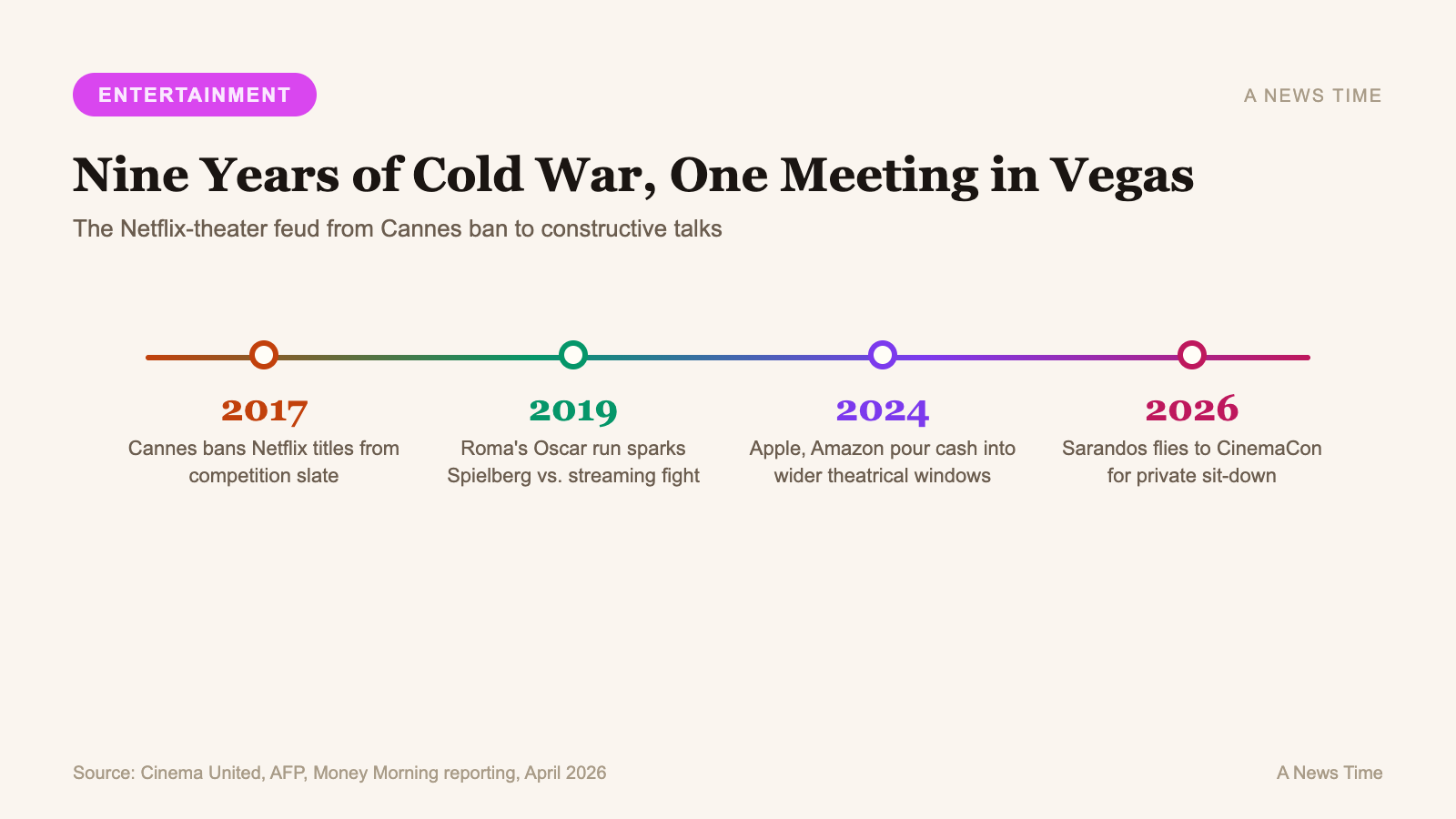
To understand how unusual this moment is, remember who these two sides used to be to each other. Netflix spent most of the last decade treating theatrical windows as a tax on its business model. Its prestige films got the bare minimum theatrical run required to qualify for the Academy Awards, usually two or three weeks in a handful of cities, specifically so major chains would refuse to book them. The chains did refuse. The loop was intentional.
The feud was cultural as well as commercial. When Netflix's Roma was nominated for Best Picture in , Steven Spielberg publicly argued that streaming films with minimal theatrical runs should be classified as TV movies and routed to the Emmys, a position the Cannes Film Festival effectively adopted by blocking Netflix titles from its competition. The cinema industry was not subtle about who it considered the enemy. Sarandos, for his part, defended the model as a response to audience behavior rather than a rejection of theaters.
That framing started to crack around , when Apple and Amazon, both late-arriving streamers chasing prestige, began pouring money into wider theatrical releases. Apple's F1 grossed $633.4 million worldwide and Amazon MGM's Project Hail Mary crossed $500 million, numbers impossible to ignore inside Los Gatos. On Netflix's most recent earnings call, Sarandos gave his quietest concession yet, saying that "this is a business and not a religion."
Why the timing matters: theaters are having their best year in five
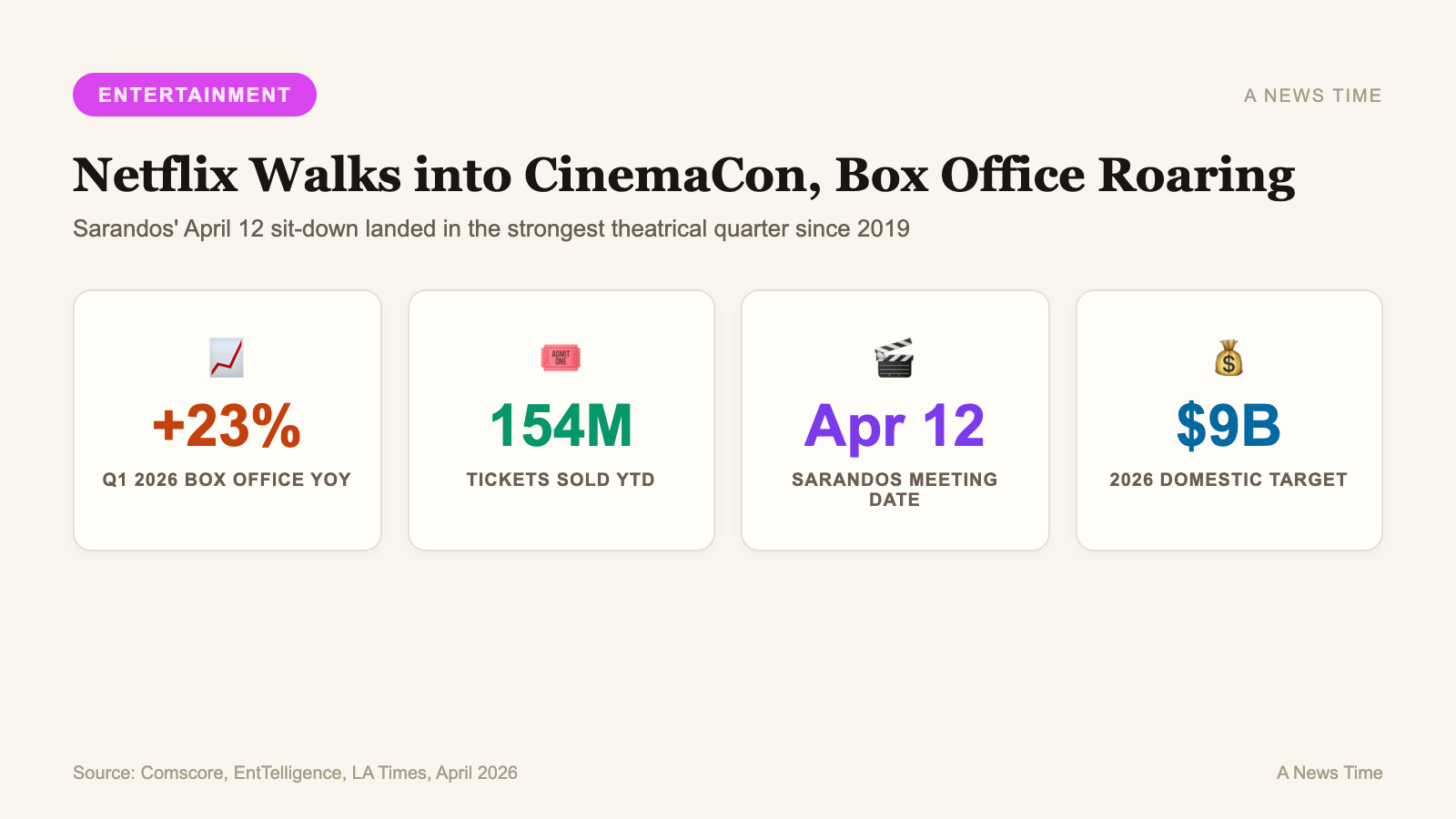
Sarandos walked into the CinemaCon meeting at a very specific moment for the exhibition business. As Cinema United's member chains gathered in Las Vegas, box office data looked genuinely good for the first time since 2019. Domestic box office revenue for the first quarter of 2026 came in about 23% higher than the same period last year, according to Comscore figures cited by the Los Angeles Times. EntTelligence data put ticket volume at 154 million for the year so far, nearly 16% higher than the same window in 2025. That is not a price-driven bump. More people are actually going.
The films doing the lifting are the ones theater owners have been quietly praying for: family crowd pleasers and adult-skewing event films released close enough together to create what Cinépolis USA chief executive Luis Olloqui described as "that cadence we needed." The Mandalorian and Grogu, Disney and Marvel's Avengers: Doomsday, Pixar's Toy Story 5, and Christopher Nolan's The Odyssey are all still to come.
| Streamer-Backed Theatrical Performance | Studio | Global Box Office |
|---|---|---|
| F1 | Apple Original Films / Warner Bros. | $633.4 million |
| Project Hail Mary | Amazon MGM Studios | $500+ million |
| The Super Mario Galaxy Movie | Universal / Illumination | Opening weekend No. 1, 2026 |
| KPop Demon Hunters | Netflix (limited theatrical) | $18 to $20 million opening |
MoffettNathanson senior analyst Robert Fishman described the current quarter in a note to clients as the strongest first quarter the exhibition business has posted since the pandemic, writing that "we believe the long-awaited box office rebound is finally here." If you are Sarandos looking for a politically cheap moment to tell cinema owners Netflix is curious about theatrical, you fly to CinemaCon the week that sentence is on the front page of every trade paper.
What Sarandos actually said in the room
O'Leary, who did not disclose specifics of the private conversation, described the tone as open and the framing as pragmatic. The meeting had been scheduled while Netflix was in the thick of its unsuccessful bid for Warner Bros. Discovery, and went ahead even after Paramount Skydance elbowed Netflix out of the deal with a $110 billion offer.
"Our door is open to anybody who wants to be in theatrical in a meaningful way. So if you're asking me, in two years, will they be doing a Netflix presentation because there's half a dozen movies going into theaters with fully supported marketing, yeah, absolutely, we'll find time."
Michael O'Leary, president of Cinema United, quoted by Agence France-Presse on April 14, 2026
That is as close to a public invitation as a trade association president is going to give on day three of his own convention. Notably, O'Leary was careful to say it would be "premature" to suggest Netflix is ready to be a full CinemaCon participant now, where rival studios preview their theatrical slates. The door is open. Nothing is signed. The distance between those two facts is the entire story.
Which Netflix titles could actually end up in theaters
If Netflix is genuinely shifting, a handful of upcoming projects are the most plausible test cases. Money Morning reported this week that Sarandos is "dipping his toe in the water" with titles including a David Fincher and Quentin Tarantino collaboration, a project called Ray Gunn, and the long-developing Narnia, which is already slated for a limited IMAX release on Thanksgiving. Those are not test-the-pool titles. A Fincher-Tarantino movie and a Narnia reboot in IMAX are exactly what theater owners have been asking streamers to send them for years.
The model Netflix appears to be eyeing is not the Paramount model, where every wide release gets a 45-day window. It is closer to what Apple and Amazon have been refining: pick titles that can carry a premium screen, market them theatrically, and treat the streaming drop several weeks later as a retention lever. KPop Demon Hunters, the company's animated hit that opened to a reported $18 to $20 million in a narrow theatrical window before going on to win two Oscars, is already a proof of concept. The question is whether it was a one-off or a template.
The bigger picture: streaming saturation and the theatrical premium
There is a reason all of this is happening now, and it is not sentiment. Netflix closed with 375 million global subscribers and guided 2026 revenue growth between 12% and 14%, a deceleration from the post-password-sharing-crackdown highs. The easy growth is gone. Theatrical, in that context, looks less like a tax and more like a marketing vehicle consumers actually pay for, and one that generates the cultural buzz streaming releases routinely fail to produce on their own.
Exhibition, meanwhile, has reasons to want Netflix in the room. Studio consolidation is the word on every theater owner's mind this week, particularly around the pending Paramount Skydance and Warner Bros. Discovery deal, which insiders worry will reduce the total number of films released per year. Fewer studios means fewer slates. Any additional supply, including from Netflix, eases that pressure. For how the streaming wars are shaping platform strategy, see our coverage of April's Netflix and Amazon price hikes and the broader shift toward ad-supported tiers.
What to watch next
The next proof point will be Netflix's upcoming earnings call, which arrives days after the CinemaCon meeting and gives Sarandos a live microphone in front of investors who now know a conversation happened. If he uses that call to name specific theatrical titles, dates, or a new release model, the pivot is real. The theater side has already signaled what it wants: O'Leary's "half a dozen movies with fully supported marketing" is a target, not a throwaway.
The second thing to watch is whether AMC, Cinemark, and Regal individually negotiate terms with Netflix outside the trade association umbrella. Money Morning reported that Sarandos also met with the CEOs of those three chains on the same trip. Those are the rooms where actual screen commitments would be made. A multi-chain booking for Narnia on IMAX Thanksgiving would be the tell. For context on the rest of the 2026 theatrical business, see our coverage of the biggest April 2026 theatrical releases and the rest of the 2026 movie calendar.
The theater owners in Las Vegas this week have been telling every reporter who will listen that 2026 is the year the business gets its posture back. Domestic ticket sales are on pace to hit the $9 billion mark the industry has been chasing since the pandemic. If Netflix quietly joins that slate, even at the margins, the story of the next box office recovery will have one fewer heavyweight writing against it.
Frequently Asked Questions
What exactly did Ted Sarandos agree to at CinemaCon?
Nothing formal. Cinema United president Michael O'Leary described the meeting as "constructive" and "preliminary." No release dates, window lengths, or revenue splits were announced. The significance is that the conversation happened at all, given Netflix's long refusal to engage with the theatrical exhibition industry on its terms.
Why is the 2026 box office up 23%?
Per the Los Angeles Times citing Comscore data, the first quarter of 2026 was the strongest since the pandemic, driven by hits including The Super Mario Galaxy Movie and Project Hail Mary. EntTelligence reported ticket volume was up nearly 16%, meaning the increase is attendance-driven, not just a price effect.
Has Netflix ever released a movie theatrically before?
Yes, but in narrow windows designed almost entirely to qualify for the Academy Awards. Roma, The Irishman, and Marriage Story all received limited runs. KPop Demon Hunters is the most recent example of Netflix testing a wider theatrical play, with an opening weekend of roughly $18 to $20 million before earning two Oscars.
Which Netflix films could actually get wide theatrical releases?
According to Money Morning, candidates include a David Fincher and Quentin Tarantino project, the animated Ray Gunn, and Narnia, which is already scheduled for a limited IMAX run on Thanksgiving 2026. None have been formally confirmed as wide releases.
What is CinemaCon?
CinemaCon is the annual trade convention of Cinema United, the North American trade association for movie theater owners. It is held in Las Vegas each April and is where major studios traditionally preview their upcoming theatrical slates for exhibition executives.