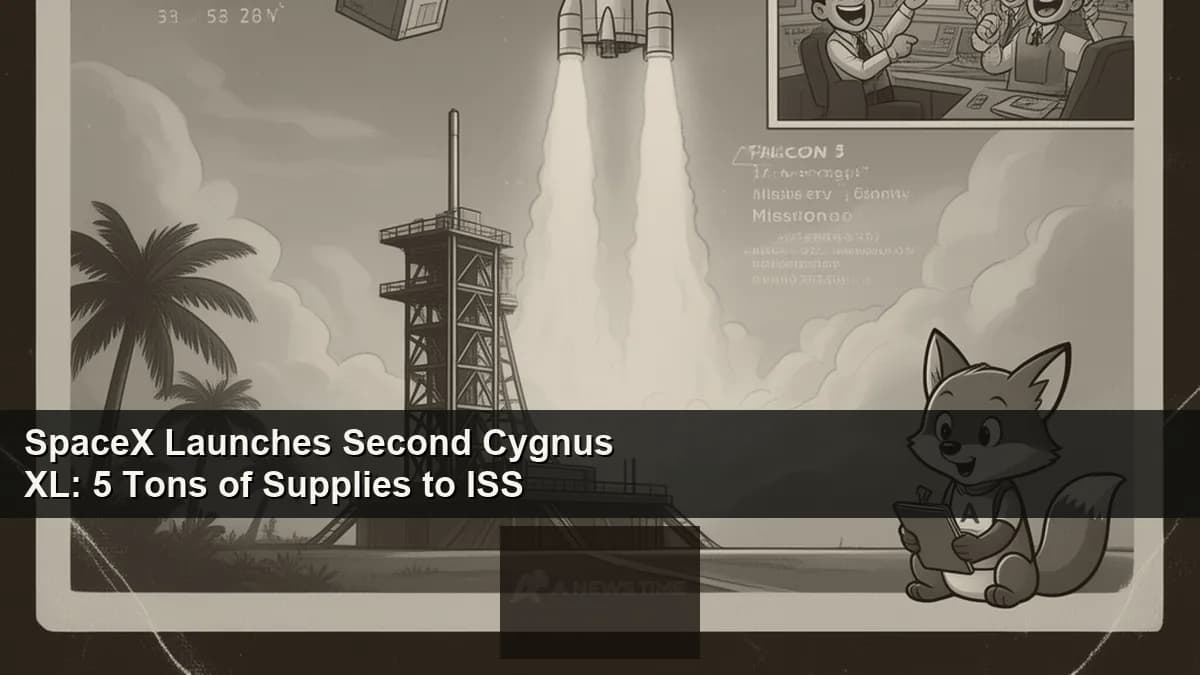
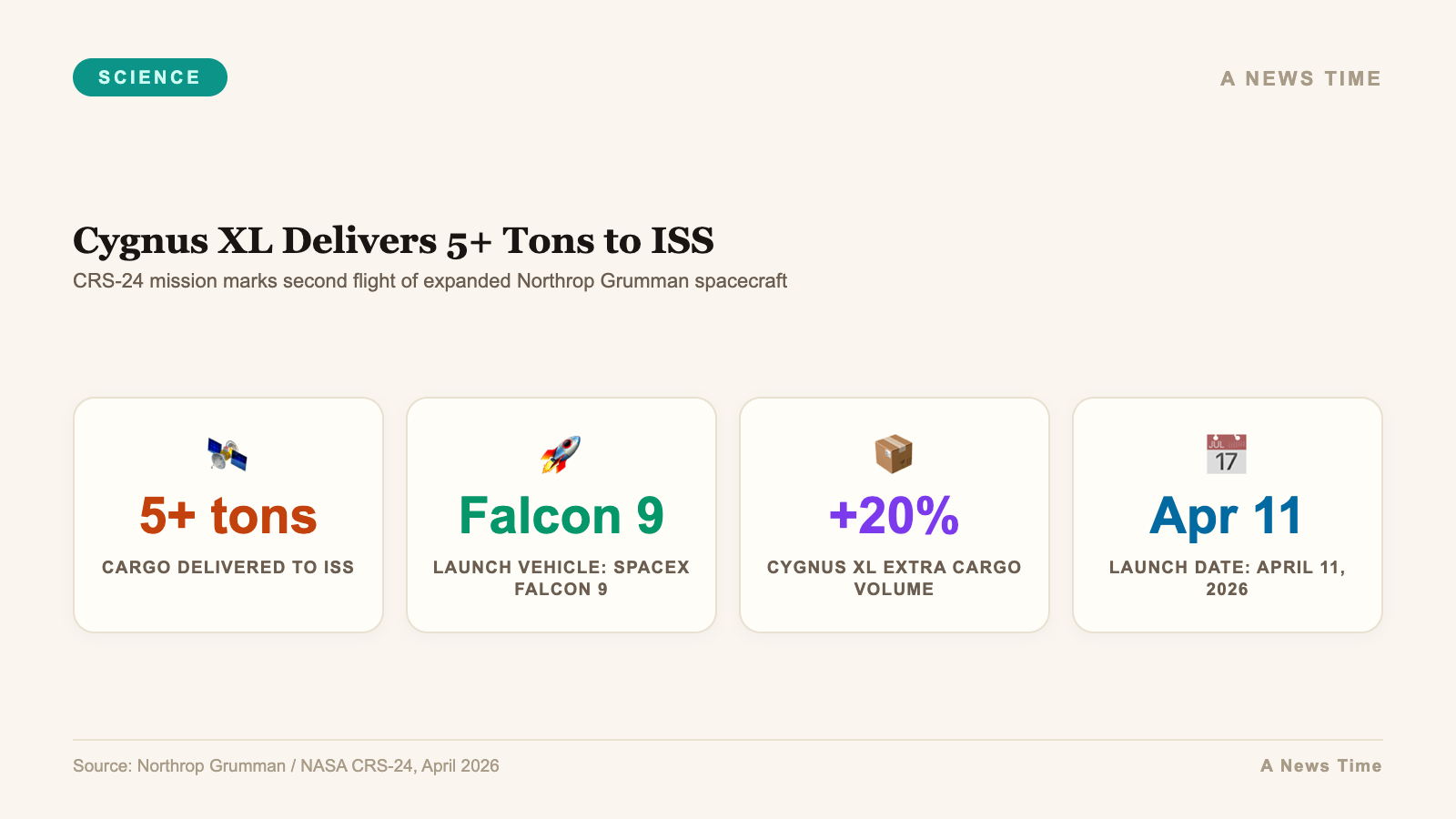
At 7:41 a.m. Eastern time on Saturday, April 11, a SpaceX Falcon 9 rocket climbed off the pad at Cape Canaveral Space Force Station in Florida with Northrop Grumman's NG-24 Cygnus spacecraft secured in its nose. The mission, formally designated CRS-24, was carrying more than 5 tons of cargo bound for the International Space Station, representing one of the largest single resupply deliveries in the history of the commercial crew and cargo program.
It was the second flight of the enlarged Cygnus XL variant, a spacecraft whose pressurized cargo module has been stretched to accommodate roughly 20 percent more volume than its predecessor. For context, that extra space is roughly equivalent to two full-size refrigerators worth of pressurized cargo capacity, which doesn't sound like much until you consider that every gram delivered to low Earth orbit still costs thousands of dollars to haul off the ground.
The Falcon 9 first stage booster performed a nominal return-to-launch-site landing, touching down at Landing Zone 1 approximately eight minutes after liftoff. Cygnus was deployed into orbit roughly 12 minutes after launch and immediately began the two-day approach sequence to the station.
What the Cygnus XL actually carries
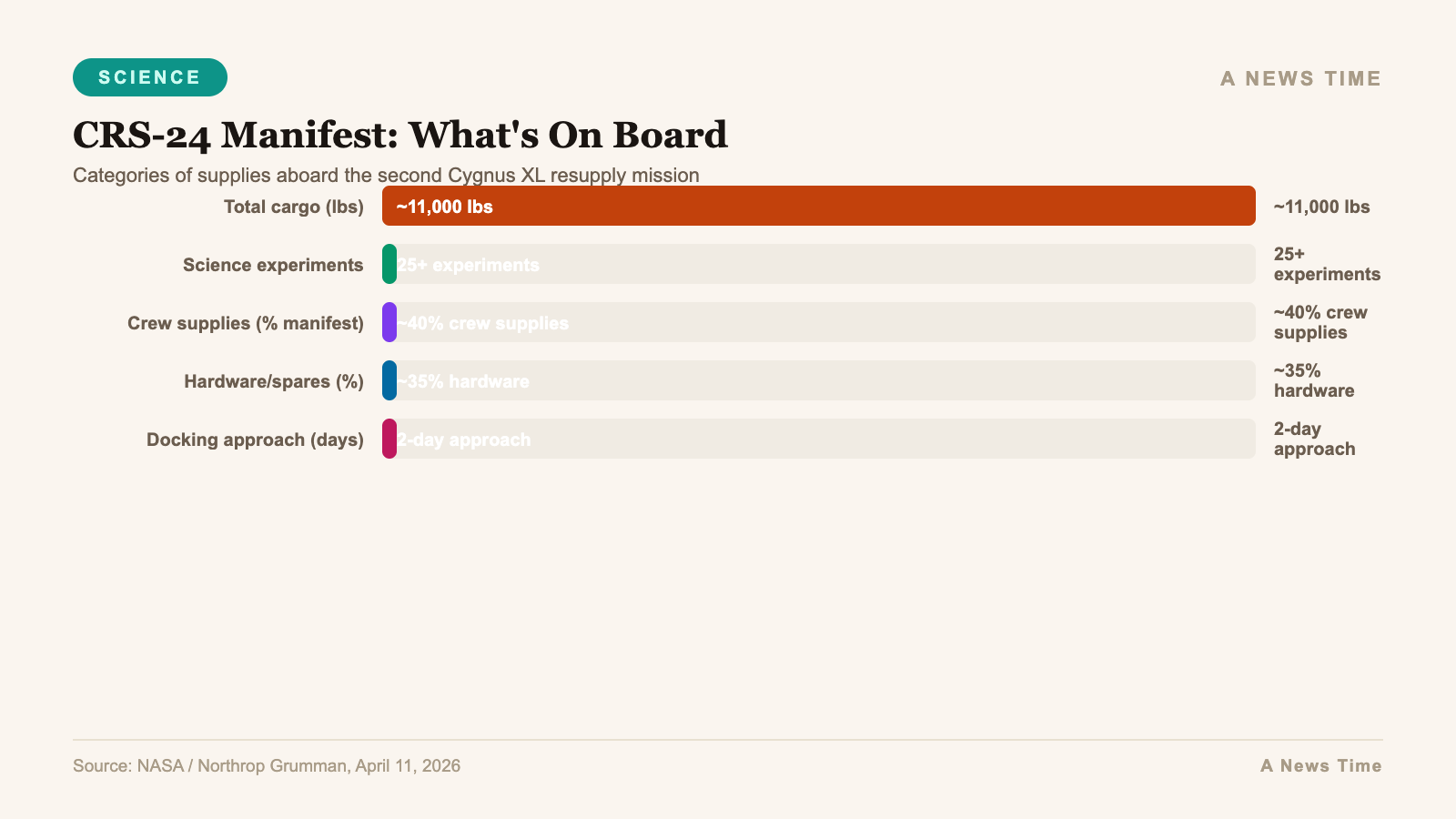
The manifest for CRS-24 includes the full range of items that keep a six-person crew alive and productive in a facility roughly the volume of a five-bedroom house floating 250 miles above the Earth. That means food, clothing, personal care items, spare hardware for station systems, scientific equipment for active experiments, and replacement parts for critical life-support systems.
Among the science payloads, NASA confirmed that CRS-24 includes materials for ongoing microgravity research into protein crystal growth, several fluid dynamics experiments designed to improve our understanding of how liquids behave without convection, and a suite of Earth observation instruments slated for external mounting. Each of those experiments was designed by researchers who waited years for an opportunity to fly their equipment. The Cygnus, as an expendable vehicle, also serves a secondary role: after it undocks from the station, it is loaded with trash and deorbited, burning up in the atmosphere over the Pacific. It is, in the frankest sense, also a garbage truck.
The station's current long-duration crew consists of members from NASA, the European Space Agency, and Roscosmos, who depend on regular resupply flights to maintain not just survival but a genuinely rigorous scientific program. On an average day, the ISS crew runs about six to eight hours of experiments across disciplines ranging from biology to material science to fundamental physics.
Why the Cygnus XL is a bigger deal than it sounds
The first Cygnus spacecraft flew in 2013, carrying about 1,400 kilograms of cargo. The Cygnus XL that flew on CRS-24 can carry more than 3,700 kilograms in its pressurized module alone. That growth was not a simple engineering exercise. Northrop Grumman had to redesign the spacecraft's structural load path, renegotiate launch vehicle interfaces, qualify new welding techniques for the extended module, and conduct a separate series of pressure tests to certify the enlarged hull for human-rated cargo operations.
For years, Cygnus flew on the Antares rocket, a medium-lift vehicle that Northrop Grumman developed partly through its own investment. Antares relied on a Ukrainian-built first stage and Russian-built engines, a supply chain that became untenable after Russia's invasion of Ukraine in 2022. Northrop Grumman quietly pivoted to launching Cygnus on SpaceX's Falcon 9, a move that has proven both more reliable and, by certain analyses, more cost-effective. The first Cygnus XL flew as CRS-22 in 2024 without incident.
The transition to Falcon 9 also means that Cygnus now benefits from what is arguably the most reliable heavy-lift vehicle in operation. As of April 2026, Falcon 9 had completed well over 350 successful missions, and the Space Coast surpassed 109 orbital launches in 2025, a record largely driven by SpaceX's extraordinary cadence.
The ISS cargo ecosystem in 2026
Cygnus is one of three major American vehicles currently supplying the International Space Station. SpaceX's own Dragon capsule handles both pressurized cargo and crew, and is notable as a reusable vehicle that returns to Earth with experiment samples and equipment. Cygnus is expendable but capable of carrying much larger single items because it does not need to survive reentry. Boeing's Starliner, after its troubled crewed test flight program, has been recertified for cargo operations and is expected to resume missions later in 2026.
On the international side, Japan's HTV program wound down in 2020 after nine missions. The European Automated Transfer Vehicle, which flew between 2008 and 2015, is no longer operational. Russia's Progress capsules continue to resupply the Russian segment of the station on a schedule roughly aligned with crew rotations. The diversity of supply pathways is not accidental. Station managers learned from the Columbia accident in 2003, which grounded the shuttle fleet and left the station dependent on Soyuz for nearly three years, that redundancy is not optional.
The ISS program is currently funded and operational through 2030 under the current NASA authorization. Several commercial station concepts, including projects from Axiom Space and Starlab, are in development to provide eventual replacements. Whatever replaces the ISS will almost certainly rely on a similar mix of commercial cargo providers, and the infrastructure and operational knowledge being built through missions like CRS-24 will flow directly into those future programs.
SpaceX's role: launch provider, not just competitor
There is something quietly notable about Northrop Grumman flying its cargo spacecraft on a SpaceX rocket to compete, in a sense, with SpaceX's own Dragon capsule for NASA cargo contracts. The commercial space business has evolved into a genuinely competitive but also deeply interdependent ecosystem. SpaceX benefits from the launch contract revenue. Northrop Grumman benefits from access to the world's most capable medium-lift vehicle. NASA benefits from having multiple cargo pathways to the station.
SpaceX's Falcon 9 booster recovery on this mission represented the vehicle's 14th flight on that particular booster, according to tracking data. Booster B1067 has become something of a workhorse in the fleet, having previously carried Crew Dragon missions, Starlink batches, and several other commercial payloads. Each reuse of a booster drops the effective cost per kilogram to orbit, which matters enormously when you are paying to ship protein crystal experiments and replacement toilet components to an altitude where the view of Earth is free but everything else is expensive.
The Falcon 9's trajectory on this mission carried it on a slightly inclined path toward the station's orbital plane before the upper stage completed the deployment burn. The Cygnus solar arrays, known as UltraFlex panels that fold open like a pair of fans, deployed successfully within hours of separation, providing the power the spacecraft needs for its two-day transit.
Rendezvous and docking: the slower half of the mission
Unlike SpaceX's Dragon, which docks autonomously to a port on the station's forward end, Cygnus approaches to a holding point about 10 meters away and then waits for a station crew member to capture it with the Canadarm2 robotic arm. The manual capture step is deliberate and adds a human verification layer before the vehicle is berthed to the station's Unity node.
The rendezvous sequence takes about 48 hours, during which Cygnus performs a series of orbit-raising burns to slowly match the station's altitude of approximately 250 miles. The spacecraft then approaches through a series of waypoints that are planned to allow the crew and mission control to abort the approach at any point if something goes wrong. It is a conservative, well-practiced choreography that has been refined across more than 20 Cygnus missions.
Once berthed, the crew will spend several weeks unloading the pressurized module. Some supplies will be used immediately; others are logged into the station's inventory system and stored for later use. When unloading is complete and the crew is ready, they will load the Cygnus with trash, expired equipment, and items slated for disposal and close the hatch. The spacecraft will then undock and spend several days in a low orbit before conducting a deorbit burn and reentering the atmosphere over the Pacific Ocean.
What we still don't know
Several questions remain open around the future of the Cygnus program. Northrop Grumman's commercial resupply contract with NASA runs through a finite number of missions, and the agency has not yet announced whether additional contracts beyond the current tranche will be awarded. The answer likely depends in part on how NASA's commercial station plans develop and whether ISS operations are extended beyond 2030.
There is also a broader question about the future of expendable cargo vehicles in a market increasingly dominated by reusable systems. SpaceX's Starship, now flying routinely in a fully reusable configuration, could theoretically carry more cargo to the ISS in a single mission than Cygnus delivers in an entire year. The economics of that equation shift depending on whether Starship's operational costs eventually drop as dramatically as SpaceX projects.
For now, Cygnus remains a reliable workhorse of the station supply chain, and CRS-24 is another successful data point in a program that has delivered, by some counts, more than 75 metric tons of supplies to the ISS since its first operational mission. In a domain where the consequences of failure are measured in crew safety and scientific continuity, reliability is its own remarkable achievement.
The bigger picture of LEO logistics
The CRS-24 mission lands at a moment when the entire architecture of human spaceflight is in a period of transition. Artemis II's successful lunar flyby and April 10 splashdown demonstrated that NASA is now flying humans beyond low Earth orbit again for the first time since 1972. SpaceX's pending IPO at a $1.75 trillion valuation reflects how thoroughly commercial launch has reshaped the industry's economics.
Against that backdrop, a successful cargo delivery to the ISS can look unglamorous. But the ISS is where more than 3,000 scientific experiments have been conducted since 2000, where techniques for long-duration spaceflight are still being refined, and where the international partnerships that underpin any future beyond-Earth program are maintained. Every Cygnus that delivers its cargo successfully is a small vote of confidence in the idea that humans can operate sustainably in space, not just visit it dramatically.
The crew onboard will have fresh food and clean equipment in a few days. That may be the most important sentence in this story.