

Confetti has barely settled in Houston, and NASA is already looking at a calendar that feels uncomfortably tight. The four Artemis II astronauts, three Americans and a Canadian, splashed down in the Pacific on , capping the first crewed trip around the Moon in more than 50 years. They were welcomed back at Ellington Field on , where families, reporters, and senior agency officials greeted a mission that, by every measurable standard, worked. Now comes the harder question: can NASA convert a flawless test flight into an actual boot print on the lunar south pole by 2028, the current official target for Artemis III?
The agency's leadership is already pivoting from celebration to construction schedules, spacesuit deliveries, and cryogenic propellant transfer tests. The road from a lunar flyby to a lunar landing is not a straight line, and almost every major piece of hardware required for the next mission is still unfinished, untested in its final configuration, or both. What happens over the next two years will determine whether Artemis III launches on time, slips into 2029, or gets rewritten entirely.
The Mission Ahead
Artemis II was, in NASA's own language, a "proving flight." Commander Reid Wiseman, pilot Victor Glover, mission specialist Christina Koch, and Canadian Space Agency astronaut Jeremy Hansen took the Orion spacecraft out past the far side of the Moon, tested every life-support and navigation system in deep space, and returned without incident. You can read our coverage of the Artemis II mission's historic success for a full breakdown of how each flight phase unfolded.
What the flight did not do, and was never designed to do, is land anywhere. Orion has no landing legs, no descent engines, and no spacesuits rated for walking on the Moon's regolith. All of that equipment belongs to Artemis III, which is a fundamentally different kind of mission. Where Artemis II was a loop, Artemis III is a rendezvous: Orion launches on the Space Launch System, docks in lunar orbit with a SpaceX Starship Human Landing System (HLS), transfers two astronauts over, and sends them down to the surface while the other two remain in orbit.
NASA has publicly targeted 2028 for this flight. Agency administrators have repeatedly said they believe the schedule is achievable if the pieces slot in on time. Independent analysts are less sure. According to reporting in the Los Angeles Times, the 2028 date assumes essentially no further hardware setbacks across at least four separate programs, a condition human spaceflight has rarely met.
What Starship Still Has to Prove
The single biggest variable is SpaceX Starship. NASA awarded SpaceX a contract in 2021 to deliver a lunar lander version of Starship, a vehicle tall enough that astronauts will ride a small elevator down from the crew cabin to the surface. Before any humans climb aboard, Starship has to complete a full uncrewed demonstration landing on the Moon. As of mid-April 2026, that demo has not happened.
To land, Starship must also solve a problem no one has ever solved at scale: transferring cryogenic methane and liquid oxygen between two spacecraft in orbit. SpaceX's plan calls for a tanker Starship to meet the lunar lander in Earth orbit and top off its propellant tanks before the lander heads for the Moon. Depending on mission profile, multiple tanker flights may be required, which means the full architecture depends on Starship flying far more often, and far more reliably, than it has to date.
None of this is impossible. Cryogenic transfer has been tested on small scales, and SpaceX has demonstrated a remarkable ability to iterate hardware quickly. But the uncrewed Starship lunar landing demo, the gate that must be cleared before any Artemis III launch, is still unscheduled. Every month it slips is a month subtracted from the 2028 target.
The Spacesuit Problem
The iconic white Apollo suits are museum pieces. Nothing in NASA's current inventory can safely keep an astronaut alive on the freezing, radiation-battered lunar south pole for more than a short excursion. That is why NASA contracted Axiom Space to build a new generation of extravehicular activity (EVA) suits, called the Axiom Extravehicular Mobility Unit, or AxEMU.
The AxEMU is being designed to handle temperatures that can plunge below minus 200 degrees Fahrenheit in permanently shadowed craters, to fit a much wider range of body types than the Apollo suits, and to give astronauts more flexibility to bend, kneel, and collect samples. Axiom has shown prototypes, but the agency still needs final flight-qualified units tested in vacuum chambers, on reduced-gravity aircraft, and during integrated dress rehearsals with Orion and Starship. Those tests take time that the schedule does not have in abundance.
There is also the logistics question of how suits get stored, serviced, and donned inside Starship's crew cabin. Every cubic foot on a spacecraft is contested real estate, and a pair of bulky suits adds mass, volume, and cooling loads that the vehicle designers are still refining.
Where Artemis III Will Land
Apollo astronauts walked on equatorial lava plains that were relatively easy to reach and relatively flat. Artemis III is aimed at the lunar south pole, a region the agency chose because it appears to hold water ice trapped in permanently shadowed craters. Ice is a scientific treasure and, if it can be mined, a potential source of drinking water, breathable oxygen, and rocket propellant for future missions.
The problem is that polar terrain is brutal. Long shadows, low sun angles that make hazard detection difficult, and steep slopes surrounding promising craters all raise the engineering bar. NASA has narrowed its candidate list to roughly a dozen landing regions, each with its own mix of scientific value and landing risk. The final selection is expected within the next year and will drive everything from Starship's guidance software to what instruments the crew packs.
"The south pole is a fundamentally different environment than anywhere humans have landed before, and choosing where to go is as much a science decision as an engineering one."Jacob Bleacher, NASA Chief Exploration Scientist
What Scientists Want From the Moon
On , the National Academies of Sciences, Engineering, and Medicine published a consensus statement on what lunar science should look like now that the Artemis II flight has proven the human transportation architecture. The report, titled "Following the Success of Artemis II, Scientists Will Shape What Comes Next for Lunar Exploration," calls for a more deliberate process for deciding which south pole sites to visit, which instruments to prioritize, and how to balance site selection between "guaranteed good science" and "risky but potentially transformative" locations.
You can read the National Academies release for the full recommendations. The headline is that the scientific community wants a seat at the table as Artemis III's traverse plan is built, not after. That means drawing on decades of orbital data from the Lunar Reconnaissance Orbiter, tying site choices to outstanding questions about the Moon's formation, and making sure early samples can survive the return trip in pristine condition.
If Apollo's defining scientific legacy was the lunar rock collection that reshaped our understanding of planet formation, Artemis's legacy could be volatile compounds: water ice, trapped hydrogen, carbon monoxide, and other molecules that record the inner solar system's early chemistry. Bringing back even a few grams of properly preserved ice would keep laboratories busy for a generation.

The Heat Shield Question
Artemis I, the uncrewed 2022 Orion flight, returned to Earth with unexpected damage to its ablative heat shield. Chunks of the Avcoat material came off in pieces during reentry rather than eroding smoothly, a pattern engineers called "liberation." NASA spent years analyzing the cause, modified the reentry trajectory for Artemis II, and declared the risk acceptable for the crewed flight. Early indications from the April 10 splashdown suggest the shield on Artemis II performed closer to predictions, but formal post-flight inspection is still underway.
Those inspection results matter enormously for Artemis III. If engineers find any surprises in the returned shield, the finding could force design changes on the Orion capsule earmarked for the landing mission, which is built and largely integrated. A redesign at this stage would be expensive and, more importantly, slow. You can revisit our reporting on the Pacific splashdown and the record-setting lunar flyby for the mission context.
The Delay Risk
The Artemis program has slipped repeatedly. Artemis I was years late. Artemis II was originally planned for 2024, then 2025, then April 2026. Artemis III has already slid from its original 2024 target to 2025, then 2026, then 2027, and now 2028. The pattern is not unusual for human spaceflight programs. Apollo slipped too. What makes the current schedule particularly fragile is the sheer number of independent pieces that have to work.
A partial list of things that must go right, in roughly the right order, within the next two years: at least one uncrewed Starship landing demonstration; multiple Starship in-orbit refueling tests; final flight qualification of AxEMU suits; delivery and checkout of the Space Launch System rocket for Artemis III; integration of the next Orion capsule; completion of the Orion heat shield post-flight analysis; approval of a south pole landing site; and a full integrated dress rehearsal involving both Orion and Starship hardware.
Industry analysts quoted in the Los Angeles Times coverage suggest that even one significant setback in any of those areas could push Artemis III into 2029 or beyond. Two setbacks almost certainly would. The 2028 target is best understood as a stretch goal, not a promise.
What We Still Don't Know
There are plenty of open questions that even people inside the program cannot answer yet:
- Whether SpaceX can complete the uncrewed Starship lunar landing demonstration in time to preserve the 2028 schedule.
- How many orbital refueling flights Starship will actually need per mission, and whether those can be flown within an operationally safe window.
- Whether the Axiom spacesuits will be delivered, flight-qualified, and integrated with both spacecraft on the current schedule.
- What the Artemis II heat shield looks like once engineers get it into a lab, and whether findings will force design changes downstream.
- Which specific lunar south pole location Artemis III will aim for, and how many backup sites will be maintained.
- How the Gateway lunar orbital station, still under assembly, fits into the picture for Artemis III versus later flights.
- Whether budget pressure, political turnover, or shifting agency priorities will reshape the program before the next crewed launch.
None of this means Artemis III is in trouble. It means the mission is a genuinely difficult piece of engineering that depends on an unusually large number of new systems all working at once. The honest answer is that nobody fully knows what the next two years will look like yet.
The Timeline Ahead
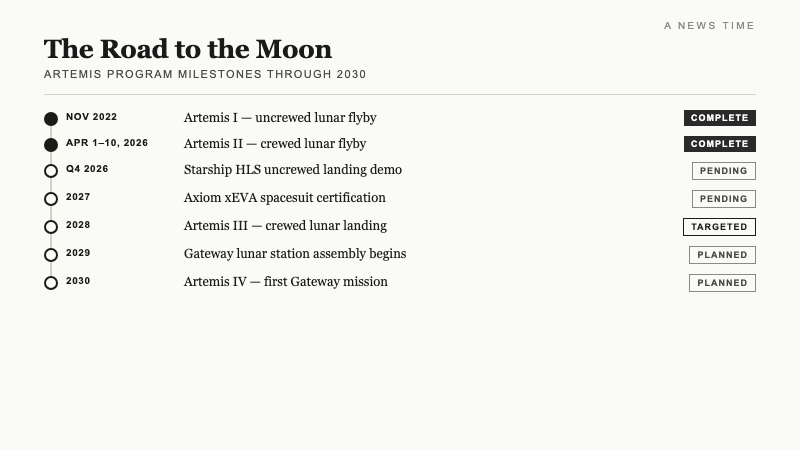
Here is a simplified roadmap of the major milestones NASA, SpaceX, and Axiom are working toward, based on current public schedules. Dates are targets, not commitments.
| Milestone | Target | Status |
|---|---|---|
| Artemis II crew return | April 2026 | Completed |
| Orion heat shield post-flight analysis | Mid 2026 | In progress |
| Starship orbital refueling demo | Late 2026 | Planned |
| Uncrewed Starship lunar landing demo | 2027 | Not yet scheduled |
| AxEMU spacesuit flight qualification | 2027 | In development |
| Artemis III landing site selection | 2027 | Under review |
| Artemis III crewed lunar landing | 2028 | Target, slip risk significant |
| Artemis IV (Gateway assembly + landing) | 2029 or later | Planning phase |
What Happens After Artemis III
If Artemis III succeeds, the program does not stop. Artemis IV is intended to deliver the first pressurized module of the Gateway, the small space station meant to orbit the Moon and serve as a staging point for surface missions. Artemis V and later flights are expected to begin rotating crews to the surface on longer stays, carrying heavier science payloads, and possibly testing pressurized rovers that would let astronauts traverse kilometers rather than meters from the landing site.
The bigger picture is that Artemis II finally confirmed one thing: Orion, the Space Launch System, deep-space life support, and human navigation around the Moon all work in a crewed configuration. That is a foundation the program did not have two weeks ago. Everything else, the landers, the suits, the Gateway, the science plans, gets built on top of that foundation.
"We now have a human-rated vehicle that has flown humans around the Moon. That changes the nature of every discussion about what comes next."NASA senior program official, speaking at the welcome-home event
What to Watch For
Over the next 24 months, watch for three pivot points. The first is the Artemis II heat shield debrief, expected this summer, which will either quietly confirm the current design or force awkward conversations about redesigns. The second is the Starship uncrewed landing demo; if that flight does not happen in 2027, 2028 is effectively out of reach. The third is spacesuit qualification, which has no dramatic public test event but determines whether the crew can actually leave the lander.
None of these are guaranteed to be smooth. But the Artemis II crew proved the hardest part of Artemis III, the human transportation, can be done. The next two years are about proving the rest. NASA's official welcome-home release called the flight "record-setting." The more interesting records are still ahead.
Sources
- NASA: Welcomes Record-Setting Artemis II Moonfarers Back to Earth
- National Academies of Sciences: Following the Success of Artemis II, Scientists Will Shape What Comes Next for Lunar Exploration
- Los Angeles Times: After Artemis II, here's what's next for NASA's return to the Moon
- NBC News: Photos from NASA's Artemis II Moon Mission