The emperor penguin stands up to 1.2 meters tall and weighs as much as 45 kilograms. It is the largest penguin species on Earth. It walks upright, huddles against Antarctic storms in groups of tens of thousands, and has evolved a remarkable set of physiological adaptations for surviving at the coldest, windiest, driest place on the planet. For millennia, it has been as permanent a fixture of the Antarctic continent as the ice itself.
That ice is now disappearing. And with it, so are the emperors.
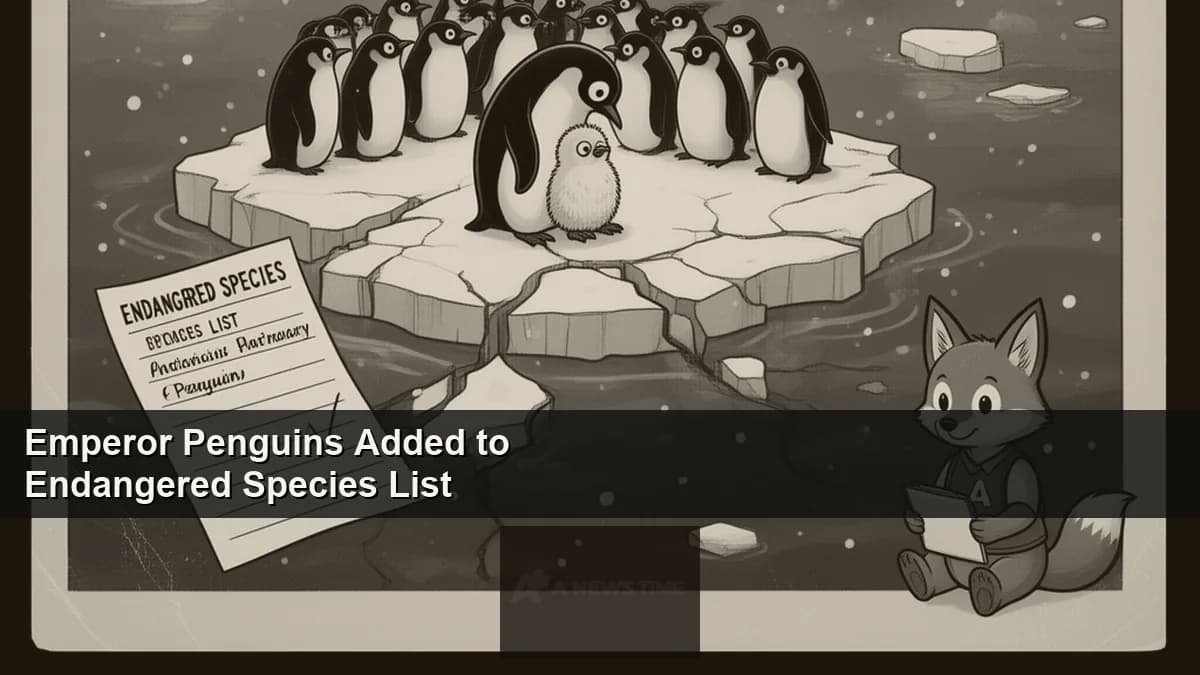
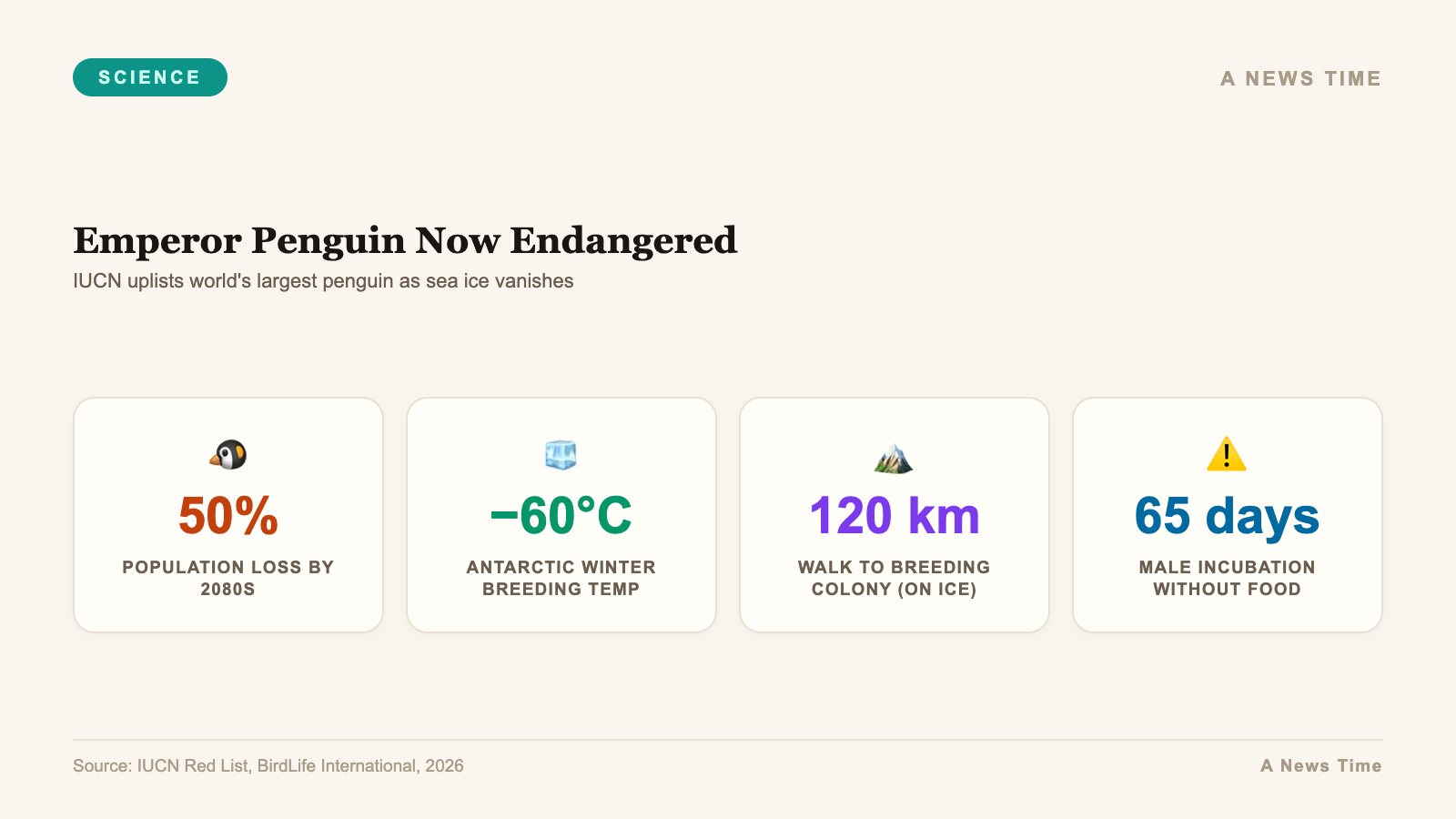
The International Union for Conservation of Nature announced this week that the emperor penguin has been uplisted to Endangered on its Red List of Threatened Species, moving from Vulnerable. The assessment was coordinated by BirdLife International, which serves as the IUCN's authority for bird classifications. The move reflects projections, now confirmed across multiple independent modeling exercises, that the emperor penguin population will halve by the 2080s if current rates of Antarctic sea ice loss continue. The primary driver is human-caused climate change.
Why emperor penguins need sea ice that stays
To understand why sea ice loss is so specifically devastating to emperor penguins, it helps to understand their extraordinary life cycle. They are the only penguins that breed during the Antarctic winter, in temperatures that can fall to minus 60 degrees Celsius with wind speeds exceeding 200 kilometers per hour. The breeding cycle begins in March or April, when the birds walk up to 120 kilometers inland across sea ice to reach their breeding colonies. The male incubates a single egg on his feet, under a brood pouch, for 65 days while the female returns to the sea to feed. The chick hatches in July or August.
Here is the critical constraint: the chick must fledge, meaning grow its waterproof adult feathers and become capable of surviving in the ocean, before the sea ice breaks up in the spring and summer. If the ice breaks up early, the chick, which is still covered in downy feathers that are not waterproof, is forced into the ocean before it is ready. The result is drowning.
The IUCN's assessment notes that sea ice in Antarctica has reached record low extents since 2016. The Antarctic sea ice minimum, measured each February when coverage is at its smallest, has been dramatically below historical averages in recent years. In 2023, Antarctic sea ice hit a new record low that shocked polar scientists. In 2024 and 2025, the pattern continued. The ice is not just retreating in summer; it is failing to rebuild adequately in winter, leaving emperor penguin breeding colonies on ice platforms that are thinner, less stable, and more vulnerable to early breakup than at any point in recorded history.
The 50 percent projection and what it means
The IUCN's endangered classification is based partly on population trend projections and partly on the current rate of observed decline. The projection that the global emperor penguin population will halve by the 2080s is based on climate models that project continued sea ice loss under current greenhouse gas emission trajectories.
The current global population of emperor penguins is estimated at roughly 250,000 to 300,000 breeding pairs, giving a total population somewhere between 600,000 and 800,000 individuals. A 50 percent reduction by the 2080s would leave between 300,000 and 400,000 birds, a number that places the species in a precarious position for long-term viability, particularly because emperor penguin breeding colonies are highly localized. If a colony loses its ice platform, the birds cannot simply relocate to an equivalent site elsewhere; suitable fast ice, meaning sea ice firmly attached to the coast, ocean floor, or grounded icebergs, is a limited and geographically specific resource.
Martin Harper, CEO of BirdLife International, issued a statement that left little room for misinterpretation. "Penguins are already among the most threatened birds on Earth," he said. "The emperor penguin's move to endangered is a stark warning: climate change is accelerating the extinction crisis before our eyes." Harper added that governments must act to urgently decarbonize the economy, a statement that is scientifically accurate and politically contentious in roughly equal measure.
The emperor penguin is not alone
The same IUCN Red List update also moved the Antarctic fur seal to Endangered and placed the southern elephant seal at risk of extinction for the first time. The Antarctic fur seal's story is particularly sobering. Its population has declined by more than 50 percent since 2000, driven primarily by reduced food availability. The fur seal's prey base, primarily Antarctic krill and certain fish species, has itself been disrupted by changes in sea ice extent and ocean temperature. Less ice means less of the algae that grow beneath it, less krill that feed on that algae, and less food for the predators that depend on krill.
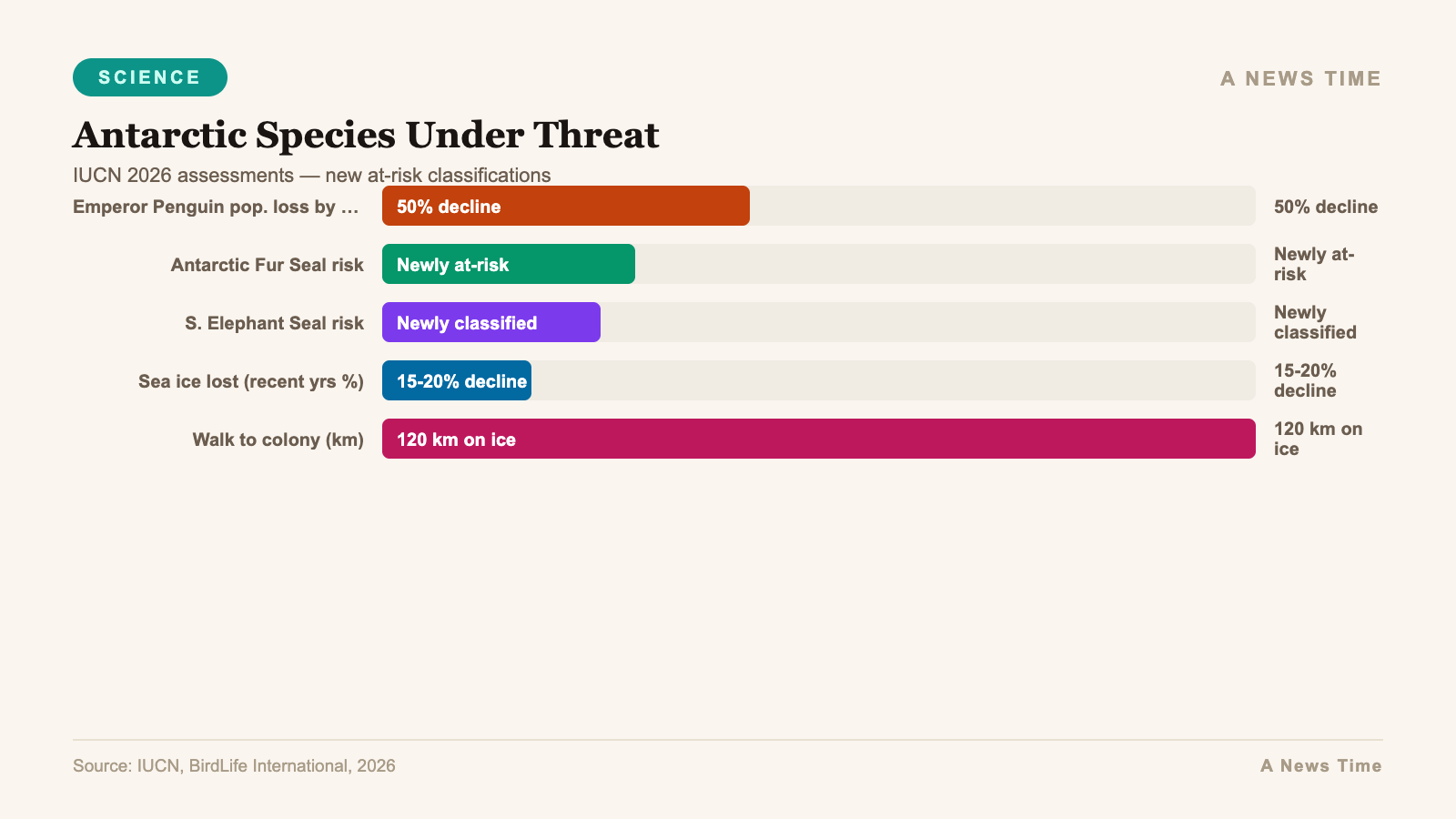
The southern elephant seal's situation involves a different mechanism. The IUCN identified disease as a significant driver, with novel pathogens expanding their range as ocean temperatures warm and allow vectors to reach previously protected high-latitude ecosystems. This is a pattern being observed across multiple Antarctic and sub-Antarctic species: warming does not just harm cold-adapted animals directly, it also opens ecological doors that were previously frozen shut.
Taken together, the three listings paint a picture of an ecosystem under simultaneous pressure from multiple directions. The sea ice is retreating. The food web is shifting. Disease vectors are expanding. And the animals at the top of the food chain, the penguins, seals, and whales that depend on the entire ecosystem functioning correctly, are bearing the cumulative weight of those disruptions.
What sea ice loss looks like on the ground
Scientific monitoring of Antarctic sea ice has been conducted by satellite since 1979, giving researchers nearly half a century of continuous records. The data show a system that was relatively stable through the 1980s and 1990s, showed modest variability through the 2000s and 2010s, and then dropped dramatically after 2016. The 2023 Antarctic sea ice minimum was so far below previous records that the statistical anomaly was described by some polar scientists as "mind-blowing." The ice extent was approximately 1 million square kilometers below the previous record minimum. To put that in scale, 1 million square kilometers is roughly three times the area of Texas.
For emperor penguins, the consequences have been direct and observable. Several Antarctic research stations have documented breeding failures at monitored colonies in years following poor sea ice formation. Satellite imagery has been used to identify emperor penguin colonies by the distinctive brown staining of their guano on white ice, and several colonies that were visible and active in the 2000s and 2010s have shown dramatically reduced populations or disappeared entirely from recent imagery.
The World Meteorological Organization documented 2025 as part of the 11 warmest years on record, with ocean temperatures playing a particularly central role in the acceleration of polar ice loss. Antarctic sea ice loss is not independent of global warming; it is one of its most legible signatures.
Conservation options and their limits
Emperor penguins live in one of the most remote and least human-inhabited regions on Earth. They are not threatened by direct hunting, habitat destruction from urban development, or most of the pressures that typically drive terrestrial species to extinction. The primary threat is singular, global, and deeply difficult to address at the scale of an individual species conservation program: the warming of the atmosphere by greenhouse gas emissions that have been accumulating since the Industrial Revolution.
This makes the emperor penguin a different kind of conservation challenge than, say, protecting a habitat patch from a local developer or enforcing a hunting moratorium. Traditional conservation tools, protected areas, captive breeding programs, direct intervention in breeding sites, cannot address the underlying driver. The only effective conservation measure for emperor penguins is a rapid global reduction in greenhouse gas emissions, a goal that is subject to international political negotiations, economic incentives, technological trajectories, and a thousand other variables that have nothing directly to do with penguins.
That said, some interventions at the margins may help. Protecting the Antarctic Specially Protected Area framework that covers many emperor penguin breeding sites provides some legal protection from the disturbance activities humans can actually control, such as tourism operations and scientific station footprints. Reducing krill fishing pressure in key Antarctic feeding areas could help maintain the prey base. And monitoring programs that track colony health in near-real-time are essential for detecting population changes quickly enough to inform management decisions.
The IUCN Red List as a scientific instrument
The IUCN Red List is not a legal document. It does not automatically trigger protections under any national or international law. What it does is provide the most authoritative scientific assessment available of extinction risk for assessed species, using standardized criteria applied consistently across tens of thousands of plants and animals. When the IUCN moves a species from Vulnerable to Endangered, it is making a precise claim: that the species meets defined quantitative thresholds for population decline, range reduction, or probability of extinction over specified time horizons.
For the emperor penguin, the move to Endangered reflects assessments of projected population decline, habitat loss, and the confidence intervals around climate model projections. It is a conservative, evidence-based judgment. The same criteria have been applied to thousands of other species, and the emperor penguin's elevation to Endangered is proportionately justified by the data.
What the listing does do, beyond its scientific function, is provide a clear public benchmark. When a species the size of a small child, adapted to survive conditions hostile to nearly all other life, cannot cope with the pace of climate change humans are generating, that is information worth having clearly stated. The emperor penguin has survived Antarctic ice ages and interglacial periods. What it cannot survive is the speed at which humans are rewriting the planet's thermal balance.
What we still don't know
The projections for emperor penguin population decline are based on climate models that have their own uncertainties, particularly regarding the pace of Antarctic sea ice loss under different emission scenarios. If global emissions peak and decline more rapidly than current trends suggest, the ice loss trajectory could be less severe than projected, and the population decline more gradual. That uncertainty is real and worth stating. It does not, however, change the direction of the trend; it affects only its speed.
Scientists also do not fully understand the behavioral flexibility of emperor penguins under environmental stress. There is evidence that some colonies have shown limited ability to shift breeding sites or timing, but whether this flexibility is sufficient to buffer against the magnitude of ice loss projected is genuinely unknown. The answer matters enormously for long-term population viability and is an active area of research at stations including the British Antarctic Survey and Alfred Wegener Institute.
What is not in question is that the ice those penguins need is declining, the trend is attributable to human greenhouse gas emissions, and the rate of decline is faster than the birds' life history can readily accommodate. The IUCN has now said so, officially, in the most rigorous species assessment framework available. The rest is politics, economics, and the complicated human machinery of deciding what to do about it.
Sources
- IUCN: Emperor Penguin and Antarctic Fur Seal now Endangered due to climate change (April 2026)
- Vancouver Sun: Climate change news roundup, week of April 12, 2026
- British Antarctic Survey: Emperor penguin research and monitoring program
- Copernicus Climate Change Service: Antarctic sea ice extent and surface temperature reports