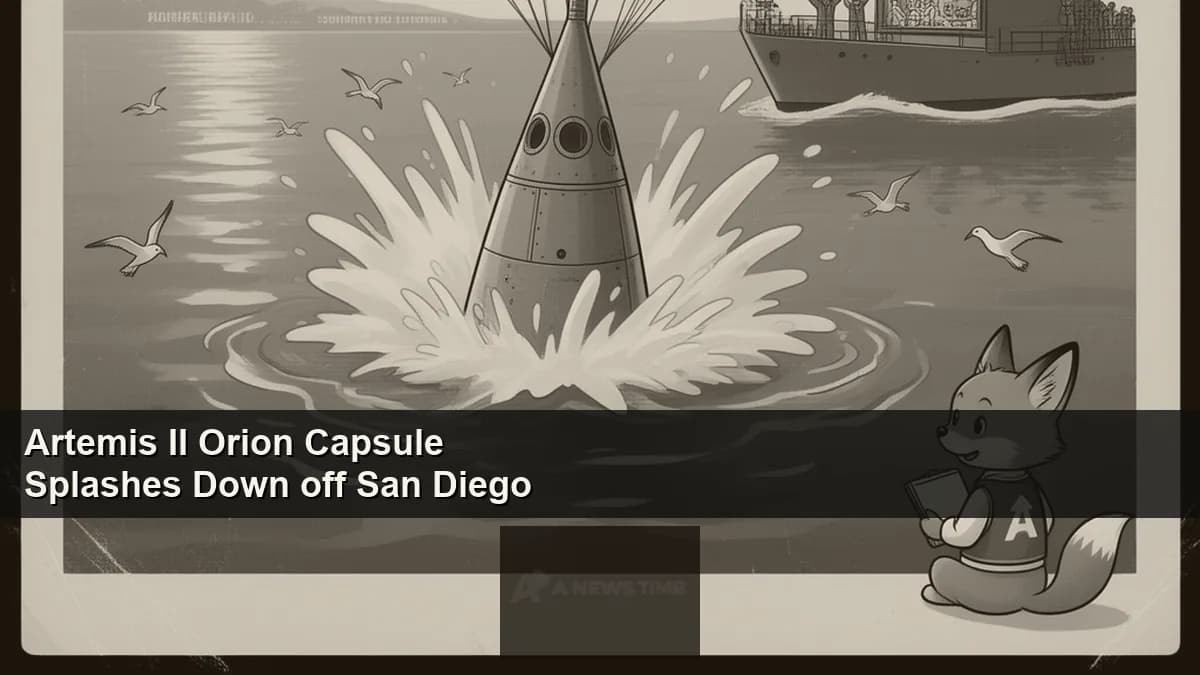
Four astronauts splashed down in the Pacific Ocean off the coast of San Diego at , concluding Artemis II and becoming the first human crew to return from lunar distance in more than five decades. Commander Reid Wiseman, pilot Victor Glover, and mission specialists Christina Koch and Jeremy Hansen rode NASA's Orion capsule to a parachute-assisted ocean touchdown, capping a 695,000-mile voyage that took them farther from Earth than any crew before them.
The splashdown, watched live by millions online and from the shores of San Diego, is more than a mission milestone. It is the first time a crew returning from the vicinity of the Moon has been recovered since the Apollo 17 astronauts landed on December 19, 1972. For anyone trying to grasp the gap: a child born that day is now old enough to be a grandparent.
The mission launched on , from Kennedy Space Center and followed a free-return trajectory around the Moon, swinging to within 4,067 miles (6,545 km) of the lunar surface on April 6. Over the next 10 days, the crew demonstrated Orion's life support systems, next-generation spacesuits, and radiation monitoring equipment in conditions that no hardware had faced with human lives at stake.
Falling Back to Earth: The Physics of Coming Home
Re-entry from lunar distance is a fundamentally different problem from re-entry after a routine orbit around Earth. The Orion capsule hit the upper atmosphere traveling at approximately 25,000 miles per hour, generating temperatures at the heat shield of up to 5,000 degrees Fahrenheit (2,760 degrees Celsius). For context, that is roughly half the surface temperature of the Sun.
The Artemis I uncrewed test flight in November 2022 revealed anomalies in how the heat shield's ablative material burned away: portions charred and separated in unexpected patterns. NASA engineers spent years analyzing those findings, modifying the shield's design and selecting a steeper, more direct re-entry angle for Artemis II specifically to reduce the duration and distribution of heat stress. Friday's successful recovery suggests those changes worked.
| Phase | Altitude / Speed | Key Event |
|---|---|---|
| Atmospheric Entry Interface | ~400,000 ft / ~25,000 mph | Heat shield begins absorbing reentry plasma |
| Peak Heating | ~230,000 ft / up to 5,000°F shield temp | Plasma blackout, temporary loss of comms |
| Drogue Parachutes Deploy | ~23,000 ft / ~325 mph | First deceleration stage, 2 drogues deployed |
| Pilot Parachutes Deploy | ~8,000 ft / ~130 mph | Three pilot chutes pull out main canopies |
| Main Parachutes Fully Deployed | ~5,000 ft / ~17 mph | Three main chutes, combined 80-yard canopy span |
| Splashdown | Sea level / ~17 mph | Pacific Ocean, off San Diego coast, 5:07 PM PT |
Orion's parachute system deployed in precisely the sequence NASA designed. Two drogue chutes opened first to stabilize the capsule and begin slowing it from 325 mph. Pilot chutes then pulled out the three main canopies, each a vivid orange-and-white, whose combined spread covers 80 yards (73 meters). That final canopy drag decelerated the capsule to roughly 17 mph for splashdown, gentle enough for the crew to feel, but firm enough that the ocean surface lands like a hard stop after 10 days of weightlessness.
Coast Guard and NASA recovery crews had pre-positioned within a landing zone approximately 550 miles in diameter. Hatch opening followed medical checks aboard the recovery vessel, with the crew expected to transfer to a San Diego military base before flying to Johnson Space Center in Houston, which they last saw on March 27.
The Crew: A Mission of Firsts Inside a Mission of Firsts
Every member of this crew carries a distinction that extends beyond this single mission. Commander Reid Wiseman, a US Navy test pilot and veteran ISS commander, led a crew that collectively broke barriers across multiple dimensions simultaneously.
Pilot Victor Glover became the first person of color to travel to the Moon and return. Mission specialist Christina Koch, who holds the record for the longest single spaceflight by a woman, became the first woman ever to journey to lunar distance. Mission specialist Jeremy Hansen of the CSA became the first non-American to make that journey.
Koch described her reaction during the mission's closest approach to the Moon, when Orion was 4,067 miles (6,545 km) above the lunar surface, as almost involuntary. "It lasted just a second or two and I actually couldn't even make it happen again," she said, "but something just threw me suddenly into the lunar landscape and it became real." The comment points to something that is genuinely hard to convey in technical mission summaries: the psychological effect on human beings of seeing the Moon as a real landscape rather than a dot in the night sky.
The mission also carried genuine human weight. On April 7, near the mission's farthest point from Earth, the crew proposed naming a previously unnamed lunar crater "Carroll," in honor of Carroll Taylor Wiseman, Commander Wiseman's late wife, who died of cancer in 2020. Hansen struggled visibly to deliver the proposal; the moment prompted tears among all four crew members. NASA confirmed acceptance of the dedication.
What the Mission Actually Tested
Artemis II was not a science mission in the way a Mars rover or a space telescope is a science mission. Its primary value was as a systems validation flight: a proof that Orion can safely carry humans to cislunar space and bring them home. That test was the experiment.
| Date | Milestone | Detail |
|---|---|---|
| Launch | 6:24 PM ET liftoff from Kennedy Space Center Launch Complex 39B | |
| Trans-Lunar Injection | Orion broke free of Earth orbit, heading toward the Moon | |
| Closest Lunar Approach | 4,067 miles (6,545 km) above the lunar surface; first crewed flyby since 1972 | |
| Distance Record | 252,756 miles from Earth; surpassed Apollo 13's 54-year-old record | |
| Crater Dedication | Crew named unnamed lunar crater "Carroll" for Commander Wiseman's late wife | |
| Splashdown | Pacific Ocean off San Diego, 5:07 PM PT; 10-day mission complete |
The systems the crew evaluated included Orion's environmental control and life support systems (ECLSS), next-generation Orion Crew Survival System spacesuits, radiation detection hardware, and communications and navigation tools for operations in deep space. All of these will be critical to the more ambitious Artemis III crewed lunar landing, currently targeted for 2028.
There was also the less glamorous category of testing: the toilet. Orion's waste management system malfunctioned more than once during the mission, requiring Koch to deploy urine collection bags and perform in-flight repairs. This is not a detail that makes it into the highlight reels, but it is precisely the kind of problem NASA needs to understand and solve before committing a crew to a surface stay on the Moon.
Read more about what the crew found at closest approach in our earlier coverage: Artemis II crew completes first crewed lunar flyby since 1972, and the record-breaking outbound leg: Artemis II breaks Apollo 13 distance record at 252,755 miles.
What We Still Don't Know
The mission's apparent success is real, but several important questions remain open in the hours and days following splashdown.
The heat shield modification made for Artemis II addressed specific anomalies found after Artemis I. NASA engineers will need to inspect the recovered heat shield in detail to determine whether the charring pattern was nominal, whether the steeper re-entry angle achieved its intended effect, and whether the shield is ready to clear Artemis III for a human landing mission. That data analysis will take weeks, not days.
The crew's physical condition is also a genuine unknown at the time of splashdown. Ten days of weightlessness at lunar distances exposes the body to radiation levels substantially higher than those during low-Earth-orbit missions. Space station crews returning after six-month stints undergo weeks of rehabilitation. The Artemis II crew will be closely monitored for the effects of cosmic ray exposure, fluid shift, muscle atrophy, and bone density changes. These are not hypothetical concerns: they are the reasons NASA's biomedical teams have been tracking the crew throughout the mission.
There is also the question of what the mission's imagery and environmental data will tell scientists over time. The crew captured high-resolution photography and video of the lunar surface, including areas of the Moon's south pole that are targets for Artemis III's landing sites. Analysis of that imagery by planetary scientists is just beginning.
The Significance: Why 2026 Is Different From 1972
When Apollo 17 splashed down in December 1972, it was the end of a program that had been politically justified as a race against the Soviet Union. Once that race was won, the Moon missions stopped. For 54 years, no human being traveled beyond low Earth orbit.
Artemis II's return is different in structure, even if the capsule shape is superficially similar to Apollo's. The mission is part of a sustained international program that includes the European Space Agency (which contributed the Orion service module), the Canadian Space Agency (Hansen's presence is tied to a formal CSA partnership), and the Japanese space agency JAXA. Sixteen nations are party to the Artemis Accords, which establish norms for responsible lunar exploration.
Nicky Fox, associate administrator of NASA's science mission directorate, framed the mission's cumulative effect in a briefing with reporters this week: "Our four Artemis II astronauts, Reid, Victor, Christina and Jeremy, took humanity on an incredible journey around the Moon and brought back images so exquisite and brimming with science, they will inspire generations to come."
The numbers now stand at 28 humans who have traveled to the Moon and returned safely: 24 from the nine crewed Apollo missions between December 1968 and December 1972, and now these four from Artemis II. The composition of that group has changed: it includes a woman and a non-American for the first time. The technology has changed: Orion carries more computing power, better life support, and more radiation shielding than the Apollo capsules. The geopolitical context has changed: this is not a two-nation race but a multilateral program.
What has not changed is the fundamental physics, and the fundamental wonder of watching a small capsule under orange parachutes settle into the Pacific while carrying four people back from the Moon.
What Comes Next for the Artemis Program
NASA's stated target for Artemis III is a crewed lunar landing in 2028, 56 years after Apollo 17. That mission will use a SpaceX Human Landing System derived from the Starship architecture to carry two astronauts from Orion to the surface. The landing zone is expected to be near the Moon's south pole, where permanently shadowed craters are believed to contain water ice that could support long-term human presence.
The agency has also outlined plans for an ambitious lunar base, budgeted at approximately $20 billion, to be constructed within a decade. That timeline depends on sustained political and budgetary support, which has not always been reliable. The Trump administration recently proposed reductions to NASA's overall budget, and the agency has already revised the Artemis schedule several times.
But Friday's splashdown provides the program with something that schedule revisions cannot manufacture: demonstrated capability. A human crew flew to the Moon's vicinity and came home safely. The heat shield survived. The parachutes opened. The life support worked for 10 days. The recovery teams performed without incident. Whatever comes next in the Artemis schedule, this mission proved the fundamental architecture is sound.
The crew of Artemis II will spend the coming weeks in medical monitoring and mission debriefs at Johnson Space Center. Their data, their imagery, and their experience will flow into the design decisions for Artemis III and beyond. Hansen and Koch have both expressed interest in returning for future missions. Glover is already on the shortlist for lunar surface assignments.
For the first time in living memory for most people alive today, the Moon is not just a destination humanity once reached. It is a destination humanity is actively heading back to, with the parachutes to prove it.
Sources
- The Guardian: Artemis II crew to end record-setting mission with Pacific Ocean splashdown
- Space.com: Watch NASA's Artemis 2 astronauts return to Earth live online today (April 10)
- NASA: Artemis II crew eclipses record for farthest human spaceflight
- NASA: Orion Parachute System Technical Overview (PDF)