

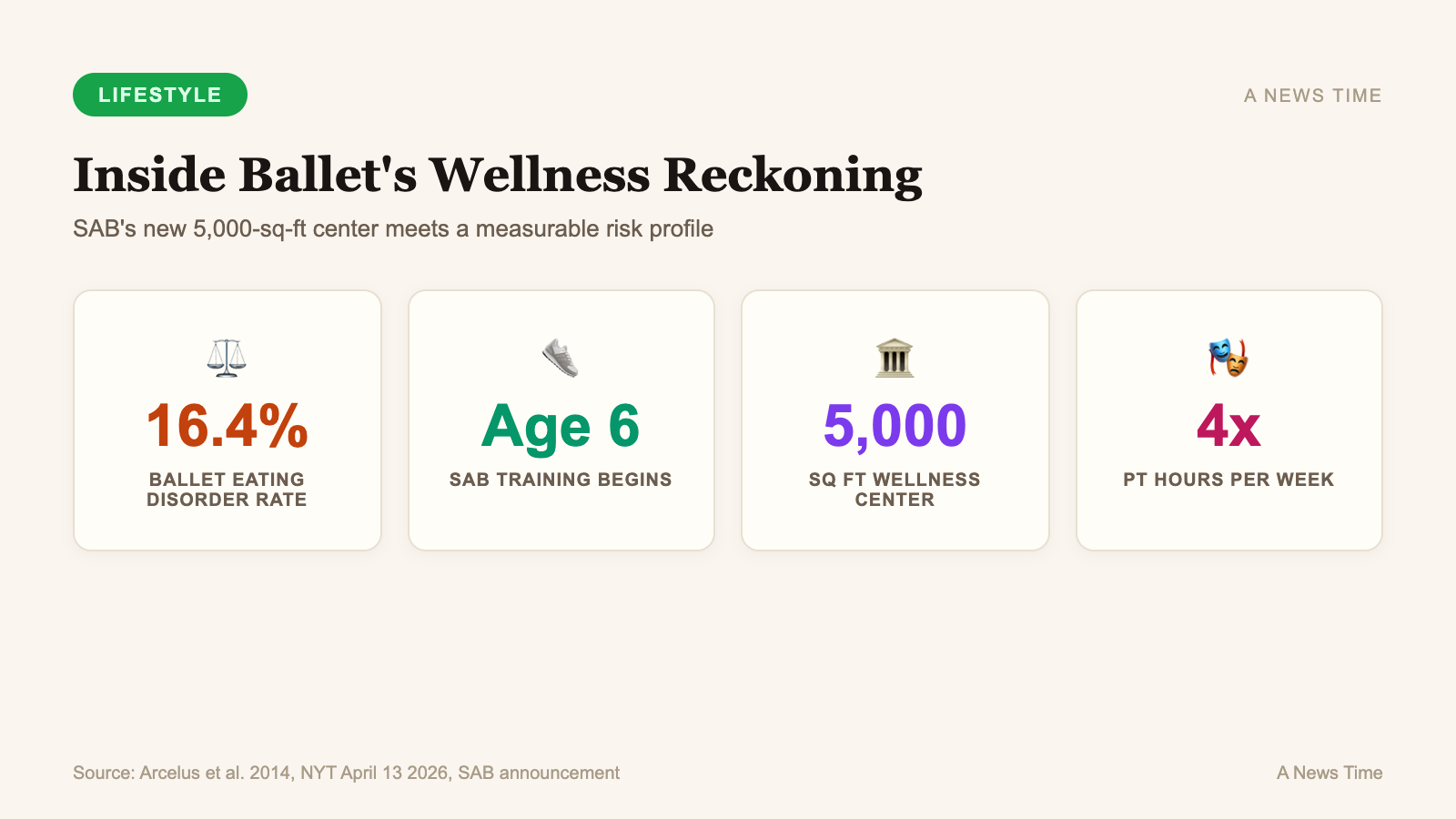
At the SAB in New York, the training ground for New York City Ballet where students begin classical instruction as young as 6, the sixth floor of the Rose Building now contains something the institution did not have for most of its nearly 90-year history: a dedicated 5,000-square-foot health and wellness center, opened in September 2025, with a strength and conditioning studio, a Pilates studio, two private physical therapy treatment rooms, offices for on-staff nutritionists and counselors, and a student commons stocked, per the New York Times, with snacks. The Times reported on April 13, 2026 that at the new center, "bodies and minds share equal billing, and everyone gets the help they need."
Read that sentence twice. Inside American ballet, it is close to a cultural earthquake.
The punishing body culture ballet has always defended
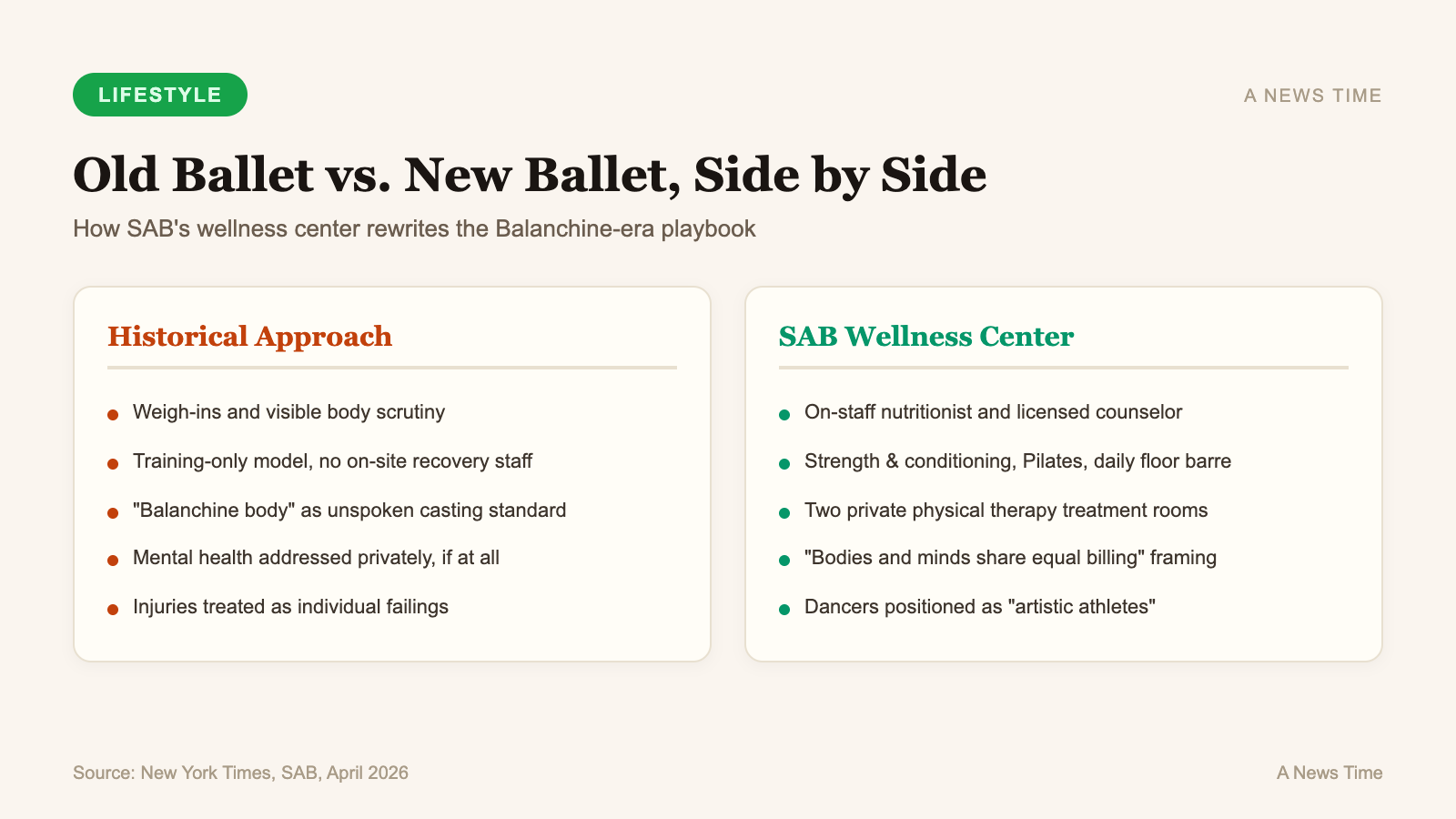
To appreciate what SAB is doing, it helps to start with what SAB has historically been. The school was founded by George Balanchine and Lincoln Kirstein in to create American-trained dancers for what would become New York City Ballet. Balanchine famously prized an ultra-thin, elongated aesthetic that shaped the look of American classical ballet for generations. The "Balanchine body," long-limbed, small-breasted, narrow-hipped, was the unspoken entry requirement for the company for most of the twentieth century. Former dancers have spent years describing, in memoirs and documentaries, the weight scrutiny, the weigh-ins, and the unspoken expectations that came with wanting to stay in the room.
The physical reality backing that aesthetic is unforgiving. A 2014 systematic review published in the European Eating Disorders Review by Arcelus and colleagues found that the overall prevalence of eating disorders among dancers was 12%, and among ballet dancers specifically it was 16.4%, figures roughly three times higher than the general population. Subsequent research in the Journal of Eating Disorders and the Tandfonline review on preventing eating pathology among elite adolescent ballet dancers has reinforced the finding: the combination of early specialization, visual assessment of bodies, and an aesthetic ideal rewarding thinness puts pre-professional ballet students at measurably higher risk than their non-dancing peers.
That is the backdrop against which SAB's new center has to be read. A 5,000-square-foot room with a licensed nutritionist and a counselor on staff, built into daily training, is not a luxury. It is the institution finally meeting the risk profile of its own curriculum.
What is actually inside the new center
The center, located on the sixth floor of the Rose Building at Lincoln Center, opened to intermediate and advanced students at the start of SAB's 2025 to 2026 winter term and expanded in programming through the spring. According to SAB's own announcement, the space includes a dedicated strength and conditioning studio, a fully equipped Pilates studio, two private physical therapy treatment rooms, and offices for the school's nutrition and counseling professionals. The school said program enhancements for the winter term include a fourfold increase in weekly physical therapy treatment hours, expanded Pilates studio hours, open coaching hours with strength and conditioning staff, and daily floor barre classes.
"Dancers are athletes, artistic athletes. It's imperative they have the right tools. You would never see a professional sports team training with the bare minimum, and neither should our dancers who are training at the top level."
Aesha Ash, Head of Artistic Health and Wellness, School of American Ballet
Ash, a former New York City Ballet soloist and one of the first Black women to dance at the company, is an unusually credible messenger for this reframe. She has spoken publicly in the past about the pressures young dancers face and the ways the institution historically failed to equip them with basic recovery tools. She is now, per the Times, running the program that puts those tools into daily rotation.
| Eating Disorder Prevalence (Research Data) | Population | Rate |
|---|---|---|
| General adult population (lifetime) | Non-dancers | ~3 to 5% |
| All dancers (Arcelus et al. 2014 meta-analysis) | Dance population | 12.0% |
| Ballet dancers specifically | Ballet | 16.4% |
| Ballet dancers, anorexia nervosa | Ballet | 4.0% |
| Ballet dancers, bulimia nervosa | Ballet | 2.0% |
The cultural shift, not just the facility
Zoom in on SAB and the new center is a real estate story. Zoom out, and it is part of a wider reckoning that elite performance sport and elite performance art have been working through for roughly the last decade. The Larry Nassar scandal in USA Gymnastics, published investigations into injury cover-ups and abusive coaching in figure skating and distance running, and the post-Athlete A wave of federal oversight changed the baseline expectation for what adults running a training pipeline for minors owed those minors. Ballet has been slower to publicly account for its version of that story, in part because the cultural glamour of Lincoln Center has historically absorbed the criticism more effectively than a Michigan gym did.
Misty Copeland, American Ballet Theatre's first Black female principal dancer, spent much of the last decade forcing a conversation about body standards, race, and access inside classical ballet. Sara Mearns of New York City Ballet, one of the company's most visible principals, has been frank on social media about her own mental health struggles inside the profession. A November 2025 New York Times piece documented a broader trend of professional ballet dancers seeking therapy and naming the internal costs of the work they do. The SAB center is, in that sense, the institutional version of a conversation its own alumnae have been pushing from the outside for years.
The ask now, from the research community and from dancers themselves, is whether the shift stays embedded when the visiting press leaves. A wellness center with a nutritionist on staff is only as good as how freely the students can use it, how confidential the conversations inside it are, and whether casting and faculty decisions still quietly track the old aesthetic assumptions. Architecture is easy. Culture is not.
Why the timing is not an accident
SAB's move arrives at a moment when the science on early specialization has caught up with the art form. Pediatric sports medicine research has been unusually clear for about five years that children who specialize in a single physically demanding discipline before puberty are at significantly elevated risk for overuse injuries, burnout, and mental health challenges compared with children who sample multiple activities. The American Academy of Pediatrics and the American Medical Society for Sports Medicine have both recommended delayed specialization for most sports. Ballet, where serious training starts by age 8 and intensifies by 11, is among the most specialized physical disciplines in the world, and the research implications land squarely on its doorstep.
There is also a pipeline question that elite ballet companies have to take seriously. If the aesthetic ideal and the training culture are producing injured, dysregulated, or mentally unwell dancers who burn out before they reach a company contract, the sustainability of the whole system is at risk. Fewer young parents in are willing to sign their children up for a pipeline that produces those outcomes, particularly as the youth sports and dance space gets more competitive and the alternative pathways, from acrobatic arts to contemporary dance to sport itself, look less brutal. A health and wellness center is a recruitment tool as much as it is a care intervention. For related context, see our coverage of how 2026 is redefining women's wellbeing and the shift toward neurowellness as a category in elite training.
What to watch next
A few indicators will tell us whether SAB's new center is the start of a durable change inside elite American ballet or a well-photographed renovation. The first is whether American Ballet Theatre, the Boston Ballet School, the San Francisco Ballet School, and Pacific Northwest Ballet School build similarly resourced programs within the next two years. Peer pressure is how institutional standards migrate across the field. If SAB is the only pre-professional school with a full wellness center in , the story will be a celebrated outlier, not a field shift.
The second is whether research collaborations follow the facility. The most rigorous version of this change would see SAB, and schools that follow, publishing longitudinal data on injury rates, eating disorder prevalence, mental health outcomes, and dancer retention alongside independent academic partners. That kind of transparency is unusual inside classical ballet, but it is now standard in elite Olympic sport programs that rebuilt after their own scandals.
The third is the quieter thing. It is whether the next generation of dancers coming through SAB, the ones who will populate New York City Ballet's corps and soloist ranks by , speak about their training the way Copeland and Mearns have had to speak about theirs: as a set of experiences they survived rather than a set of practices that supported them. If that conversation sounds different coming from dancers who trained inside the new center, the shift will have taken. If it sounds the same, the room was not the point. For adjacent reporting, see our coverage of exercise as a mental health intervention and the broader recovery and longevity science shaping 2026 wellness.
Frequently Asked Questions
What is the School of American Ballet?
SAB is the official school of New York City Ballet, founded by George Balanchine and Lincoln Kirstein in 1934. It is one of the most selective pre-professional classical ballet schools in the United States, training students as young as 6 through the end of high school, with many students progressing into professional ballet companies.
What is the new Artistic Health and Wellness Student Center?
It is a 5,000-square-foot facility on the sixth floor of the Rose Building at Lincoln Center, opened in September 2025. It houses strength and conditioning, Pilates, physical therapy, nutrition counseling, and mental health services for SAB's intermediate and advanced students, and is overseen by Aesha Ash, the school's Head of Artistic Health and Wellness.
Why are eating disorders a particular concern in ballet?
Peer-reviewed research, including the 2014 systematic review by Arcelus and colleagues, has found eating disorder prevalence of approximately 16.4% among ballet dancers, roughly three times higher than the general population. The combination of early specialization, an aesthetic ideal prizing thinness, and visible body assessment contributes to the elevated risk.
Is ballet the only performance field making this shift?
No. Elite gymnastics, figure skating, and distance running programs have all been working through similar reckonings, many of them driven by public scandals. Ballet has been slower to publicly address its version of the conversation, which is part of what makes SAB's move institutionally significant.
Who is Aesha Ash?
Aesha Ash is a former New York City Ballet soloist and one of the first Black women to dance at the company. She now serves as SAB's Head of Artistic Health and Wellness, overseeing the new center and the school's expanded physical, nutritional, and mental health services for students.
Sources
- A Wellness Center for Young Ballet Students (Snacks Included) - The New York Times
- A Brand-New Space for SAB's Artistic Athletes - School of American Ballet
- Prevalence of eating disorders amongst dancers: a systematic review and meta-analysis - European Eating Disorders Review (PubMed)
- Ballet Dancers Are Starting to Prioritize Their Mental Health - The New York Times