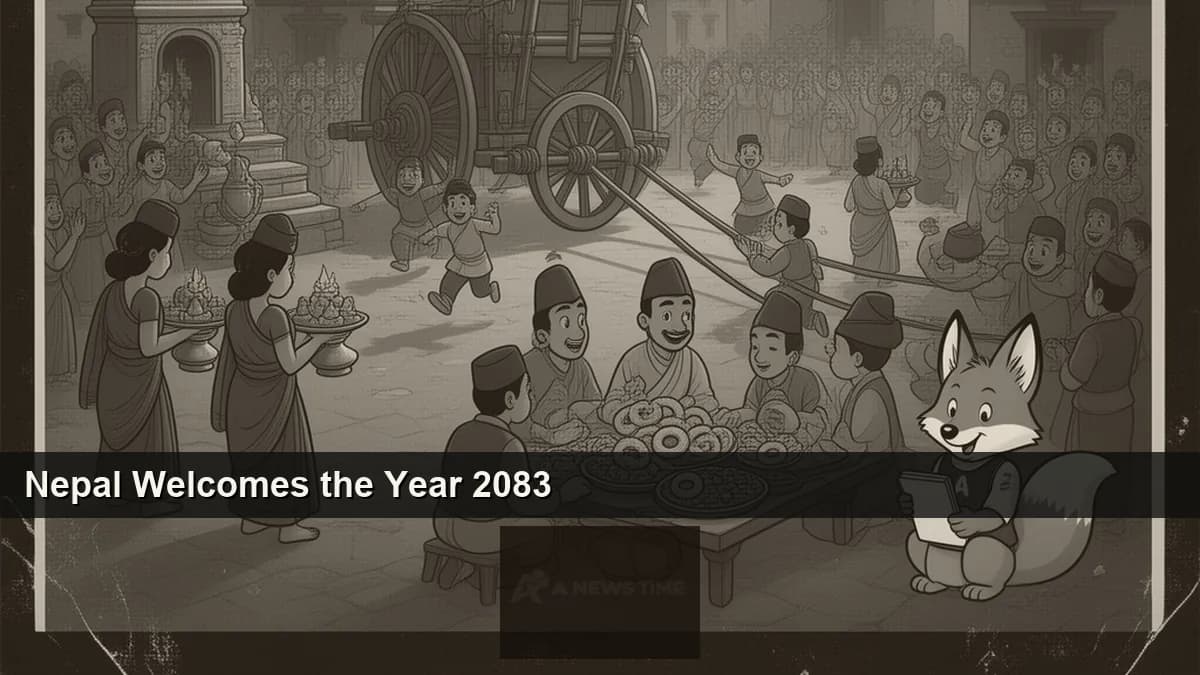
The first thing you notice in Bhaktapur on the morning of is the rope. It is thick, hand-laid, longer than a city block, and by sunrise it is already wet with dew and crowded with shoulders. Hundreds of men lean into it in two opposing tugs, a linen-draped chariot carrying the god Bhairav wobbling at the center like a wooden cathedral on wheels. Somewhere behind the chariot, a woman in a red sari is frying sel roti on a roadside burner, the batter hissing as it hits ghee, a perfect ring forming in seconds. This is the BS calendar turning over. Nepal's new year does not arrive quietly.
Across the country on Monday, Nepalis marked the arrival of the year 2083 in the Bikram Sambat calendar, the official civil calendar of Nepal. The day is known simply as Baisakh 1, the first of the month of Baisakh, and according to The Himalayan Times, the morning began with presidential messages, temple visits, community feasts, and the opening rites of the Bisket Jatra festival in Bhaktapur, one of the oldest continuously practiced new year celebrations in South Asia.
How the Bikram Sambat Calendar Works
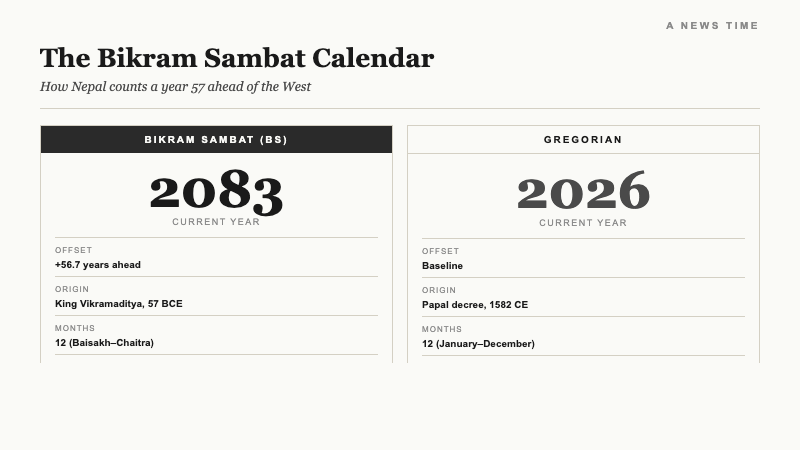
The Bikram Sambat calendar, abbreviated as BS, runs roughly 57 years ahead of the Gregorian calendar most of the world uses for business and travel. So when Americans and Europeans mark 2026, Nepalis are stepping into 2083. The offset is not a rounding error or a recent invention. It is the product of a solar calendar tradition attributed to the legendary King Vikramaditya, who, according to historical accounts collected by the English-language edition of Ratopati, is said to have inaugurated the era in 57 BCE to commemorate a military victory.
Unlike a lunar calendar, which tracks the phases of the moon and shifts against the seasons, Bikram Sambat is a solar calendar with twelve months that roughly track the sun's position. The months vary in length, the new year always falls in mid-April, and the year is counted from that ancient starting point rather than a religious birth date. Nepal officially adopted Bikram Sambat as its civil calendar in the early twentieth century. It shares linguistic roots with Hindi and Sanskrit calendrical systems and has cousins in parts of northern India, but within Nepal it is the calendar of record. Birth certificates, school enrollment, government notices, and the daily paper all run on BS first, Gregorian second.
Bisket Jatra in Bhaktapur
If there is one image that defines Baisakh 1 for outsiders, it is the Bisket Jatra, the chariot-pulling festival held in Bhaktapur, a medieval city in the Kathmandu Valley about nine miles east of the capital. The festival is older than the calendar change that put it on New Year's Day, and it has survived earthquakes, political upheaval, and a major restoration effort after the 2015 quake damaged parts of the old city.
According to NewsOnAir, the Bisket Jatra centers on two massive wooden chariots, one carrying the deity Bhairav and the other carrying the goddess Bhadrakali. Devotees pull the chariots through the narrow alleys and brick squares of Bhaktapur over several days, and the festival's rhythm is scored by dhime drums, brass horns, and the constant shouted coordination of the rope teams. A ceremonial tug of war between the eastern and western halves of the city determines which side claims bragging rights for the year.
Radio Nepal's coverage of the opening rituals, published in English translation on Monday morning, noted that Nepal's president and vice president had issued formal greetings to citizens at home and abroad, and that the Bhaktapur festival had opened with the traditional erection of a ceremonial pole known as the yasin, a lingam tree trunk that marks the start of the new year and is ritually felled as the festival closes.
The Sel Roti Question
Ask any Nepali where home tastes like, and there is a decent chance the answer will involve sel roti. It is the ring-shaped rice-flour doughnut that shows up at every major Hindu Nepali festival, from Tihar to weddings to, of course, the new year. The dough is made from soaked rice ground to a thick, pourable batter, sweetened lightly with sugar and sometimes perfumed with cardamom, banana, or ghee. You pour it into a pan of hot oil in a single spiraling stream, a gesture that takes years to get right, and the ring sets up in seconds into something crispy on the outside and almost cake-like within.
For Baisakh 1, families will often fry dozens of sel roti in the pre-dawn hours, setting them on cloth-lined plates for offerings at the household shrine before breakfast. The finished rings travel well, which is part of their longevity. They get packed into tiffins for the car, handed to neighbors, stacked on temple plates, and, these days, shipped by courier to Nepali households in the diaspora who cannot find them at the Asian grocer down the block.
There is no single correct sel roti. Recipes vary by region, caste, and family, and the argument over whose grandmother makes the best one is as fierce and as affectionate as any Italian argument over red sauce.
Samaybaji and the Newari New Year Table
In the Kathmandu Valley, and particularly among the Newar community that built much of Bhaktapur's old city, Baisakh 1 is not a sel roti holiday so much as a samaybaji holiday. Samaybaji is a ceremonial platter, served cold, that stitches together the staples of Newari cooking into a single composed plate. The centerpiece is chiura, pressed and beaten rice that looks a little like wide flakes of white cereal. Around it sits choyela, spiced grilled meat, often water buffalo or chicken, tossed with mustard oil, chili, garlic, and fenugreek. Black beans called bhuti, a piece of dried and fried fish or smoked meat, a wedge of boiled egg, a pickled vegetable, a slice of ginger, and sometimes a small cup of aila, a local rice liquor, fill out the platter.
A samaybaji plate is not just a meal. It is an offering, a history lesson, and a culinary index card of the valley all at once. Every element has a ritual meaning, and the composition traces back hundreds of years in Newar religious practice. When a Newar family in Patan or Bhaktapur sets out samaybaji on the morning of Baisakh 1, they are doing something a family in the same neighborhood was doing long before the Bikram Sambat calendar became the civil standard.
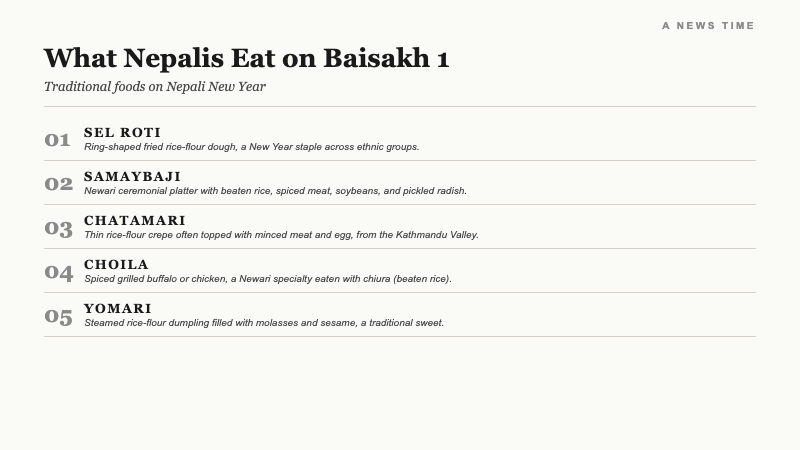
Alongside samaybaji, a Newari new year table might also include chatamari, a thin rice-flour crepe sometimes called Nepali pizza because of the toppings that can land on it, and yomari, a steamed dumpling of rice flour stuffed with molasses and sesame that is more closely associated with the winter festival of Yomari Punhi but makes occasional cameos at the new year table as well.
A Bhaktapur Perspective on the Festival
Scholars of Newar ritual have long argued that the Bisket Jatra has less to do with the calendar than with an agricultural and mythological logic older than any modern dating system. In a comment carried by Rising Nepal Daily's photo coverage, a cultural commentator framed the festival this way.
"For Bhaktapur, Bisket Jatra is not a new year festival that happens to involve chariots. It is a chariot festival that happens to fall at the new year. The meaning is in the rope, the crowd, and the pole, not in the date on the calendar."Cultural scholar quoted in Rising Nepal Daily, April 14, 2026
That distinction matters because it explains why the festival looks and sounds the way it does. There is very little pageantry imported from elsewhere. The costumes, the chants, the food stalls along the route, and the household rituals in the surrounding neighborhoods are all specific to the valley, and they have been refined over generations.
Bikram Sambat at a Glance
For readers outside Nepal trying to keep the calendars straight, here is a quick reference comparing Bikram Sambat and the Gregorian calendar most international readers use day to day.
| Feature | Bikram Sambat | Gregorian |
|---|---|---|
| Year in 2026 | 2083 | 2026 |
| Offset | +57 years (approximate) | baseline |
| New Year date | Baisakh 1 (mid-April) | January 1 |
| Type | Solar, with variable month lengths | Solar, with fixed month lengths |
| Origin | Attributed to King Vikramaditya, 57 BCE | Refined from Julian calendar, 1582 CE |
| Official use | Nepal (civil calendar) | Global business and international standard |
| First month | Baisakh | January |
The takeaway is simple. The Bikram Sambat calendar is not a novelty. It is a working civil system that governs everyday administrative life in Nepal, and Baisakh 1 is its equivalent of a combined New Year's Day and national cultural holiday.
Signature Baisakh 1 Foods
Here is a short field guide to the dishes most likely to appear on a Nepali table on Baisakh 1, with a note on where each comes from within the country.
- Sel roti: Ring-shaped rice-flour fried bread. Found across Nepal, central to Hindu festival tables, often exchanged as gifts among neighbors.
- Samaybaji: A composed Newari platter from the Kathmandu Valley, anchored by beaten rice and spiced meat, with ritual significance that predates the civil calendar.
- Chatamari: A thin rice-flour crepe, traditionally Newari, served with minced meat, vegetables, or egg on top.
- Choyela: Spiced grilled and tossed meat, typically water buffalo, served cold as part of samaybaji or as its own dish.
- Yomari: A steamed rice-flour dumpling with a sweet molasses and sesame filling, most closely tied to Yomari Punhi in winter but occasionally served in spring.
- Aila: A traditional Newari rice liquor used ritually in small cups, still brewed at home in parts of the Kathmandu Valley.
You can find many of these dishes at Nepali restaurants in the US and UK, though samaybaji in particular is often reserved for specific occasions and family events rather than menu staples. If you are looking for a way in, a good Newari kitchen in Queens or London will usually do a samaybaji platter for festivals by prior arrangement.
How Nepal's Diaspora Celebrates Baisakh 1
The Nepali diaspora is younger and smaller than the Indian or Chinese diasporas, but it has grown quickly over the past two decades. In the United States, Queens is one of the most visible hubs, with Nepali grocers, restaurants, and cultural associations clustered in neighborhoods like Jackson Heights and Woodside. Dallas has a large and well-organized community, Northern Virginia and the Washington DC suburbs hold steady numbers, and Los Angeles has a growing presence tied in part to university students and tech workers. In Europe, London is a center of Nepali life, with generations of families linked to the British Gurkha regiments.
On Baisakh 1, these communities tend to do a few things at once. Cultural associations host formal events, often in rented community halls or school gyms, with music, dance, and a buffet of Nepali food. Temples run special pujas. Families gather for meals at home or at a restaurant, and there is usually a bigger-than-usual rush on sel roti ingredients at Nepali grocers in the days leading up. Social media fills with photos of platters and rope pulls from back home. It is a day that functions as both a new year and a collective act of keeping in touch with a country that is many time zones away.
For readers who want to learn more about visiting the Kathmandu Valley, see our Kathmandu Valley travel coverage, which goes deeper on the region's festival calendar and temple etiquette.
What Is Different About 2083
Every Nepali new year arrives with its own local context, and 2083 is no exception. Nepal is still working through the long tail of post-earthquake restoration in Bhaktapur and the broader valley, and some of the monuments along the Bisket Jatra route have only recently reopened after years of scaffolding. The festival is also navigating the same pressures other cultural events face in 2026. More smartphones, more drones, more content creators in the crowd, and more international tourism returning after the pandemic years.
For the diaspora, there is a generational shift underway as well. The first wave of Nepali Americans and Nepali Britons who arrived in the 1990s and 2000s are now raising children in English-speaking contexts, and Baisakh 1 is increasingly a classroom event, not just a home event. Nepali language schools hold special days, and cultural organizations have started publishing bilingual explainers on the calendar, the festivals, and the food.
Food writers in the broader global food scene have also started to take Nepali cuisine more seriously in recent years, a trend we have covered in our broader global cuisine coverage. For context on which cities are leading in food and drink right now, including those with strong Nepali restaurant scenes, see our piece on Food and Wine's top global food cities.
The Calendar's Place in Modern Nepal
It is easy for outsiders to read Bikram Sambat as a piece of folklore, but that undersells it. In Nepal, BS is the date stamp on the electricity bill, the year on the driver's license, the schedule for public holidays, and the frame through which most people talk about the passage of time. Gregorian dates are also present, especially in international business and tourism, but BS comes first in most official documents. A Nepali colleague might mention that their child started school in 2080 BS the same way an American would say their child started school in 2023.
That parallel life gives Baisakh 1 a weight that a calendar change usually does not carry. It is not simply the start of a new tax year. It is the start of a year in a system that is living, present, and genuinely used. When a Bhaktapur family sets out samaybaji before dawn and a Queens community center opens its doors to Nepali neighbors that evening, they are marking the same day on the same working calendar.
What Comes Next on the Nepali Calendar
Baisakh 1 kicks off a year that is full of distinctive festivals, and the diaspora is already planning the rest of 2083. The biggest event on the Nepali calendar, Dashain, lands in October, a fifteen-day festival centered on family reunions, the goddess Durga, and the giving of tika, a rice-yogurt-vermilion paste that elders press onto the foreheads of younger relatives. Tihar, the five-day festival of lights, follows a few weeks later and includes days honoring crows, dogs, and cows, as well as the famous Bhai Tika ritual between siblings. In the valley, Indra Jatra, Gai Jatra, and the Krishna Janmastami celebrations all still draw crowds. On the Nepali table, that calendar translates into a rolling year of specific foods, and there is almost always something being fried, steamed, or offered.
For now, the rope teams in Bhaktapur are getting ready for the next stretch of Bisket Jatra. The sel roti in the household kitchens is probably almost gone. And the samaybaji plates are being cleared, one composed bite at a time, in homes from the Kathmandu Valley to Jackson Heights. It is the beginning of 2083. There are a lot more Baisakhs ahead.
Sources
- The Himalayan Times, Nepal New Year 2083 BS coverage
- Radio Nepal Online, Baisakh 1 presidential greetings and festival coverage
- English Ratopati, Today is New Year: Celebrating with Joy
- NewsOnAir, Nepal begins New Year celebrations with Bisket Jatra in Bhaktapur
- Rising Nepal Daily, Bisket Jatra photo feature and cultural commentary