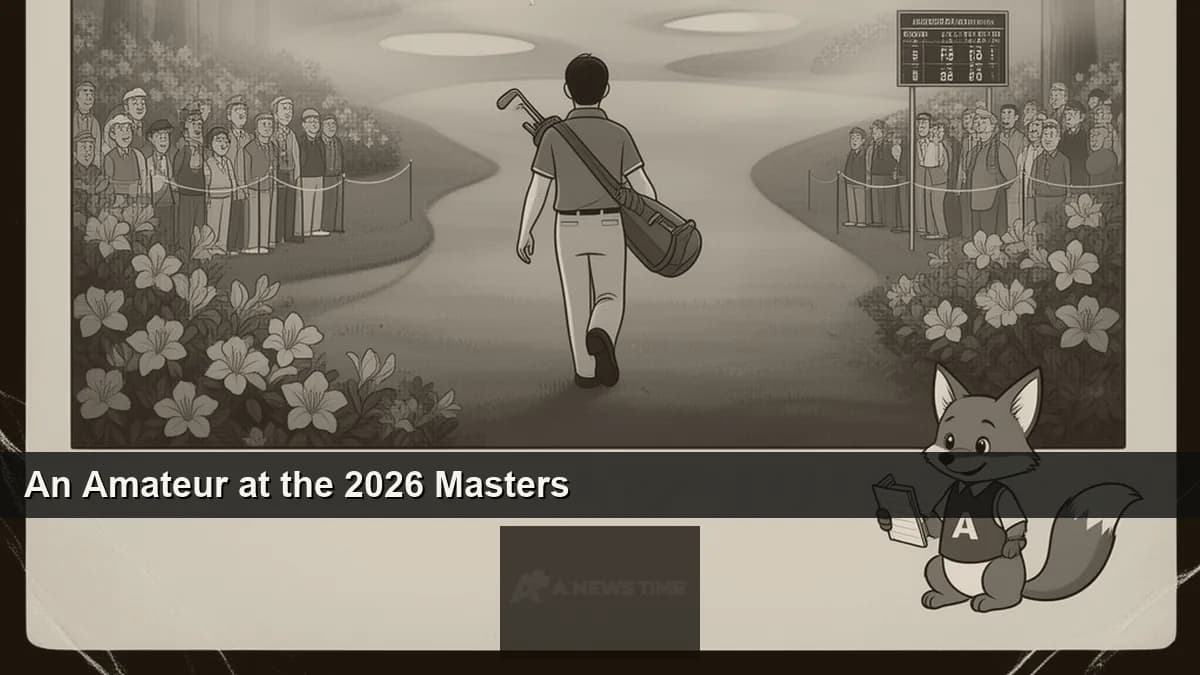
The first tee at Augusta National is quiet in a way no other tee box in golf is quiet. Pine needles muffle footfalls. Patrons whisper. A starter reads your name like he is introducing a surgeon. And on the morning of , one of the names read into that hush belonged to Brandon Holtz, a 39-year-old real estate agent who spends most of his weeks showing split-levels and negotiating closing costs, and who had just become one of the only amateurs in the 2026 Masters field.
Holtz is not a kid with a closet full of college trophies waiting for his inevitable turn on the PGA Tour. He is a mid-career adult with a day job and a mortgage, and in the eyes of The Athletic's Peak desk, which profiled him during Masters week, that is exactly why his story matters. The Peak vertical exists to write about the mental side of sports, and Holtz's week at Augusta offered a near-perfect case study: what happens when a person who does not compete for a living is dropped into a week that professionals train their entire adult lives to survive.
The Tee Shot That Started Everything
Holtz's first round at the 2026 Masters began the way every Masters round begins, with an opening tee shot down the left-to-right fairway of the first hole, a 445-yard par-4 officially named "Tea Olive." It is one of the most watched opening drives in the sport. The lane is narrow, framed by pines, and nerves routinely turn the hole into an early bogey for even the most seasoned touring pros. Holtz arrived on the tee paired with a fellow competitor, a caddie he had only recently started working with, and a gallery several layers deep.
Touring professionals describe this moment in well-worn language. They talk about trusting the routine, shrinking the world to the ball, controlling what they can control. Holtz, by his own account to The Athletic, had no such catalog of phrases to lean on. What he had was a swing he believed in, a family in his corner, and the honest realization that the scale of the week was going to test a part of him that his amateur career had never been forced to touch.
Who Is Brandon Holtz
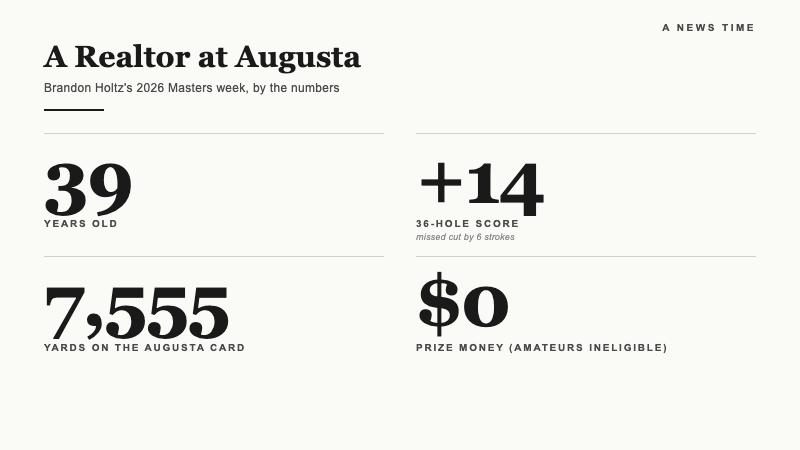
Holtz is, on paper, the kind of golfer who passes unnoticed at a crowded municipal driving range. He is 39 years old. He works full time as a real estate agent. He has a family, a client list, and a schedule that does not bend easily around tournament prep. He is not a club pro. He is not a touring pro who fell off the mini-tours. He is a competitive amateur who kept getting better while the rest of his life filled in around him, and who eventually played his way into the most exclusive field in golf.
This profile is common in the USGA's mid-amateur ranks, where the U.S. Mid-Amateur Championship exists specifically for golfers 25 and older who are not trying to make a living from the game. The Mid-Am winner has received an invitation to the Masters since 1989, and the Masters Tournament has long maintained a tradition of including amateur champions in its field. Whether Holtz arrived through that exact pathway or another amateur qualifying route, the effect is the same: a man whose inbox is full of purchase agreements spent a Thursday morning playing the same course as Scottie Scheffler.
How You Get to Augusta as an Amateur
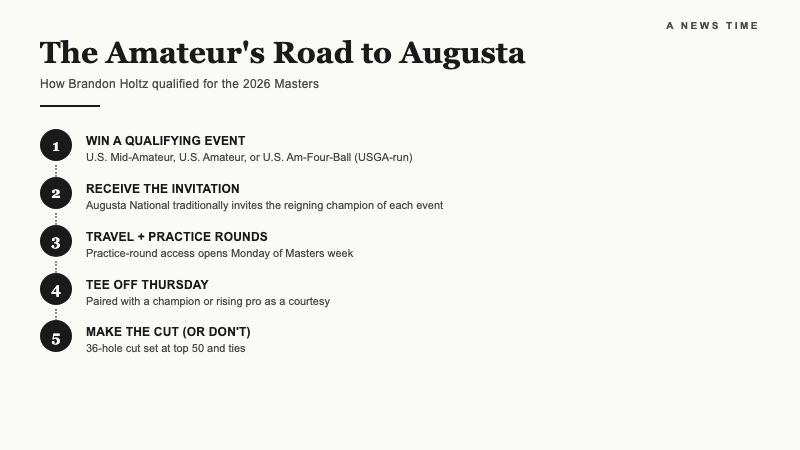
Most golf fans assume Masters invitations arrive by some combination of world ranking and tournament victories, and for most of the field, that is true. But Augusta National has always reserved spots for amateurs, and those spots represent several distinct and narrow doors.
- U.S. Amateur champion and runner-up: the traditional amateur pathway, open to any amateur in the United States or abroad who can qualify.
- U.S. Mid-Amateur champion: the door built specifically for older, working amateurs 25 and up, the category Holtz's profile most closely resembles.
- British Amateur champion: Augusta has honored the Royal and Ancient's amateur title holder for decades.
- Asia-Pacific Amateur and Latin America Amateur champions: tournaments Augusta National helped create to expand the amateur pipeline globally.
- NCAA Division I individual champion and the top amateur in the World Amateur Golf Ranking: added in recent years.
Each of those doors requires not just a hot week, but a season of hot weeks against players who, in many cases, are one decision away from turning professional themselves. The math is brutal. A working adult has to outplay college stars who treat golf as a full-time job, and then has to survive a match-play gauntlet where a single bad hole can end the run. Holtz's presence in the 2026 field, regardless of the exact door he walked through, is the product of a player who competed at that level while also showing houses.
The Mental Math of a 39-Year-Old at the Masters
The Athletic's Peak desk exists to take the mental side of sport seriously, and its profile of Holtz treats his week as a psychology story first and a golf story second. That reframing matters. When a touring pro misses a cut at Augusta, the story is a technical one: a balky driver, a cold putter, a bad read on a Sunday pin. When an amateur like Holtz steps into the same field, the variables stack differently. He is not only trying to execute shots. He is also trying to process an environment his nervous system has never encountered.
Holtz told The Athletic the week was "mentally exhausting," a phrase that sounds modest until you unpack what it covers. Sports psychologists who work with amateur qualifiers at majors routinely describe a specific cognitive load that professionals have largely automated away. The amateur has to think about where to stand during a playing partner's pre-shot routine. He has to think about how loudly to speak to his caddie in a silent gallery. He has to think about the pace of play on a course he is seeing at full tournament speed for the first time. He has to think about the cameras. He has to think about the fact that he is thinking about the cameras.
"Holtz told The Athletic that the experience of playing the 2026 Masters was mentally exhausting in a way he had not anticipated, and that the hardest part was not the shots he had to hit, but the volume of decisions stacked on top of every swing."Brandon Holtz, paraphrased from his interview with The Athletic's Peak desk
That is not the language of a player complaining about his draw. That is the language of a person describing sensory overload, and it is exactly the kind of honesty the Peak desk was built to surface.
The Day Job, The Dream Job
Part of what makes Holtz's story unusual is the unbridgeable gap between his ordinary Tuesday and his Masters Thursday. The players he walked past in the locker room had spent the previous week on manicured driving ranges with swing coaches, sports psychologists, strength trainers, and putting consultants. Holtz had spent the previous week, most likely, closing on houses. Scottie Scheffler earned more than 29 million dollars in on-course winnings over the 2024 PGA Tour season alone, a figure that captures how completely the modern touring pro is insulated from anything resembling an office calendar.
| Category | Brandon Holtz (amateur) | Typical Masters pro |
|---|---|---|
| Primary weekday activity | Showing homes, negotiating sales | Tournament play and practice |
| Dedicated swing coach | Occasional | Full-time on retainer |
| Sports psychologist | Rare | Standard in support team |
| Annual rounds in tournament conditions | Dozens at most | Well over one hundred |
| Caddie | Local or short-term hire for the week | Career caddie, years together |
| Financial stake in the result | None (amateur status) | Substantial prize money |
That table is not meant to diminish Holtz. It is meant to explain why his "mentally exhausting" framing is the only honest summary a person in his position could offer. The professionals in the field are not just better ball strikers. They are surrounded by infrastructure designed to make a week like Masters week feel ordinary. Holtz had to build his own scaffolding in real time.
The Mental Demands Holtz Faced
Sports psychologists who study major-championship performance point to a specific cluster of cognitive loads that hit hardest on debut. For an amateur, every one of them lands at once.
- Environmental novelty: the sound, scale, and pace of Augusta during Masters week are unlike anything in club or mid-am competition.
- Identity pressure: the player is representing not just himself, but every amateur who dreams of the same invitation.
- Media attention: interviews, cameras, and social feeds amplify every shot in a way amateurs rarely experience.
- Decision fatigue: club selection on unfamiliar greens, wind reads, pace-of-play awareness, and gallery management all stack across 18 holes.
- Comparison stress: walking the same fairways as Scheffler, Rory McIlroy, and Jon Rahm forces constant, involuntary self-assessment.
- Recovery load: after the round ends, the amateur cannot retreat to a pre-built routine the way pros do, which makes sleep and focus harder to rebuild.
None of those demands shows up on a scorecard. All of them shape one.
The Augusta Amateur Tradition
Augusta National's relationship with amateur golf predates the tournament as we know it. Bobby Jones, one of the club's co-founders, remained an amateur throughout his career, and the club has always positioned itself as a steward of amateur golf rather than a showcase exclusively for the paid class. The Silver Cup, awarded to the low amateur who makes the cut, is one of the most coveted unpaid prizes in the sport. Amateurs who have claimed it in recent memory include several players who went on to long, successful professional careers.
| Year | Low amateur / notable amateur storyline | Outcome |
|---|---|---|
| 2022 | Various collegiate invitees | Silver Cup awarded to the low amateur making the cut |
| 2023 | Sam Bennett, former U.S. Amateur champion | Widely celebrated amateur run, tied for low amateur honors |
| 2024 | Neal Shipley, U.S. Amateur runner-up | Named low amateur, played final round with Tiger Woods' grouping nearby |
| 2025 | Mixed amateur field of U.S. Amateur and international winners | Silver Cup claimed in a competitive amateur bracket |
| 2026 | Brandon Holtz, real estate agent and mid-amateur | Profiled by The Athletic's Peak desk on the mental cost of the week |
Placed in that company, Holtz's week is not an outlier. It is a continuation of a tradition, but with an important wrinkle: most of the players in the recent amateur column were college stars on a pre-professional track. Holtz is not. His day job is not a waypoint. It is his actual job, and he is going back to it this week.
What The Peak Desk Profile Actually Captures
The Athletic's Peak vertical has, over the last year, become a reliable home for this kind of story. It has written about the pressure on young stars like Lamine Yamal as they are asked to carry clubs at 17, and it has written about veterans navigating identity shifts after retirement. Holtz fits the desk's template because his story is almost purely a psychology story. The technical details of his rounds matter less than the texture of what he said after them.
Holtz's framing, as relayed in the Peak profile, emphasized the accumulation of micro-decisions rather than any single dramatic moment. He did not describe a meltdown. He did not describe a miracle. He described the experience of running a high-stakes cognitive task at full intensity for several consecutive days without the support structure that professionals rely on. That phrase, "mentally exhausting," may be the most honest thing any Masters participant said about the 2026 tournament.
Where This Story Ranks Among Amateur Masters Moments
Amateur storylines at the Masters tend to fall into two categories. The first is the college star on a glide path to the professional game, the player who will appear on tour inside 18 months and whose Masters debut is a preview of a career. The second is the anomaly: the older amateur, the dentist, the banker, the real estate agent, whose invitation is both the peak and the point. Holtz belongs to the second category, and his profile in The Athletic gives that category a voice it rarely gets.
It is a different kind of significance than the one attached to a rookie prospect's debut, and it deserves different language. This is not a fairy tale. Holtz worked for this. Amateur qualifying pathways are not lotteries. They are multi-year tournaments against deeply prepared competition. The meaning of his week is not that a "regular guy" showed up at Augusta. It is that a competitive amateur, working inside the limits of a full life, was good enough to earn a tee time that most pros never touch, and then was honest enough to describe what that tee time actually cost him.
That honesty is what the Peak desk was built to capture, and it is why the story reached an audience outside of golf. Readers who would not be able to name the 2026 champion a month from now will remember the man who said the hardest part of his Masters was the volume of decisions, not the distance of the putts.
What Comes Next for Holtz
Holtz will return to his regular life this week. Showings will resume. Clients will email. The Augusta scorecards will be framed somewhere, and the caddie bib will be folded into whatever drawer amateur mementos go into. He has said, in the Peak profile and in follow-up coverage, that he has not decided what his competitive schedule looks like beyond the summer's mid-amateur and state events. Most mid-ams return to the events that built their games in the first place: state opens, regional mid-am championships, and the qualifying rounds for the U.S. Open and the U.S. Amateur. That is the most likely next chapter.
Whether or not he returns to Augusta, Holtz's week has already kicked off a broader conversation. Coaches, psychologists, and fellow mid-amateurs have used the profile as a point of reference when talking about how to prepare working adults for major-championship pressure. It is the kind of conversation The Athletic was hoping to start by sending its mental-performance desk to cover an amateur in the Masters field, and it has spilled outside of golf into the wider "what sports actually ask of the people who play them" discussion that has shaped much of the outlet's best recent work, including pieces that sit alongside coverage of this year's WNBA Draft moment and other stories where the mental game is the real story.
The next time a 39-year-old real estate agent walks up the first fairway at a major, he will do so with a little more language available to him. That is a small improvement, but it is the kind the Peak desk exists to make possible, and it is a better legacy for Holtz's week than any number on a leaderboard would have been.
Sources
- The Athletic: Brandon Holtz, the real estate agent at the 2026 Masters (Peak desk)
- Masters.com: Official Masters Tournament information and amateur tradition
- USGA: U.S. Mid-Amateur Championship overview and qualification
- USGA: U.S. Open championship information
- The Athletic: Peak desk coverage of young stars and pressure (Lamine Yamal)