
One hundred and forty-plus submissions from 28 countries. A judging panel that includes former education ministers, practicing classroom teachers, and EdTech investors who have collectively funded hundreds of learning technology companies. A shortlist that reads like a map of where educational technology is actually moving in 2026, rather than where conference keynotes say it should be moving.
The EdTech Innovation Hub (ETIH) has published its Innovation Awards 2026 shortlist, and the picture it paints is both energizing and clarifying. AI is everywhere, as expected. Workforce learning is ascendant, as projected. But the most striking signal from this year's shortlist is geographic: the center of gravity for innovative EdTech development is shifting, and the companies doing the most compelling work on real-world learner outcomes are as likely to be based in Nairobi or Manila as in San Francisco or London.
What the ETIH Awards Measure
The EdTech Innovation Hub bills itself as an independent research and advocacy organization focused on educational technology's impact on learning at scale. Its annual awards process is distinctive within the crowded field of EdTech industry recognition events for its explicit emphasis on documented outcomes rather than technological novelty. Entries are evaluated not primarily on what a product does technically but on what it demonstrably achieves for learners -- completion rates, knowledge retention, employment outcomes, and the kinds of durable skill development that persist beyond a single course or credential.
This outcomes-first framing makes the ETIH awards useful as a temperature reading of the industry in ways that more feature-focused awards programs are not. The companies that make the shortlist have survived an evaluation process that asks hard questions about whether the technology is working for the people it is supposed to serve. That filter is valuable in a sector that is often long on innovation claims and short on rigorous impact evidence.
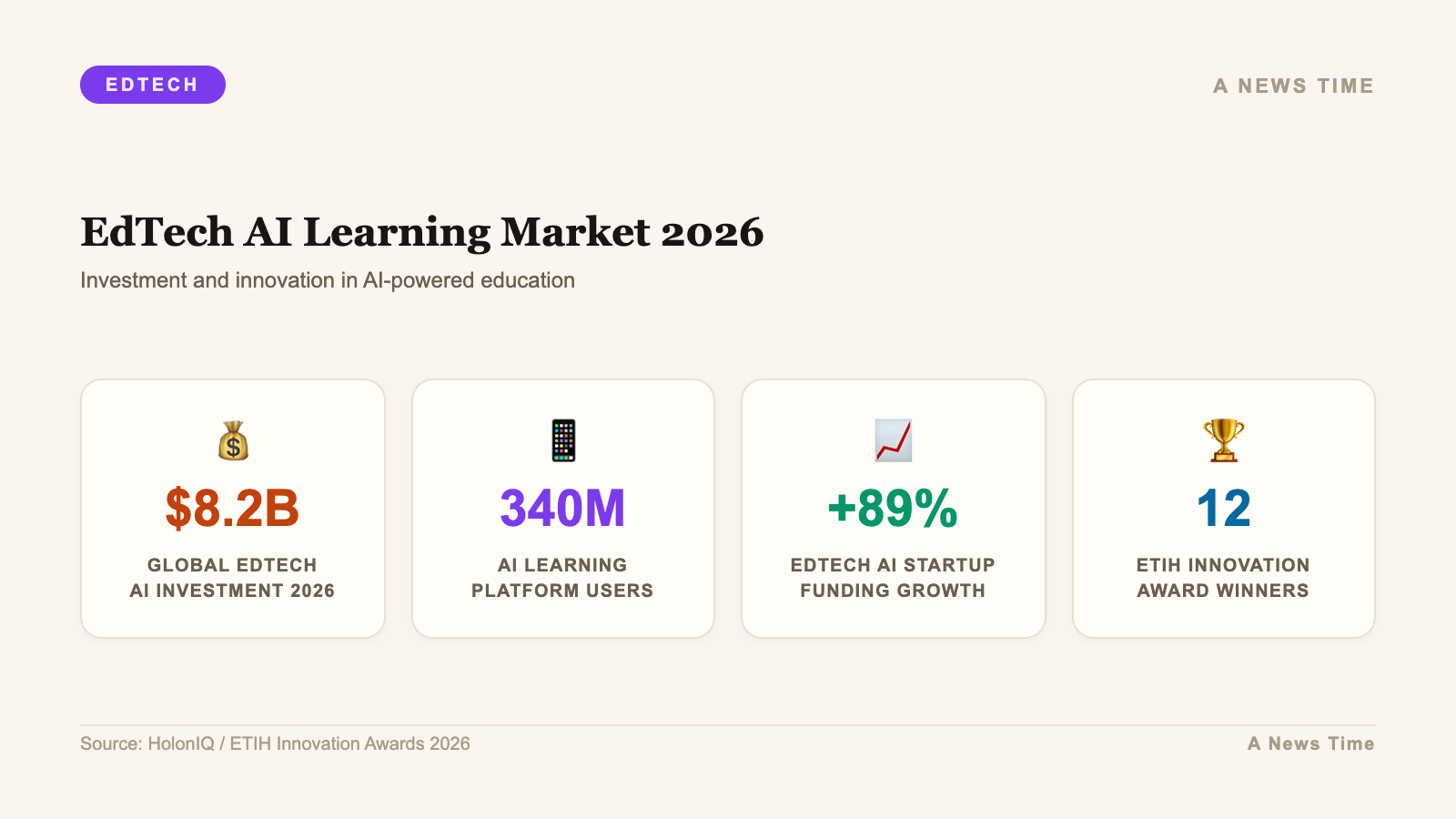
The 2026 awards cycle opened for submissions in November 2025 and received 142 entries by the January closing date, a significant increase from the 97 entries in the 2024 cycle. The ETIH's evaluation team attributes the growth to two factors: increasing global awareness of the awards within the EdTech investment community, and a general industry recognition that demonstrating measurable impact has become a competitive differentiator as institutional buyers -- school systems, governments, and employers -- have grown more sophisticated in their procurement criteria.
AI Dominates the Shortlist, but Not as a Buzzword
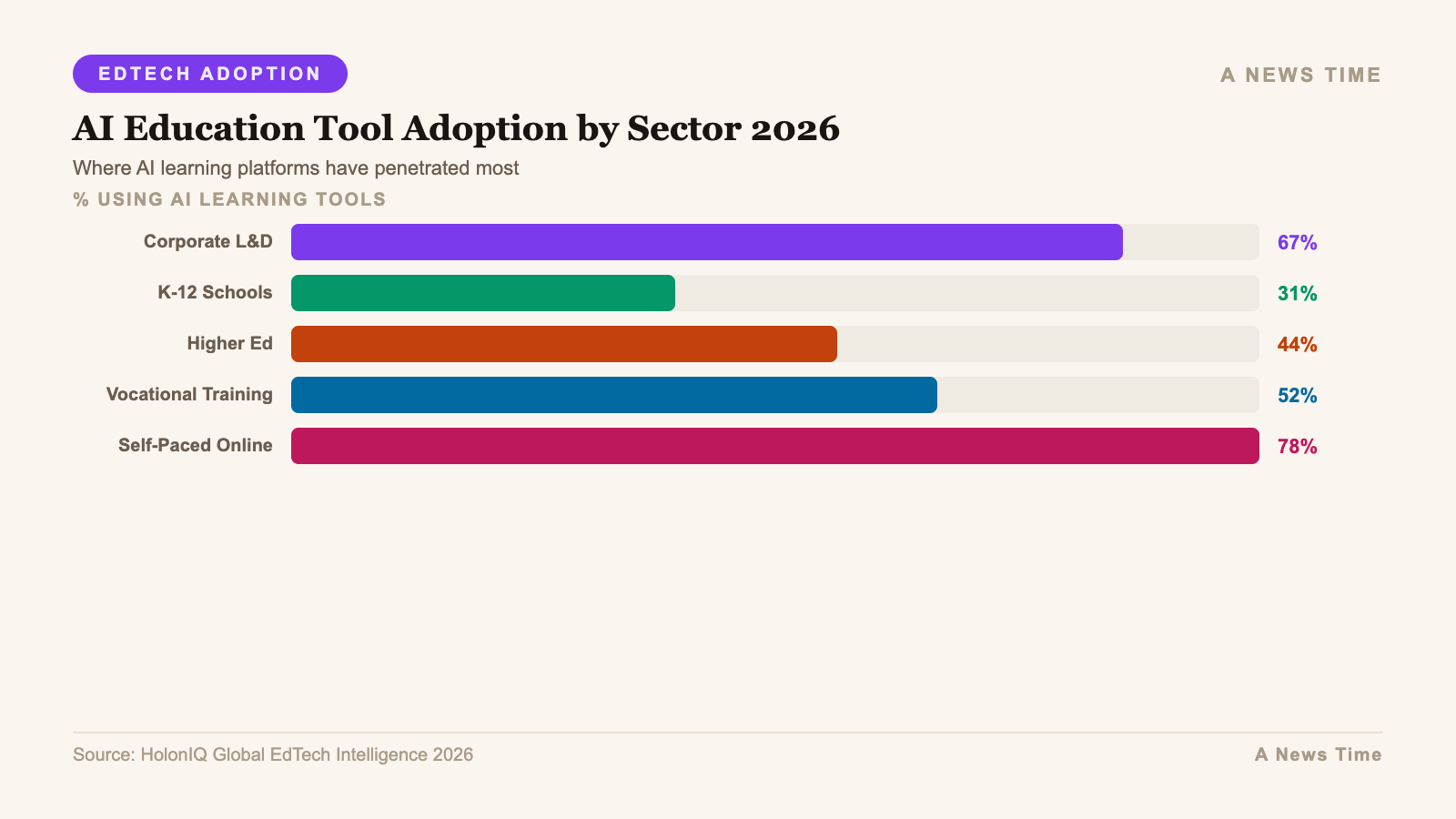
Artificial intelligence appears as a component of the majority of shortlisted entries, but the way it appears is telling. The AI applications that made the shortlist are predominantly deployed in adaptive learning personalization, automated feedback systems, and language accessibility features rather than in the more speculative AI tutoring and AI teacher replacement applications that have generated the most media coverage over the past two years.
Several shortlisted companies are using AI to solve a problem that has historically been the Achilles heel of digital education at scale: the identification of learners who are struggling before they disengage entirely. Traditional learning management systems generate enormous amounts of behavioral data -- time-on-task, click patterns, assessment performance -- but extracting actionable early warning signals from that data has required either expensive human review or simplistic rule-based alerts that generate too many false positives to be operationally useful. Several shortlisted tools use large language models trained on learning behavior datasets to produce significantly more accurate early intervention triggers.
One shortlisted platform from a South African company has deployed this approach across a network of 340 secondary schools, reducing course dropout rates by 31 percent in a two-year pilot. Another, developed by a consortium of Southeast Asian universities, uses the same basic architecture to identify university students at risk of failing to complete their degree programs in time, connecting them with peer tutors and academic advisors based on predicted need rather than waiting for students to self-identify. These are not glamorous applications, but they are the kind of quiet infrastructure improvements that determine whether EdTech actually changes educational outcomes at the system level.
Workforce Learning Takes the Lead
If AI personalization is the dominant technical theme of this year's shortlist, workforce learning and upskilling is the dominant programmatic one. Of the 38 companies that made the final shortlist, 22 operate primarily in the corporate or continuing education space rather than in K-12 or higher education. That proportion represents a meaningful shift from previous ETIH award cycles, in which formal education applications had typically commanded a larger share of the finalists.
The shift reflects both where the investment has been flowing and where the demonstrable demand exists. Corporate training budgets, which contracted sharply during the pandemic years and remained depressed through 2023, have recovered strongly in 2025 and 2026 as employers have recognized that the AI-driven restructuring of the labor market requires continuous skills development rather than periodic credential acquisition. The companies building tools for this market are increasingly sophisticated in their understanding of adult learning psychology, organizational change management, and the specific ways in which workplace learning differs from academic learning.
One shortlisted company that has attracted particular attention from the judging panel is a UK-based platform focused on skills-based learning pathways for mid-career workers in the healthcare sector. Its model uses a combination of competency mapping, AI-guided content curation, and cohort-based peer learning to reduce the time required for professional upskilling by approximately 40 percent compared to traditional continuing education programs. The platform has been adopted by 11 NHS trusts and three major private hospital networks, giving it a real-world scale that most EdTech companies at the shortlist stage lack.
Geographic Diversity as a Signal
The geographic spread of the 2026 shortlist is genuinely notable. Previous ETIH award cycles have been dominated by North American and European entries, reflecting where the bulk of EdTech investment capital has historically concentrated. This year's shortlist includes companies from Brazil, Indonesia, Kenya, Nigeria, the Philippines, Pakistan, and Rwanda alongside the expected concentration from the US, UK, and India.
The African representation is particularly significant. Sub-Saharan Africa has one of the world's youngest and fastest-growing school-age populations, and the educational infrastructure challenges it faces -- teacher shortages, limited physical facilities, unreliable electricity -- have historically made technology adoption difficult and expensive. The companies on this year's shortlist that operate in African markets have built specifically for those constraints: low-bandwidth content delivery, offline-first architecture, feature phone accessibility, and teacher support systems designed for under-resourced school environments.
A Rwanda-based company shortlisted in the infrastructure innovation category has built a micro-learning platform that delivers curriculum-aligned content via SMS and basic USSD codes, making it accessible on any mobile network without requiring smartphone ownership or data connectivity. Its pilot deployment covers 41,000 secondary school students across rural Rwanda with documented learning outcome improvements across national examination cohorts. This is EdTech problem-solving that looks nothing like what Silicon Valley produces, and it arguably addresses a more pressing educational need.
The AI Literacy Category
New for 2026, the ETIH added an AI Literacy award category to recognize tools and programs explicitly focused on helping learners at all levels understand, use, and critically evaluate artificial intelligence. The category received 23 entries, the highest number for any new category in the awards' history, and the shortlisted finalists span the full educational spectrum from elementary school to corporate professional development.
The creation of the category reflects a judgment call by the ETIH that AI literacy is no longer a niche or advanced subject but a foundational competency for participation in the 21st century economy. Its inclusion also signals an acknowledgment that educational systems globally have been slow to incorporate AI literacy into mainstream curriculum, leaving the work to specialized programs and extracurricular initiatives that serve only a fraction of the students who need this preparation.
Several of the shortlisted AI literacy programs take approaches that challenge the assumption that AI education requires expensive technology access. A Philippines-based nonprofit shortlisted in this category delivers a six-week AI literacy curriculum through community facilitators in barangays without reliable internet access, using printed materials and facilitated discussion rather than software tools. Its learner outcomes data, collected through pre and post-program assessments, shows knowledge retention rates comparable to technology-mediated programs at a fraction of the cost per learner.
What the Judging Panel Is Looking For
The ETIH has published a detailed framework describing how the judging panel will weigh the shortlisted entries against each other in the final evaluation. The framework places evidence of real-world impact at 40 percent of the overall score, with secondary weightings for scalability potential (25 percent), equity and accessibility (20 percent), and innovation quality (15 percent).
This weighting structure is deliberately conservative in its treatment of innovation as a standalone value. An EdTech product can be technically sophisticated, pedagogically novel, and beautifully designed while failing to improve learning outcomes at the scale and consistency that the ETIH's framework demands. The panel's composition reinforces this emphasis: in addition to EdTech investors and technology experts, the panel includes four practicing educators, a government education policy advisor, and two researchers specializing in educational measurement and evaluation.
The panel chair, a former education minister from Finland whose country's educational system is among the most studied in the world, has described the evaluation process as "deliberately uncomfortable for companies that have great products but weak evidence." That discomfort, she suggests, is precisely the point: the industry needs evaluation frameworks that force the discipline of outcome measurement rather than rewarding the appearance of innovation without the substance of impact.
The Bigger Picture for EdTech in 2026
The ETIH Innovation Awards shortlist is one data point in a broader EdTech landscape that remains genuinely unsettled. The investment boom of 2020 and 2021, driven by pandemic-era demand, was followed by a significant correction in 2022 and 2023 that forced consolidation, layoffs, and business model pivots across the sector. The companies that survived that correction and are now on the ETIH shortlist have generally emerged with more disciplined product development processes, clearer revenue models, and stronger outcome evidence than the cohort that attracted capital during the boom years.
The sector is also navigating a more complex regulatory environment. The EU's AI Act, which took effect in staged phases beginning in 2025, imposes specific requirements on AI-powered educational systems including transparency obligations and human oversight requirements that have forced significant product redesign at several companies. Compliance costs have been particularly challenging for smaller EdTech companies operating across multiple markets, and the regulatory environment has accelerated consolidation in the European market as smaller players have merged or been acquired by larger companies with compliance infrastructure already in place.
For further context on the broader workforce development picture and its implications for educational technology demand, see our piece on decision education in the AI economy and Larry Fink's assessment of AI's impact on the class of 2026.
Winners to Be Announced in May
The ETIH Innovation Awards 2026 winners will be revealed at the organization's annual Global Summit in London in late May. The summit brings together approximately 800 EdTech leaders, investors, educators, and policy makers for two days of programming that uses the awards as an anchor for broader conversations about the direction of educational technology development.
Past ETIH award winners have shown a reasonably strong track record of subsequent commercial success and policy influence. Several previous winners in the workforce learning and online access categories have gone on to significant funding rounds and government-scale deployments that might not have happened without the credibility signal the award provided. For companies operating in a sector where distinguishing genuine impact from marketing claims is genuinely difficult, that signal has real value.
The 2026 shortlist suggests that the best work being done in educational technology right now is neither the most headline-grabbing nor the most expensively capitalized. It is practical, evidence-grounded, built for the learners who most need it, and increasingly coming from places the industry has historically overlooked. If the judges do their jobs well, the winners in May will make that reality visible to an audience that has the resources and motivation to act on it.