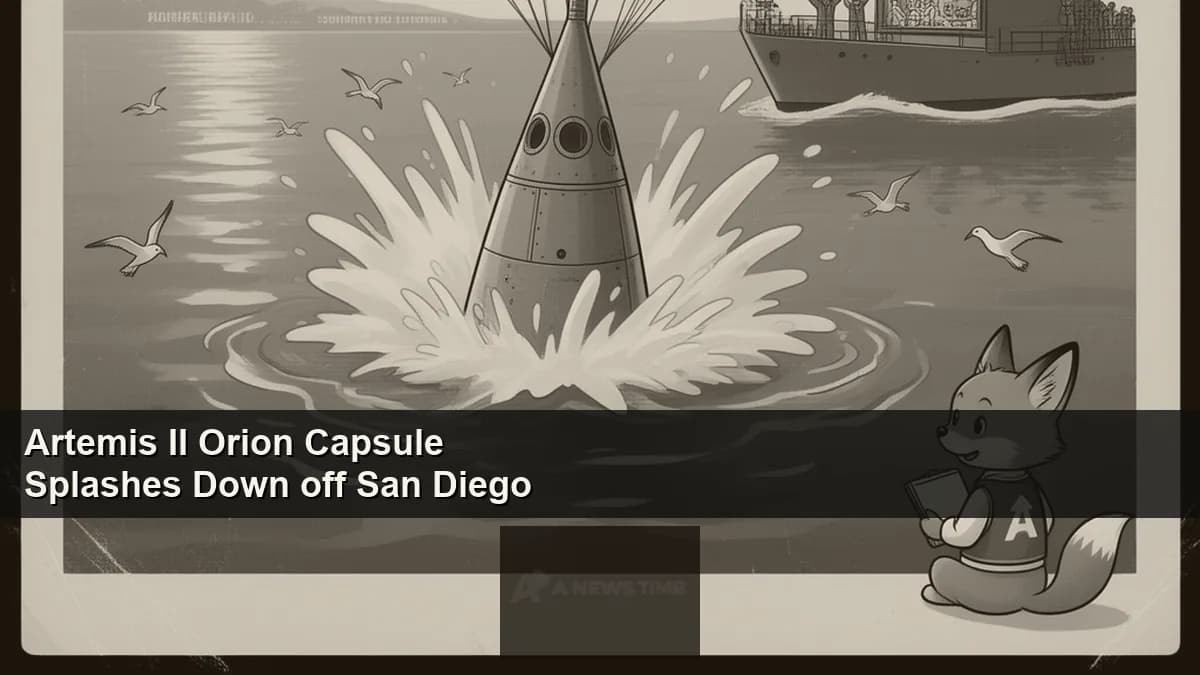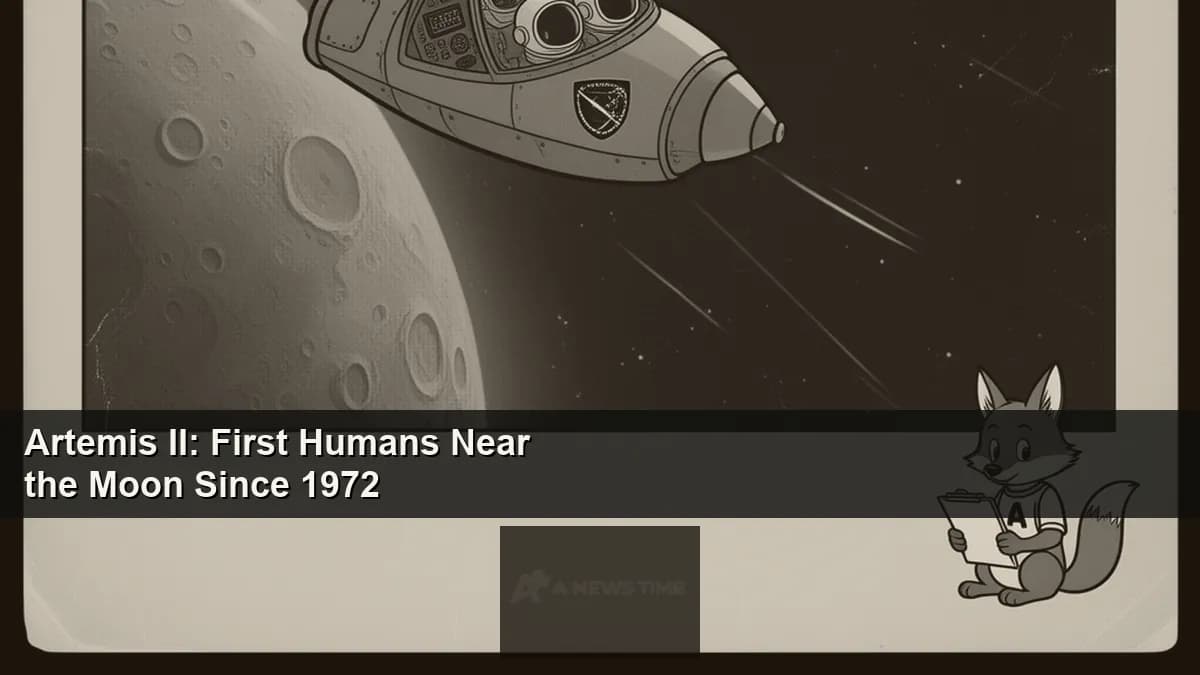
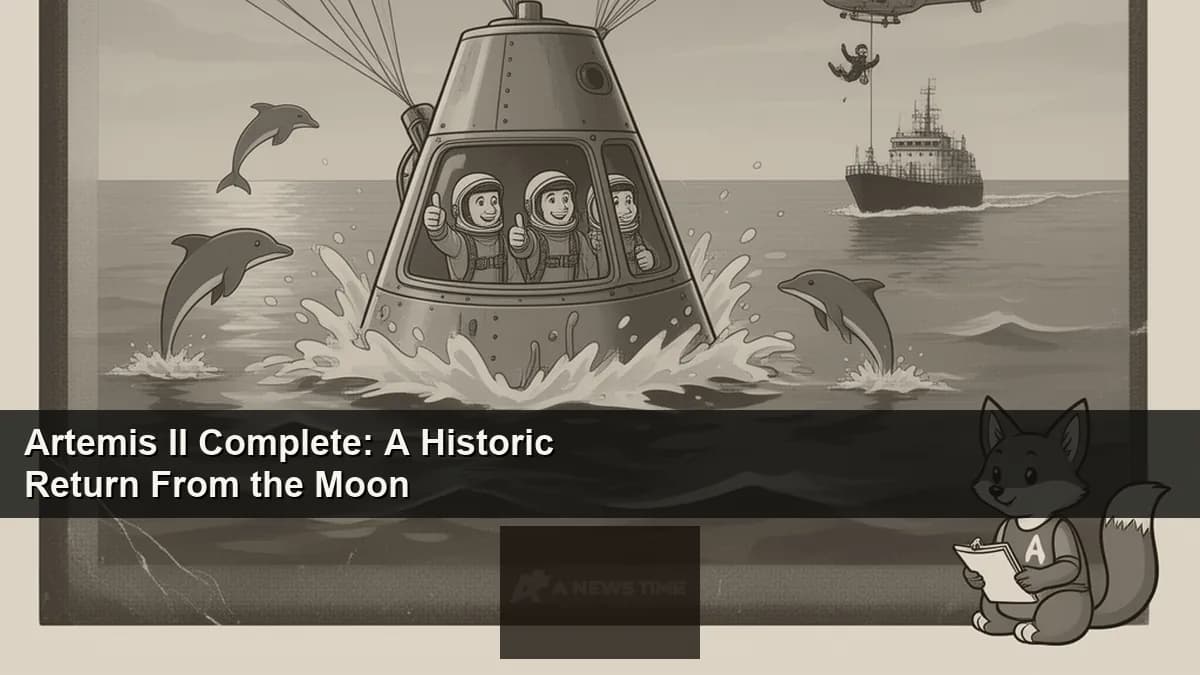
When Commander Reid Wiseman radioed "four green crew members" from inside a bobbing Orion capsule off the California coast on , he was not just reporting a safe splashdown. He was closing a 54-year gap in human history. The crew of Artemis II had traveled farther from Earth than any human being ever had, looped around a Moon that most of them had only ever seen from the ground, and come home. For the first time since the last Apollo astronauts returned in December 1972, the words "crewed lunar mission: complete" can be written without a question mark.
The nine-day, nine-hour journey began on , when SLS lifted off from Kennedy Space Center in Florida, carrying Wiseman, Pilot Victor Glover, and Mission Specialists Christina Koch and Jeremy Hansen on a free-return trajectory around the Moon. It ended with a parachute-assisted splash into the Pacific Ocean roughly 960 kilometers off the California coast. Between those two events, the four astronauts generated enough scientific data, engineering validation results, and genuinely surprising observations to keep researchers occupied for years.
The Numbers Behind a Record-Breaking Voyage
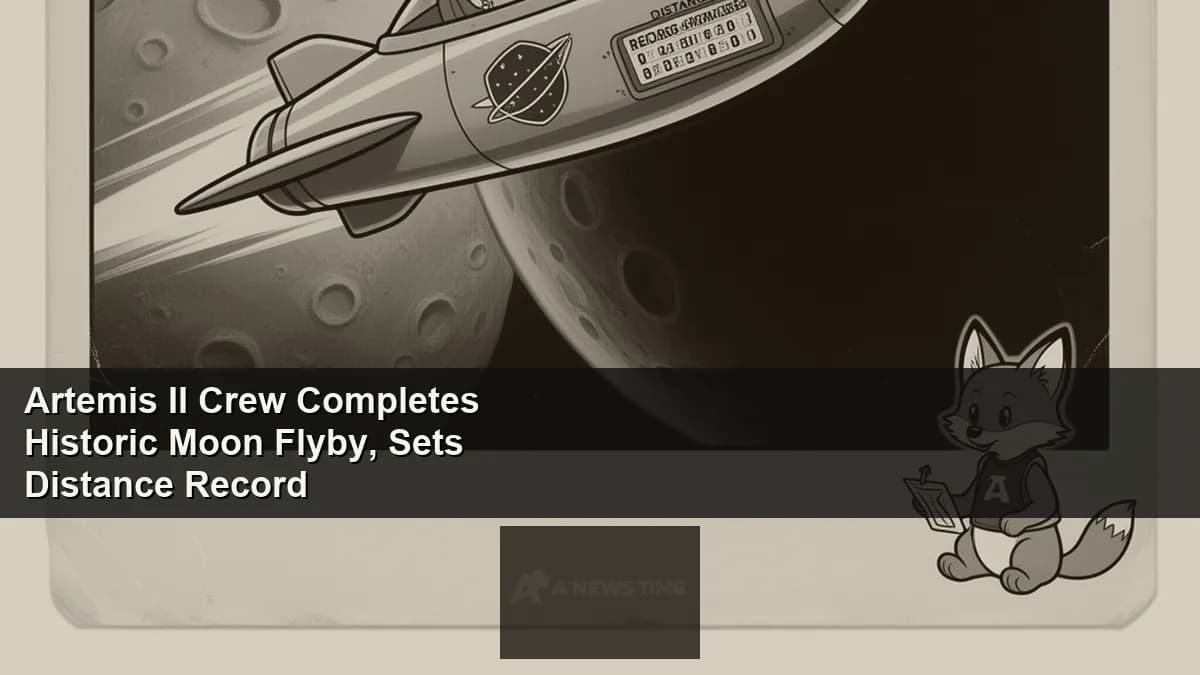
Scale is hard to hold in the mind when it comes to space travel. Here is one way to think about the distance Artemis II covered: if you could drive a car from New York City to Los Angeles and back without stopping, repeating that trip roughly 72 times, you would cover the same distance the Orion capsule reached at its farthest point from Earth. At 406,771 kilometers (252,755 miles), the crew surpassed the previous human distance record, set by the crew of Apollo 13 in April 1970, when a mid-mission oxygen tank explosion forced Jim Lovell, Jack Swigert, and Fred Haise on an unplanned deep-space detour. That record stood for 56 years. It no longer does.
| Metric | Artemis II (2026) | Previous Record / Benchmark |
|---|---|---|
| Peak distance from Earth | 406,771 km (252,755 mi) | Apollo 13: 400,171 km (248,655 mi) in 1970 |
| Mission duration | ~9 days, 9 hours | Apollo 17 (last crewed lunar): 12 days, 14 hours |
| Crew size | 4 (3 NASA, 1 CSA) | Apollo missions: 3 per flight |
| Closest lunar approach | ~6,545 km (4,067 mi) | Free-return trajectory, no orbit insertion |
| Splashdown location | Pacific Ocean, off California | Apollo 17: Pacific Ocean, off Samoa |
| Years since last crewed lunar mission | 53 years, 4 months | Apollo 17 returned December 19, 1972 |
Jeremy Hansen, the Canadian Space Agency astronaut aboard the mission, became the first Canadian in history to travel beyond low Earth orbit. That distinction matters not just for national pride but as a demonstration of the international coalition NASA has built for the Artemis program. If human spaceflight is going to become genuinely sustainable, it cannot rest on a single nation's political will alone.
What the Mission Was Actually Testing
Artemis II was never intended to be a science mission in the traditional sense. Its primary job was validation. Every system aboard Orion that will keep astronauts alive on future lunar landings, the life support hardware, next-generation spacesuits, and radiation monitoring equipment, needed to prove itself in actual deep-space conditions rather than on Earth simulators. The mission passed those tests.
NASA's Artemis science lead, Kelsey Young, was careful to frame expectations before the mission flew. In a pre-flight briefing, she described Artemis II as "reconnaissance for future landed missions" rather than a primary research vehicle. But what the crew found during the flyby exceeded those modest expectations, particularly in three areas: visual observations of the lunar surface from crewed perspective, impact flash detection, and the discovery of an earthshine effect that nobody had fully anticipated.
The Moon as a Sponge: Earthshine and a Design Problem
Of all the scientific surprises from Artemis II, the earthshine finding may have the most immediate practical consequence for future mission planning. When Earth and the Moon were simultaneously visible through Orion's windows, the sunlight reflected from Earth was bright enough to completely wash out the subtle color variations on the lunar surface that the crew was trying to photograph and describe. Mission Specialist Christina Koch put it in terms that needed no scientific translation.
"As soon as the Earth got close enough to be in my field of view to take them both in at the same time, the moon dulled, it turned into a sponge, it's almost like it went matte."
Christina Koch, NASA Mission Specialist, post-splashdown debrief
The earthshine was so intense through one of Orion's windows that the crew improvised a solution, covering the window with a spare shirt to reduce the glare. It worked, but only in the way that duct tape works: it solved the immediate problem while flagging a real engineering gap. NASA engineers are already considering dedicated window shades as a design requirement for future crewed lunar vehicles. The issue will matter even more for astronauts attempting precision surface observation during Artemis III and beyond.
The surface itself, though, rewarded careful looking. From a distance, the Moon reads as a uniform gray. But Wiseman, Koch, Glover, and Hansen reported seeing green, brown, and orange hues in the regolith as they flew across its face. These variations carry geochemical information. Different mineral compositions scatter and absorb light differently, and trained eyes reporting those variations in real time, correlated with their spacecraft position, can give geologists data that orbital cameras alone cannot fully capture.
"These ultimately get at chronology of the solar system, at how the inner solar system has evolved over time, which connects to the moon being the witness plate for our planet."
Kelsey Young, NASA Artemis Science Lead, April 7 press conference
Impact Flashes and a Solar Eclipse Seen Only From the Moon
Two other scientific observations from Artemis II stand out. The first: the crew witnessed a solar eclipse that no human being has ever seen before and very few would ever be positioned to see again. When the spacecraft passed behind the Moon, the Sun appeared slightly smaller in the sky than the lunar disk, something that never happens from Earth's surface, where the sizes appear nearly identical. The Sun vanished behind the lunar horizon, and for a few minutes the four astronauts floated in a darkness lit only by the far galaxy.
Commander Wiseman later described the experience in distinctly human rather than technical terms.
"The eclipse occurred, and then we had 5 minutes of human emotional reaction to staring at that orb floating in the vastness of space. Then right after that, somebody in the cabin said, 'Let's look for impact flashes,' and immediately we saw one or two or three."
Reid Wiseman, Artemis II Commander, post-splashdown debrief
Impact flashes, the brief sparks of light produced when meteorites strike the Moon's unlit surface, are one of the few ways researchers can estimate how frequently projectiles hit the lunar surface in real time. That data matters for engineering. Every future habitat, rover, and astronaut suit deployed on the Moon will face bombardment from incoming micro-meteorites. Understanding the statistical rate of strikes helps mission planners set the right tolerances for structures and equipment. The Artemis II crew observed what appeared to be multiple flashes during the few minutes they spent watching the darkened lunar surface, adding directly to the observational dataset.
| Observation Type | What Was Found | Why It Matters |
|---|---|---|
| Lunar surface color | Green, brown, orange hues at close range | Mineral composition mapping, landing site selection for Artemis III and IV |
| Earthshine effect | Earth's reflected light overwhelmed lunar surface detail | Requires dedicated window shades on future missions |
| Lunar solar eclipse | Sun appeared smaller than Moon, full occultation | First crewed observation of this geometry, emotional and scientific data |
| Impact flashes | 2 to 3 possible flashes observed on darkened surface | Real-time meteorite impact rate estimation for surface engineering |
| Far-side terrain | Regions observed directly by humans for the first time | Visual reconnaissance for areas never seen in direct human observation |
What This Means for the Road Ahead
The success of Artemis II does not guarantee the success of what follows, and it is worth being precise about that distinction. The mission validated the Orion spacecraft and SLS rocket as a functional crewed vehicle capable of reaching lunar distances and returning the crew safely. It did not test lunar orbit insertion, docking with a lunar lander, or surface operations. Those remain unproven, and two of them will need to work on the first attempt if the Artemis IV Moon landing in 2028 is going to happen on schedule.
The next mission, Artemis III, is currently planned for 2027. In a significant departure from earlier program design, Artemis III will not visit the Moon at all. Instead, it will test Orion's ability to dock with a lunar lander in Earth orbit, validating the rendezvous and docking procedures that will be critical for the surface landing. The reconfiguration reflects a broader shift at NASA under the current administration, prioritizing a modular, step-by-step testing approach over milestone-by-milestone lunar visits.
Artemis IV, the planned crewed landing, is targeting 2028. If it succeeds, human beings will stand on the Moon for the first time since Harrison Schmitt and Gene Cernan left the lunar surface on December 14, 1972. The gap between that last footprint and the next one will then be more than 55 years. Whether the landing happens on schedule will depend on the performance of the SpaceX Human Landing System, the pressurized suit systems still in development, and the political continuity of NASA's funding over the next two budget cycles.
For anyone who wants to understand what a sustained lunar presence would look like in practice, consider where international competition now sits. NASA's pivot toward a surface lunar base rather than an orbital station places it on a conceptual collision course with China's Chang'e program, which has similar aspirations for the lunar south pole. Both programs regard the ice deposits in permanently shadowed craters near the poles as the resource that makes permanent habitation viable. Water can be split into hydrogen and oxygen, which means rocket fuel. The nation that figures out sustained polar operations first will hold a significant strategic advantage in deep-space logistics.
Fifty-Three Years Is a Long Time to Wait
The cultural weight of Artemis II is not easily separated from its technical accomplishments. There is a generation of people now in their 50s who grew up expecting to see humans on Mars by the time they were adults. There are engineers in their 30s who chose aerospace careers partly because they believed they would work on missions to lunar bases or asteroid mining operations within their professional lifetimes. The gap between Apollo and Artemis has been a source of genuine frustration in the scientific community, not just nostalgia.
What Artemis II provides, beyond its engineering data and its science observations, is evidence that the gap is actually closing. The images from the mission, the crew photographs of Earth hanging over the lunar limb, the accounts of the solar eclipse, the descriptions of a Moon that looks different up close than it does through a telescope, these have entered the public record in a way that orbital imagery never quite achieves. Humans in space, describing what they see, changes how other humans think about what is possible.
Kelsey Young captured something important when she described the lunar observations made by the crew in terms of the Moon serving as a "witness plate" for the inner solar system. Every crater, every mineral variation, every layer of regolith preserves a record of what the solar system was doing when it formed. The Moon does not have weather. It does not have plate tectonics. Things that happened 4 billion years ago are still sitting on its surface, waiting to be read. Every human mission that gets eyes close to that surface adds resolution to a picture that science has been trying to reconstruct for decades.
For more on the science of the Artemis II lunar flyby and the far-side observations made on April 6 through 8, see our earlier deep-dive into the mission's scientific objectives.
What We Still Don't Know
- The full dataset from Orion's radiation monitoring instruments has not yet been analyzed. Deep-space radiation exposure for crew is one of the most significant unknowns for long-duration missions beyond low Earth orbit.
- The impact flash observations made by the crew need corroboration. Distinguishing meteorite strikes from instrument artifacts or reflections requires detailed comparison with ground-based monitoring data.
- Long-term effects of the mission on crew health, including bone density changes, fluid shifts, and psychological adaptation to lunar-distance spaceflight, will be tracked over months to years of post-mission monitoring.
- The exact performance margins of Orion's heat shield and parachute systems during the high-speed re-entry will take weeks of engineering analysis to fully characterize.
- Whether the schedule holds for Artemis III in 2027 and the crewed landing in 2028 depends on budget continuity and technical progress that remain genuinely uncertain.
Frequently Asked Questions
- Did Artemis II land on the Moon?
- No. Artemis II was a free-return flyby mission, meaning the crew traveled around the Moon without entering lunar orbit or descending to the surface. The mission's primary goal was to test the Orion spacecraft and Space Launch System under real deep-space conditions with a crew aboard. The first crewed lunar landing in the Artemis program is planned for Artemis IV in 2028.
- Who were the four astronauts on Artemis II?
- Commander Reid Wiseman (NASA), Pilot Victor Glover (NASA), Mission Specialist Christina Koch (NASA), and Mission Specialist Jeremy Hansen (Canadian Space Agency). Hansen became the first Canadian to travel beyond low Earth orbit.
- Why did it take so long to go back to the Moon after Apollo?
- After Apollo 17 in 1972, NASA's budget was redirected toward the Space Shuttle program and, later, the International Space Station. Several Moon-return programs were initiated and then cancelled over the following decades, including the Constellation program in 2010. Artemis began in earnest in 2017 and faced multiple technical delays before achieving this first crewed flight in 2026.
- What is the difference between Artemis II and Artemis III?
- Artemis II was a crewed lunar flyby that validated the Orion spacecraft and SLS rocket. Artemis III, planned for 2027, will test rendezvous and docking of Orion with a lunar lander in Earth orbit, but will not visit the Moon. Artemis IV (2028) is the planned first crewed lunar surface landing.
- What was the earthshine effect the crew described?
- Earthshine is the sunlight reflected from Earth's surface and atmosphere back toward the Moon. When both Earth and the Moon were visible simultaneously through Orion's windows, the reflected light from Earth was bright enough to wash out the subtle color and texture details of the lunar surface. The crew improvised by covering a window with a spare shirt, and NASA engineers are now considering dedicated window shades for future missions.
Sources
- New Scientist: NASA's Artemis II mission was a historic success (April 11, 2026)
- NASA Artemis Program official page
- NASA Orion Multi-Purpose Crew Vehicle overview
- Live Science: Science news this week, Artemis II splashes down (April 11, 2026)
Written by Priya Anand, Science & Education Writer