
At 6:12 a.m. on the southern tip of Bali, the sky over Nusa Dua is the color of wet limestone. Staff at The Westin Resort Nusa Dua are rolling yoga mats across a wooden deck that faces the Indian Ocean. A pair of European honeymooners drift toward the breakfast pavilion. And for the first time, a local Denpasar-based designer who didn't spend a single rupiah on a room key is signing in at the front desk, swapping her driver's license for a wristband and a towel.
She is there because on , The Westin Resort Nusa Dua, Bali formally launched a new set of wellness spaces alongside a Wellness Day Pass experience, opening its pools, fitness facilities, yoga sessions, and spa amenities to people who are not staying overnight. The property, part of Marriott International's Westin brand, is marketing the program under the banner "Flow. Sweat. Renew." and pitching it to both non-guest travelers and residents of southern Bali. The announcement, distributed through PRNewswire and picked up by outlets including Malaysia Sun, is small in scale. The trend it sits on top of is not.
What the Wellness Day Pass Actually Includes
The Wellness Day Pass is essentially an unbundled version of a resort stay. Guests who buy in get access to the property's refreshed wellness spaces, the outdoor pools, the fitness center, scheduled group classes like yoga and guided meditation, and a window of spa access. According to the resort's materials, the pass also bundles a food and beverage credit that can be applied at on-property restaurants, letting day visitors turn a three-hour drop-in into something closer to a half-day retreat without paying an overnight rate.
Here is the structure Westin is promoting, distilled:
- Access to the resort's newly expanded wellness spaces and treatment areas
- Use of pools, loungers, and the outdoor wellness deck
- Scheduled classes including sunrise yoga and guided breathwork
- A window of fitness center access with Westin's signature gear library
- A spa experience component, bookable on arrival
- A food and beverage credit valid at select on-property outlets
None of this is conceptually new. What is new is who it is sold to. Historically, a Nusa Dua resort pool belonged to the people in the rooms above it. Under this program, it belongs, for a day at a time, to anyone with a booking confirmation.
Why Hotels Are Selling Day Passes to Non-Guests
The clean explanation is math. A resort pool deck has a fixed footprint, a fixed staff rota, and a ceiling on how many towels it can launder. On any given weekday outside of Bali's peak season, that deck is routinely under-used. A day pass turns spare capacity into margin without building a single new room.
"Hotels are sitting on billions of dollars of underutilized assets in the middle of the day," ResortPass chief executive Michael Wolf told CNBC Travel in 2024, describing the opportunity he has been pitching investors since launching the platform. "A pool that's half full at 2 p.m. is a pool that could be generating revenue if the right guest could just walk through the front door."
There is a second explanation, which is harder to quantify but louder in the industry: hotels are in a fight for local relevance. A property that functions only as a bed for tourists is increasingly vulnerable to Airbnb and serviced apartments. A property that functions as a neighborhood wellness club, a restaurant, a co-working floor, and a weekend escape is much harder to disintermediate. The day pass is the cheapest way to start that repositioning.
The Westin Well-Being Playbook
Westin has been leaning on wellness as a brand pillar longer than most of its Marriott stablemates. The chain organizes its guest experience around what it calls the Six Pillars of Well-Being: Sleep Well, Eat Well, Move Well, Feel Well, Work Well, and Play Well. Every pillar has its own operational artifacts, from the Heavenly Bed program to the RunWESTIN maps to the gear lending library that hands out New Balance shoes and workout clothes to guests who forgot to pack theirs.
A day pass is an obvious extension of that playbook. If the brand's argument has always been that staying at a Westin is marginally better for your nervous system than staying at a generic business hotel, then inviting non-guests to sample that argument for a few hours is a low-cost marketing channel. It is also a low-friction way to sell the brand to travelers who will eventually book an overnight stay at a different Marriott property somewhere else in the world.
The company has been tightening that loop for a while. Westin opened its first freestanding "Well & Being Spa" concept in Scottsdale, Arizona years ago, and has been quietly expanding wellness-forward programming across Asia-Pacific. The Nusa Dua launch is part of that creep, not a departure from it.
Bali's Wellness Tourism Moment
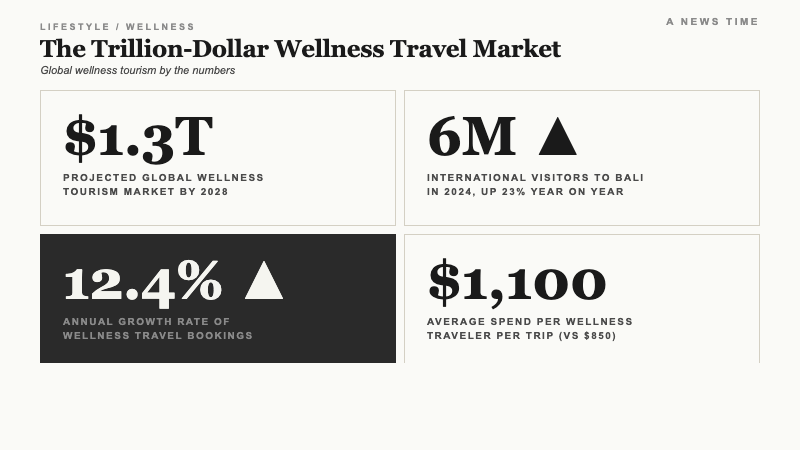
Nusa Dua is not a random setting for this experiment. Bali welcomed roughly 6 million international visitors across 2024 and 2025 combined, according to Indonesian tourism statistics, and wellness travelers have been one of the fastest-growing segments of that recovery. Ubud, 40 kilometers north, has spent two decades being branded as the global capital of yoga retreats and plant-based cafes. Canggu has absorbed the surf-and-sound-bath crowd. Nusa Dua, historically a slightly more corporate enclave of gated beachfront resorts, has been trying to find a wellness identity that doesn't feel like a copy of its neighbors.
A resort day pass program is a plausible answer. It lets Nusa Dua properties sell the premium amenities of a five-star compound without forcing visitors to commit to the full package. It is also, quietly, a way to pull domestic travelers back onto the resort strip. Indonesian Ministry of Tourism data from 2025 showed domestic tourism rebounding faster than inbound international travel, and Jakarta residents flying into Denpasar for long weekends are exactly the demographic most likely to pay for a curated day of pool, spa, and yoga without wanting to book a room.
"We're seeing demand from people who want the aesthetics and the amenities of a resort stay without the financial or logistical commitment of actually checking in. A day pass lets us meet that demand without cannibalizing rooms."Senior Westin Asia-Pacific wellness executive, PRNewswire statement
The numbers on the broader market are the loudest part of the story. The GWI has projected that wellness tourism will grow past 1 trillion dollars in annual spending by 2028, up from around 830 billion in 2024. That is a staggering figure for an industry category that barely had a name 15 years ago, and it sets the macro backdrop against which every hotel wellness announcement should be read.
What ResortPass and DayAxe Built
Westin is not inventing the day-pass category. It is plugging into one that has quietly matured since 2022. Two platforms dominate the English-language conversation. ResortPass, founded in 2016 and scaled aggressively during and after the pandemic, now sells day access to more than 1,500 hotels in North America and parts of the Caribbean. DayAxe, a smaller competitor, focuses on curating pool and cabana experiences at mid-tier and boutique properties.
Both platforms argue that they are unlocking the same "underutilized asset" thesis ResortPass's founder described, and both charge a cut to the hotels that list. The prices on those platforms vary wildly, but the shape of the product has settled: a fixed-fee wristband, a time window, and a short menu of amenity access tiers. A budget summer day at a suburban Holiday Inn pool might list for less than 40 dollars on ResortPass. A full-day cabana at a Miami Beach five-star can clear 300 dollars before tax, towels, or tip.
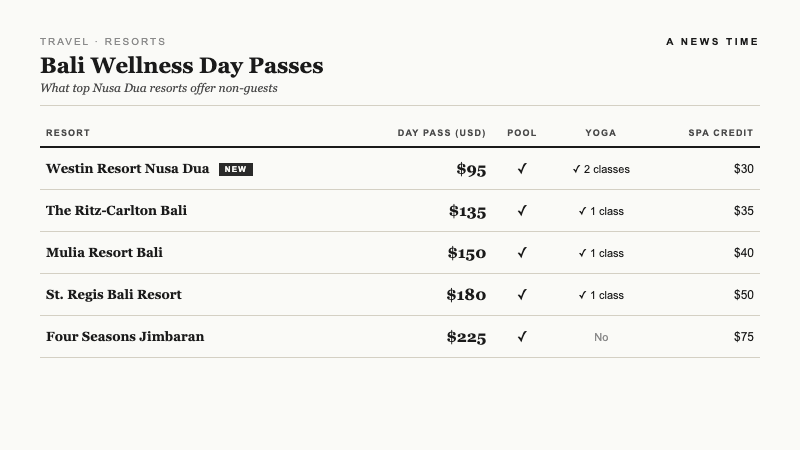
For an idea of how Bali's wellness resort day passes are starting to stack up against one another, here is a snapshot of publicly advertised options in the Nusa Dua and greater southern Bali area, with price ranges in US dollars:
| Property | Price range (USD) | Core inclusions | How to book |
|---|---|---|---|
| The Westin Resort Nusa Dua (new) | ~$75 to $150 | Pools, wellness classes, fitness, spa window, F&B credit | Direct booking, Marriott channels |
| The Mulia, Nusa Dua | ~$90 to $180 | Pools, beach loungers, F&B minimum spend | Direct booking, walk-in |
| Ayana Estate, Jimbaran | ~$60 to $200 | Rock Bar access, cliff pools, spa add-ons | Direct booking, concierge |
| Padma Resort Legian | ~$50 to $110 | Pools, F&B credit, fitness access | Direct booking |
| Typical boutique Canggu villa pass | ~$25 to $70 | Pool, light snack, optional yoga | Local apps, Instagram DM |
The Westin pass is priced roughly in the middle of that market, which is where its brand positioning has always been. It is also one of the few programs on the island being marketed explicitly through the "wellness" door rather than the "pool club" one.
The Celebrity Wellness Conversation, and Why It Matters
Wellness as a consumer category does not live or die on hotel press releases. It lives on how it gets talked about in culture. Earlier this month, the Economic Times published a widely shared quote from Cynthia Erivo, the Grammy and Tony winner currently filming the second part of Wicked, who summarized her own routine simply: "Meditation, yoga, working out, and eating well. That's my wellness." The quote was not sold as a manifesto. It read almost like a shrug.
That kind of flat, unembellished framing is an interesting counterweight to the high-gloss way wellness gets marketed to tourists. Celebrity wellness discourse has always oscillated between the austere and the absurd. Gwyneth Paltrow and Goop pulled the category toward the absurd. Erivo, Michelle Obama, and a growing group of athlete-turned-advocate voices have been pulling it back toward the boring and the sustainable.
The Westin launch is interesting precisely because it sits in between. The wellness space, the yoga deck, and the spa room are the stage set. The person paying the pass fee is the one who has to decide whether they can drop their phone, their inbox, and their running internal monologue for the six hours they have booked. The resort can sell the infrastructure. It cannot sell the state of mind, even though the marketing will frequently imply that it can.
What the Data Says About Paying for Rest
There is a growing body of research on why people struggle to actually rest, and why paying for a designated rest environment tends to work better than trying to rest at home. A 2023 paper in the Journal of Environmental Psychology, led by researcher Mathew White at the University of Exeter, found that people reported significantly higher restoration scores in environments that felt "away" from their daily routines, a concept the field calls being-away. The effect was strongest when the environment had clear visual boundaries from everyday life. A gated resort in Nusa Dua, with staff in uniform and a pool that does not contain any of the laundry a person left at home, qualifies almost comically well.
A separate 2024 survey from the American Psychological Association found that 61 percent of US adults said they had difficulty "fully disconnecting" from work during vacations, and that the number climbed above 70 percent for workers under 40. The implication is not that people are lazy or phone-addicted. It is that home environments have become so saturated with professional signals that rest requires physical relocation. That is exactly the pain point a day pass addresses.
The limitation of the research, and the reason the framing here should stay careful, is that environmental restoration does not automatically translate to sustained behavior change. A single day at a wellness resort is not a substitute for the structural conditions, adequate paid leave, manageable workloads, accessible mental health care, that shape long-term wellbeing. The day pass is a coping tool, not a cure. Selling it as a cure would be exactly the kind of wellness rhetoric the last decade has, rightly, started to push back on.
Day Passes, the Bali High Season, and What Comes Next
The practical question for Bali specifically is whether the day-pass economy holds up through the island's high season. From June through early September, Nusa Dua resorts are routinely at or near full occupancy, and the math that makes day passes attractive during shoulder season, i.e., empty pool decks, inverts. Expect dynamic pricing. Expect blackout dates. Expect more resorts to cap day-pass inventory on weekends and public holidays, the same way ski resorts cap single-day lift tickets during peak weeks.
The more interesting question is how the product evolves. Westin's Nusa Dua launch is bundling wellness classes and F&B credit into the pass, which moves it away from the purely transactional pool-and-towel model that dominated the early years of the category. If that bundling works, expect other Marriott brands, and competing chains like Accor, IHG, and Hyatt, to copy it, especially in Asia-Pacific wellness markets like Thailand, Vietnam, and Sri Lanka. It fits neatly alongside the global fitness travel boom, which is already reshaping how destinations in Europe and Southeast Asia are marketing themselves to wellness-seeking travelers.
It is also worth watching how this interacts with softer wellness trends. The same audience that is paying for Nusa Dua day passes is the one that has pushed the Japanese walking trend into viral rotation on TikTok, and that is also driving the growth documented in the wellness festival and mHealth boom. The consumer appetite for structured, low-stakes, slightly performative wellness programming is bigger and broader than any single product launch.
Who the Day Pass Is Really For
It is tempting to cast the day-pass economy as either a democratizing force (you can taste the Marriott experience for the price of a nice dinner) or a stratifying one (you can buy rest if you have disposable income, you can buy the idea of rest if you do not). Both readings are partially true. A Denpasar creative who books a Westin day pass three times a year is buying a different product than a Jakarta executive who uses it every other weekend, and both are buying a different product than the Australian tourist who drops in between a temple tour and a flight home.
What the launch actually reveals is the commodification of a specific piece of the wellness stack: physical environment. The yoga, the breathwork, the meditation guidance, those can be assembled for free from a YouTube account and a spare corner of a living room. The pool view, the teak deck, the quiet, the staff pouring cold coconut water, those cannot. They are the part of wellness that is genuinely scarce, and they are the part that a hotel can credibly sell by the hour.
In that sense, Westin's Wellness Day Pass is less an innovation than a confession. The brand is saying, in as many words, that the scarce resource in the global wellness market is not advice. It is a pleasant, controlled space in which to stop for a few hours. Whether that scarce resource should cost 75 dollars or 150 dollars or 800 dollars is a market question. Whether it should be scarce at all is a much bigger one, and one the hotel industry is unlikely to answer any time soon.
For now, the Nusa Dua sunrise keeps arriving at 6:12 a.m. The mats keep getting rolled out. The wristbands keep getting handed over. And the Bali wellness economy keeps building a product aimed squarely at people who would like, very much, for a day to feel different from the one before it.
Sources
- Malaysia Sun / PRNewswire: Flow. Sweat. Renew. The Westin Resort Nusa Dua, Bali Launches New Wellness Spaces and Wellness Day Pass Experience
- Economic Times: Cynthia Erivo on her wellness routine
- Global Wellness Institute: Wellness economy statistics and wellness tourism projections
- ResortPass: Day pass marketplace for hotel amenities