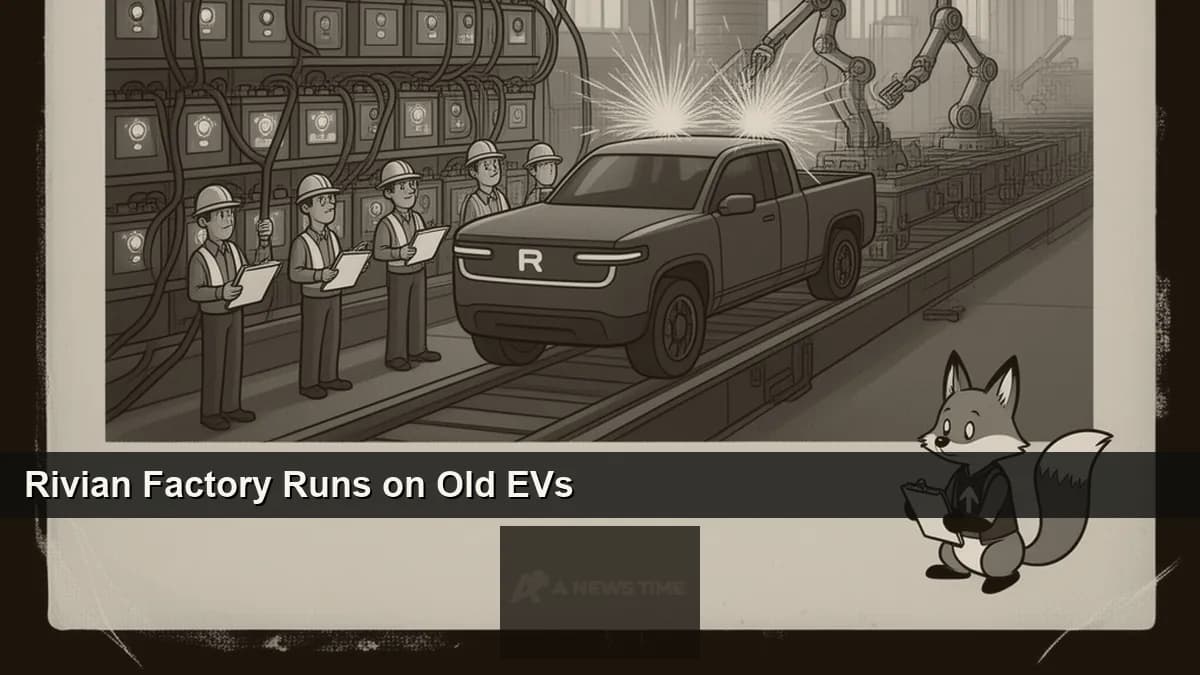
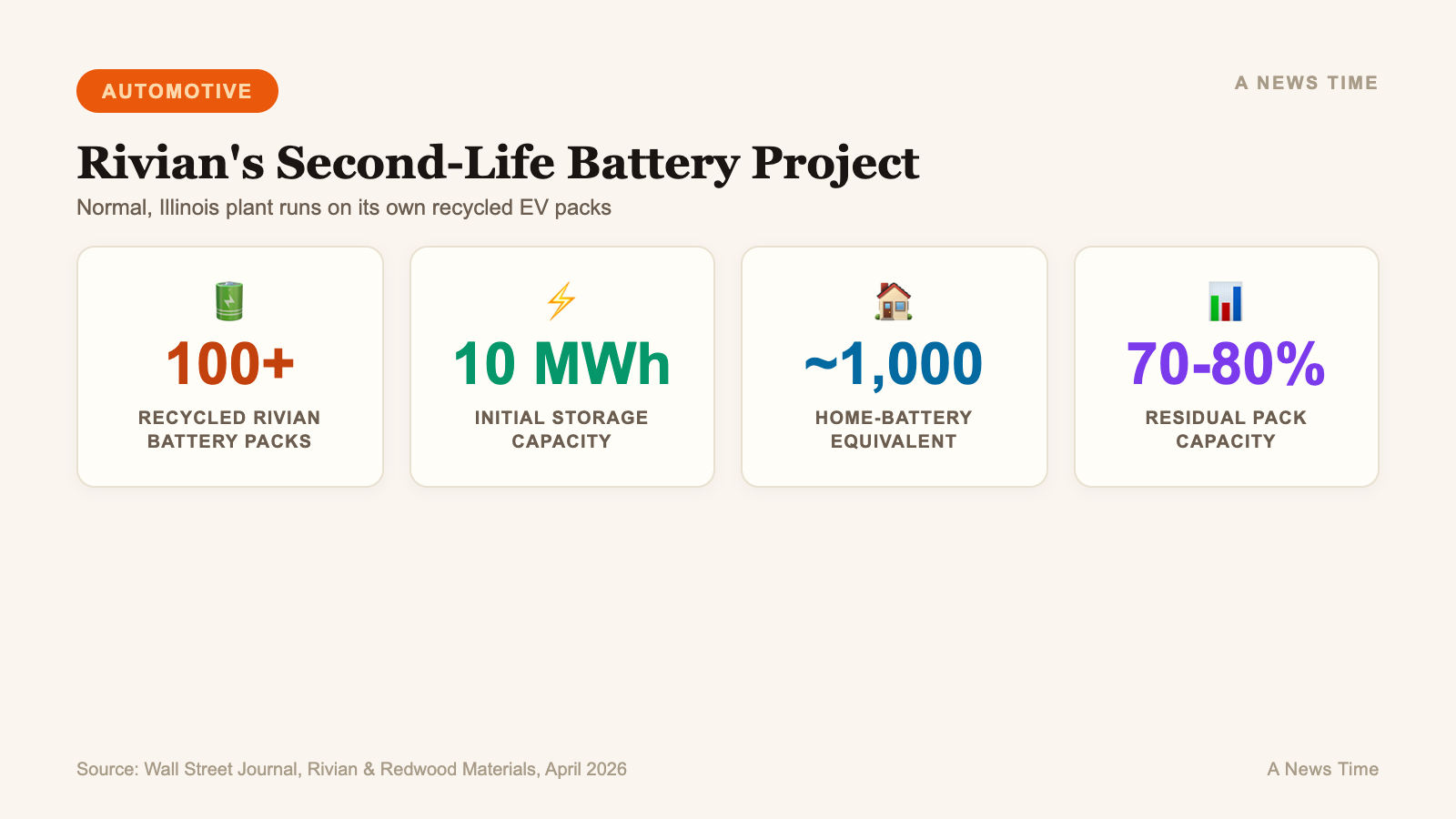
Rivian Automotive confirmed on that its Normal, Illinois assembly plant will be powered in part by more than 100 recycled Rivian electric vehicle battery packs, deployed in partnership with Nevada-based battery recycler Redwood Materials. The Wall Street Journal first reported the project, which Rivian said would become the largest repurposed-battery energy storage system at an automotive manufacturer in the United States when it comes online later in 2026. The system will initially provide 10 megawatt-hours of storage capacity, roughly equivalent to 1,000 home battery units wired together, drawn from Rivian test vehicles and from customer vehicles whose batteries remain viable even when the car itself can no longer drive. The deal lands at a moment when the entire EV industry is rethinking what to do with aging battery inventory, and it is the first production-scale answer from a major US carmaker to the second-life battery question that has been sitting on the industry's roadmap for years.
The economics Rivian is buying
The mechanical idea behind the project is straightforward. Used EV battery packs typically retain 70 to 80 percent of their original capacity when they are pulled from vehicles, which is below the threshold for reliable automotive use but well above what is needed for stationary grid storage. Rather than send those packs to a shredder for lithium and nickel recovery, Redwood Materials is integrating them into Redwood Energy storage units and wiring them up at the Normal plant to offset grid electricity purchases during peak demand periods.
Rivian Chief Executive RJ Scaringe, in the Wall Street Journal interview, put the rationale in two sentences: "It saves Rivian money on what it takes to run the plant. It reduces the demand on the grid, which is great." Neither Rivian nor Redwood disclosed the specific cost of the project, but the logic of the trade is easy to see. Industrial electricity prices across the United States rose 4.5 percent between 2024 and 2025, outpacing general inflation, and electricity demand pressure from artificial-intelligence data centers is keeping regional grids tight enough that a manufacturer with its own behind-the-meter storage gains both a cost buffer and a reliability buffer.
Redwood Materials founder JB Straubel, formerly Tesla's chief technology officer and battery technology lead, framed the speed advantage bluntly in the WSJ story: "These batteries are already built. We need to integrate them and connect them together, but that can happen quite fast. They don't have to get imported from some other place." That is a capital allocation argument as much as an engineering one, because it means Rivian is avoiding the expense of sourcing new cells, shipping them across the Pacific, and going through a multi-year commissioning cycle for utility-scale storage hardware.
| Project Specification | Detail |
|---|---|
| Location | Rivian assembly plant, Normal, Illinois |
| Storage capacity (initial) | 10 megawatt-hours |
| Battery packs used | More than 100, from Rivian test and end-of-life vehicles |
| Partner | Redwood Materials (Sparks, Nevada) |
| Purpose | Peak-hour grid offset, reliability buffer |
| Claimed milestone | Largest automotive-manufacturer second-life storage in US |
| Expected completion | Late 2026 |
Second-life storage, explained
The term "second life" in the battery industry refers to the practice of redeploying a used lithium-ion pack for a lower-demand application rather than recycling it immediately into raw metals. An EV pack that started its life propelling a vehicle at highway speeds sees hundreds of full charge-discharge cycles over ten years, and by the time it comes out of the vehicle, its peak output and range efficiency are degraded. Grid storage does not need peak output or range efficiency. It needs capacity at a specific voltage, delivered reliably over slow charge-discharge windows. A degraded EV pack is still perfectly capable of that job for another five to ten years of service life.
The industry has been talking about second-life storage since roughly 2015, but production-scale deployment has lagged for three reasons. The first is that used-pack supply was simply too thin in the early EV years. The second is that the engineering work of reconfiguring different battery chemistries, pack geometries, and battery management systems into a single cohesive storage unit is hard and costly. The third is that the business case against new lithium iron phosphate grid-storage products weakened as LFP prices kept falling through 2023 and 2024.
The Rivian-Redwood deal resolves two of those three problems. Rivian is a single-chemistry, single-vehicle-architecture supplier to the project, so Redwood is not juggling packs from a dozen different OEMs. And as gridside electricity demand has spiked on the AI data center build-out, the cost gap between a new LFP system and a second-life EV pack system has narrowed meaningfully, because the installed base of degraded EV batteries is now large enough to matter and new-cell supply is being reallocated toward higher-margin applications.
How it fits Rivian's margin story
Rivian has been running at a negative gross margin on its vehicles for most of its public life, and CEO RJ Scaringe has repeatedly told investors that manufacturing cost reductions at the Normal plant are the central line item behind the company's path to profitability. Plant power is not the largest line item in auto manufacturing, but it is not trivial, and any structural improvement in electricity cost compounds over the lifetime of the facility. For a company whose earnings calls have focused heavily on fixed-cost absorption, a self-supplied peak-hour buffer is the kind of incremental improvement that shows up in cash flow without requiring a headline capital expenditure commitment.
The project also carries an ancillary benefit that is harder to quantify but equally real: it takes used Rivian battery packs that would otherwise sit on warehouse shelves or move through costly reverse-logistics channels and turns them into revenue-contributing assets on Rivian's own property. Rather than bearing the storage and disposal cost for end-of-life batteries, Rivian is converting that liability into an operating offset. Scaringe told the WSJ that while storage "is not a focus for us as a business right now," Rivian hopes to do more at its sites with Redwood, which is the kind of language that suggests the project is part of a broader plan rather than a one-off experiment.
Rivian's second manufacturing facility, under construction in Georgia and slated to open in 2028, is the obvious candidate for a follow-on deployment. If the Normal system performs to specification through its first year of operation, building in second-life battery storage at the Georgia plant during construction is cheaper than retrofitting it later, and it would stretch the life of Rivian's growing bank of returned battery packs into real on-site utility.
"It saves Rivian money on what it takes to run the plant. It reduces the demand on the grid, which is great."
RJ Scaringe, Chief Executive Officer, Rivian Automotive, to The Wall Street Journal
Comparison with Tesla, GM, and Ford
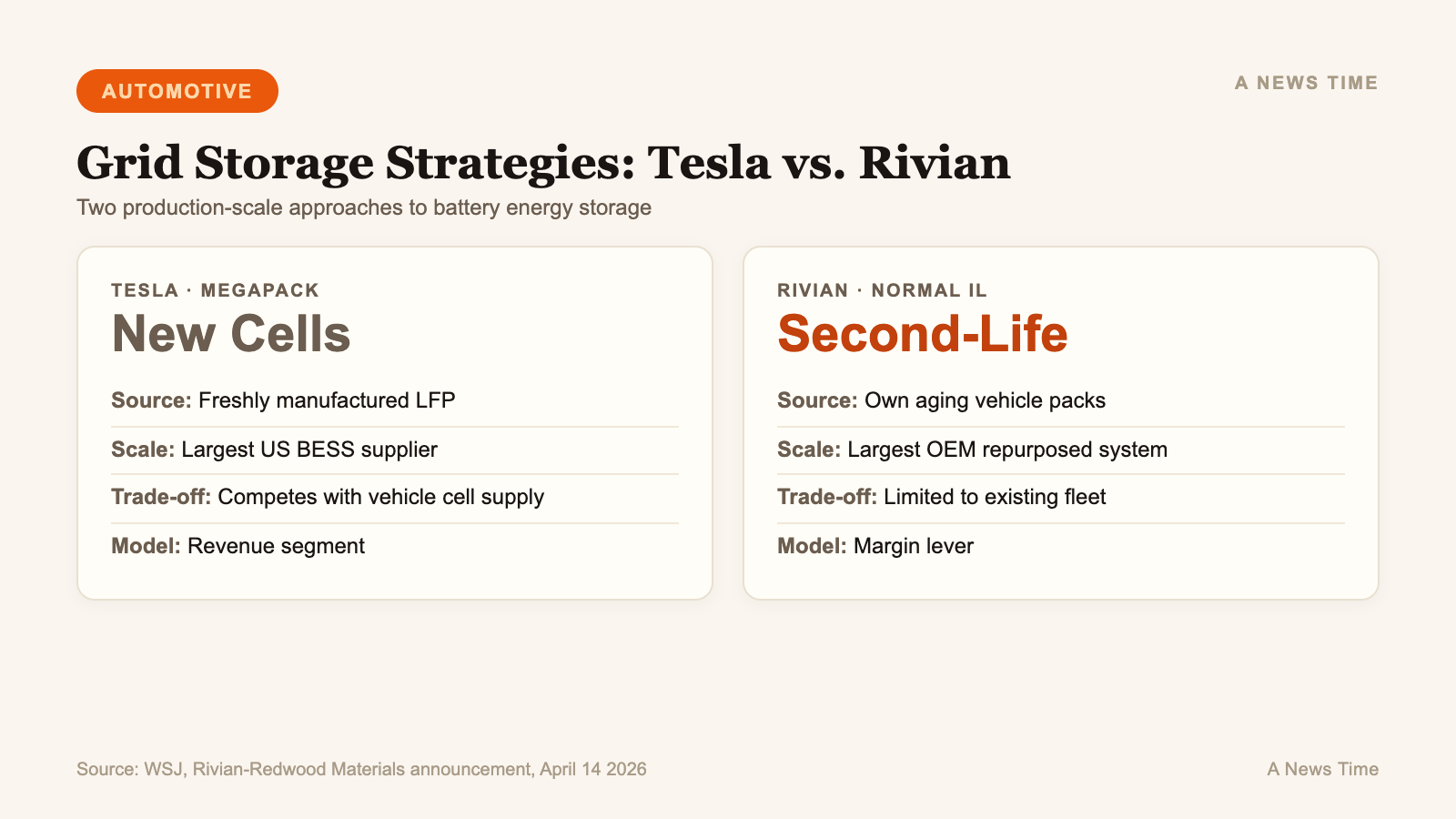
The Rivian announcement lands in a market where every legacy and new-entrant automaker is scrambling to redefine the role of battery manufacturing as EV sales growth has slowed. Wall Street Journal coverage from earlier in 2026 documented how Ford and General Motors have been retooling battery facilities originally planned for EV production to serve commercial grid storage and AI data center customers, rather than letting those plants sit idle as delayed vehicle programs push demand out. Tesla, which is already the largest battery energy storage supplier in the US through its Megapack business, reported that grid storage was the fastest-growing segment of its revenue base in 2025.
None of those companies, however, have built a production-scale second-life system at the automotive manufacturing level. Tesla's Megapacks are built from new cells. Ford and GM's retooled facilities are producing new-cell systems. Rivian's setup is the first US example of a carmaker using its own aging vehicle packs to power its own production line. For context on how the broader EV manufacturing landscape is shifting under these pressures, see our coverage of delayed and canceled EV programs, the 28 percent drop in new EV sales driving the used-market surge, and the BYD fast-charging battery push that is pressuring US manufacturers on cell-level economics.
The strategic difference between Rivian's approach and its larger competitors' is scale-to-commitment ratio. Tesla's Megapack business is enormous but depends on a continuous pipeline of new cells that compete directly with vehicle production for the same raw-material supply. Rivian's system uses batteries that are already inside the company's ecosystem and have no better alternative use. That is a more capital-efficient model at the margin, particularly for a company that is still working toward positive unit economics on vehicle production.
EV circularity and what comes next
Battery circularity, meaning the closed-loop flow of materials and cells from vehicle to second life to recycling to new cells, has been a talking point for EV policy advocates for most of the last decade. Rivian-Redwood is not a full closed loop on its own, but it is a real data point on the second-life leg of that loop, and the first one that can be evaluated at commercial scale on a manufacturing floor rather than in an R&D laboratory. If the Normal deployment delivers its promised 10 megawatt-hours reliably through a full year of plant operation, it becomes the template that other OEMs can copy, and the economics improve for everyone as more packs come off warranty.
The longer-term question is whether Redwood Materials can handle the pack volumes that will come at the industry through 2027 and 2028 as early Rivian, Tesla, and GM models reach the end of their first ownership cycles. Redwood's existing hydrometallurgy facility in Sparks, Nevada, handles metal recovery, and the company has been positioning itself as the default North American partner for OEM battery circularity programs. A second Rivian deployment in Georgia, plus potential follow-on deals with other manufacturers, would test that capacity in short order.
For the broader auto industry, the Rivian announcement is also a signal about how manufacturers plan to manage power costs at a time when industrial electricity prices are outpacing general inflation. A plant that can hedge roughly 10 megawatt-hours of peak demand with its own hardware is less exposed to utility rate cases and less exposed to grid reliability shocks. Both factors matter for forward cost-of-goods-sold assumptions, and neither was showing up in OEM planning documents three years ago. The Normal project is a quiet correction of that blind spot.
What to watch next
Three things to track through the end of 2026. The first is the completion timeline on the Normal deployment itself, because any slippage past the "later this year" commitment would signal integration complexity that other OEMs should know about before copying the model. The second is whether Rivian's next earnings call, scheduled for early May, quantifies the expected electricity cost offset from the system, because a concrete number anchors the manufacturing-margin story in the cash flow model.
The third is whether Redwood Materials announces parallel deals with Ford, General Motors, or Tesla. JB Straubel's Redwood has already been expanding partnerships across the EV supplier base, and a Ford or GM second-life system at one of the retooled Michigan or Ohio battery plants would validate the Rivian-Normal template at much larger scale. The US battery energy storage market is on track to grow meaningfully through 2028, and second-life systems represent the lowest-cost entry point for manufacturers who already own the hardware. For a small company like Rivian, the Normal project is a margin lever. For the industry, it is a proof of concept that circular-battery economics can work at production scale, and the proof just got filed.
Frequently Asked Questions
How many batteries is Rivian using at the Normal plant?
More than 100 Rivian EV battery packs will be integrated into a 10 megawatt-hour storage system, installed in an area roughly the size of a small parking lot at the Normal, Illinois assembly plant. That is equivalent to approximately 1,000 home-energy battery storage units wired together.
Where are the batteries coming from?
The packs are sourced from Rivian test vehicles and from customer-returned vehicles whose batteries remain functional even when the car itself can no longer drive. Rivian sends the packs to Redwood Materials, which integrates them into Redwood Energy storage units and delivers the system back to the Normal plant.
Who is Redwood Materials?
Redwood Materials is a Nevada-based battery recycling and materials company founded by JB Straubel, the former chief technology officer and co-founder of Tesla. The company has been building out North American capacity to process used EV batteries and recover lithium, nickel, and cobalt for reuse in new cell manufacturing.
Is this the same as battery recycling?
No. Battery recycling recovers raw materials like lithium and nickel by processing end-of-life packs. Second-life storage, which is what Rivian and Redwood are doing here, keeps the packs intact and redeploys them as stationary energy storage. Recycling typically happens after second-life use ends.
Will other Rivian factories use the same system?
CEO RJ Scaringe told the WSJ that Rivian hopes to do more projects with Redwood, though he characterized stationary storage as "not a focus for us as a business right now." Rivian's second manufacturing facility, under construction in Georgia and slated to open in 2028, is the most likely candidate for a follow-on deployment.
Sources
- Rivian's Illinois Factory Will Run on Recycled EV Batteries - The Wall Street Journal
- Rivian's Illinois Factory Will Run on Recycled EV Batteries - MSN (WSJ syndication)
- As EV Market Stalls, Battery Makers Shift to Grids and Data Centers - The Wall Street Journal
- Rivian and Redwood Materials to repurpose battery packs for energy storage - Seeking Alpha