The 2025-26 NBA regular season produced one of the most deliberately uncompetitive bottom halves in league history. Three franchises, the Washington Wizards, the Indiana Pacers, and the Brooklyn Nets, finished in a mathematical dead heat for the worst record in the league, separable only by point differential. All three crossed the 60-loss threshold. All three gave extended minutes to players who will not be on their rosters next season. All three managed down their win totals in the final month with a transparency that tested the patience of the league office.
Commissioner Adam Silver, addressing reporters at the pre-lottery press conference on April 10, used language that the league has historically avoided. "The incentive structure has produced outcomes we are not comfortable with," he said. "We will look at this seriously in the offseason." It was the clearest signal yet that the NBA may be preparing another structural reform of a lottery system that has already been adjusted twice in the past decade.
None of that changes the math for this year. The lottery balls will be drawn on May 12. The team that wins the No. 1 pick will almost certainly select Cameron Boozer, the most coveted draft prospect since Caitlin Clark crossed over from collegiate basketball, and the draft itself takes place June 25 at the Barclays Center in Brooklyn. Here is everything that matters about who has the best shot, what the odds actually mean in practice, and what happens to the franchises that lose.
The Three Contenders: Wizards, Pacers, and Nets
The Washington Wizards finished 18-64, the worst record in the Eastern Conference and the worst in franchise history. For a franchise that drafted John Wall first overall in 2010 and still carries the salary consequences of that era on its books in various forms, this season was a deliberate bottoming-out. Head coach Brian Shaw, in his first year of a four-year deal, gave explicit minutes to players the organization has been developing: Jared Butler (19), Matas Buzelis (21), and Carlton Carrington (19) all played over 25 minutes per game at points in the season. The win total was not the point.
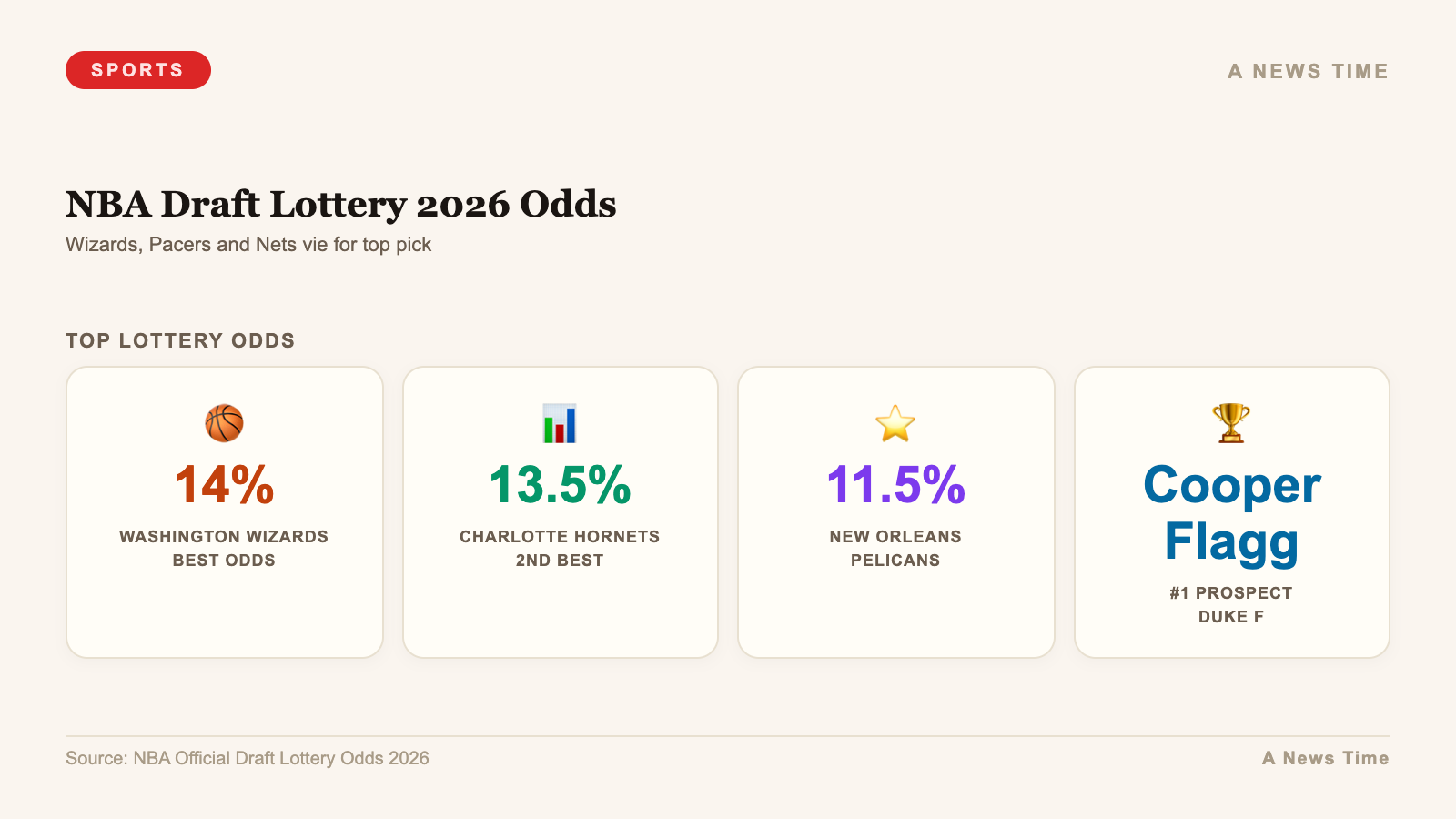
The Wizards' 14 percent top-pick odds represent the ceiling of what the lottery system allows. That number sounds dominant until you run it through a simple probability calculation. Over three lottery draws, a team with 14 percent odds expects to win the top pick exactly once. It also means that in 86 percent of outcomes on May 12, the Wizards walk away with a pick that falls somewhere between second and fifth.
Indiana's situation is more complicated. The Pacers, who were Eastern Conference finalists in 2024 and 2025, began rebuilding aggressively this season after Tyrese Haliburton was traded to the Houston Rockets in August in a deal that returned three first-round picks plus a young center. The front office made a specific calculation: this was the one season, given Haliburton's departure and the roster's transition window, to finish as low as possible and maximize lottery exposure. They went 19-63.
The Brooklyn Nets went 20-62. Their approach was the most philosophically interesting of the three. Under new ownership following Joe Tsai's sale of a minority stake to a sovereign wealth fund partnership in late 2024, the Nets committed fully to a tear-down that began with the Kevin Durant trade in 2023 and has now reached its deepest point. Their 12.5 percent lottery odds come paired with a roster that includes six players on rookie contracts and a front office that has not committed to a head coach for next season. They are building from the foundation up, and they want Cameron Boozer to be the foundation.
| Team | Record | Top-Pick Odds | Top-4 Odds |
|---|---|---|---|
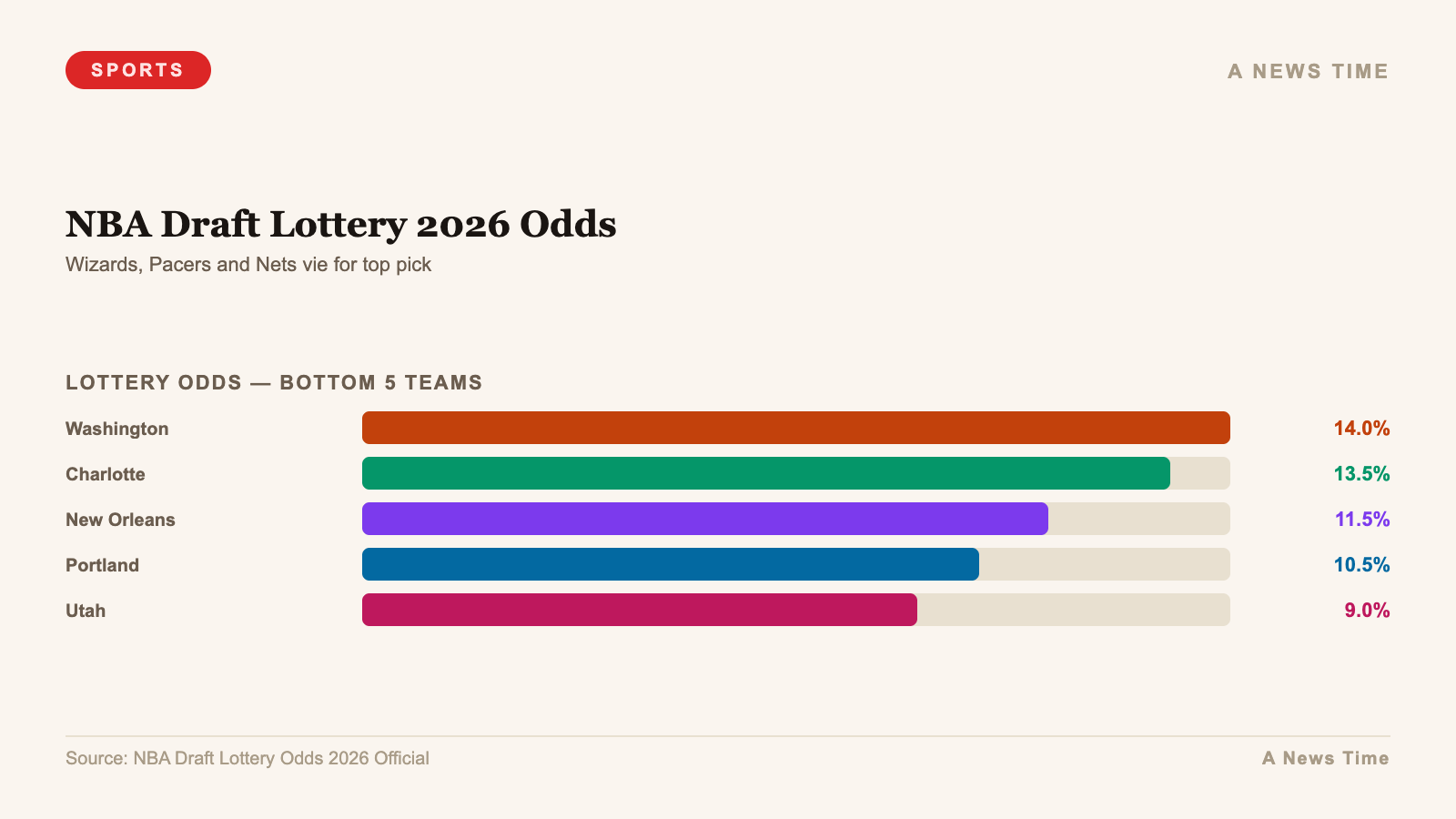
| Washington Wizards | 18-64 | 14.0% | 47.9% |
| Indiana Pacers | 19-63 | 13.4% | 46.2% |
| Brooklyn Nets | 20-62 | 12.5% | 44.4% |
| Charlotte Hornets | 22-60 | 10.5% | 39.2% |
| San Antonio Spurs | 24-58 | 9.0% | 34.8% |
| Portland Trail Blazers | 24-58 | 9.0% | 34.8% |
Cameron Boozer: The Pick That Justifies the Race to the Bottom
Understanding why three franchises were willing to lose 60 or more games requires understanding Cameron Boozer. The 19-year-old forward from Duke is the consensus No. 1 prospect and has been since his sophomore year in high school, when his combination of size, skill, and basketball intelligence began drawing comparisons to Dirk Nowitzki and Kevin Durant from evaluators who are usually reluctant to invoke those names.
Boozer finished his freshman year at Duke averaging 22.4 points, 9.8 rebounds, and 4.1 assists per game on 51.8 percent shooting from the field and 38.4 percent from three-point range. His defensive versatility, the ability to guard positions 2 through 5 at the college level, has translated in pre-draft workout settings where he has regularly covered wing players despite standing 6-feet-10-inches tall.
His father Carlos Boozer, who played 13 seasons in the NBA including an All-Star appearance with the Utah Jazz in 2008, has been visible in Duke's facility throughout the season. The family element adds a story dimension to the draft, but the evaluators focused on the data rather than the narrative are unanimous. Boozer is a potential franchise cornerstone, a player who projects as a four-time All-Star minimum and who could anchor a team through the next decade.
For context, the last time a prospect generated this kind of pre-draft consensus was Zion Williamson in 2019. The three teams competing for the top pick are not just competing for one draft class. They are competing for the potential to build the next great franchise around a single player.
Adam Silver's Warning and the Tanking Problem
The league's response to this season's bottom-quartile competition has been more pointed than usual. Adam Silver, in office since 2014 and the architect of the last major lottery reform in 2019, said on April 10 that the current season's tanking dynamic had "reached a threshold that is difficult to defend publicly." It is the strongest language he has used on the subject since the flat-odds reform gave the bottom three teams equal 14 percent odds, reducing the incentive to finish as low as possible rather than merely somewhere in the bottom three.
The 2019 reform did reduce extreme tanking. Before it, teams would lose 70 games on purpose to maximize their odds from 25 percent. After it, the gradient flattened enough that finishing 15th in the lottery versus 1st made less of a difference in top-pick probability. But three teams finishing within two games of each other at the absolute floor of the standings suggests that the equilibrium has shifted again, with franchises now targeting the bottom three specifically rather than any lower.
Proposed reforms being discussed in league circles include a wheel system, in which draft order rotates on a fixed schedule regardless of record, removing lottery incentives entirely. Another proposal would assign bonus lottery balls to teams that show "competitive intent," measured by a combination of win total and fourth-quarter point differential in losses. Neither proposal has formal support from the Board of Governors. Both reflect the league's genuine uncertainty about how to balance competitive rebuilding with on-court product integrity.
For the three teams in the lottery right now, the reform conversation is background noise. They have already made their bets. The lottery either validates or punishes those bets on May 12.
What the Non-Boozer Picks Look Like
If the Wizards, Pacers, or Nets win the top pick, the other two drop to the 2nd and 3rd selections. The rest of the draft class is thin relative to the top, which is partly why Boozer's consensus is so strong: there is no clear second franchise player in this class.
The second pick is likely to be Matas Buzelis from the Wizards' own roster, if they win No. 1 and he falls on a different team. Buzelis, who entered this season as an early second-round prospect and has developed into a legitimate lottery talent, is 6-feet-9-inches, has a 7-foot wingspan, and is averaging 14.2 points and 6.8 rebounds in his age-21 season. He is not a franchise center like Boozer, but he is a legitimate starting power forward at the NBA level.
The third pick is widely projected to be either Dylan Harper, the Rutgers guard who was the most productive player in the Big Ten this season at 23.6 points per game, or Ace Bailey, the wing from Rutgers who draws comparisons to Kawhi Leonard in his defensive instincts and lateral quickness. Both are first-round locks and both project as high-level starters within three years.
The gap between the first pick and the rest of the draft is the engine driving all the behavior at the bottom of the league standings. When one player projects this cleanly as a generational talent, the cost-benefit of a bad season shifts dramatically for franchises in transition.
Franchise Outlooks: What Each Team Does With Its Pick
Washington's front office has been transparent about its vision. The Wizards want Boozer to be the cornerstone of a rebuild that pairs him with Kyle Filipowski, the 22-year-old center they selected 14th in last year's draft, who has shown enough complementary skill to project as a starting big alongside a franchise power forward. The theoretical lineup: Carrington at the 1, Jordan Poole at the 2 (if the Wizards retain him after his expiring deal), Boozer at the 4, Filipowski at the 5.
Indiana's plan is more dependent on draft position. If they land Boozer, they pair him with Bennedict Mathurin, who at 23 has developed into a legitimate scoring wing. If they miss and fall to No. 2 or 3, Buzelis or Harper still gives them a franchise building block. Their Haliburton trade picks come in at 2027 and 2028, providing additional draft capital if the summer's free agency does not produce the point guard they need.
Brooklyn's path is the least certain. They have the draft picks, the cap space, and the organizational patience. What they do not have is a clear second piece to build around. If they win Boozer, they become immediately appealing in free agency as a New York market team with a 19-year-old star. If they fall to No. 3, the rebuild extends by at least another full season before the young core coheres.
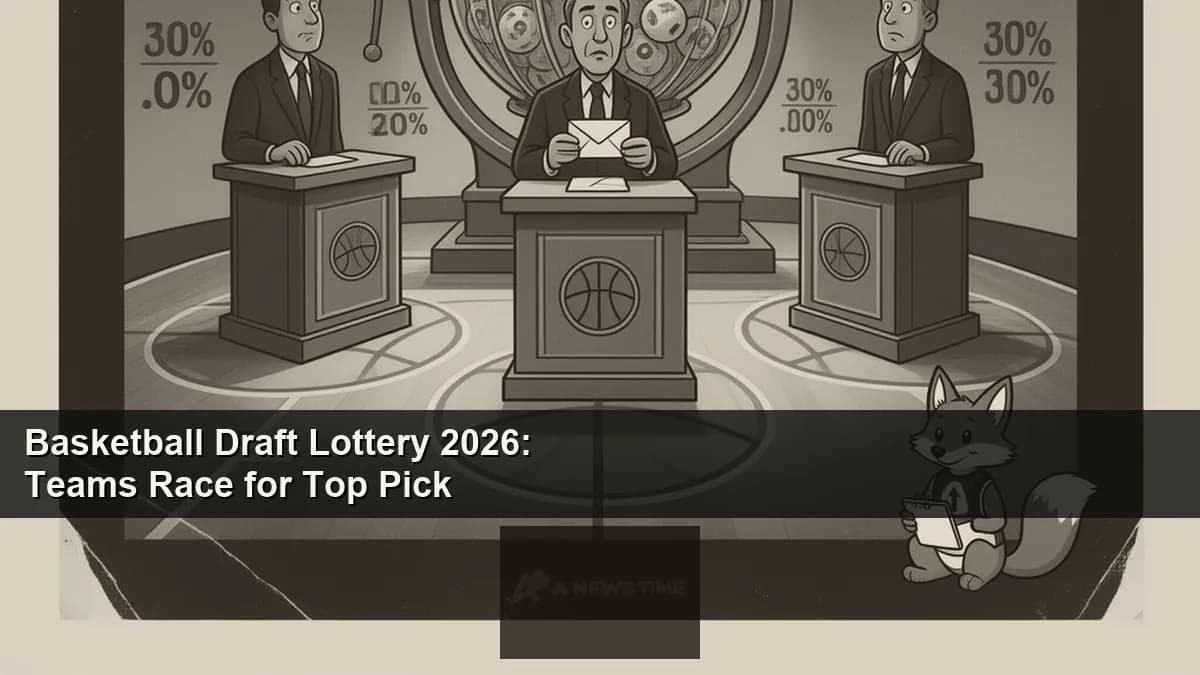
The Lottery Mechanics and How the Draw Works
The NBA Draft Lottery has used the same basic ping-pong ball format since 1990, updated with the flat-odds reform in 2019. Fourteen balls numbered 1 through 14 are placed in a drum. A combination of four balls is drawn, and each team's assigned combinations correspond to their odds. There are 1,001 possible combinations; the 1000th is unassigned and triggers a redraw. The top four picks are determined by lottery; picks 5 through 14 are assigned in inverse order of record.
The process is run privately by representatives from each participating team, with an independent accounting firm overseeing the draw. Results are not revealed until the televised presentation on May 12. The show, broadcast on ESPN, begins at 8 PM Eastern and typically generates viewership comparable to a minor playoff game.
For the Wizards, Pacers, and Nets, the draw on May 12 is the culmination of a season spent making deeply uncomfortable choices. Whether those choices pay off is a matter of 14 ping-pong balls and the statistical indifference of a lottery machine.