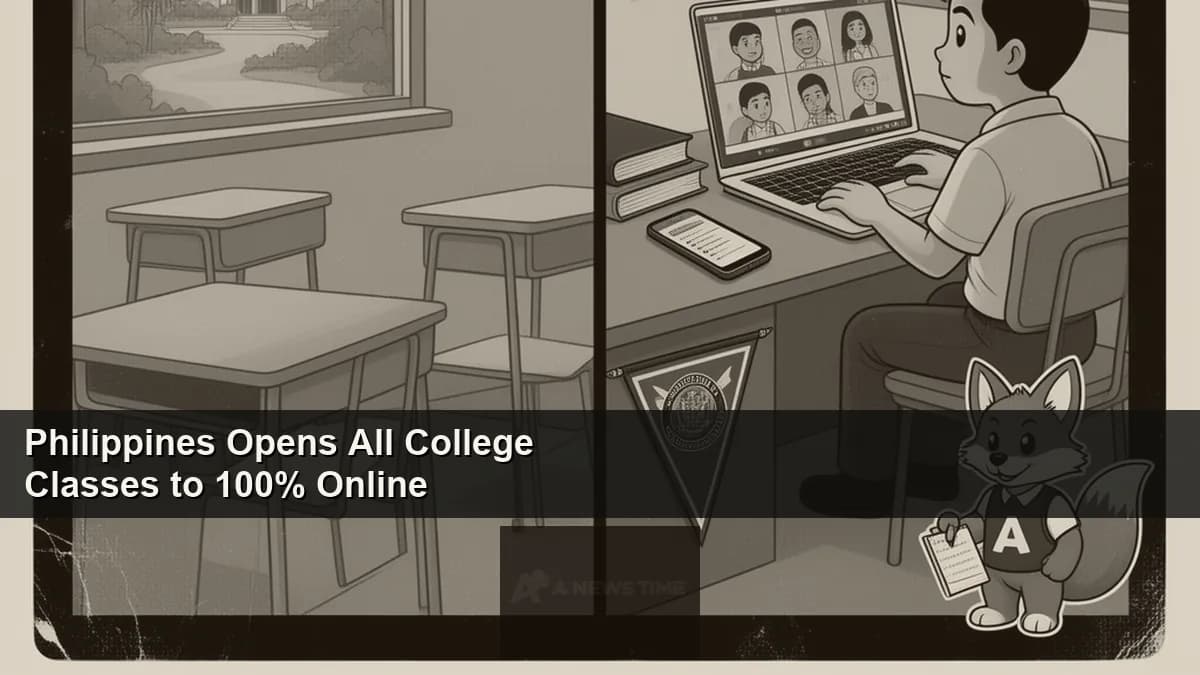
The Philippines' Commission on Higher Education finalized a sweeping policy change on , giving every college and university in the country the option to move all instruction online in direct response to a national fuel and power crisis that has made commuting to campus financially untenable for hundreds of thousands of students and faculty. CHED Chairperson Shirley Agrupis announced the decision at a press briefing on , calling it a temporary "stop-gap mechanism" to shield students from soaring transportation and electricity costs triggered by global supply disruptions. The policy covers all accredited HEIs in the country, both public and private, and takes effect immediately.
The change is significant not because online learning is new to the Philippines, but because the existing rules had drawn a hard line between emergency modalities and normal operations. Private institutions were restricted to a 50-50 blended learning arrangement. State universities and colleges were required to hold 75% of instruction in person. Those ratios had been in place since pandemic-era emergency rules began winding down, and their removal now marks the broadest relaxation of in-person requirements since the COVID-19 public health emergency ended. Agrupis framed the approval as a revival of pandemic-era flexibility rather than a new policy from scratch, telling reporters that CHED was "giving full flexibility to adhere to the previously issued COVID-19 pandemic CMO," while adding one new layer: schools can now determine for themselves whether they are ready for a fully online setup.
What changed and what did not
Before this ruling, the regulatory landscape was tiered. Private HEIs operated under a blended learning requirement that kept at least half of all coursework face-to-face. State universities and colleges faced an even stricter 75% in-person mandate, reflecting longstanding policy assumptions that public institutions serve students with lower average digital access. Both tiers are now suspended in favor of institution-level judgment.
The new framework gives each institution three responsibilities. First, it must self-assess whether its IT infrastructure, faculty capability, and student connectivity can support a fully online delivery. Second, it must ensure that shifting to digital modalities does not compromise intended program outcomes, a condition Agrupis stated explicitly at the briefing. Third, it must continue to operate under existing academic quality frameworks. A school that goes 100% online is still subject to accreditation standards, curriculum requirements, and student protection rules.
Critically, the policy does not automatically convert any institution into a recognized ODEL provider. Formal accreditation as a permanent distance learning institution still requires a separate, rigorous application process. Schools that use this emergency flexibility to deliver online classes this semester are doing so under temporary authorization. Any institution that wants to maintain fully online operations after the crisis resolves will need to go through standard ODEL accreditation channels.
The policy also aligns with Memorandum Circular No. 114 from the Office of the President, which directed all government agencies and institutions to adopt energy conservation measures in response to the fuel supply disruption. For the education sector, moving instruction online reduces the energy load on physical campuses while simultaneously cutting the transportation burden on students and faculty.
The crisis driving the decision
To understand why CHED moved quickly, it helps to understand what students and faculty are currently paying to get to class. The Philippines is experiencing a fuel and power crisis rooted in global supply chain disruptions, and retail fuel prices have climbed sharply in recent months. For students commuting to universities in Metro Manila and other urban centers, daily transportation costs have become a meaningful financial pressure on top of tuition and fees. Faculty, particularly those traveling between campuses or from provincial residences, face comparable strain.
The government response has been multi-pronged. The Office of the President issued the energy conservation directive. The Department of Energy intensified its crackdown on fuel hoarding and profiteering, issuing show-cause orders to nearly 100 establishments as of mid-April 2026. The Palace also ordered a 20% fare discount for commuters starting . CHED's online learning authorization is one component of a broader administration effort to reduce the economic friction of daily movement during the crisis period.
The Department of Education made a parallel move for K-12, with the agency implementing flexible work arrangements for school-based personnel and signaling openness to remote instruction options where feasible. The alignment between DepEd and CHED signals that the government is treating the fuel crisis as a systemic education access issue, not just a logistics inconvenience.
| Institution Type | Previous Maximum Online Allowed | New Maximum Online Allowed |
|---|---|---|
| Private Higher Education Institutions | 50% (blended learning ceiling) | 100% (subject to self-assessed readiness) |
| State Universities and Colleges | 25% (75% face-to-face required) | 100% (subject to self-assessed readiness) |
| Permanent ODEL-accredited institutions | 100% (already accredited) | 100% (no change) |
Who is affected and what it means for students
The Philippines has one of the largest higher education systems in Southeast Asia. As of the most recent CHED data, the country has over 1,900 accredited HEIs serving approximately 3.7 million students. The vast majority of those institutions are private, and most of them were operating under the 50% blended learning cap before this ruling. State universities enroll roughly 900,000 students across the archipelago, with a disproportionate share attending institutions outside Metro Manila where commuting distances are long and fuel price increases hit harder.
For students, the immediate practical effect is that their institution may contact them in the coming days or weeks to announce a shift to fully digital instruction. Whether that actually happens depends on each school's honest assessment of its infrastructure and faculty readiness. Institutions with strong LMS platforms, trained faculty, and good prior enrollment in online programs will likely move quickly. Schools with weaker digital capacity may choose to stay at their current blended ratio rather than risk learning outcome degradation by moving online before they are ready.
For students who were already struggling with connectivity at home, the shift carries a different risk. The digital divide in the Philippines, while narrowing, remains real. Urban students with reliable broadband will experience the transition differently than students in provincial and rural areas where mobile data is the primary connection method and power outages are more frequent. CHED's insistence that institutions self-assess readiness before committing is, in part, an acknowledgment of this divide.
The digital divide in the Philippines is not a single gap but a geography of gaps. Metro Manila students and provincial students are not experiencing the same internet. Any policy that treats them identically will serve some students well and others poorly.
Policy observation, Philippine Institute for Development Studies, on remote learning equity, 2021
For students already enrolled in part-time programs while working full-time, the shift to fully online may actually reduce financial pressure. Transportation costs eat into take-home pay in ways that are invisible in standard tuition discussions. A student who commutes two hours each way and pays for fuel or jeepney fares daily is spending real money that a fully online semester would eliminate. That calculation is one reason the student response to the announcement has been broadly positive in early social media signals.
The accreditation boundary and why it matters long-term
The most important regulatory nuance in the CHED announcement is the boundary between temporary authorization and formal ODEL accreditation. This distinction deserves attention because it will shape what happens when the fuel crisis eventually eases.
Under Philippine higher education law, institutions that want to operate as permanent online distance learning providers must go through a formal ODEL accreditation process that involves curriculum review, faculty credentialing, platform assessment, and student support evaluation. That process is separate from, and more demanding than, the emergency flexibility CHED is now extending. The emergency authorization does not count toward ODEL accreditation. It does not create a fast-track pathway. It is strictly a crisis tool.
This matters for two reasons. First, students enrolling under the emergency arrangement are protected by the same standards and credentials as they would be in face-to-face instruction. Their degrees will not carry any asterisk. The temporary online delivery does not change the accreditation status of the programs they are enrolled in. Second, institutions that discover during this period that online delivery works well for their student population will need to go through the full ODEL process if they want to maintain that option after the crisis ends. The emergency authorization is not a shortcut to permanent digital operation.
| Dimension | Emergency Authorization (April 2026) | Permanent ODEL Accreditation |
|---|---|---|
| Duration | Temporary, crisis-linked | Ongoing, subject to renewal |
| Application required | No (self-assessment by institution) | Yes (formal CHED application process) |
| Platform review | Internal assessment only | External CHED review required |
| Faculty credentialing | Existing standards apply | Additional ODEL-specific requirements |
| Student degree validity | Full validity (same as face-to-face) | Full validity (formally accredited) |
For institutions that were already planning ODEL accreditation before this crisis, the emergency semester is essentially a large-scale pilot. Running fully online at scale under real-world conditions will generate operational data that formal accreditation reviewers will find useful. Schools that manage the transition well and document outcomes carefully may find the ODEL application process smoother as a result.
A global pattern: crisis-driven flexibility as a policy lever
The Philippines is not the first country to use an external crisis as justification for relaxing online learning restrictions in higher education, and it almost certainly will not be the last. The pandemic established the template: a sudden shock forces governments to authorize remote instruction broadly, institutions discover that online delivery is more operationally viable than pre-crisis rules assumed, and some fraction of those temporary authorizations becomes permanent policy once the emergency ends.
Dubai's education authority, the KHDA, announced new home-based learning guidelines in early April 2026 that allow parents to use distance learning arrangements for children aged zero through six, extending flexible delivery options into the earliest years of formal education. While the Philippines and Dubai are responding to different pressures, the direction of travel is consistent: regulatory bodies that once tightly controlled the conditions under which remote learning was permitted are now building flexibility directly into their policy frameworks, rather than treating it as an emergency exception.
The long-run policy question for the Philippines is whether the CHED emergency authorization accelerates a conversation the country was already having about expanding ODEL capacity more broadly. The Philippines has a large overseas Filipino worker population, a significant share of which has family members who would benefit from fully online degree programs that do not require physical attendance. The pandemic demonstrated demand. The fuel crisis is demonstrating it again. At some point the emergency justification becomes redundant, and the real policy argument shifts to whether the existing ODEL accreditation process is adequately scaled to meet that demand.
The pandemic proved that Philippine higher education can operate online at scale when it has to. The fuel crisis is proving it again. What we have not yet done is build the permanent regulatory infrastructure to match the demonstrated capacity.
Higher education policy analyst, comment to regional media, April 2026
That infrastructure question is where the CHED announcement becomes most consequential. The short-term relief is real and meaningful for students facing unaffordable commutes. The longer-term opportunity is that this second major demonstration of online delivery viability puts significant pressure on CHED to streamline the ODEL accreditation pathway, not to eliminate quality standards, but to make formal recognition something institutions can realistically pursue within a reasonable timeframe.
What institutions and students should do right now
The CHED authorization came into effect immediately, but institutions need time to assess their readiness and communicate with students. Here is what the practical timeline looks like for most stakeholders:
- Institutions with existing online infrastructure: Expect official communications from your school within the next one to two weeks. Schools with functioning LMS platforms and faculty who completed online teaching training during the pandemic are the most likely to act quickly.
- Students with reliable home internet: Monitor communications from your registrar and academic departments. If your institution announces a transition, your existing enrollment and credit standing carry forward without interruption.
- Students with limited connectivity: Proactively contact your institution's academic affairs or student services office to ask what support will be available. Many schools will maintain hybrid options or provide data allowances for students who cannot reliably access online platforms at home.
- Faculty: Check with your department chair and academic technology office. Institutions that go fully online will need faculty who can deliver synchronous and asynchronous instruction. Prior COVID-era online teaching experience will be directly applicable.
- Institutions assessing ODEL long-term: Use this semester as a documented pilot. Collect data on student completion rates, platform stability, and learning outcome assessments. That documentation is directly relevant to a formal ODEL accreditation application.
The broader picture for Philippine higher education is one where enrollment trends, tuition pressures, and geographic barriers have been building a structural case for expanded online delivery for years. The fuel crisis accelerated the regulatory decision, but the underlying demand was already there. Our earlier reporting on global college enrollment trends rising despite higher-ed backlash found that students in price-sensitive markets consistently prioritize credentials that reduce total cost of attendance, not just tuition. Transportation is a real and frequently underweighted component of that total cost. A fully online semester eliminates it entirely.
Looking ahead: what this means for Philippine higher education
CHED has been explicit that this is a temporary measure tied to a specific crisis. What it becomes after the crisis depends on three things: how well institutions execute the online transition, how the government responds to evidence of successful delivery, and whether the ODEL accreditation process is reformed to match demonstrated capacity.
The institutions that will shape that outcome are the ones that treat this semester not as an inconvenient detour but as an operational test with real data value. Schools that run fully online programs with measurable outcomes, documented faculty support systems, and student retention rates comparable to face-to-face delivery will have a compelling case when CHED eventually reviews the emergency period and decides what, if anything, to carry forward permanently.
Research from our coverage of the OECD's Digital Education Outlook 2026 found that online learning environments only produce durable learning gains when institutions invest in pedagogical design, not just technology access. That finding applies directly here. The Philippine institutions most likely to demonstrate that emergency online delivery works are the ones that do not simply move lecture slides to Zoom, but invest in the design of online learning experiences that produce the competencies students enrolled to gain.
The global direction of travel in higher education policy is toward greater flexibility, not less. The Philippines' CHED decision is one more data point in that trend. Whether it accelerates the country's permanent expansion of online higher education or simply serves as a useful crisis valve that closes when fuel prices normalize is a question that the next twelve months will begin to answer. The regulatory infrastructure, the institutional capacity, and the student demand are all present. What has been missing until now is the policy authorization to test them at full scale. That authorization now exists.
The 2026 fuel crisis is doing in the Philippines what the 2020 pandemic did globally: forcing institutions and regulators to test assumptions about online delivery that had never been stress-tested under real conditions.
Regional education policy roundtable, Southeast Asia, April 2026
For students, faculty, and administrators navigating the transition, the practical advice is to treat the quality standards as non-negotiable even when the delivery mode is changing. The credential on the other side of this semester is exactly as valuable as it was before the crisis, provided the learning outcomes that justify it are protected. That protection is CHED's stated condition for the emergency authorization, and holding institutions accountable to it is the central policy challenge of the months ahead. CHED's emphasis that intended program outcomes must not be sacrificed is not boilerplate. It is the single most important sentence in the announcement for students who are about to trust a new modality with their academic progress.
For deeper context on how the demand for flexible, skills-aligned credentials is reshaping higher education globally, see our coverage of the World Economic Forum's reskilling revolution and what it means for 850 million workers.
Frequently Asked Questions
- Does this mean my school has to go 100% online?
- No. The CHED ruling gives institutions the option, not the obligation, to go fully online. Each school must assess its own IT infrastructure and faculty readiness before deciding whether to make the shift. Your institution may choose to stay at its current blended ratio, increase online delivery partially, or move to full online instruction depending on its assessed capacity.
- Will my degree be affected if my school goes fully online this semester?
- No. The emergency authorization does not change the accreditation status of your enrolled program. Degrees earned during this period carry the same validity as degrees earned under normal face-to-face instruction. CHED has confirmed that academic standards and learning outcomes must be maintained throughout the emergency period.
- Does this authorization mean my school is now an accredited ODEL provider?
- No. The emergency flexibility and formal ODEL accreditation are two separate things. A school using this authorization to deliver online classes has temporary permission to do so during the crisis. Permanent accreditation as an online institution requires a separate, formal CHED application process that was not changed by this ruling.
- What if I do not have reliable internet access at home?
- Contact your institution's student services or academic affairs office immediately. Schools are encouraged to assess student connectivity as part of their readiness evaluation. Many institutions will maintain options for students with limited home internet access, including hybrid arrangements or data support programs.
- How long will the emergency authorization last?
- CHED has described the measure as temporary and linked it specifically to the national fuel and power crisis. No end date has been set publicly. The authorization will remain in place as long as the crisis conditions that prompted it persist, and CHED will likely issue a separate communication when normal blended learning ratios are reinstated.
Written by Priya Anand, Science & Education Writer
Sources
- CHED: College classes can now go 100% online — Philippine Information Agency, April 10, 2026
- Dubai allows home-based learning for children aged 0-6 under new KHDA guidelines — Times of India, April 2026
- Commission on Higher Education official website — ched.gov.ph
- Palace orders 20% fare discount for commuters starting April 15 — Philippine Information Agency, April 10, 2026