There is nothing romantic about reading the fine print on your hotel booking at 11 p.m. the night before departure. But if that booking is for Barcelona in 2026 and you have not yet looked at the line item labeled "tourist tax," consider doing it now. The city has restructured its accommodation surcharge, and the combination of Barcelona's municipal fee and Catalonia's regional levy has produced one of the highest tourist tax stacks in southern Europe. It will not break a vacation budget. But it will surprise the traveler who assumed the number on the confirmation email was the final number.
The mechanics of Barcelona's tourist tax system have always been more layered than the single-number figure that most travel sites quote. Understanding the 2026 structure requires distinguishing between two separate taxes that apply simultaneously: the regional Catalan tourist tax (taxa turistica) and the Barcelona city surcharge on top of it. The 2026 revisions increased the city surcharge component, pushing combined totals upward across all accommodation categories.
The Two-Tax Architecture: Catalonia Plus Barcelona
Catalonia's regional tourist tax has existed since 2012. It applies to all tourist accommodation across the autonomous community, from hotel rooms and apartment rentals to cruise ship berths. The regional rates are tiered by accommodation type and category, with higher-rated properties paying more per person per night.
Barcelona's city surcharge, the recàrrec, was introduced in 2017 as an additional layer on top of the Catalan base rate. When Barcelona announced its 2026 increases, it was specifically the city surcharge that rose, while the Catalan base rates remained unchanged. This means the total tax a visitor pays has two components with different legal origins, collected together by the accommodation provider and distributed respectively to the Catalan regional government and Barcelona City Council.
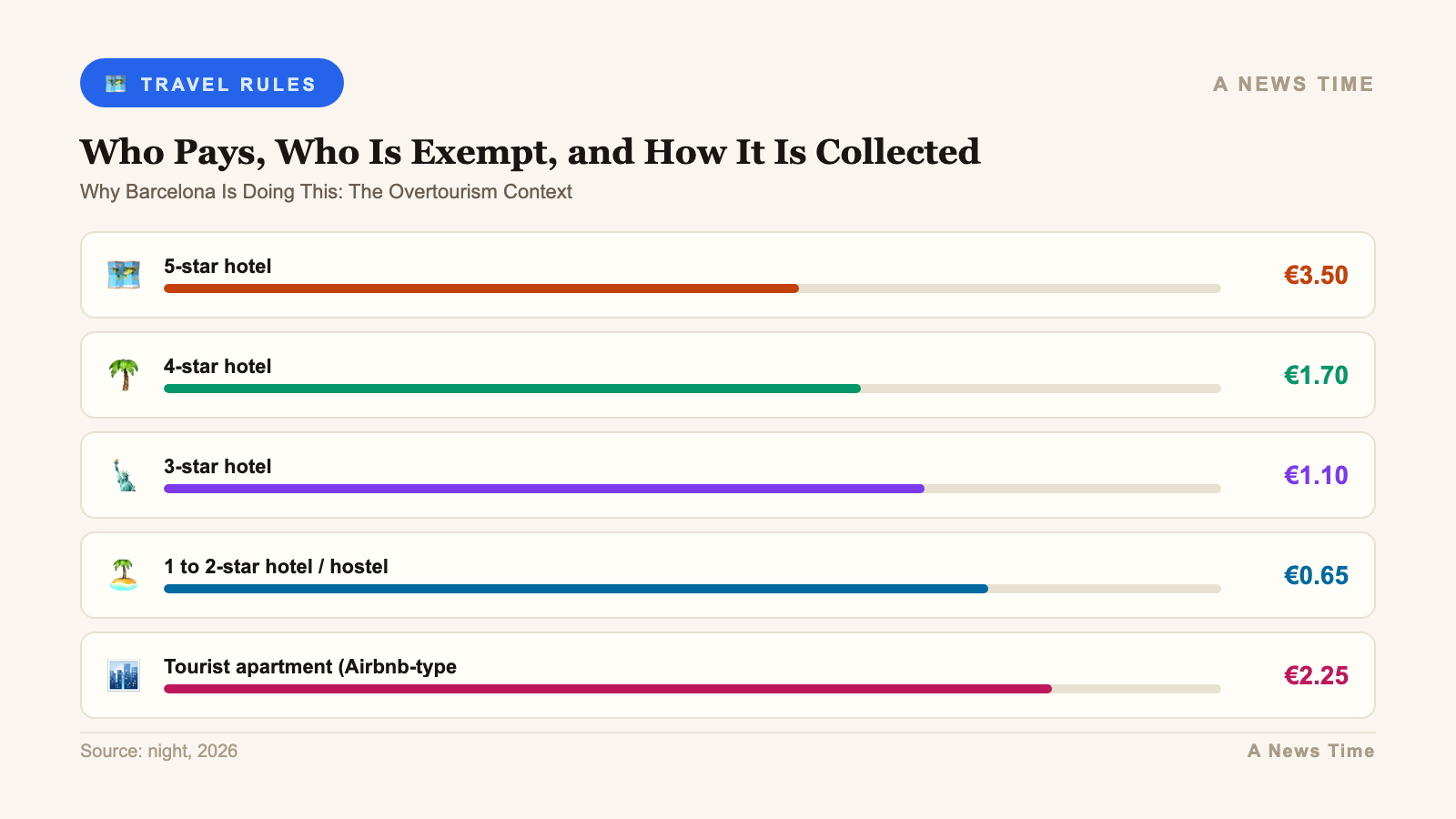
| Accommodation Type | Catalan Base Rate (per person/night) | Barcelona Surcharge (per person/night) | Total (per person/night) |
|---|---|---|---|
| 5-star hotel | €3.50 | €4.00 to €4.50 | €7.50 to €8.00 |
| 4-star hotel | €1.70 | €3.00 to €3.50 | €4.70 to €5.20 |
| 3-star hotel | €1.10 | €2.00 to €2.50 | €3.10 to €3.60 |
| 1 to 2-star hotel / hostel | €0.65 | €1.50 to €2.00 | €2.15 to €2.65 |
| Tourist apartment (Airbnb-type) | €2.25 | €3.50 to €4.00 | €5.75 to €6.00 |
| Cruise ship berth (per port call) | €6.50 | €5.00 to €7.00 | €11.50 to €13.50 |
The practical implication for a typical four-night family stay in a three-star hotel near the Eixample: two adults would pay approximately €3.10 to €3.60 per person per night, totaling €24.80 to €28.80 in tourist tax on top of the room rate. For a couple staying four nights in a five-star hotel near the Passeig de Gracia, the combined tax comes to €60 to €64. These are real numbers that belong in the budget line before you book, not as a surprise on the checkout receipt.
Who Pays, Who Is Exempt, and How It Is Collected
The tourist tax applies to any person over the age of 16 staying in tourist accommodation in Catalonia, including Barcelona. Children under 16 are exempt. The tax applies per person per night, which means a family of four with two children pays for the two adults only.
Spanish residents who can demonstrate legal residency in Catalonia are exempt from the regional tax component. This exemption is verified by accommodation providers and requires a valid Spanish national identity card or residency certificate. Non-Spanish EU citizens and all international visitors are liable for the full combined rate.
Collection practice varies by property. Most hotels collect the tax at check-out, presenting it as a separate line item on the final bill. Some budget properties and hostels collect at check-in. Apartment rental platforms increasingly include the tax in the displayed total, though some still add it at the payment confirmation stage. The safest practice is to ask at booking confirmation stage whether the displayed price includes the tourist tax, or check the platform's itemization carefully.
The tax is per person, not per room. This matters for solo travelers, who pay the full per-person rate, and for families with young children who need to verify whether the platform's occupancy calculation includes children under 16 in the taxable count. Booking platforms sometimes calculate tax incorrectly based on total occupancy rather than taxable adults; discrepancies should be raised with the accommodation provider before arrival.
Why Barcelona Is Doing This: The Overtourism Context
The 2026 tourist tax increase does not exist in a policy vacuum. It is part of a broader set of measures the Barcelona municipal government has been assembling over several years to address what it characterizes as an overtourism crisis that is damaging resident quality of life and long-term city liveability.
The city receives approximately 12 million overnight tourist stays annually, plus an estimated 20 million day-trippers who arrive by coach or cruise ship and generate economic activity without paying accommodation taxes. The ratio of visitors to resident population in the central districts, particularly the Gothic Quarter, Born, and Barceloneta, has reached levels that are difficult to manage from an infrastructure and public services perspective.
The tax increase is being implemented alongside several other measures. The most consequential is the announcement that Barcelona will not renew short-term tourist apartment licenses in the city center when the current licenses expire at the end of 2028. This will remove approximately 10,000 Airbnb-type apartments from tourist use and return them to the long-term residential rental market. The municipality's position is that housing affordability for residents is a more pressing policy priority than maintaining accommodation supply for visitors.
"The question we are answering with this policy is: who is this city for? Our answer is that it is primarily for the people who live here, and secondarily for visitors. That ordering has consequences for accommodation policy and tax policy."
Barcelona City Council spokesperson on the 2026 tourist tax reform, April 2026
The broader European context matters here too. As our analysis of overtourism across European cities documents, Barcelona's approach is among the most aggressive but not an outlier. Venice, Amsterdam, and Dubrovnik have all moved toward price-based and supply-side management tools. Barcelona is simply further along the political arc, partly because the housing crisis has been more acute and the protest movements more organized.
How the Tax Revenue Is Supposed to Be Spent
This is the question that tends to attract the least attention from travelers and the most scrutiny from local residents and industry groups. Tourist tax revenue flows to both the Catalan regional government and Barcelona City Council, with different allocation frameworks for each.
The Catalan regional government allocates its tourist tax revenue to the Tourist Promotion Fund, which is split between tourism promotion (bringing more visitors) and sustainable tourism management (managing the visitors who are already here). Critics, including several Barcelona municipal councillors, have argued that allocating overtourism tax revenue to tourism promotion represents a circular dysfunction: taxing visitors to fund campaigns to attract more visitors.
Barcelona's city surcharge revenue is more directly tied to resident-welfare expenditure. The 2025 budget allocated city tourist tax revenue to social housing development, public space maintenance in the city center, and neighborhood social services. The 2026 increase is specifically projected to fund infrastructure maintenance in the highest-traffic heritage areas of the city, where the physical wear from pedestrian volumes has accelerated maintenance costs beyond normal budget provisions.
Industry groups representing Barcelona's hotel sector have broadly accepted the tourist tax structure as preferable to alternatives like visitor caps or quotas, which would limit occupancy and therefore revenue. The hotels' argument is that the tax is a relatively small cost to visitors, does not materially affect booking decisions, and generates funds that maintain the public infrastructure hotels depend on for their attractiveness to visitors. The apartment rental sector's response has been more resistant, particularly in light of the 2028 license non-renewal announcement.
Booking Platforms and the Hidden Tax Problem
One of the most practical irritants of the Barcelona tourist tax structure is the inconsistency with which booking platforms handle its display and collection.
Booking.com typically displays room rates exclusive of tourist tax, noting in small print that "local taxes may apply." The actual tax amount is often not specified until the payment confirmation stage, or is quoted in aggregate for the stay rather than per person per night, which makes it difficult for travelers to verify the calculation. This is legal under current EU consumer protection regulations but arguably fails the spirit of transparent pricing.
Airbnb's approach varies by host. Many hosts in Barcelona have configured their listings to include the tourist tax in the displayed price, which produces more transparent totals. Others add it as a separate item at checkout. The platform's pricing algorithm calculates tax based on total occupancy, which can overcharge families with young children who should be exempt.
Hotel direct booking sites are generally the most transparent, partly because large hotel groups have legal teams that keep their consumer-facing materials in line with tax disclosure requirements. If you are comparing the cost of a hotel booking versus an apartment rental in Barcelona, confirm the tourist tax treatment on both before concluding that one is cheaper than the other. The displayed difference may compress or reverse when taxes are properly accounted for.
For extended stays, remember that the tourist tax is typically capped after a set number of nights. The cap varies by accommodation category and is set in the Catalan tax regulation rather than by the individual property. Long-term stays of two weeks or more may see the tax liability stop accruing partway through the booking, though the property should advise you of this at check-in.
Budgeting for Barcelona in 2026: Real Numbers
Running through specific scenarios illustrates where the tourist tax sits relative to total trip cost.
A solo traveler staying five nights in a mid-range three-star hotel near the Gracia neighborhood will pay approximately €15 to €18 in combined tourist tax, on top of a room rate that might run €80 to €120 per night in April. The tax represents roughly 3 to 4 percent of total accommodation cost. Meaningful if you're budget-traveling at the margins, but not trip-altering.
A couple staying seven nights in a four-star hotel in the Eixample, in the typical mid-April to mid-May spring travel window, will pay €65.80 to €72.80 in combined tourist tax for the two of them. Their nightly room rate will run approximately €180 to €280 per night. The tax is roughly 5 to 6 percent of accommodation cost.
A family of four (two adults, two children under 16) in a tourist apartment for five nights will pay the per-person rate for two adults only: approximately €57.50 to €60.00 total. Their apartment rate might run €150 to €250 per night. The tax here is roughly 5 to 7 percent of accommodation.
Cruise passengers face a different calculation. The per-port-call rate on cruise ships has been increased most aggressively in 2026, reflecting Barcelona's specific objection to cruise tourism's economic profile (high visitor volumes, relatively low onshore spending per head, significant infrastructure wear). A cruise passenger's combined tax per Barcelona port call will run approximately €11.50 to €13.50. This is collected by the cruise line and appears on the shipboard account rather than being paid directly.
Comparing Barcelona to Other European Tourist Tax Cities
Context helps. Barcelona's 2026 combined tax rate is not the highest in Europe, but it is among the more significant for budget travelers due to the two-layer structure.
Amsterdam charges a tourist tax of 12.5% of the room rate, which makes it more expensive than Barcelona for anyone staying in mid-range or upmarket accommodation. A €150-per-night Amsterdam hotel generates €18.75 in tourist tax per night versus Barcelona's €4.70 to €5.20 for a comparable four-star property.
Venice's day-tripper entry fee, currently €5 on peak days, applies separately from accommodation taxes and is the only major European tourist levy targeting non-overnight visitors. The Venice fee is paid via a digital QR code system at entry points to the historic center.
Paris has a tourist tax structure that is broadly comparable to Catalonia's regional approach, tiered by accommodation category, with Paris-specific surcharges layered on top in the city's central arrondissements.
Rome and Florence have city-level tourist taxes without a regional layer, typically running €3 to €7 per person per night depending on accommodation star rating.
In the European context, Barcelona's tax is positioned in the middle range for major tourist cities, though the combination of the regional levy plus city surcharge creates a more complex disclosure environment than single-rate systems. The 2026 increase brings it closer to Amsterdam's absolute cost for mid-range properties while remaining below Amsterdam's percentage-based system for premium accommodation.
What Changes If You Stay Outside Barcelona City Limits
The Barcelona city surcharge applies only within the Barcelona municipality. The Catalan regional tax applies across the entire autonomous community. Travelers staying in municipalities adjacent to Barcelona, such as Hospitalet de Llobregat, Badalona, or Sant Adria del Besos, pay the Catalan rate without the Barcelona surcharge. This produces a modest but real cost difference for budget travelers who are visiting the city on day trips from more affordable periurban accommodation.
Sitges, the beach and culture town approximately 40 minutes from Barcelona by train, falls within Catalonia but outside the Barcelona municipality. Visitors staying there pay only the Catalan regional rate. Given that Sitges has excellent beaches, a strong independent restaurant scene, and accommodation that runs significantly cheaper than central Barcelona, it is worth considering as a base for visitors who want to experience Barcelona and the coast without paying Barcelona city center prices and full tourist tax.
The same logic applies to the Costa Maresme coast north of Barcelona, accessible by the R1 Rodalies train line. Caldetes, Calella, and Pineda de Mar all offer beach accommodation at rates well below Barcelona's central neighborhoods, with the Catalan tourist tax and no city surcharge. The train journey into Barcelona's Passeig de Gracia takes 40 to 60 minutes depending on the stop.