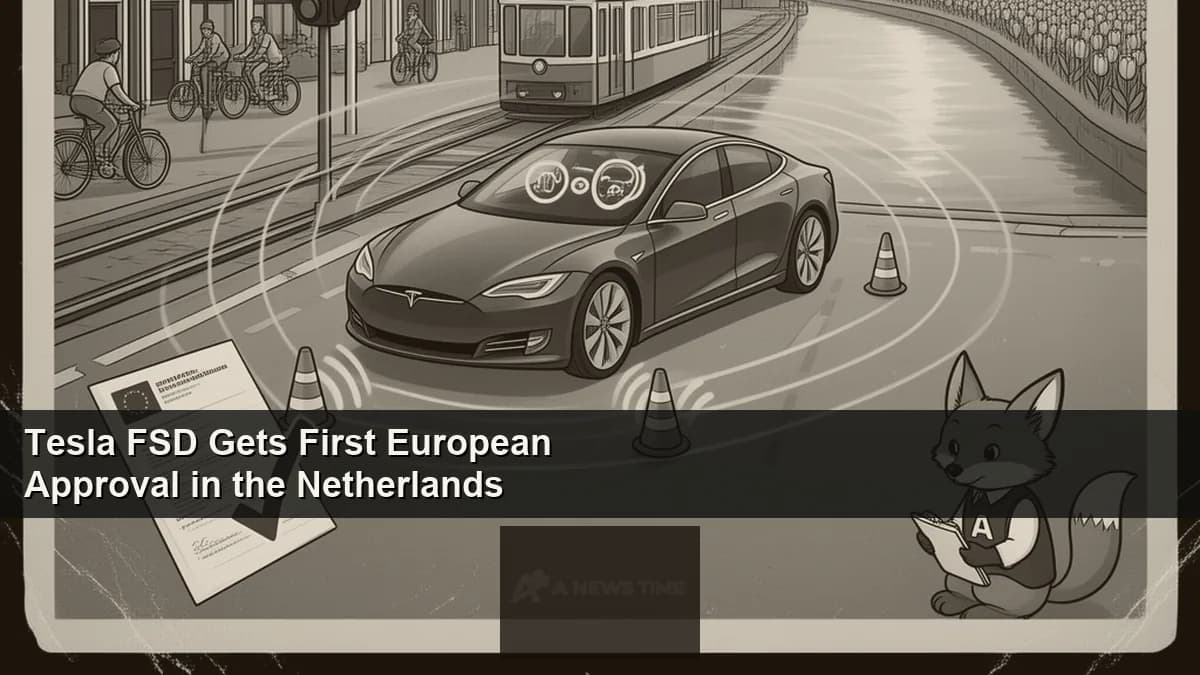
Tesla cleared a regulatory wall that has held back its most closely watched software product in Europe for more than three years. On , the Dutch vehicle authority RDW granted approval for Tesla's Full Self-Driving (FSD) software package in the Netherlands, making the country the first member of the EU to authorize the system on public roads. The sign-off is narrow in technical scope, but broad in strategic importance: under EU mutual-recognition rules, a single national type approval can serve as the foundation for a bloc-wide rollout, and Tesla now has one.
What the RDW Approval Covers
The RDW is the Dutch agency responsible for vehicle type approval, roadworthiness inspection, and driver licensing. It is also one of the most active type-approval authorities in Europe for advanced driver-assistance systems, having previously signed off on versions of Tesla's Autopilot, Navigate on Autopilot, and the Summon feature. Monday's decision extends that track record into the full FSD stack, including in-city navigation, traffic-light and stop-sign response, and the automated lane-change logic that has been the biggest sticking point under UNECE regulation.
According to the filings and reporting from AOL, the RDW approval allows Tesla to enable a supervised FSD mode on Dutch roads for eligible Model 3, Model Y, Model S, Model X, and Cybertruck vehicles running current hardware. The authorization specifies that a licensed driver must remain attentive, with hands available and eyes on the road, and that the system's operation is subject to the existing Dutch traffic code. Tesla has said a software update pushing the feature will begin rolling out in the coming weeks, initially as an opt-in beta for owners who already purchased the FSD package.
Why the Netherlands Went First
The Netherlands has been quietly positioning itself as Europe's most ADAS-friendly regulator for years. Dutch roads are dense, well-signed, and heavily instrumented; the country has a national strategy for automated driving that dates back to 2015; and the RDW has built an internal testing regime that automakers describe as strict but predictable. Mercedes-Benz, BMW, and Volvo have all used RDW as their lead approval agency for Level 2 and Level 2+ features before pushing outward to Germany, France, and Scandinavia.
For Tesla, that institutional willingness mattered. FSD's lane-change behavior, which allows the system to move into an adjacent lane without the driver manually activating the turn signal, sat outside the bounds of the previous UNECE Regulation 79 framework. The updated version of that regulation, which took effect across UNECE signatories in late 2025, created room for supervised automated lane changes under specific conditions. The RDW was one of the first agencies in Europe willing to interpret the new language in a way that accommodated Tesla's implementation. According to reporting published by AOL on Monday, the Dutch authority requested additional logging and driver-monitoring data from Tesla during the testing phase, and the company agreed to ship those features in the version released for Dutch customers.
"The RDW's decision reflects a conservative reading of the updated UNECE framework, not a leap of faith," one European regulatory consultant told National Today in commentary published this week. "They are saying the system meets a Level 2 supervisory standard under current law. They are not saying Tesla has been given permission to run unsupervised."
FSD Is Still Level 2, and That Matters
This point is worth emphasizing because the branding does a lot of work that the engineering does not. Full Self-Driving, as approved by the RDW, remains a Society of Automotive Engineers (SAE) Level 2+ system. That means the driver is legally and functionally responsible for the vehicle at all times, must monitor the driving environment continuously, and must be able to take over immediately. The car can steer, accelerate, and brake on its own across a wider range of scenarios than standard Autopilot, but it is not authorized to operate without human supervision, and it cannot legally be used hands-off.
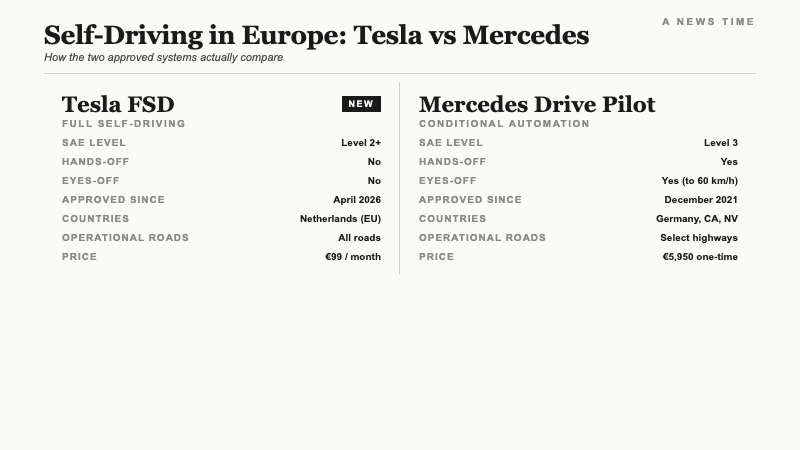
Mercedes-Benz, by contrast, has held a Level 3 approval for its Drive Pilot system in Germany since 2021, a certification that allows eyes-off, hands-off operation within a defined operational design domain. Drive Pilot received its own Dutch approval earlier, but only for use on specific motorways below 95 kilometers per hour in congested traffic. The distinction between Level 2+ and Level 3 is not marketing semantics. It is the legal difference between "driver is responsible for the crash" and "manufacturer is responsible for the crash."
The Mercedes Comparison
The cleanest way to understand what Tesla just won, and what it did not, is to put the two systems side by side. Both are legal in the Netherlands now. Only one allows the driver to stop paying attention.
| Feature | Tesla FSD (Dutch approval) | Mercedes Drive Pilot |
|---|---|---|
| SAE level | Level 2+ | Level 3 |
| Hands-off capable | No, driver must remain attentive | Yes, within operational design domain |
| Approved speed ceiling | Full posted limits | 95 km/h (highway traffic jam pilot) |
| Approved road types | Urban, suburban, highway | Limited mapped motorways |
| Approved countries | Netherlands (first EU) | Germany, Netherlands, parts of US |
| Package price | Approximately 7,500 euros one-time or subscription | Approximately 6,000 euros annually |
| Liability during engagement | Driver | Manufacturer (within ODD) |
On paper, Drive Pilot is the more advanced system legally. In practice, Drive Pilot only works in slow-moving highway traffic jams in perfect weather on pre-mapped sections of road. Tesla FSD, once active in the Netherlands, will work on a much broader set of roads and scenarios, but with a human on the hook the entire time. Which one is "better" depends on whether the buyer wants convenience on one commute per year or every commute.
What Dutch Drivers Can and Cannot Do With FSD
Tesla has published a preliminary owner-facing document outlining the envelope of the approved system. The short version is that Dutch FSD looks essentially identical to the North American version, with additional driver-monitoring enforcement and a few localization tweaks for European signage and right-of-way conventions.
- Permitted: supervised automated steering, acceleration, and braking on urban, suburban, and highway roads under Dutch traffic law.
- Permitted: automated lane changes with driver confirmation, and unconfirmed lane changes on highways when the onboard camera confirms a clear gap.
- Permitted: traffic-light recognition and response, stop-sign compliance, roundabout navigation, and automated parking.
- Not permitted: hands-off operation, eyes-off operation, or use of the system while the driver-monitoring camera flags inattention.
- Not permitted: operation in designated geofenced zones including certain historic city cores, pedestrian zones, and roadworks.
- Not permitted: any form of fare-carrying or commercial autonomous operation. This is a private-vehicle consumer feature only.
The RDW has also required Tesla to implement a stricter driver-monitoring protocol than the one currently shipping in North America. If the system detects sustained inattention, it will warn, slow, and eventually disable FSD for the remainder of the trip. A repeat offender's account can be suspended from FSD entirely for a rolling period, which is a mechanism Tesla already uses in the United States but enforces unevenly.
What This Means for the EU Rollout
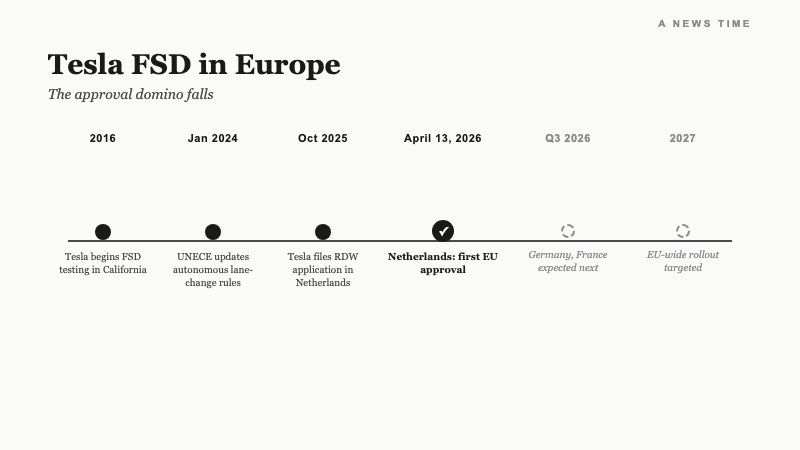
The mechanical answer to "what comes next" is type-approval mutual recognition. Under EU single-market rules, a vehicle type approval issued by one member-state authority is valid across the bloc, with some exceptions for national traffic law. In theory, that means FSD is now legal to enable on Tesla vehicles registered anywhere in the EU. In practice, each national authority will want to review the software against its own road-traffic regulations, and some countries will move faster than others.
Germany, which has been the most protective of its domestic automakers on ADAS regulation, is expected to be the slowest. France and Spain are likely to follow the Netherlands within months. The Nordics have historically moved in lockstep with the RDW, so Denmark, Sweden, and Norway (the last of which is not an EU member but is part of the broader European regulatory zone) should not be far behind. Italy is a wild card because of its fragmented regional road authorities.
For Tesla, the commercial upside is immediate. The company has been collecting FSD package purchases from European customers for years with no mechanism to deliver the feature. Those pre-paid subscriptions now convert into revenue recognition events as the software activates, which matters for a company that just missed Q1 delivery consensus.
Tesla's Q1 2026 Problem and the Robotaxi Story
The Dutch news arrives in the middle of an uncomfortable quarter for Tesla. The company reported 358,000 vehicle deliveries in Q1 2026, up roughly 6% year-over-year but below the Wall Street consensus of 365,000 units. Shares of Tesla (TSLA) were down about 29% from their recent highs heading into the announcement, and the delivery miss added to a narrative that the core auto business is growing more slowly than the company's valuation demands.
That backdrop is why the FSD news matters beyond the Netherlands. It gives bulls a tangible data point to anchor the robotaxi thesis that has been propping up Tesla's stock through the delivery slowdown. Analysts at Bank of America and Morgan Stanley published notes last week arguing that 2026 should be understood as the "year of the robotaxi," with Morgan Stanley's Adam Jonas reiterating a bullish price target on the basis of Cybercab production ramping and FSD expanding internationally. Bank of America's John Murphy wrote that regulatory progress in Europe would be one of the three or four "gating signals" for the robotaxi narrative to hold into the second half of the year.
"Investors are not paying for Model Y deliveries at this valuation. They are paying for the probability-weighted option on a global robotaxi network," one sell-side analyst told National Today in commentary published over the weekend. "Every piece of regulatory friction that falls away tightens that option."
Cybercab, Model S, and the Wider Lineup
The Dutch approval also connects to Tesla's other 2026 product milestones. The company is in the middle of standing up production of the Cybercab, its purpose-built two-seat robotaxi platform. Cybercab relies on a version of the same FSD software stack that just got Dutch approval, but at Level 4 or Level 5, not Level 2+. Getting the supervised version legal in a regulated market is not the same thing as getting an unsupervised version certified, but it moves the regulatory conversation forward. For more context on where Cybercab currently sits, see our coverage of the Cybercab production launch.
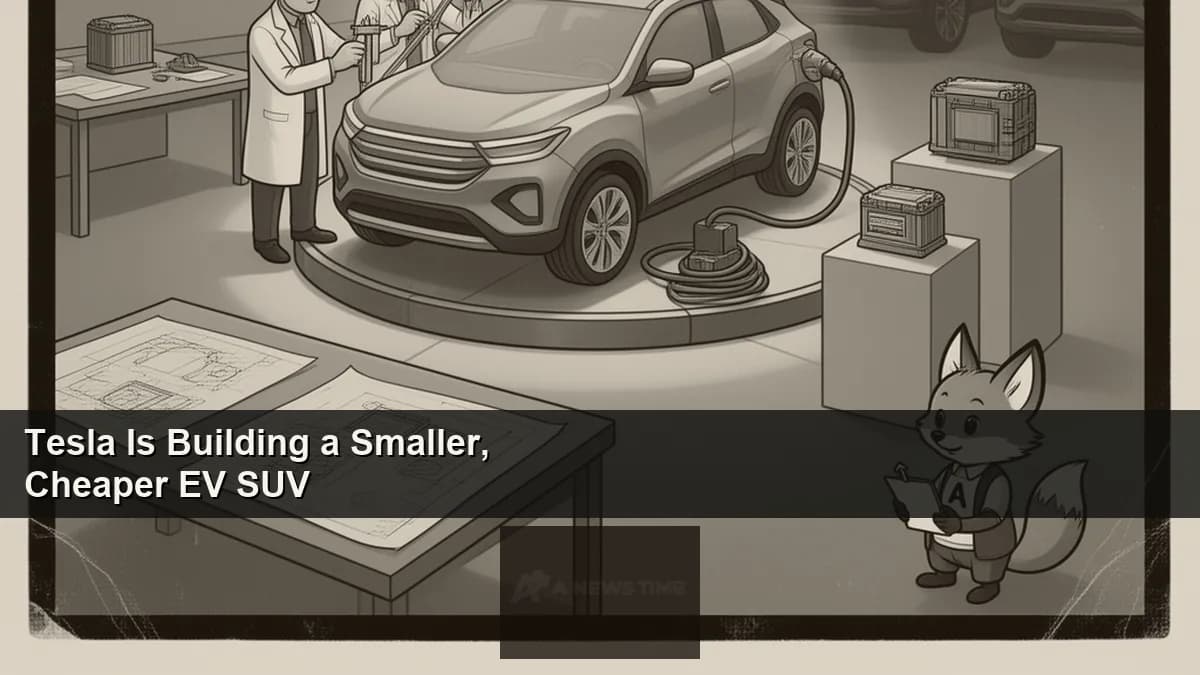
Tesla is also reviving Model S and Model X production lines that had been effectively mothballed for low demand, and is running development on a smaller, cheaper crossover that the company hopes to price below the current Model Y. For details on that program, see our report on the smaller, cheaper Tesla SUV in development. The China business, meanwhile, has been a rare bright spot after a strong March; readers can find more in our story on Tesla's recent China sales surge.
Taken together, the picture is of a company trying to rebuild momentum on several fronts at once: cheaper hardware, revived flagships, a purpose-built robotaxi, and now a regulatory beachhead in Europe for its software. The bull case holds only if enough of those pieces land.
How This Compares to the US FSD Story
In the United States, FSD remains in a regulatory gray zone. The National Highway Traffic Safety Administration has several open investigations into Autopilot and FSD-related incidents, including a multi-year probe into phantom braking and a more recent inquiry into driver-monitoring effectiveness. Tesla has continued to ship FSD updates to North American customers throughout those investigations, but without any formal approval framework equivalent to a European type approval.
One of the quiet tensions inside Tesla's regulatory strategy is that a supervised Level 2+ approval in the Netherlands is actually a more formal, more documented, more auditable permission than anything Tesla currently holds in the United States. American regulators have not blocked FSD, but they also have not blessed it. European regulators have now explicitly blessed a version of it. That creates an awkward asymmetry: the home market is more permissive in practice but less supportive on paper.
For Tesla's legal exposure, this distinction matters. An approved type certification is a defense against certain product-liability claims in European courts in ways that an unregulated deployment in the United States is not. The Dutch approval is not just a sales milestone. It is also a litigation shield.
What to Watch Next
Three things worth tracking over the next ninety days. First, the pace at which other EU national authorities accept the RDW type approval without additional review. The faster that happens, the faster Tesla converts deferred FSD revenue into recognized revenue. Second, any public data from the Dutch deployment on driver-monitoring compliance and disengagement rates. The RDW reporting framework will make that data available to other regulators, and it will shape how quickly Germany and France move. Third, whether Tesla makes any public move on Level 3 certification in Europe, which would be the first step toward actually competing with Mercedes Drive Pilot on its own technical terms rather than on software breadth.
Cybercab is the longer arc. If Tesla can ship Cybercab production units in the second half of 2026, and if FSD is active in enough European markets to support a limited robotaxi pilot somewhere in the EU, the story changes. If Cybercab slips into 2027 and FSD approvals stall after the Netherlands, the story is just "Tesla can sell a driver-assist upgrade in one more market." Those are very different outcomes for a stock that is trading on the optionality rather than the fundamentals. The Dutch approval is a real data point on the optimistic side of that ledger, which is why it moved.