FutureFit AI, the Toronto workforce-development company whose software helps governments and large employers move displaced workers into new roles, announced on that it had secured a strategic investment from Achieve Partners, a U.S. private investment firm focused on workforce training and education-to-employment companies. The deal arrives at a moment when the phrase "career navigation" has shifted from self-help jargon into a line item on state and provincial budgets. Oracle and Meta have both cut technology jobs in 2026, Silicon Valley is openly debating what it means that some founders are proposing to "stop hiring humans" in favor of agents, and BlackRock chief executive Larry Fink has spent much of the year warning that Gen Z faces a distinct AI jobs crisis. FutureFit AI sits in the middle of that conversation because its customers are the institutions actually paying for the fallout.
The Deal
Achieve Partners describes itself as a private investment firm focused on education-to-employment businesses, which in practice means it buys stakes in companies that help people move from school or unemployment into jobs that pay a living wage. FutureFit AI fits that thesis cleanly. The company does not sell its software to individual job seekers. Its customers are governments, workforce boards, community-college systems, and enterprise employers running large-scale reskilling programs for their own staff.
Neither party disclosed the size of the investment in the April 13 announcement, and neither named a specific valuation. The language used in the release from FutureFit AI described the transaction as a "strategic investment to help governments and industries navigate AI's impact on people and jobs." The framing is consistent with the way Achieve Partners has talked about its portfolio elsewhere: the firm tends to back businesses that sell into public systems and enterprise HR departments rather than direct-to-consumer education brands.
What is unusual is the timing. Previous waves of workforce-tech funding tracked the 2010s coding-bootcamp boom and, later, the online-learning surge during the pandemic. This round of capital is landing during a labor-market story with a sharper edge: the software being sold is meant to cushion workers from the same technology that attracts most of today's venture funding.
What FutureFit AI Actually Does
FutureFit AI's platform is built around three functions. It maps an individual worker's existing skills, both formal credentials and the softer competencies picked up on the job. It compares that map against open roles inside a region or an employer's workforce, flagging adjacent jobs the worker could plausibly move into. And it generates personalized learning pathways, usually a mix of short courses, employer-funded training, and apprenticeships, that close whatever gap remains between the worker's current profile and the target role.
The company calls the combination a talent marketplace. In marketing copy it sounds similar to any number of other HR tools, but the operational difference is that FutureFit AI is designed to serve very large, heterogeneous populations at once. A state workforce board running an unemployment insurance system is not trying to match ten engineers to ten job descriptions. It is trying to look at two hundred thousand displaced workers spread across a dozen industries and figure out which retraining programs are actually worth funding with public money.
That design choice shapes the product. FutureFit AI's clients include state and provincial governments, workforce agencies, and major employers running internal mobility programs. The platform's value, according to the company, is less about producing a slick interface for one job seeker and more about giving a labor-market administrator a readable picture of where displaced workers can realistically go.
- Skills extraction from resumes, assessments, and prior work history
- Adjacent-role matching that flags transferable-skill pathways
- Personalized learning plans tied to local training providers
- Labor-market analytics dashboards for workforce administrators
- Integration with unemployment insurance and case-management systems
- Outcome tracking on placement, wages, and retention
The Goldman Sachs Number Everyone Is Citing
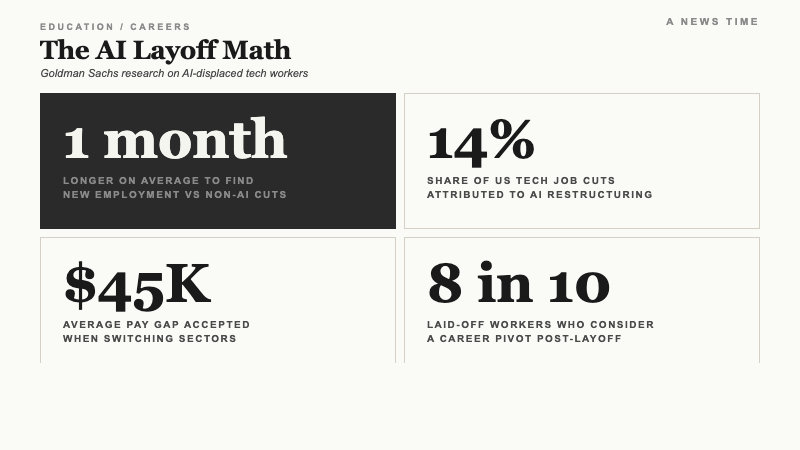
The investment announcement landed inside a news cycle dominated by a single data point. Goldman Sachs research, circulated widely in early April and covered by The Economic Times, found that technology workers displaced in the current AI-driven layoff wave are taking roughly one month longer on average than workers in other industries to find new employment. The delta is not astronomical, but it is meaningful for household budgets, and it is the kind of number that gets quoted inside state labor departments when they are deciding how long to fund retraining benefits.
The Goldman note framed the delay as a sign that the tech labor market is structurally different in 2026 than it was in previous downturns. Job openings in software engineering have not disappeared, but the specific roles being cut, including some middle-layer managerial and generalist positions, are not being created at the same pace on the other side. Workers looking for a one-for-one replacement are finding that the replacement does not exist.
"The laid-off tech workers we follow are not unemployable. They are, on average, taking about a month longer to reenter the workforce than peers in other sectors, and they are more likely to change industries when they do."Goldman Sachs labor research team, cited by The Economic Times
That "change industries" line is the part that matters most to FutureFit AI's pitch. If displaced workers are moving out of software altogether, the question is not how to reskill them for slightly different tech roles. It is how to guide them into health care, skilled trades, logistics, or public-sector jobs without losing the economic value of skills they already have. That kind of cross-sector matching is exactly what the company claims to automate.
The Public-Private Retraining Model
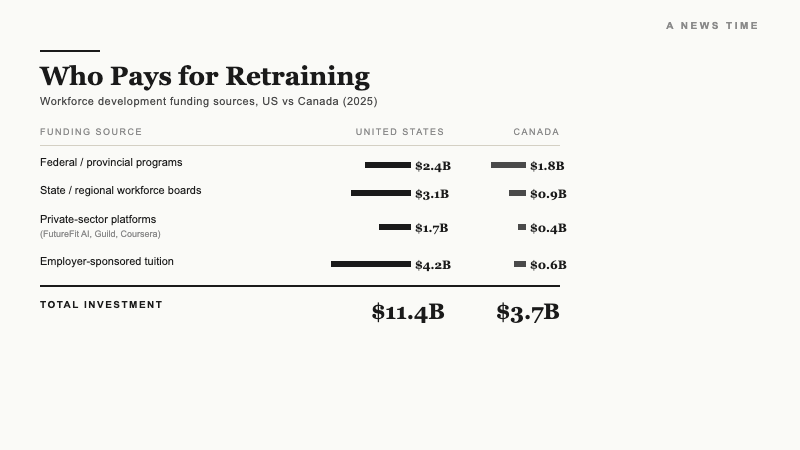
For a long time, workforce retraining in North America was a public-sector story. States ran employment offices, Canada ran provincial career centers, and private companies showed up only at the margins, usually as training vendors. The education-to-employment category that Achieve Partners invests in blurs that line. Companies like FutureFit AI sell software directly to those public systems, taking on what used to be in-house analytics work.
Consultants who study the category describe the shift as an unbundling of the employment office. Instead of building technology in-house, workforce agencies increasingly buy modular tools from specialized vendors: one platform for case management, another for skills assessment, another for labor-market forecasting. FutureFit AI sits inside that stack as the piece that decides where a worker could plausibly move next.
"The agencies we work with do not have the engineering capacity to build what FutureFit AI builds. Ten years ago, they would have tried. Today, they know that buying a specialized tool is more honest about where their comparative advantage lies."Labor-market analyst at a U.S. workforce policy think tank, paraphrased from a recent panel discussion
The flip side of that shift is a dependency question. Public workforce systems that rely on private vendors also take on the risk that those vendors pivot, get acquired, or shut down. Achieve Partners' investment is partly about de-risking that story for customers. A well-capitalized vendor with patient ownership is a more durable partner than a startup on a short runway, and that durability is arguably the core thing governments are buying when they sign multi-year contracts.
Who Funds Workforce Tools Now
The list of investors active in workforce technology has changed sharply since 2022. Traditional venture firms that poured money into coding bootcamps and consumer upskilling apps have largely stepped back. The capital that remains is coming from a narrower set of players: private equity firms like Achieve Partners, philanthropic funds tied to national foundations, and strategic arms of large staffing and payroll companies.
That shift matters because those investors have longer time horizons and different exit expectations than a Series A venture fund. A private investment firm funding a workforce-navigation company can afford to wait for government contracts to close, for pilot programs to turn into statewide rollouts, and for procurement cycles that sometimes run 18 months or longer. Consumer ed-tech could never have lived inside that timeline.
The broader category has also been reframed. In 2020, companies like FutureFit AI would have been described as "ed-tech." In 2026, they are increasingly described as "labor-market infrastructure." The language change is not accidental. It signals that the product is being sold less as a learning experience and more as a piece of civic plumbing.
What the Data Shows About Displacement
Numbers from across the OECD in 2026 paint a picture that is both less dramatic and more uncomfortable than the loudest headlines suggest. Aggregate unemployment remains historically low in the United States and Canada, but specific occupations are being hollowed out. Indeed data from Australia, reported in early 2026, showed a sharp rise in the share of job postings that mention AI tools, a sign that employers are not replacing workers wholesale but are rewriting the job descriptions for everyone they hire. In India, Business Today reported that only a fraction of the country's 1.5 million annual engineering graduates have been trained in emerging AI technologies, a mismatch that is starting to shape hiring for multinationals staffing global capability centers.
| Signal | Source | Implication for retraining |
|---|---|---|
| Tech layoffs at Oracle and Meta | 2026 corporate announcements | Concentrated displacement in high-wage roles |
| One-month longer job hunt for displaced tech workers | Goldman Sachs research | Income gap during transition, higher need for bridge support |
| AI mentions surging in Australian job ads | Indeed data, 2026 | Incumbent workers face new skill expectations mid-career |
| Small share of India's 1.5M engineering grads trained in emerging AI | Business Today, 2026 | Gap between degree supply and employer demand |
| BlackRock chief warning on Gen Z jobs | Larry Fink public remarks, 2026 | Youth labor-market entry under pressure |
None of these signals points to a single clean prescription. Together they describe a labor market where the old shorthand of "get a degree, get a job" is fraying at the edges, and where the institutions historically responsible for workforce transitions are looking for better tools to see what is actually happening.
The Skills Gap vs. The Skills Bubble
There is a healthy debate among labor economists over whether what is happening in 2026 is a genuine skills gap or a skills bubble. Advocates of the skills-gap framing argue that employers have real unmet demand for workers with specific technical competencies and that retraining is the obvious fix. Skeptics argue that the "gap" is often a pricing story: employers would find qualified workers if they raised wages, and calling the mismatch a skills problem shifts the burden onto workers and public budgets.
FutureFit AI's positioning tries to sidestep the argument. By tying its recommendations to actual open roles in a specific local labor market, the platform is explicitly not promising that a given training course leads to a theoretical job somewhere in the AI economy. It points workers toward roles that employers in their region are hiring for right now. That is a more modest claim than much of the industry has historically made, and it is probably a more defensible one given how volatile the top of the tech labor market has become.
Readers interested in how the "skills of the future" debate is being reshaped should also look at coverage of Larry Fink's AI jobs crisis warning, which ties the workforce conversation to generational cohort effects, and a recent piece on decision education in the AI economy, which argues that judgment under uncertainty is itself a trainable skill that most curricula ignore.
What Governments Are Buying
The purchasers on the other side of FutureFit AI's contracts are rarely elected officials directly. They are program directors at workforce boards, labor-market information teams inside state departments of labor, and the public-sector arms of provincial employment services in Canada. What those buyers are looking for, according to people familiar with how these procurements work, is evidence that a retraining dollar moves a worker into a job that lasts.
That standard is harder to meet than it sounds. Historically, workforce programs tracked "placement" as the main metric: did the worker find a job at all. Increasingly, funders want to see retention at six and twelve months, wage progression, and whether the new role is actually in the field the training prepared the worker for. FutureFit AI's pitch is that its platform can capture those outcomes at a population scale, not just anecdotally.
The company's existing relationships with public workforce systems give it access to the kind of longitudinal data that would let those claims be tested. That is one of the less-discussed reasons why an investor like Achieve Partners would find the business attractive. A workforce-tech company with a meaningful outcomes data set is rare, and in a category where everyone is selling the same kinds of features, outcomes data becomes the defensible asset.
The Silicon Valley Panic in Context
Much of the public conversation about AI and jobs in early 2026 has been shaped by a small number of high-profile moments. Digital Journal's coverage of Silicon Valley's "stop hiring humans" discussion described a founder class openly debating whether entire categories of entry-level office work should be handed to agents. Meta's president, in remarks reported earlier in the year, argued publicly that the United States needs a bigger blue-collar workforce to match the AI-era economy. Those statements are not official policy, and the people making them are not the ones writing retraining checks, but they set the tone that workforce agencies are reacting to.
"We are watching customers ask us to model scenarios that would have sounded like science fiction in 2023. What happens to our caseload if a quarter of customer-service jobs go to agents in three years. Those questions are now routine procurement conversations."Paraphrased remarks from a workforce-technology executive, cited in recent industry coverage
The honest answer is that nobody knows the exact shape of the transition. Even the Goldman Sachs research that underpins much of the current discussion is a snapshot, not a forecast. What is clear is that institutions are behaving as if the transition is real, and they are buying tools accordingly. FutureFit AI's new round is one visible sign of that behavior.
The Parallel Ed-Tech Story
Workforce-navigation platforms are not the only piece of the education-to-employment stack attracting attention in 2026. Traditional ed-tech, including the ETIH EdTech Innovation Awards 2026, has spent the year rewarding companies that build AI tutors, adaptive assessment tools, and employer-funded micro-credentials. What separates the FutureFit AI round from those products is the buyer. Ed-tech companies usually sell to schools or to consumers. FutureFit AI sells to the people running the other side of the labor market.
That distinction matters because the incentives are different. A consumer ed-tech company benefits from engagement and course completion. A workforce-infrastructure company benefits from job placements and wage outcomes, because those are the numbers its public-sector customers report back to legislatures. The money sloshing into workforce infrastructure is effectively a bet that the outcome-accountable version of education technology is the more durable one.
What Scales From Here
The practical question now is what the new capital lets FutureFit AI do that it could not do before. Scaling workforce software is not mostly a technology problem. It is an integration problem. Each new government customer arrives with its own case-management system, its own labor-market taxonomy, and its own legal rules about how worker data can be used. Growing from dozens of contracts to hundreds requires building a services layer that can absorb those differences without slowing down the core product roadmap.
Patient capital helps with that kind of expansion in a way that venture funding often does not. A firm like Achieve Partners is comfortable funding a services organization inside a software company, because its portfolio thesis is that education-to-employment businesses look more like health-tech than like consumer software. They grow slower and they stick longer. The new round is likely to fund that kind of build-out, although neither company has published a specific headcount or geography plan.
Watch, too, for the geographic question. FutureFit AI is Canadian, and its earliest reference customers were provincial workforce systems. The investment from a U.S.-based firm points toward a push into American state workforce boards, where contracts tend to be larger and procurement cycles longer. Whether the company can turn that relationship into a broader U.S. footprint is the real growth story baked into this round.
The Bigger Workforce Question
The FutureFit AI announcement is a corporate-development story on its surface. Underneath, it is a marker of how quickly the institutions that manage labor-market transitions are being asked to adapt. Governments do not usually move at the speed of technology cycles. In 2026 they are being asked to, and the tools they buy to do it are now part of the AI economy story whether they want to be or not.
The next 12 months will reveal whether workforce-technology companies can actually deliver the outcomes their customers are writing into contracts. The answer depends on choices that have nothing to do with software: how long unemployment benefits last, whether training programs are funded for long enough to matter, and whether employers meet displaced workers with openings that pay comparably to the jobs they lost. FutureFit AI can help the labor-market administrators navigate those choices, but it cannot make them. What the Achieve Partners investment does is ensure that the navigation layer has the runway to still be around when the choices are made.
For readers trying to make sense of the year's AI jobs discussion, the sensible question is no longer whether a shift is underway. It is whose data you trust to describe it. The institutions paying for FutureFit AI's software are making an explicit bet that the best view of the labor market will come from the tools actually moving workers through it, rather than from quarterly earnings calls or venture-capital pitch decks. That is a reasonable bet. It is also a testable one.
Sources
- FutureFit AI announces strategic investment to help governments and industries navigate AI's impact on people and jobs, Newswire
- FutureFit AI: Strategic Investment From Achieve Partners To Scale Workforce Development Technology, Pulse2
- Fired by Oracle, Meta: Goldman Sachs warns laid-off tech workers job hunt may be long and costly, The Economic Times via MSN
- 'Stop hiring humans': Silicon Valley confronts AI job panic, Digital Journal