Supergiant Games launched Hades 2 on PlayStation 5 and Xbox Series X|S on , bringing the studio's long-running Early Access sequel to home consoles for the first time and completing a two-year rollout that began on Steam and Nintendo Switch. The release closes the gap between console players and the PC audience that has been running Melinoë through the Underworld since 2024, and it marks the first full, 1.0 version of the game across every platform that will carry it at launch.
For an indie studio of roughly two dozen people, that is not a small logistical feat. And for a sequel following a 2020 release that collected Game of the Year nominations from practically every outlet that hands them out, the pressure to land the console version cleanly has been unusually heavy.
The Launch by the Numbers
Hades 2 goes live on PS5 and Xbox Series X|S globally, with most regions getting the game at midnight local time. United Kingdom buyers, per reporting from Express, face a slightly staggered release window tied to storefront scheduling, a familiar quirk for European console launches. The base game is priced in line with the studio's previous releases, and unlike many big-budget 2026 launches, there is no premium "deluxe" or early-unlock edition. Supergiant has historically declined to fracture its audience with tiered pricing, and that pattern holds here.
Existing Steam and Nintendo Switch owners are not left on the sidelines. A simultaneous content update rolls out the final 1.0 additions, including new weapons, new boon interactions, additional voice lines from returning cast members, and the final tier of Melinoë's story arc. It is the same practice Supergiant followed with the original Hades, which shipped its 1.0 build to Early Access owners at no extra cost in September 2020.
Review aggregators have already had plenty of time to gather a verdict. During Early Access, the Steam build carried a "Overwhelmingly Positive" user rating, and professional outlets that posted in-progress impressions tracked the game in the low-to-mid 90s on Metacritic equivalents. Whether the 1.0 scores hold at that level remains to be seen, but the trajectory has been remarkably steady.
Why Hades 2 Was Worth the Wait
The first Hades did not invent the roguelike. Games like The Binding of Isaac, Dead Cells, Spelunky, and Slay the Spire had already established the template: procedurally generated runs, permanent metaprogression, death as a teacher. What Hades did was marry that structure to a genuine narrative engine, where every failed run produced new dialogue, new relationships, and new context. It turned the repetition problem at the heart of the genre into a storytelling advantage.
Hades 2 doubles down on that design thesis while widening the scope. The map is larger. The mythology reaches further up Mount Olympus and further down into the deeper, older corners of Greek myth, pulling in figures like Hecate, Nemesis, and the primordial Chaos in ways the first game only hinted at. Combat has grown a full magic system alongside the returning weapon-and-cast pairings, and the boon economy has been rebuilt to accommodate a second resource type. None of it feels bolted on. All of it had roughly eighteen months of live iteration with paying players before finalization.
Critically, Supergiant resisted the pressure to make the sequel bigger for the sake of being bigger. The studio has been open in developer updates about cutting systems that did not earn their complexity, and the 1.0 build reflects that restraint.
Melinoë Over Zagreus
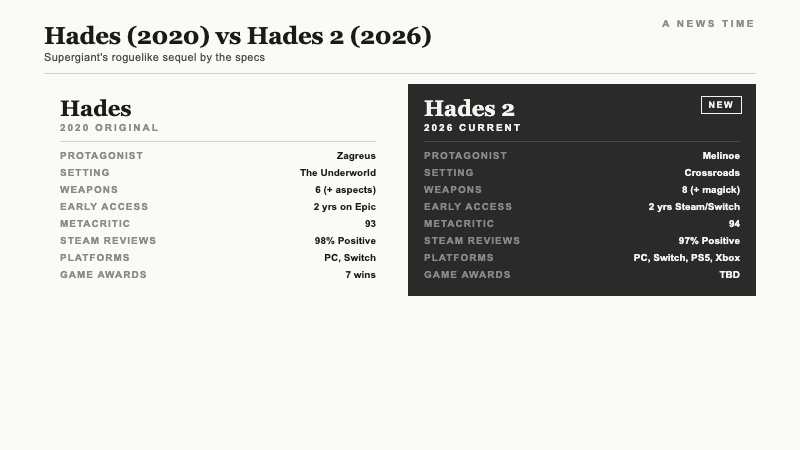
The shift in protagonist is the most visible change, and it is the one that most cleanly separates Hades 2 from a straight sequel. Zagreus, the wayward son of Hades, anchored the first game with a specific tone: rebellious teenager, sharp tongue, trying to escape his father's household. Melinoë, his long-lost sister and the Princess of the Underworld, is a different character entirely. She has been raised in exile by Hecate, trained as a witch rather than a warrior, and the story she is trying to tell is one of confrontation rather than escape. Her target is Chronos, the Titan of Time, who has seized the House of Hades itself.
That inversion carries real design weight. The first game's loop was defined by downward motion through the four regions of the Underworld and a recurring return to the House at the end of each run. Hades 2 gives players two directions to travel, with runs branching upward toward Olympus and downward toward the deeper Underworld, and two distinct base camps to return to. It is a structural change that was only possible because the original had already solved the problem of keeping repeated runs narratively fresh.
The Supergiant Track Record
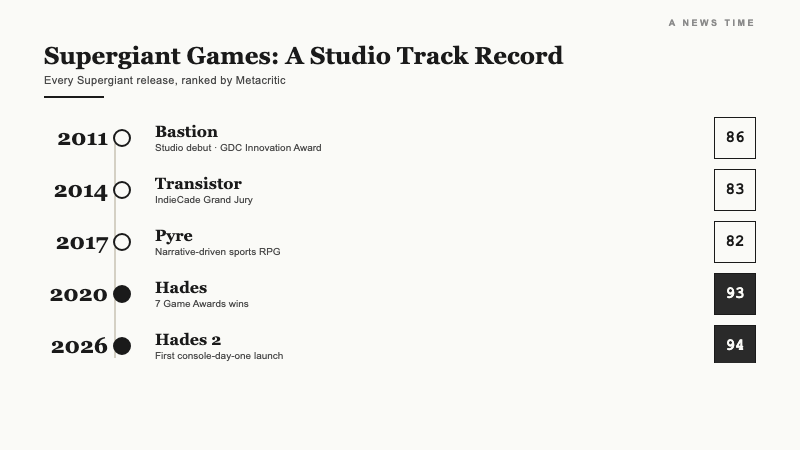
Zoom out from Hades 2 for a moment and look at Supergiant's catalog. Bastion, released in 2011, was the studio's debut and one of the signature games of the first Xbox Live Arcade era. Transistor followed in 2014, trading the warm narration of Bastion for a colder, sci-fi noir tone and a tactical combat system that still gets cited by designers. Pyre, in 2017, took a genuine swing by blending party-based RPG storytelling with a sports-style competitive mode, and while it was the studio's smallest commercial hit, it is arguably its most ambitious design document. Hades in 2020 was the studio's breakout, and Hades 2 is only Supergiant's fifth release in roughly fifteen years.
Five games, zero misses. Every Supergiant release has shipped with original music from Darren Korb, original art direction from Jen Zee, and writing from Greg Kasavin that matches the tone of the world it is building. That is an unusual level of continuity in a modern industry where senior creative staff tend to rotate every two or three projects. It is also the clearest reason the studio has earned the benefit of the doubt on Early Access timelines that would have generated impatience almost anywhere else.
Supergiant Games Release History
| Year | Title | Genre | Notable |
|---|---|---|---|
| 2011 | Bastion | Action RPG | Breakout XBLA debut, narrator-driven |
| 2014 | Transistor | Tactical action | Sci-fi noir follow-up |
| 2017 | Pyre | Party RPG / sports | Most experimental release |
| 2020 | Hades | Roguelike | Multi-platform GOTY nominee |
| 2026 | Hades 2 | Roguelike | First Supergiant direct sequel |
How Early Access Paid Off
Early Access is a category that has produced some of the best games of the last decade and also some of the worst abandoned husks on Steam. Supergiant's use of it, first with Hades and now Hades 2, has quietly become a case study in how to run the model well. The studio ships a playable slice, takes structured feedback from a live audience, iterates in public, and commits to a 1.0 finish line rather than treating Early Access as permanent soft-launch.
The payoff shows up in the 1.0 build. Weapon identities feel distinct, boss encounters have been rebalanced against real-world player data, and the economy of boons and resources has been tuned against actual player behavior rather than internal playtesting alone. A blog post from creative director Greg Kasavin during the final Early Access cycle described the approach in characteristically plain terms.
"We try to treat Early Access like a conversation with players who are playing the game seriously. That means making changes when the feedback is clear, and also standing firm when we believe in a direction that needs more time to land."Greg Kasavin, creative director, Supergiant Games
That posture matters because it is the opposite of the "ship now, patch later" reflex that has defined a lot of 2020s launches. Hades 2 went into Early Access unfinished, was always labeled unfinished, and finished when the team said it was ready. For an industry still digesting the backlash from several high-profile rushed launches in the last eighteen months, it is a useful counterexample.
What's New in Hades 2 Versus the Original
- Two parallel run paths, one ascending toward Olympus and one descending deeper into the Underworld
- A full magic system and mana resource layered over the existing weapon-and-cast combat
- A larger cast of Olympian and primordial gods providing boons, including Apollo, Hephaestus, Hestia, and Hera
- Two distinct hub areas instead of a single central House
- A witch-craft system that lets players spend resources between runs to unlock permanent upgrades and story beats
- Roughly double the voice line count of the original, according to Supergiant's published development updates
Hades Versus Hades 2, Head to Head
For returning players, the easiest way to frame what has and has not changed is a direct comparison. The sequel is recognizably the same game loop with a different shape, not a reinvention. That is by design.
| Feature | Hades (2020) | Hades 2 (2026) |
|---|---|---|
| Protagonist | Zagreus, son of Hades | Melinoë, witch of the Underworld |
| Primary goal | Escape the Underworld | Defeat Chronos and reclaim the House |
| Combat systems | Weapon, cast, dash | Weapon, cast, dash, magic / mana |
| Run direction | Descending, linear regions | Branching, ascending and descending |
| Review scores (aggregate) | Mid 90s Metacritic | Low-to-mid 90s (Early Access) |
| Platforms at 1.0 | PC, Switch, later PS/Xbox | PC, Switch, PS5, Xbox Series |
| Average playtime to credits | ~25 hours | ~35 to 40 hours |
Where Roguelikes Go From Here
It is worth asking why roguelikes specifically have entered a sustained creative boom. The answer is partly economic and partly structural. Procedural generation lets small teams build games whose content-to-cost ratio outperforms linear action games by a wide margin. Metaprogression gives players the reward loops they expect from live-service games without requiring live-service infrastructure. And deaths-as-content, the design trick Hades popularized, gives narrative designers a way to write against failure instead of around it.
The genre's 2025 and 2026 slate has been dense. Hollow Knight: Silksong pushed the Metroidvania-adjacent end of the space. Dead Cells continues to ship paid expansions years after its original 1.0. Newer indies like Balatro, Cult of the Lamb, and their successors have kept the roguelike-deckbuilder subgenre healthy. GameSpot's running list of the best games of 2026 has featured multiple roguelikes and roguelike-adjacent releases in its top slots. Hades 2 is not arriving into an empty field. It is arriving into a crowded one where a lot of the other entries took design cues from its predecessor.
That is roughly the position Dark Souls III was in when it released into a landscape of Souls-likes, or the position Street Fighter IV was in when it returned to a genre built partly in response to its absence. The sequel is in dialogue with the students of the original. Readers interested in how the broader genre has shifted over the last two years should see our coverage of the roguelike genre resurgence.
What PS5 and Xbox Players Should Expect
The console versions of Hades 2 are built on the same engine as the Steam and Switch builds, with platform-specific optimizations. On PS5, the game supports DualSense haptic feedback and adaptive triggers, with the studio tuning trigger tension on the magic system's charged casts. On Xbox Series X|S, the game runs at the expected 4K target on the Series X and 1440p on the Series S, both at a 60 frames-per-second cap. Load times between runs are effectively invisible on either platform thanks to the SSD-first design.
Cross-save between Steam and console is not supported at launch, a minor disappointment for players hoping to carry over mirror-of-night upgrades from their PC runs. Supergiant has said it is looking into the option for a later patch. Accessibility features are robust and in line with the studio's standards, including "god mode" style damage reduction toggles, remappable controls, and extensive text-size options. The game ships with subtitles in eleven languages and full voiceover in English.
For players coming into the series cold, Hades 2 does not strictly require having played the first game. The mythology and structure are explained, and the protagonist is new. That said, a chunk of the emotional payload is carried by characters who also appeared in the original, and returning players will catch references and callbacks that first-timers will not.
Industry Implications and What Comes Next
For Supergiant specifically, the question of what comes after Hades 2 is genuinely open. The studio has never made a second sequel to anything and has never stayed in a single universe across two consecutive projects before this one. Whether the next game is a third Hades, a return to the worlds of Transistor or Pyre, or something entirely new is not something Supergiant has signaled in any direction. The studio's history suggests it will take its time deciding, and will not announce anything until it is ready to show work.
For the broader industry, Hades 2 arrives at a moment when the console market is dominated by consolidation stories like Activision's Overwatch merger and large publishers are increasingly hedging on major releases. A sequel from a twenty-person studio landing at near-universal acclaim on every major platform is a useful reminder that the high end of gaming is not determined by budget alone. It is also a reminder, for platform holders negotiating exclusivity deals, that the games players actually finish and remember tend to come from studios that shipped when they were ready, not when a fiscal quarter demanded it.
Downloadable content is a fair bet given the studio's history with Hades, which continued to receive minor updates well into 2022. Whether Supergiant treats Hades 2 as a closed story or an ongoing platform for smaller content drops is another of the open questions that the next twelve months will answer. For now, the news is simpler. One of the best-reviewed roguelikes in the genre's history is now playable on every major console, and the studio that built it has, once again, stuck the landing.