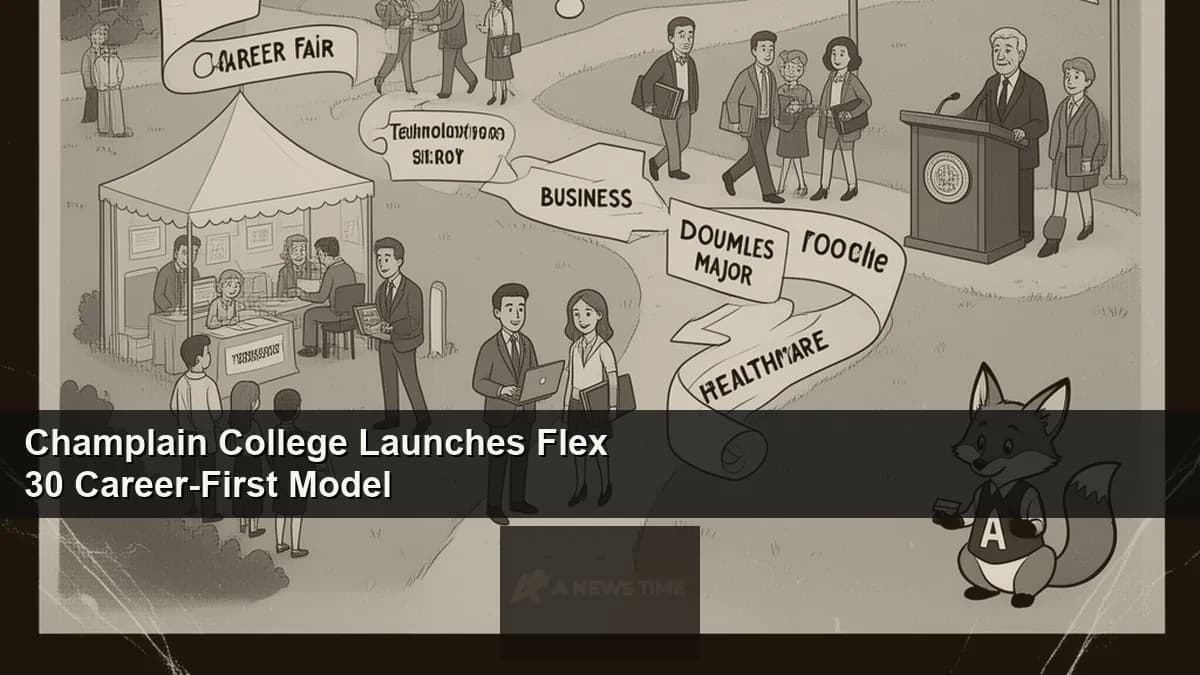
Champlain College has announced a structural overhaul of its undergraduate program that will reshape how every incoming four-year student spends their time on the Burlington, Vermont campus, beginning in fall 2026. The new model, branded Flex 30, gives each student 30 flexible credits, the equivalent of one full academic year, to spend on a combination of co-ops, internships, double majors, study abroad, independent research, or career-focused experiences. The college made the announcement on , in a release covered by Vermont Business Magazine.
The redesign matters because Champlain has spent the past decade building its identity around the bet that a four-year liberal arts degree is no longer the right product for most students. Flex 30 is the formal codification of that bet. By giving every student structured space to pursue work experience inside the curriculum rather than alongside it, the college is trying to answer a question that the rest of higher education has been dancing around for years. What does an undergraduate degree actually credential in a market where employers increasingly skip the degree altogether?
What Flex 30 actually changes
The shift comes in four parts. The first is what Champlain calls the Upside-Down Curriculum, the idea that students should engage with their major from day one rather than spending the first two years working through general education requirements before touching their field. Champlain has been moving in this direction for several years, but Flex 30 makes the early-major exposure standard for everyone.
The second is the 30 flexible credits themselves. Students can use them for any combination of out-of-classroom experiences, including formal co-ops, semester-long internships at partner employers, study abroad placements, independent capstone projects, or additional courses toward a second major. The credits do not extend the degree timeline. They sit inside the existing four-year structure as a kind of curated portfolio space.
The third is studio learning and applied general education. The college is moving its general education courses into formats that connect directly to each student's major rather than treating them as a separate distribution requirement. A computer science student's writing course will be tied to technical communication. A business student's quantitative course will be tied to data-driven decision making. The pedagogy is meant to feel more like an industry studio than a traditional lecture.
The fourth is the Champlain Exchange, a career platform the college is expanding to connect students directly with leading employers through course projects, semester-long co-ops, tailored internships, and workforce-based experiences. The Exchange has been running on a smaller scale for several years and is now being scaled up as the connective tissue between Flex 30 credits and actual employer placements.
Why now, and what president Alex Hernandez is saying
The timing is not accidental. Champlain's leadership team has been watching the same data that has spooked higher education broadly. Undergraduate enrollment is down at most non-elite institutions. Public confidence in the value of a four-year degree continues to erode in surveys. Employers across multiple industries are loosening degree requirements for entry-level roles. And the cohort of high school seniors expected to apply to college over the next decade is shrinking due to the demographic cliff.
President Alex Hernandez framed the launch as an explicit response to those pressures.
Our students are highly capable, enthusiastic, and motivated. Champlain graduates hit the ground running and our new model will help them thrive during a time of profound change. By providing students with the most powerful career-focused education possible, we're setting them up to innovate, lead, and succeed with their passions.Alex Hernandez, President, Champlain College
Hernandez took the Champlain presidency in 2023 with a mandate to make the college's career-first identity more concrete. Flex 30 is the most visible product of that mandate. It is also the kind of move that other small colleges with distinctive missions are likely to study closely, because the bet is that a structured experiential year, baked into the degree rather than added on, is what differentiates a residential undergraduate program from the cheaper alternatives now available online.
How this fits into the broader career-versus-degree debate
Champlain has historical credibility on this question that most colleges do not. The school has consistently reported that roughly 90 percent of its on-campus students achieve a successful career outcome within six months of graduation, a number that puts it ahead of most regional comparable institutions. Champlain ranks in multiple categories of US News and World Report's "Best Colleges," appears in The Princeton Review's 2025 list of "The Best 390 Colleges," and earned the number nine spot in Princeton Review's "2025 Top Schools for Game Design," a niche but lucrative undergraduate market where Champlain has built a recognizable brand.
The college also runs more than 100 online undergraduate and graduate programs, which gives it a broader student base than its 2,200 on-campus undergraduate population would suggest. The Flex 30 announcement applies specifically to incoming on-campus students, but the underlying philosophy of career-aligned credit design will likely migrate into the online programs as well over time.
The broader context is a higher education industry in upheaval. Recent reporting on the 2026 skills-based hiring trend shows that the share of US job postings that require a four-year degree has continued to fall. Surveys of Generation Z workers compiled in our coverage of the 66 percent of Gen Z teaching themselves the skills employers want tell the same story from the demand side. Champlain's bet is that a degree can still compete with those alternatives, but only if it is designed to deliver something the alternatives cannot: a structured, credentialed year of professional experience inside an academic frame.
What the new majors will look like
Alongside the Flex 30 announcement, Champlain disclosed that its Curriculum Committee is exploring a new generation of majors in high-demand areas including artificial intelligence, healthcare, business, and the arts. Final approval for those programs is expected in June, and the new programs will be available to current and enrolling students starting in fall 2027.
Provost and chief academic officer Monique Taylor said the new majors are the natural extension of the Flex 30 model. "Champlain's new academic model is the natural evolution of our professionally-focused mission," Taylor said in the announcement. "Its emphasis on experiential learning provides a wide variety of options that will help students engage with the campus, the community and the world."
Taylor also noted that current Champlain students are encouraged to collaborate with their academic advisors to explore opportunities within the model that align with their planned graduation requirements and timelines, suggesting some elements of the Flex 30 framework will be available to upperclassmen on a case-by-case basis even before the formal rollout.
The risks built into the redesign
Flex 30 is not without execution risk. Three things will determine whether the model works as advertised.
The first is whether Champlain can sign enough employer partners to meet the placement demand. If every incoming student is supposed to use 30 credits on co-ops or internships, the college needs roughly one experiential placement per student per year. That is a meaningful operational lift, especially in a small Vermont city where the local employer base is finite. The Champlain Exchange will need to scale aggressively, and the college will need to recruit national employer partners willing to take students remotely or for short residencies.
The second is whether the studio learning approach to general education delivers the breadth that traditional gen-ed requirements were designed to ensure. Critics of integrated general education have long argued that connecting writing courses to a student's major produces graduates who can communicate inside their field but not across fields. Champlain's bet is that the trade-off is worth it. The next decade will tell.
The third is cost. The redesign does not extend the degree timeline, but the operational cost of running a credit-bearing co-op program at scale is significantly higher than the cost of running a traditional lecture. Champlain has not announced a tuition change tied to Flex 30, but the underlying economics will determine whether the model is sustainable beyond the first few cohorts.
What to watch through the year
Two things to track. The first is whether Champlain publishes early-cohort data showing how Flex 30 students used their flexible credits and how those choices correlated with post-graduation outcomes. That data will tell the rest of the higher education sector whether the model produces measurable returns. The second is whether other small private colleges with distinctive missions adopt similar frameworks. Beloit, Olin, Hampshire, and a handful of others have been experimenting with career-aligned curriculum for years. A high-profile rollout from Champlain could push those experiments into the mainstream.
For now, the Flex 30 announcement is the clearest statement yet from a small private college that the traditional four-year residential degree needs to be rebuilt around what employers actually value. Whether Champlain has the operational capacity to deliver on that promise is the question the next two years will answer.