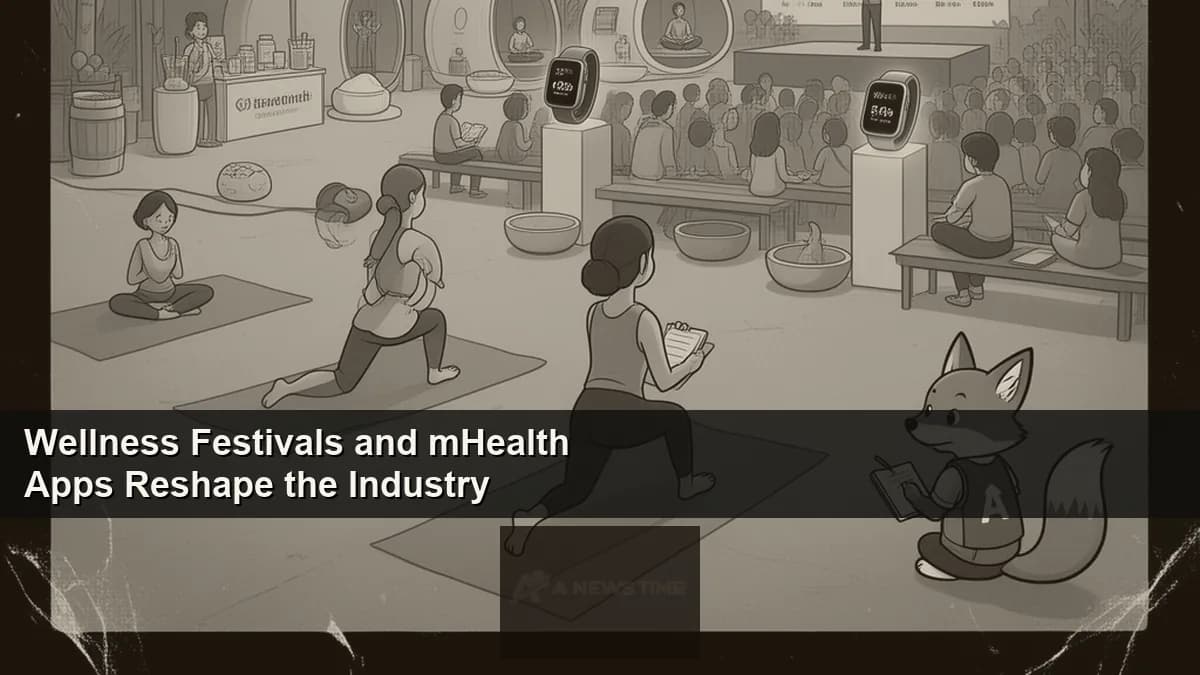
Picture someone standing at the edge of an ice bath on a Bangkok rooftop, music playing softly, strangers cheering them on as they lower themselves into the cold water. In the spring of 2026, that scene is not an anomaly. It is the brand identity of a new wellness venue called The Big Chill, one of five spaces that opened or announced imminent debuts in Thailand in April alone. Each one is slightly different in format. All of them are pointing at the same cultural current: a shift in how Bangkok, and the broader global wellness market it now participates in, understands what a wellness experience is supposed to do.
The timing is notable. April 2026 has seen a cluster of openings that, taken individually, each represent a distinct bet about what the wellness consumer wants. Taken together, they sketch a picture of an industry reorienting itself around three converging ideas: that recovery and performance belong under the same roof, that community is not a byproduct of wellness but a core mechanism of it, and that ancient healing practices and sports medicine can occupy the same building without contradiction. Thailand, historically known for its spa culture and traditional Thai massage, is suddenly also the setting for AI-managed gyms, chakra residency programs, cold plunge clubs, and integrated sports medicine facilities spanning nearly 10,000 square meters.
Five New Spaces, One Converging Argument
The most visible piece of Bangkok's April wellness expansion is The Lobb Club, located in the Sathu Pradit neighborhood. The concept, built around the phrase "Play, Balance, Belong," merges indoor tennis courts, private golf simulator rooms, a pickleball court, and an all-day dining space called The Lobbar into a single environment where the social transitions between sport and food happen naturally rather than requiring a change of venue. A dedicated recovery zone featuring ice baths is slated for launch in the weeks following the initial opening.
The design is conspicuously photogenic, a choice that matters in a market where the visual grammar of a space communicates its audience as much as its membership pricing. The Lobb Club is positioning itself at the intersection of lifestyle aesthetics and performance infrastructure, a combination that resonates strongly with the professional demographic that Bangkok's wellness market is competing hardest to attract.
Sterling Sport and Wellness, located on Sukhumvit 24, is making a similar bet with a different emphasis. The facility offers padel, pickleball, tennis, and squash courts alongside a Muay Thai academy and barre studio, an eclectic combination that would have seemed disjointed a decade ago. Its recovery clinic offers private sauna sessions and cold plunge access. Its nutrition-focused dining component treats food not as a convenience feature but as part of the same intervention framework as the workouts happening twenty meters away. Sterling is explicitly positioning itself as a one-stop destination: movement, recovery, nutrition, and community in one visit.
The most technically ambitious of the April openings is The O2 Bangkok, scheduled for its official debut in June and already drawing significant attention for its scale and concept. Spanning 10,200 square meters across four storeys in Thonburi, the complex operates on what its developers call an "injury-to-membership" model, a phrase that encapsulates something genuinely new in how wellness and medicine are being integrated in the Thai market. Suklert Clinic, the sports medicine and preventive care component embedded within the facility, is not a wellness amenity tacked onto a gym. It is a co-equal pillar of the concept, treating rehabilitation, prevention, and performance training as a continuous spectrum rather than separate services. The facility will house Thailand's first AI-managed gym, adding a layer of personalization that connects daily workouts to ongoing health data in real time.
| Venue | Location | Core Concept | Status (April 2026) |
|---|---|---|---|
| The Lobb Club | Sathu Pradit, Bangkok | Design-led sport and social club: tennis, pickleball, dining, recovery | Open |
| The Big Chill | Rooftop, Bangkok | Social cold plunge and sauna club with community programming | Open |
| Sterling Sport and Wellness | Sukhumvit 24, Bangkok | Integrated sport, recovery, and nutrition destination | Open |
| The O2 Bangkok | Thonburi, Bangkok | 10,200 sqm injury-to-membership medical and sports complex | Opening June 2026 |
| Kempinski The Spa (Residency) | Siam, Bangkok | Expert holistic healing residency: chakra, Reiki, sound therapy | Through April 20 |
The Kempinski Residency: When Ancient Practice Meets Luxury Hospitality
While the new sport and social clubs are making arguments about integrated performance, the Kempinski The Spa at Siam Kempinski Hotel Bangkok is hosting a different kind of statement this April. Holistic healer Rajeshwari Nerurkar, whose career spans decades of practice across India, China, and Japan, has taken up a limited-time residency at the spa running through . The residency offers five treatments: Therapeutic Asian Therapy, Bio-Energetic Chakra Restoration, Shiro-Vitality Cranial Ritual, Micro Chakra Therapy, and Reiki Immersion. Priced at THB 7,000 and THB 8,000 for 60- and 90-minute formats respectively, each session begins with a personalized consultation that frames the treatment around the specific energetic and physical state the guest arrives with.
The format is significant for what it represents about how luxury hotels are thinking about wellness programming. The "expert in residence" model moves the spa experience from a menu-driven transaction to a practitioner-led encounter. You are not selecting a treatment from a list. You are entering a temporary relationship with a specific healer who brings a particular body of knowledge and a distinct methodology, and whose presence at the spa is finite and therefore worth scheduling around.
"Holistic healing draws on the understanding that the body, mind, and energy field are one integrated system. When we address the energetic dimension of a condition, we are not bypassing the physical, we are working at a level that influences all the others simultaneously."
Rajeshwari Nerurkar, holistic healer in residence, Kempinski The Spa, Bangkok, April 2026
The Kempinski residency positions Bangkok within a global conversation about what premium wellness hospitality can offer that a standard hotel spa cannot. It is not competing on treatment count or suite square footage. It is competing on depth of expertise and the kind of healing encounter that cannot be automated, standardized, or replicated by a differently trained practitioner.
The Cold Plunge Trend and the Community Mechanics of Discomfort
The Big Chill's arrival in Bangkok is worth examining separately because it represents a trend that is, on the surface, about a specific modality, cold water immersion, but is actually about something more fundamental in how wellness experiences are being designed. Cold plunge and contrast therapy (alternating between cold and heat) has accumulated a meaningful body of evidence over the past several years, with research pointing to benefits including reduced muscle soreness, improved cardiovascular resilience, and regulatory effects on the nervous system's stress response. But The Big Chill is not primarily marketing on clinical outcomes. It is marketing on the social experience of collective discomfort.
The rooftop format, the guided group plunges, the coffee and coconuts afterward, the music: these are not incidental to the wellness proposition. They are the wellness proposition. What The Big Chill is selling is the experience of doing something uncomfortable with other people, which activates a specific kind of social bonding that researchers studying group endurance and shared stress have identified as distinct from the bonding that occurs in comfortable, low-stakes social environments.
"When people go through a challenge together, even a voluntary one like a cold plunge, the physiological arousal of the experience gets associated with the people sharing it. That is one reason why fitness communities built around effortful shared experiences tend to generate stronger social bonds than those built around convenience."
Dr. Emma Seppala, Social Connection Researcher, Stanford University, speaking on community and shared stress, 2025
This is the mechanism behind the run club boom that has reshaped urban social life in cities from New York to London to Bangkok. The trend toward community-centered wellness spaces, which this publication has tracked in depth across the run club movement and the social gym trend, is finding a new expression in cold plunge venues where the challenge itself is the connective tissue between strangers.
Thailand as a Node in the Global Wellness Economy
What makes the April 2026 Bangkok wellness surge meaningful beyond local market dynamics is where it sits within the broader global picture. The GWI estimates the global wellness economy at more than $6 trillion and growing, with wellness tourism as one of its fastest-expanding segments. Southeast Asia, and Thailand specifically, has long been a significant node in that network: the country's spa culture, traditional healing practices, and relatively accessible premium hospitality have made it a destination for wellness tourism in the way that Tuscany is a destination for food tourism or Iceland for adventure tourism.
What is shifting in 2026 is that Bangkok is no longer primarily a destination for international wellness tourists arriving from Europe and North America. It is developing its own domestic and regional wellness consumer class, one that has absorbed global wellness culture and is demanding local infrastructure sophisticated enough to satisfy it. The five venues opening this April are largely aimed at Bangkok residents and regional travelers, not the international wellness tourist on a two-week retreat. The target demographic is the professional who wants the sports medicine clinic and the cold plunge and the chakra healing session to exist within reasonable distance of their apartment, as features of ordinary life rather than components of an exceptional trip.
| Wellness Category | Bangkok 2026 Representation | Global Trend Alignment |
|---|---|---|
| Integrated sport and recovery | Sterling, The O2, The Lobb Club | Strong: matches global "one-stop" fitness hub trend |
| Cold and heat contrast therapy | The Big Chill, Sterling, The Lobb Club | Strong: cold plunge category growing globally since 2023 |
| Traditional and energy healing | Kempinski The Spa residency | Growing: luxury wellness pivoting to practitioner-led depth |
| Sports medicine integration | The O2 Bangkok (Suklert Clinic) | Emerging: rehabilitation-to-membership models are new globally |
| Community-centered design | All five venues | Dominant: social infrastructure is the primary differentiator in 2026 |
The convergence between Bangkok's expansion and the global wellness moment is not coincidental. The same forces driving the proliferation of longevity-focused wellness destinations elsewhere, a post-pandemic reorientation toward health as a proactive rather than reactive concern, the metabolic health crisis that has made preventive medicine a mass-market conversation, and the social isolation data that has made community infrastructure a wellness imperative, are operating in Bangkok as much as in any American or European city.
The connection to the precision lifestyle medicine conversation happening in clinical settings globally is also worth noting. Researchers at institutions like Emory University, including Dr. Neil Iyengar of the Winship Cancer Institute, have been advancing the argument that lifestyle interventions, diet, exercise, stress management, should be treated with the same rigor as drug development: specific dosing, precision targeting, and outcomes tracking. The "injury-to-membership" model at The O2 Bangkok, and the biomarker-aware recovery clinics at Sterling, are consumer-market expressions of exactly that framework. The line between wellness destination and clinical intervention is becoming harder to locate.
What the Wellness Residency Model Tells Us About Where Premium Health Is Going
The Kempinski residency format is not unique to Bangkok. Expert-in-residence programs have been gaining traction in luxury hotels globally, particularly at properties in destinations with established wellness reputations. What makes Rajeshwari Nerurkar's residency worth examining as a signal is the breadth of modalities she brings together: chakra healing, Reiki, Tuina bodywork, and sound therapy, representing a synthesis of Indian, Japanese, and Chinese healing traditions within a single practitioner's practice.
This synthesis is itself a trend. The most sought-after wellness practitioners in the luxury hospitality space in 2026 are not specialists in a single modality. They are translators, people who can move between traditions and adapt their approach to a guest who arrives with a Western biomedical frame of reference and needs a bridge to practices that operate on entirely different epistemological foundations. The personalised consultation that begins each Kempinski session is doing exactly that work: it is an intake process that maps the guest's condition onto a framework that the treatment protocol can address.
The parallel with what is happening at the other end of the wellness spectrum, in the AI-managed gym and sports medicine complex of The O2 Bangkok, is more legible when framed this way. Both are doing personalization: one through energetic diagnostics and intuitive practitioner expertise, the other through biomarker data and algorithmic optimization. The difference in method is substantial. The underlying commitment to treating each individual's health as a specific problem requiring a specific solution is identical.
"The wellness industry's most significant shift in the past decade is not any particular modality. It is the turn toward personalization at every price point and every tradition. Generic wellness, the same class for everyone, the same treatment for everyone, is being replaced by approaches that ask first: who is this person, and what do they actually need?"
Global Wellness Summit, 2026 Trends Intelligence Report
For travelers and Bangkok residents navigating these new options, the abundance of choice in April 2026 is real. Whether you are drawn to the social cold plunge, the chakra restoration session, the AI-optimized training floor, or the Muay Thai academy adjacent to a barre studio, the question the Bangkok wellness market is now positioned to answer is: what kind of health are you trying to build, and which of these environments is the right tool for building it? That is a different question, and a more interesting one, than the destination spa used to ask. And it is a question that more of Bangkok's residents, and the global wellness travelers arriving in the city, are showing up with a readiness to answer.
If the neurowellness trend and the longevity residence movement are the macro architecture of where wellness is heading, Bangkok's April cluster is the neighborhood-level proof of concept: five venues, one holistic residency, and a city choosing to treat integrated health infrastructure as a competitive advantage.
Frequently Asked Questions
- What is the Kempinski The Spa wellness residency in Bangkok in April 2026?
- Siam Kempinski Hotel Bangkok's Kempinski The Spa is hosting holistic healer Rajeshwari Nerurkar through April 20, 2026. She offers five signature treatments combining chakra healing, Reiki, Tuina bodywork, and sound therapy, priced at THB 7,000 and THB 8,000 for 60- and 90-minute sessions respectively. Each session begins with a personalized consultation.
- What is The O2 Bangkok and when does it open?
- The O2 Bangkok is a 10,200 square meter, four-storey integrated sports and medical complex in the Thonburi district, scheduled to open in June 2026. It operates on an "injury-to-membership" model, connecting sports medicine care (via embedded Suklert Clinic), rehabilitation, and performance training under one roof, alongside Thailand's first AI-managed gym and sport academies.
- Why is cold plunge therapy trending as a social experience?
- Cold water immersion activates a physiological stress response that, when shared in a group setting, triggers social bonding mechanisms similar to those observed in other shared-challenge environments. Venues like The Big Chill in Bangkok are designing around this, using community programming, music, and post-plunge social time to make the discomfort of cold immersion a connector rather than an ordeal.
- How does Bangkok's April 2026 wellness expansion connect to global trends?
- Bangkok's new spaces directly mirror global wellness economy trends: integrated sport-recovery hubs, practitioner-led luxury wellness experiences, community-centered design, and sports medicine embedded in consumer fitness contexts. The city is developing a domestic wellness consumer class demanding locally-built infrastructure, not just international wellness tourism flows.
- What does "precision lifestyle medicine" mean in the context of the Bangkok wellness boom?
- Precision lifestyle medicine treats diet, exercise, and recovery protocols the way pharmaceutical researchers treat drugs: with specific dosing, individual targeting, and outcomes tracking. The O2 Bangkok's injury-to-membership model and Sterling's recovery clinic both reflect this shift from generic wellness programming toward individually calibrated health interventions, a trend advancing simultaneously in clinical oncology and consumer wellness.
Sources
- The Wellness Edit: What's New in Thailand Wellness This April 2026 — Lifestyle Asia Bangkok
- Breast Cancer Survivorship: Precision Lifestyle and Metabolic Health Trends — CURE Today
- Sterling Sport and Wellness Bangkok — Official Site
- Rajeshwari Nerurkar Wellness Residency — Kempinski The Spa, Bangkok
Written by Danielle Reyes, Entertainment & Lifestyle Writer