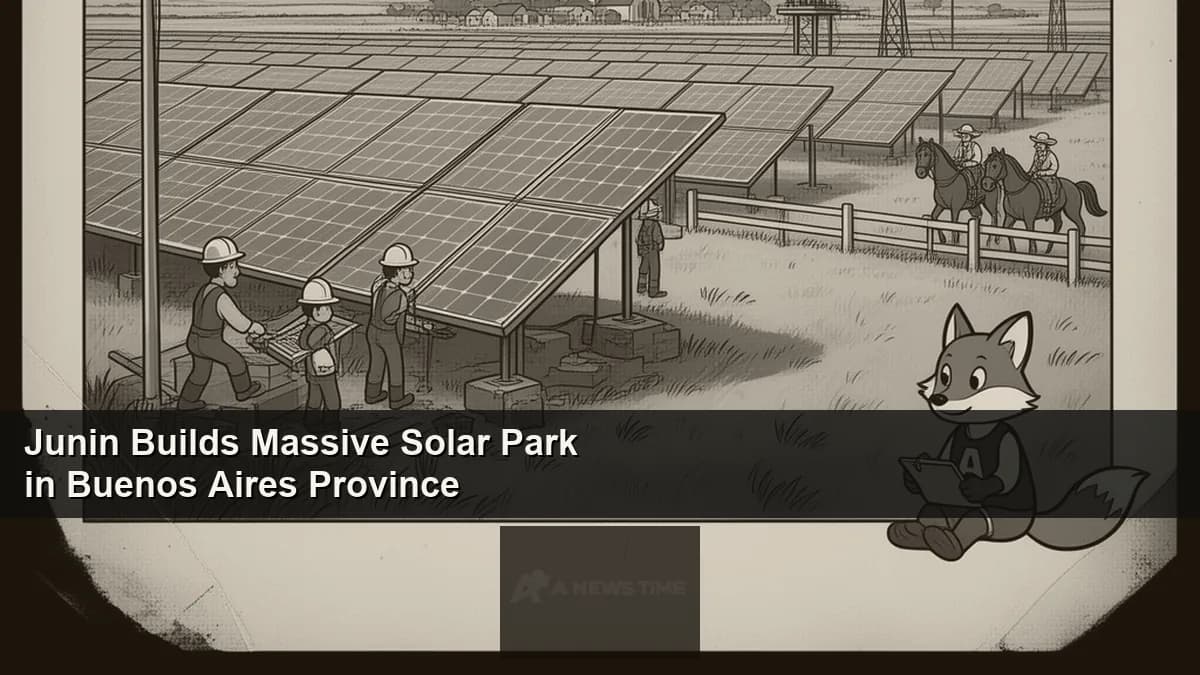
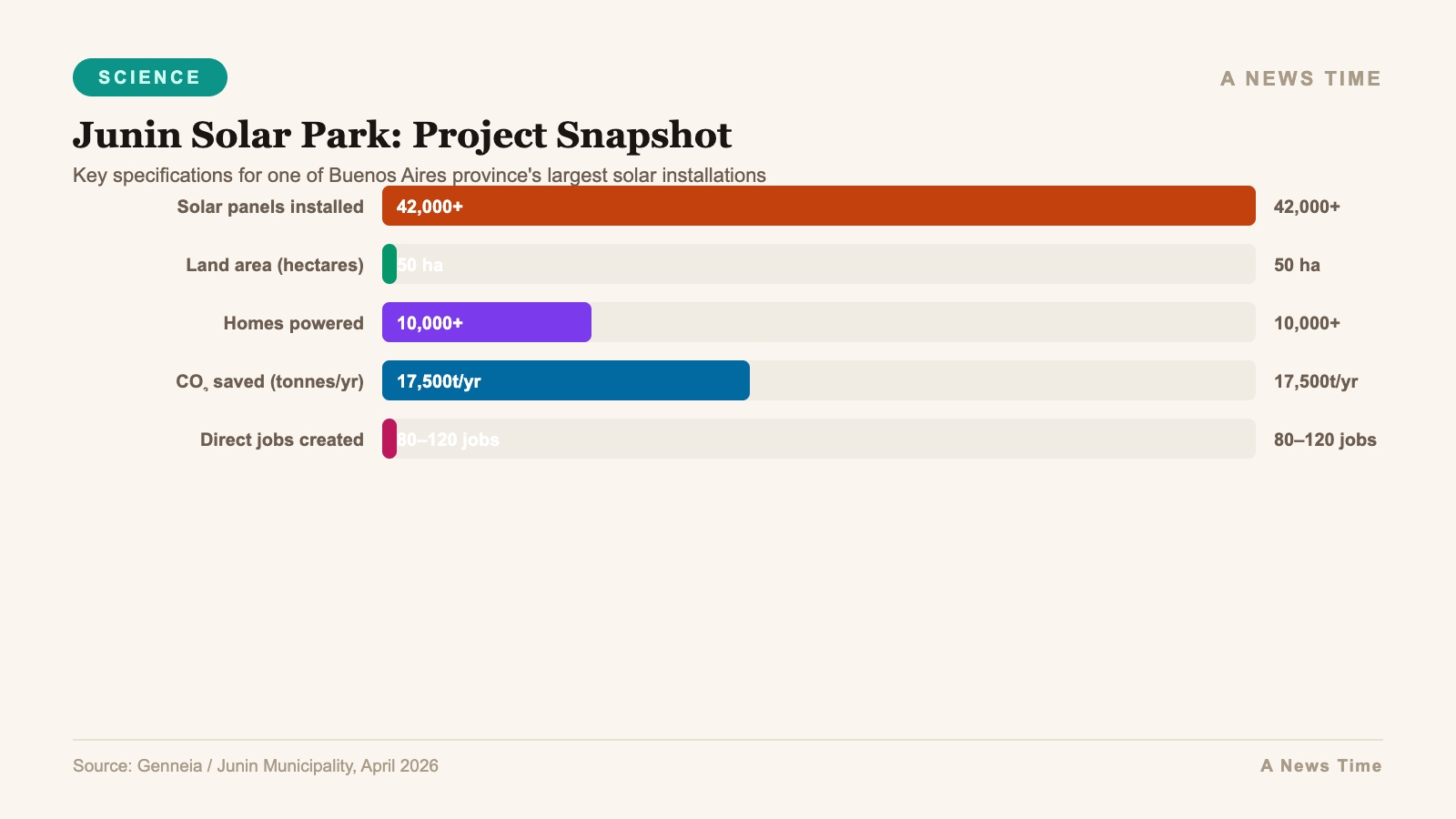
The announcement from Junin's municipal government landed with a specificity that distinguishes it from the broad declarations that often accompany renewable energy projects in Latin America. Fifty hectares. More than 42,000 solar panels. Twenty megawatts of installed capacity. A $20 million investment. Those numbers are not aspirational targets but construction specifications, and the company that will build the project, Genneia, is Argentina's largest renewable energy operator with operational experience across wind and solar facilities in multiple provinces. When Junin says it is building one of the largest solar parks in Buenos Aires province, the claim is grounded in something more than municipal ambition.
The project was confirmed in April 2026 by local and regional environmental media, placing Junin at the center of a regional story about how mid-sized Argentine municipalities are positioning themselves within the country's renewable energy transition. Buenos Aires province is the most populous in Argentina and has historically been heavily dependent on centralized fossil fuel generation transmitted across long distribution networks. The Junin solar park, generating power locally for local consumption, represents a different model of energy supply that has been gaining traction across the country's interior.
What 20 Megawatts Means in Practice
Twenty megawatts of installed photovoltaic capacity is a meaningful number in the context of a mid-sized Argentine city. Junin has a population of approximately 100,000 people and is the administrative center of the Junin Partido, a rural district in the northwest of Buenos Aires province whose economy is primarily agricultural. The municipality's total electricity consumption reflects that scale: residential, commercial, and industrial demand that a 20 MW solar facility can address in substantial part under favorable solar conditions.
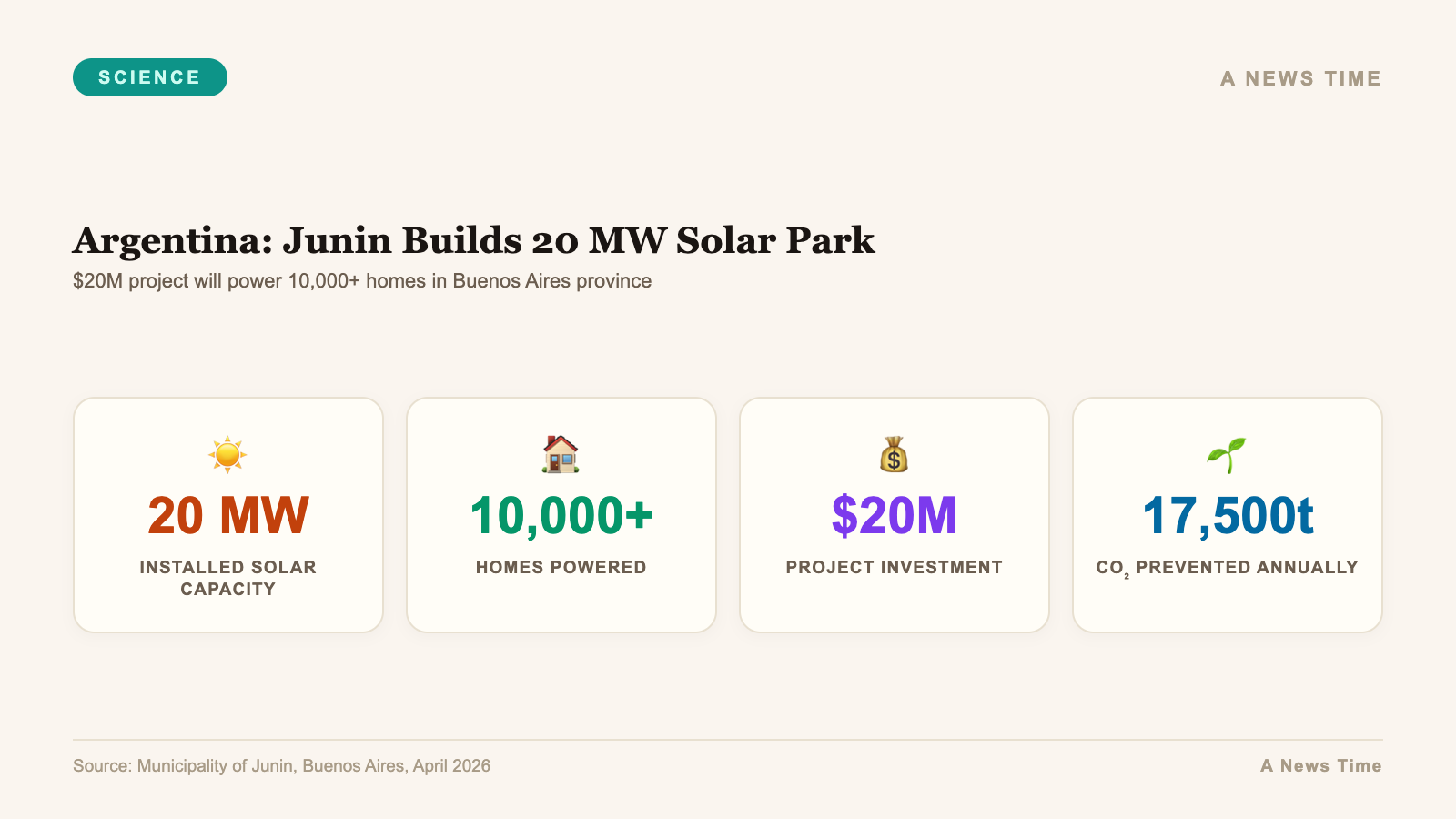
The official estimate of supplying more than 10,000 homes is a conservative projection based on average residential consumption in the Buenos Aires province interior. In practice, a 20 MW plant operating at the solar resource levels typical of northwestern Buenos Aires, which receives substantially more annual direct sunlight than the provincial capital, will generate in the range of 35 to 40 gigawatt-hours per year. That production displaces a corresponding volume of thermal generation from the national grid, reducing both the cost of electricity supplied to local consumers and the carbon footprint associated with it.
The carbon accounting is straightforward. Argentina's electricity grid has an emissions factor of approximately 0.5 kilograms of CO2 per kilowatt-hour, varying by season and generation mix. The 17,500 tonnes of annual CO2 avoidance claimed in the project announcement is consistent with those grid emissions factors applied to the expected annual generation. That figure is equivalent to removing approximately 3,800 gasoline-powered passenger vehicles from the road for a full year, or to planting roughly 280,000 trees.
Genneia and the Argentine Renewable Sector
Genneia's selection as the project contractor reflects the company's position at the top of Argentina's renewable energy industry. Founded in 2004 and restructured following Argentina's debt crisis into one of the country's primary independent power producers, Genneia now operates wind and solar facilities across multiple Argentine provinces and is the country's single largest renewable electricity generator.
The company's portfolio includes wind farms in Patagonia that are among the largest in Latin America, and solar projects in the Puna altiplano region of northwestern Argentina that benefit from some of the highest solar radiation levels anywhere on Earth. Its experience building and operating utility-scale renewable facilities in Argentina's varied regulatory and infrastructure environments gives the Junin project a technical backing that smaller contractors could not provide.
Genneia's involvement also signals the project's bankability. Renewable energy projects in Argentina have historically faced financing challenges linked to the country's macroeconomic instability and currency risk. The company's track record of completing and operating projects through multiple cycles of Argentine economic turbulence provides municipal partners with confidence that the Junin facility will be built on schedule and operated reliably after commissioning.
Buenos Aires Province and the Energy Transition
The province of Buenos Aires encompasses a territory roughly the size of Spain with a population of more than 17 million, making it both the geographic and demographic center of Argentina. Its energy infrastructure reflects the centralized planning approach that has characterized Argentine electricity policy since the post-war nationalization period: large thermal and hydroelectric plants connected to major urban centers via high-voltage transmission lines, with rural and secondary urban areas often receiving less reliable and more expensive power.
The shift toward distributed renewable generation addresses several of those structural problems simultaneously. Solar and wind resources in the province's interior are abundant and effectively free. Projects like the Junin solar park generate power at the point of consumption, reducing transmission losses and infrastructure maintenance costs. They also reduce exposure to the grid's vulnerability to supply disruptions, which have historically been more severe in interior municipalities than in the Buenos Aires metropolitan area.
The provincial government's PROINGED program, which supports the installation of solar parks in interior localities, and the national PERMER project, which extends electricity access to communities outside the conventional grid, both provide policy frameworks that facilitate projects like Junin's. PROINGED has backed several solar installations across the province's interior in the past three years, and the Junin project is among the largest in that program's portfolio to date.
Argentina in the South American Clean Energy Context
Argentina's renewable energy transition has accelerated since the passage of the RenovAr law in 2016, which created a framework for competitive auctions of renewable energy contracts and attracted significant foreign and domestic investment. By 2025, renewable sources, primarily wind and solar, account for approximately 15 percent of Argentina's electricity generation, up from less than 2 percent in 2016. The national government has set targets for renewable generation reaching 30 percent by 2030.
Neighboring countries provide instructive comparison. Chile has moved faster toward renewable integration, with solar energy from the Atacama Desert now supplying significant proportions of the central and northern grids at costs that make new fossil fuel generation economically inviable. Brazil has developed substantial wind capacity in its northeastern states and is expanding solar installations across the semiarid interior. Uruguay, a smaller market, has achieved renewable penetration exceeding 90 percent of electricity generation through a combination of wind, hydro, and biomass.
Argentina's transition has been slower than the region's fastest movers, partly due to the macroeconomic instability that complicates long-term infrastructure investment and partly due to the scale of the natural gas sector, which has historically had significant political and economic influence over energy policy. The Vaca Muerta shale formation in Neuquen province contains natural gas reserves that energy sector analysts describe as among the largest in the world, and the incentive to develop and export that gas has complicated the decarbonization calculus for Argentine policymakers.
Projects like Junin's solar park exist within this tension. They do not resolve the macro-policy debate about how fast Argentina should transition away from fossil fuels. But they demonstrate that at the municipal scale, the economics of solar power are sufficiently compelling to justify major investment independently of the national policy environment. The $20 million project will pay back its capital cost over a period that energy analysts typically estimate at eight to twelve years for Argentine solar installations of this scale, after which the electricity it generates costs essentially nothing beyond maintenance.
Jobs and Local Economic Impact
The project announcement specifies 80 to 120 direct construction jobs, with additional indirect employment in services, logistics, and regional supply chains. In a city of 100,000 people in an agricultural district, those numbers represent meaningful labor market impact during the construction phase.
The operational employment picture is more modest. Utility-scale solar installations require relatively small permanent workforces: a 20 MW facility typically employs between 5 and 15 full-time staff for monitoring, maintenance, and administration after commissioning. The construction jobs are real but temporary, and the permanent employment creation from solar projects is consistently smaller than comparable investment in conventional generation or manufacturing would produce.
The economic case for the project rests less on direct employment and more on energy cost savings for local businesses and residents, which are substantial and permanent. Industrial and agricultural enterprises in Junin's district pay significant electricity costs for irrigation pumps, grain drying equipment, and processing facilities. Reducing those costs through locally generated solar power improves the competitiveness of the agricultural sector that underpins the regional economy in ways that temporary construction employment does not.
The Lithium Connection and Argentina's Energy Future
Argentina sits at the center of the Lithium Triangle, the region comprising the Puna highlands of Argentina, Bolivia, and Chile that contains more than half of the world's identified lithium reserves. The battery storage that increasingly complements solar and wind generation depends on lithium, and Argentina's position as a major lithium producer has led to discussions about whether the country could develop a vertically integrated clean energy sector, mining lithium for batteries that store electricity generated by domestic solar and wind installations.
That vision remains largely theoretical at the national scale, but at the project scale, the integration of battery storage with solar generation is already occurring in some Argentine installations. The Junin project announcement does not specify a battery storage component, but the provincial energy agency has indicated that combining solar parks with lithium battery systems is a priority for future installations. Studies from the UNCUYO digital library, cited in the original project reporting, indicate that the central Buenos Aires region is particularly well suited for this kind of hybrid solar-plus-storage development.
The broader picture for South American clean energy is one of accelerating momentum. The International Energy Agency's most recent data indicates that renewable energy investment in South America reached record levels in 2025, driven by Brazil's offshore wind expansion, Chile's solar boom, and Argentina's accelerating solar sector. Municipal projects like Junin's are a constituent part of that regional story, demonstrating that the transition is happening not only in national policy frameworks and corporate boardrooms but in practical decisions being made by local governments on behalf of the communities they serve. For related coverage of global clean energy trends, see our recent piece on the EPA endangerment finding reversal and its implications for US climate policy, and our coverage of climate heat inequality in vulnerable nations.
Sources
- Betting on Clean Energy: Junin Builds One of the Largest Solar Parks in Buenos Aires Province -- Noticias Ambientales
- Genneia Renewable Energy -- Company Portfolio and Project History
- Argentina National Renewable Energy Policy -- Secretaria de Energia
- South and Central America Energy Data -- International Energy Agency