By any conventional measure, Michael should not be a controversial film. It is an authorized biopic of one of the most commercially successful entertainers in human history, directed by Antoine Fuqua, starring a member of the subject's own family, and produced with the full cooperation of the Michael Jackson Estate. The music is licensed. The choreography is faithful. The production budget is substantial. Everything about it follows the established grammar of the prestige music biopic.
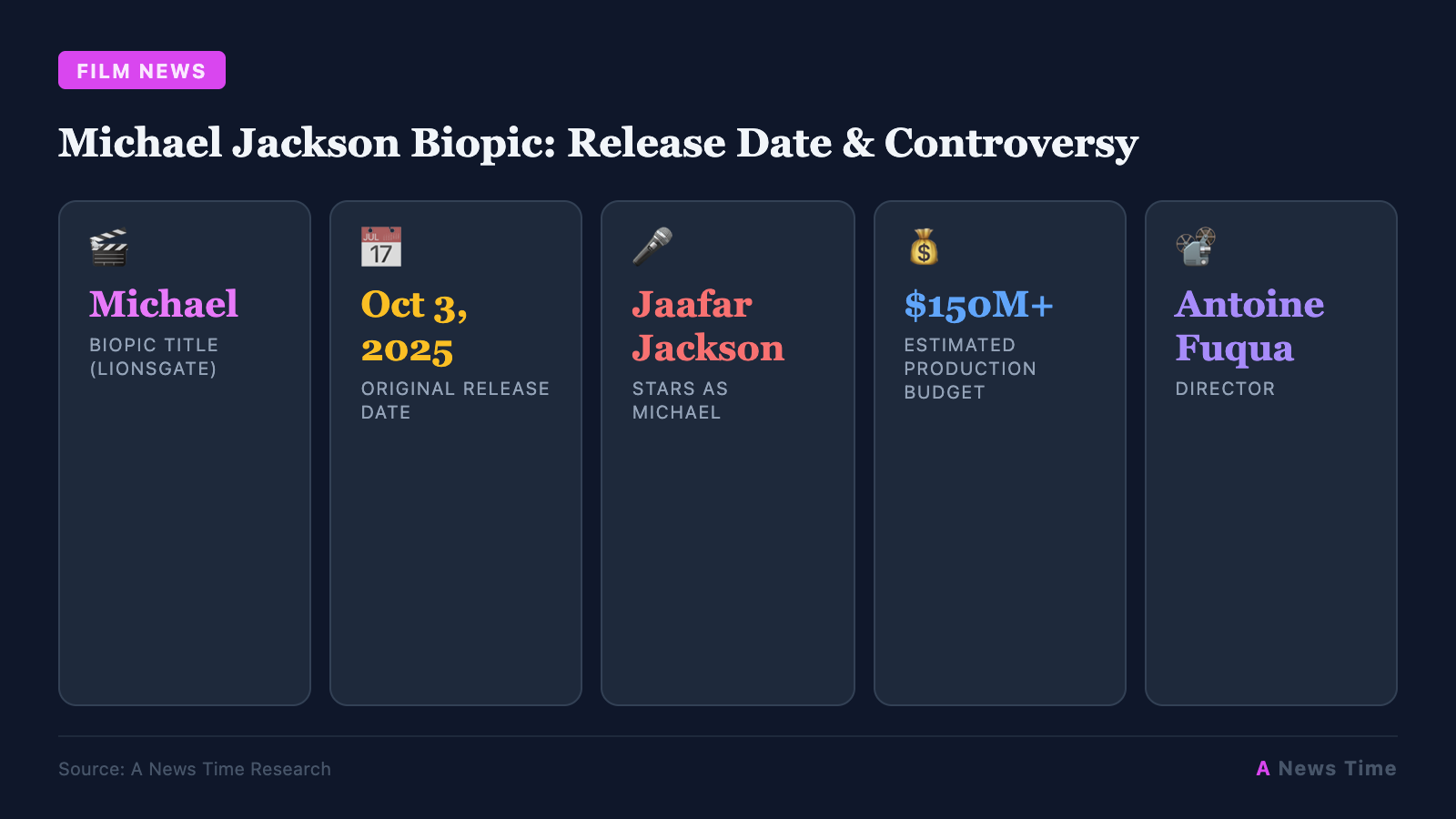
And yet no film arriving in theaters this April carries more cultural baggage, more pre-release tension, or more unresolved questions about what cinema owes its subjects and their audiences. Michael opens on April 24, 2026, at roughly 4,200 North American theaters, and it will arrive as the latest test of whether the entertainment industry can tell a complicated man's story while acknowledging the complications -- or whether it will sidestep them entirely.
The Making of the Film
The path from concept to screen took nearly a decade. The Michael Jackson Estate began developing a feature film biography in the mid-2010s, cycling through multiple producers and treatment drafts before the project gained serious momentum with the attachment of Antoine Fuqua as director. Fuqua, whose filmography spans Training Day, The Equalizer franchise, and Emancipation, brought both a prestige drama credibility and a willingness to engage with complex Black American cultural figures that made him a credible fit for the assignment.
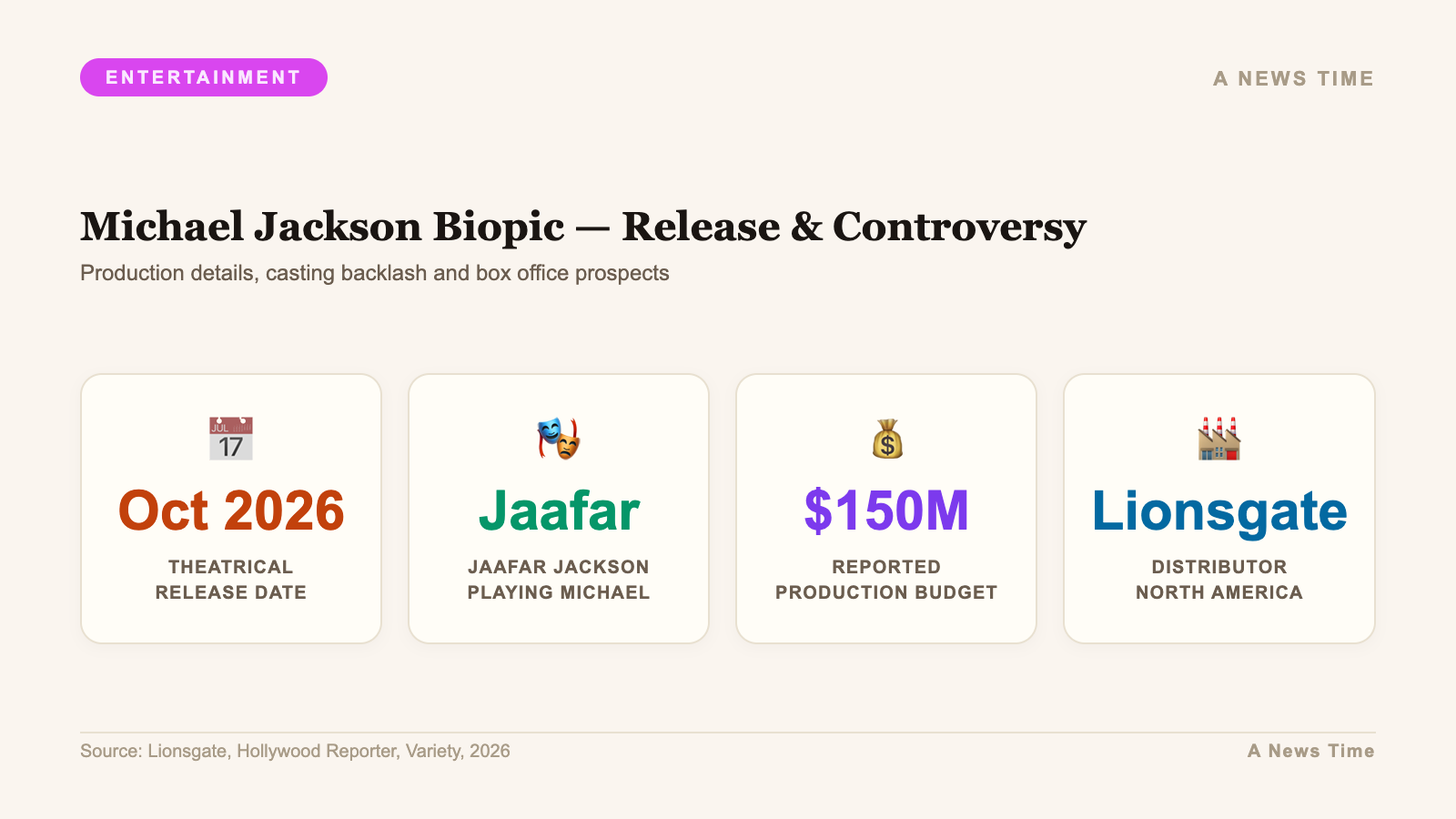
The casting of Jaafar Jackson -- Michael's nephew, the son of younger brother Jermaine -- resolved what had been the production's most sensitive creative challenge. Casting an outsider in the role of one of the most recognizable performers in history was always going to be contentious, but casting a family member carried its own set of complications: the risk of hagiography, the accusation that the estate was simply safeguarding the brand rather than enabling genuine biographical filmmaking.
What defused those concerns, at least among the film's early supporters, was Jaafar's demonstrated commitment to the role. He trained for five years under choreographers who had worked directly with Michael Jackson, worked with vocal coaches to master the idiosyncratic production timbre of Jackson's voice, and spent time studying archival footage in a process that reportedly consumed the better part of three years before shooting began. The trailers released in the past six months have shown a performance that, in isolated clips, is genuinely startling in its accuracy.
What the Film Covers
According to the production's official synopsis and interviews with Fuqua, Michael spans three decades of Jackson's career. The film opens with his childhood in Gary, Indiana and his early years in the Jackson 5, covers the Off the Wall and Thriller era as the central act of the story, and extends through the Bad and Dangerous periods before arriving at the final decade of Jackson's life, including the HIStory album cycle, the This Is It concert rehearsals, and his death in 2009.
The screenplay, written by John Logan, reportedly spends significant time on the psychological cost of Michael Jackson's childhood in the entertainment industry and on his complicated relationship with his father Joe Jackson, elements that align with accounts from multiple Jackson family members and biographers over the years. The romance with Lisa Marie Presley and the Debbie Rowe relationship are also apparently addressed, though the depth of treatment for those threads remains unclear from pre-release materials.
What the film does not do, based on available information, is engage substantively with the child sexual abuse allegations brought by Wade Robson and James Safechuck in Dan Reed's 2019 HBO documentary Leaving Neverland. The Jackson Estate, which served as a co-producer on the film, has maintained since 2019 that those allegations are false and has pursued legal action against both accusers. Fuqua has stated in interviews that he chose not to make a film "about allegations" but about the music and the man behind it.
The Shadow of Leaving Neverland
Leaving Neverland remains the most significant complicating factor in any assessment of Michael. The four-hour documentary presented detailed, consistent, and emotionally devastating testimony from two men who claim Jackson sexually abused them as children over periods of years. The documentary's premiere at the 2019 Sundance Film Festival generated immediate and widespread mainstream discussion, temporarily altered Jackson's radio airplay, and forced several cultural institutions to reconsider how they contextualized his legacy.
The Jackson Estate's response has been aggressive and legally sophisticated. Estate co-executors John Branca and John McClain filed a $100 million lawsuit against HBO over the documentary, arguing it violated a 1992 non-disparagement clause in a Jackson-HBO concert deal. That lawsuit has proceeded through courts slowly. The estate has also provided substantial financial and logistical support to researchers and journalists challenging the documentary's timeline and the credibility of Robson and Safechuck's accounts.
The debate over what happened is not resolved. There is no trial record, no criminal conviction, and no settled civil verdict on the specific allegations in Leaving Neverland. There is detailed and credible-sounding testimony from two men who recanted earlier sworn denials to make those accusations. And there is a counter-narrative funded in part by an estate with obvious financial incentives to protect a catalog that generated approximately $2.1 billion in revenue between 2009 and 2025.
Critics who had hoped the film would engage with this complexity have been largely disappointed by what the pre-release materials suggest. A film that acknowledges the allegations while presenting the evidence and counterevidence fairly would be a genuinely difficult and valuable cultural document. A film that elides them entirely is a different kind of project -- not necessarily dishonest, but incomplete in ways that will follow it through its release and awards season cycle.
The Case for the Film
There is a legitimate artistic and biographical case for what Fuqua and Logan have apparently made. Michael Jackson the cultural figure exists independently of the unresolved allegations, and his influence on music, dance, music video as an art form, and global pop culture is not reducible to the worst things he has been accused of. A serious examination of how a child prodigy from Gary, Indiana became the most globally recognized human being of the late 20th century is a legitimate subject for a prestige film.
The argument also runs that biographical films are not legal proceedings or investigative journalism. Bohemian Rhapsody made a commercially successful film about Freddie Mercury without engaging in depth with his HIV-positive status or the circumstances of his death; Rocketman took theatrical liberties with Elton John's biography while preserving emotional truth; Walk Hard parodied the entire genre's tendency to flatten complexity into redemption arcs. The question for Michael is not whether it should have been made, but whether the choices Fuqua made serve the audience or protect the estate.
The performances appear to serve the film regardless of those larger arguments. Colman Domingo plays Joe Jackson in a role that early reviews from pre-release screenings describe as one of the year's best supporting performances. Nia Long appears as Katherine Jackson. And Jaafar Jackson's performance, by consensus from the journalists and critics who attended early screenings, is the film's central achievement -- a physical and vocal transformation that earns the attention the production is claiming.
Box Office Expectations and Competition
Music biopics have shown considerable range in commercial performance. Bohemian Rhapsody earned $910 million worldwide on a $52 million production budget. Elvis grossed $287 million against an $85 million budget and earned eight Academy Award nominations. Rocketman was a more modest performer at $195 million but achieved strong critical reception and long-tail streaming success.
Michael opens against a calendar that includes a holdover from Robert Pattinson and Zendaya's The Drama and a limited engagement from a competing prestige documentary. Early tracking from industry analysts puts the domestic opening weekend at $60-80 million, which would place it among the stronger music biopic debuts on record. International markets, particularly in Asia and South America where Jackson's fanbase remains intensely devoted, are projected to add significantly to that total.
The streaming afterlife matters as much as theatrical performance for a film of this type. Universal Pictures, which is distributing Michael domestically, has a standard 45-day theatrical window agreement before the film moves to premium VOD. The eventual landing on a streaming platform -- almost certainly one of the major subscription services given the estate's existing catalog licensing relationships -- will determine the film's true cultural reach over the following decade.
What the Critical Response Will Tell Us
Reviews embargo until the week before opening, meaning that full critical assessments are not yet available at time of publication. But the shape of the pre-release conversation suggests that critics will divide roughly along two lines: those who assess the film primarily as a biographical and cinematic work, and those who cannot evaluate it without addressing the elephant the film chose not to put in the room.
Both responses are valid. The former is the more traditional review; the latter is the more culturally honest one. What will be interesting to watch is which approach the major awards bodies take. The film is clearly positioned as an awards contender -- Fuqua directed, Domingo co-stars, the music is extraordinary -- but the Academy's recent track record suggests a sensitivity to the context around subjects that will complicate a straightforward awards campaign.
For updates on Michael's performance and the awards conversation as it develops, follow our entertainment coverage. For broader context on the April theatrical calendar and what else is opening this month, see our guide to April 2026's biggest theatrical releases and the full 2026 movie release calendar.
A Film the World Will Have Opinions About
Whatever Michael is as a film -- and by the accounts of those who have seen early cuts, it appears to be a technically accomplished and emotionally engaging one -- it arrives as a cultural event that cannot be evaluated on cinema terms alone. It is a statement by an estate worth billions of dollars about how one of history's most complicated legacies should be remembered. It is a performance by a young man honoring his uncle with five years of dedicated work. And it is a film arriving into a world where the people who accused that uncle of abuse are still alive, still telling their stories, and still waiting for an accounting that may never come.
Audiences will make their own choices about what that means for how they experience the film. The theater seats will fill regardless. The music will play. And the conversation about Michael Jackson -- the man, the music, the myth, the accusations, and the impossibility of holding all of it at once -- will continue long after the credits roll.