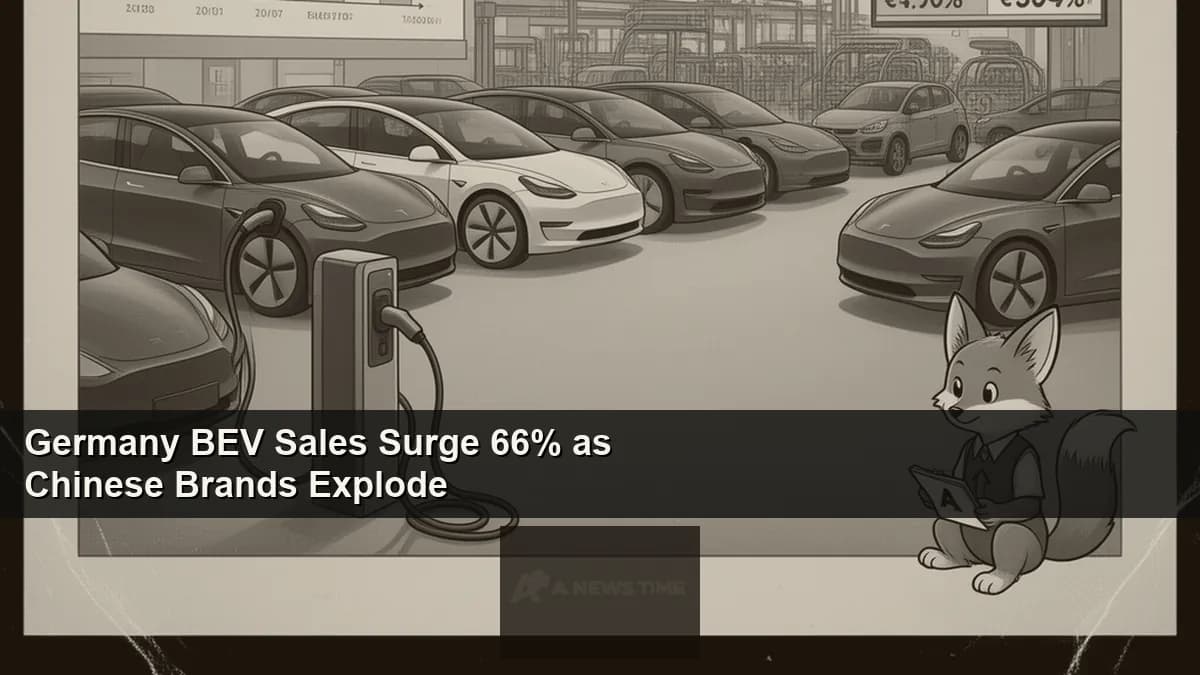
Germany's automotive market produced its strongest monthly growth figures since when the KBA, the German Federal Motor Transport Authority, released March 2026 registration data in . Total new car registrations reached 294,161 units, a 16% increase year-over-year, and BEV sales in particular rewrote the recent narrative of European EV market stagnation. Battery electric vehicles hit 70,663 registrations in March, a 66.2% year-over-year increase that pushed BEV market share to 24%, up 7.2 percentage points from March 2025. That is the largest BEV share figure recorded in Germany since August 2023, and it carries the fingerprints of specific policy action rather than organic demand recovery.
The numbers extend into a strong first quarter. BEV registrations rose 41.3% for the full Q1 2026 period, with a 22.8% market share across all three months. When plug-in hybrids are included, electrified vehicles commanded 34.2% of the March market, and the combined electrified total (BEV plus PHEV plus conventional hybrid) reached 64.1% of all registrations in the month. For context, petrol vehicles accounted for a declining 35.6% share combined with diesel. Germany's combustion engine era is not ending tomorrow, but the March data makes clear which direction the trend line is running.
The Policy Catalyst Behind the Numbers
Reading the March BEV surge as purely organic demand would be a mistake. The German federal government announced a new EV incentive scheme in , effective retroactively from January 1, with the official subsidy portal set to open in May. The announcement created a specific market dynamic: buyers who were already considering an EV purchase accelerated their timelines to lock in eligibility, while some consumers who had been waiting for policy clarity made purchase decisions on the basis of the announced (though not yet disbursed) support.
This kind of front-loading behavior is well-documented in automotive incentive cycles. Germany experienced the reverse dynamic in , when the abrupt cancellation of the previous EV subsidy program caused a sharp BEV market collapse that lasted well into 2024. Manufacturers and dealers learned from that episode to communicate incentive timelines more clearly to buyers, and the January 2026 announcement was specific enough about retroactive eligibility to generate the purchase-decision pull-forward visible in the March data.
Ina Gronemeyer, a senior analyst at Autovista24, framed the incentive effect precisely.
"The March numbers reflect both pent-up demand from early 2026 and the forward-looking effect of the new incentive announcement. The real test is what happens after the portal opens in May and whether the policy infrastructure can handle the volume of applications efficiently."
Ina Gronemeyer, Senior Analyst, Autovista24
The May portal opening creates a natural follow-on data event. If application processing is smooth and disbursements reach buyers within reasonable timeframes, the incentive effect should sustain elevated BEV registration rates through Q2 and Q3. If the process encounters administrative delays or the subsidy pool is capped below demand levels, the March spike risks being a one-quarter phenomenon.
Chinese Brands: From Curiosity to Competition
The most structurally significant data in the March German report is not the BEV market share figure. It is the performance of Chinese automotive brands. BYD grew registrations by 644.5% year-over-year in March, reaching a scale that placed it at 1.3% of the total German market in Q1 2026 with 9,120 units registered across the first three months. Leapmotor expanded by 370.7% from a smaller base, and Xpeng grew 179.4%.
These growth rates require context: they start from low absolute numbers that make percentage gains mathematically large. BYD registering 9,120 units across Q1 is not the same as Volkswagen's 131,012 March registrations alone. The Chinese brands are competing at volume levels that European legacy manufacturers would classify as rounding errors. But market share is built incrementally, and the trajectory of Chinese BEV brands in Germany is a more important story than any single month's registration total.
What makes the Chinese brand growth notable is that it is happening alongside, not instead of, broader market growth. This is not a zero-sum reallocation of existing buyers from European brands to Chinese ones. The March data shows the overall market growing 16%, with Chinese brands growing faster than average and capturing a disproportionate share of new buyers entering the BEV segment for the first time. That dynamic is more concerning for European manufacturers than a flat-market share gain would be, because it means Chinese brands are establishing first-time customer relationships rather than just poaching existing EV buyers.
| Brand / Group | March 2026 YoY Change | Q1 2026 Units (BEV market context) | Market Position |
|---|---|---|---|
| BYD | +644.5% | 9,120 (Q1) | 1.3% Q1 share; accelerating |
| Leapmotor | +370.7% | Growing from small base | Sub-1% share; establishing presence |
| Xpeng | +179.4% | Growing from small base | Sub-1% share; premium EV segment |
| Tesla | +160% | 12,829 (Q1) | Recovering from 2025 lows |
| Volkswagen Group | -5.3% | 131,012 (March alone) | 18.7% share; declining from historic highs |
| Skoda | +24.6% | Strong absolute volume | VW Group subsidiary outperforming parent |
| BMW Group | +8.1% | Solid volume growth | Premium segment outperforming market avg |
Tesla's Germany Recovery and What It Means
Tesla's 160% year-over-year growth in March and 12,829 unit Q1 total deserves attention because it represents recovery from a specific low point. Tesla's German registrations had fallen sharply in late 2024 and early 2025 for reasons that included the Giga Berlin production disruptions, a general brand sensitivity period around Elon Musk's public profile in European markets, and the absence of significant model refreshes that gave buyers a reason to upgrade or switch to Tesla from other BEV options.
The Q1 2026 recovery reflects the launch of the refreshed Model Y in European markets and a pricing adjustment that brought Tesla back into more direct competition with the premium European BEV segment. It also reflects end-of-quarter delivery pushes that Tesla manages consistently across all markets. For more analysis of Tesla's Q1 dynamics globally, see our coverage of Tesla's Q1 2026 production and delivery tensions.
What the German data adds to that picture is that Tesla is competing effectively in a market where Chinese brands are also growing fast and where Volkswagen's own BEV lineup is pushing hard with the support of a major advertising campaign. Volkswagen's largest-ever EV campaign targeted the Chinese market primarily, but the brand investment in BEV credibility is a cross-market effort. In that crowded field, Tesla's 160% growth suggests the brand's core proposition is intact even if competitive pressure is higher than it has ever been.
Volkswagen's Problem in Its Home Market
Volkswagen Group registered 131,012 vehicles in March across its brands, but the headline Group figure masks a significant divergence. The VW brand itself fell 5.3%, maintaining 18.7% market share but losing ground in absolute terms in its own home market. Meanwhile, the Group's subsidiaries told a different story: Skoda grew 24.6% and BMW Group (separate from VW Group but a useful comparison) grew 8.1%.
Imelda Labbe, president of the VDIK, the German association of international automakers, noted the competitive dynamics in her response to the March data.
"The growth is real and the policy direction is clear, but the competitive field in Germany's BEV segment looks fundamentally different today than it did two years ago. European manufacturers need to compete on value, not just on brand heritage. The consumers responding to the new incentive scheme are comparing options across the full market, including Chinese brands that they would not have seriously considered in 2023."
Imelda Labbe, President, VDIK (German Association of International Automakers)
VW's challenge is structural as much as it is competitive. The Group spent years debating how aggressively to transition its manufacturing capacity to BEV production, and the periods of incentive uncertainty in Germany between 2023 and 2025 complicated those investment decisions. Now, with the incentive scheme back in place and Chinese brands with lower manufacturing cost structures capturing the attention of value-focused buyers, VW finds itself competing for a BEV market that is growing while its internal combustion vehicle volumes decline.
The VW brand's decline contrasts sharply with Skoda's 24.6% growth. Skoda has consistently positioned its EVs at lower price points within the VW Group architecture, which places it closer to the value segment where the new incentive scheme has the most purchase-decision impact. That internal dynamic, where a lower-cost Group subsidiary outperforms the flagship brand, will put pressure on VW to either defend its price positioning or push volume through its own affordable BEV offerings.
The Broader Powertrain Shift in March 2026
The March data captures a market in genuine transition across all powertrain categories, not just an EV segment story. Petrol registrations fell 4.9% year-over-year, and diesel fell 0.6%, while conventional hybrids (those that cannot be plugged in) grew 17.4% to 87,850 units and still represented 29.9% of March registrations, the single largest segment by share. The hybrid performance is the counterintuitive element in the otherwise clean BEV narrative: conventional hybrids are growing, not declining.
This hybrid growth reflects a distinct consumer segment that wants improved fuel economy relative to pure petrol but is not ready to manage the charging logistics of a BEV. As petrol prices in Germany have remained elevated, partly reflecting global oil market dynamics tied to the Iran conflict that our European EV market analysis examined in detail, the operating cost case for hybrids has strengthened for buyers who drive primarily city and suburban routes where stop-and-go driving allows the electric assist to add measurable efficiency.
- BEV: 70,663 units, +66.2% YoY, 24% share (up 7.2 percentage points)
- PHEV: 29,996 units, +13%, 10.2% share
- Conventional hybrid: 87,850 units, +17.4%, 29.9% share (largest single segment)
- Combined electrified (all types): 64.1% of March market
- Petrol: -4.9% YoY
- Diesel: -0.6% YoY
- ICE combined: 35.6% share
The SUV segment, often used as a proxy for consumer confidence and willingness to make larger financial commitments, grew 29% in March and represented 37.1% of all registrations. SUV BEV models drove much of the BEV volume growth, as German buyers have shown a consistent preference for crossover and SUV form factors even when choosing electric powertrains. Thomas Peckruhn, a board member at ZDK, the German automotive trade association, described the powertrain data in terms of market structure.
"What we are seeing is not a single BEV wave replacing everything else. It is a multi-powertrain market where each segment is growing or declining based on its value proposition to specific buyer types. The incentive structure determines which segments accelerate fastest, but the long-term direction is electrification across the board."
Thomas Peckruhn, Board Member, ZDK (German Automotive Trade Association)
Commercial vs. Private Registrations: Who Is Buying
The split between commercial and private registrations illuminates where BEV demand is being driven. Commercial registrations, which include fleet purchases by corporations, leasing companies, and small businesses, represented 65% of the March market and grew 13% year-over-year. Private registrations grew faster at 22.2%, but from a smaller base. The commercial dominance of the German car market is a structural feature: fleet operators and leasing companies act on total cost of ownership calculations over 3-4 year cycles, and BEV economics on those timelines are particularly compelling when energy prices are elevated and incentives are available.
Private buyer growth at 22.2% is the number that is most policy-sensitive. The January 2026 incentive announcement was targeted specifically at private buyers, who had been more price-sensitive and risk-averse about BEV adoption than corporate fleet buyers. If the May portal opening and subsequent subsidy disbursements proceed smoothly, private buyer growth rates should be sustained or accelerated through the summer. A failure to deliver on the announced incentives quickly would hit private buyer registrations more sharply than commercial volumes, which have their own corporate fleet management rationale.
The Q1 BEV total of 22.8% market share across all buyer types represents a meaningful validation of Germany's revised electrification policy posture. The country had been one of Europe's less consistent markets on EV policy between 2023 and 2025, and the Q1 2026 data suggests that clear, forward-looking incentive communication can move demand even before the subsidies are physically disbursed. Whether that lesson informs future policy stability is the question that will determine whether March 2026 marks the beginning of a sustained BEV expansion or another incentive-driven spike followed by market correction.
The structural position of Chinese brands at the entry and mid-market tiers, combined with Tesla's recovery in the premium BEV segment and Skoda's value positioning within the VW Group, means European legacy manufacturers face competitive pressure from multiple directions simultaneously. BYD's 644.5% growth is not simply a novelty statistic. It is evidence of a competitive model arriving in volume and at price points that address the affordability objection that has limited BEV adoption among middle-income buyers. The May incentive portal opening, followed by summer sales data, will determine whether Germany's March 2026 breakthrough holds or partially retraces. Either way, the powertrain composition of the German market in three years will look materially different from what it did 12 months ago.
Frequently Asked Questions
What drove the 66.2% BEV sales increase in Germany in March 2026?
The primary driver is a new German federal EV incentive scheme announced in January 2026 with retroactive eligibility from January 1. The subsidy portal opens in May, which created a purchase-decision pull-forward as buyers accelerated timelines to lock in eligibility. Broader market growth of 16% provided an additional tailwind, and new model availability from both European and Chinese brands expanded the range of competitively priced BEV options.
Why is BYD growing so fast in Germany if its market share is still small?
BYD entered the German market from a near-zero base, which produces mathematically large percentage gains on relatively modest absolute volumes. The 644.5% growth reflects BYD establishing its dealer network, adding model availability, and entering a market that is actively growing through incentive policy. The 9,120 units BYD registered in Q1 2026 is significant as a proof point for Chinese brand acceptance in Germany's quality-conscious market, even though it represents a fraction of Volkswagen's monthly volume.
How does Germany's BEV performance compare to other major European markets?
Germany's 24% BEV share in March 2026 positions it above the European average but below leading markets like Norway, which has achieved BEV shares above 80% through long-standing policy consistency. France and the United Kingdom have maintained BEV shares in the 15-20% range. Germany's incentive instability between 2023 and 2025 suppressed its BEV share relative to its industrial capacity for EV production. The March data suggests the country is re-aligning with its manufacturing ambitions on the demand side.
What does the German BEV surge mean for European automakers competing with Chinese brands?
The March data confirms that Chinese brands are moving from market testing to market competing in Germany. BYD, Leapmotor, and Xpeng are capturing new BEV buyers, particularly at price points below premium European brands, with lower manufacturing cost structures that support competitive pricing. European manufacturers face a structural challenge: their BEV models are largely designed around cost structures built for internal combustion production, and competing on price with Chinese brands means either accepting lower margins or finding cost reductions in EV manufacturing that take years to implement.
Will Germany's BEV growth rate continue at this pace?
The March figure includes a front-loading effect tied to the incentive announcement. A moderation from 66.2% year-over-year growth is likely once the pull-forward demand normalizes. The more important metric is whether the underlying trend sustains at elevated levels above historical norms. If the May subsidy portal processes applications efficiently and private buyers receive disbursements within reasonable timeframes, Q2 and Q3 BEV share should remain significantly above 2025 comparables. The full-year 2026 BEV share is expected to exceed the Q1 average of 22.8%.