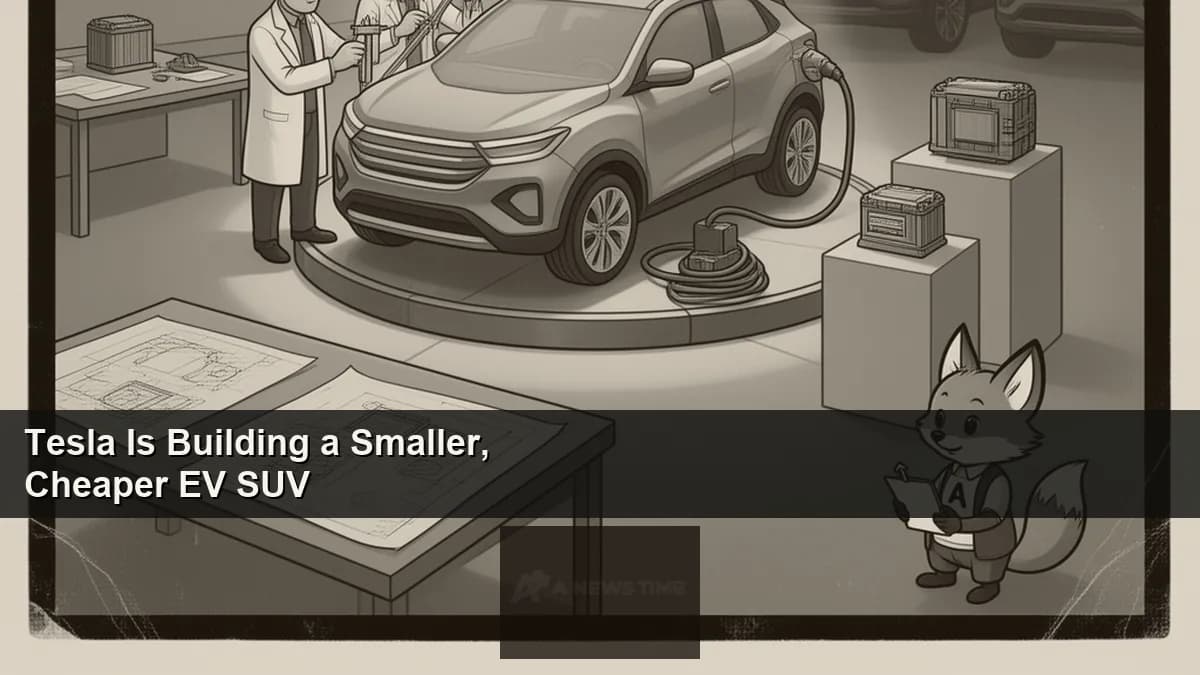
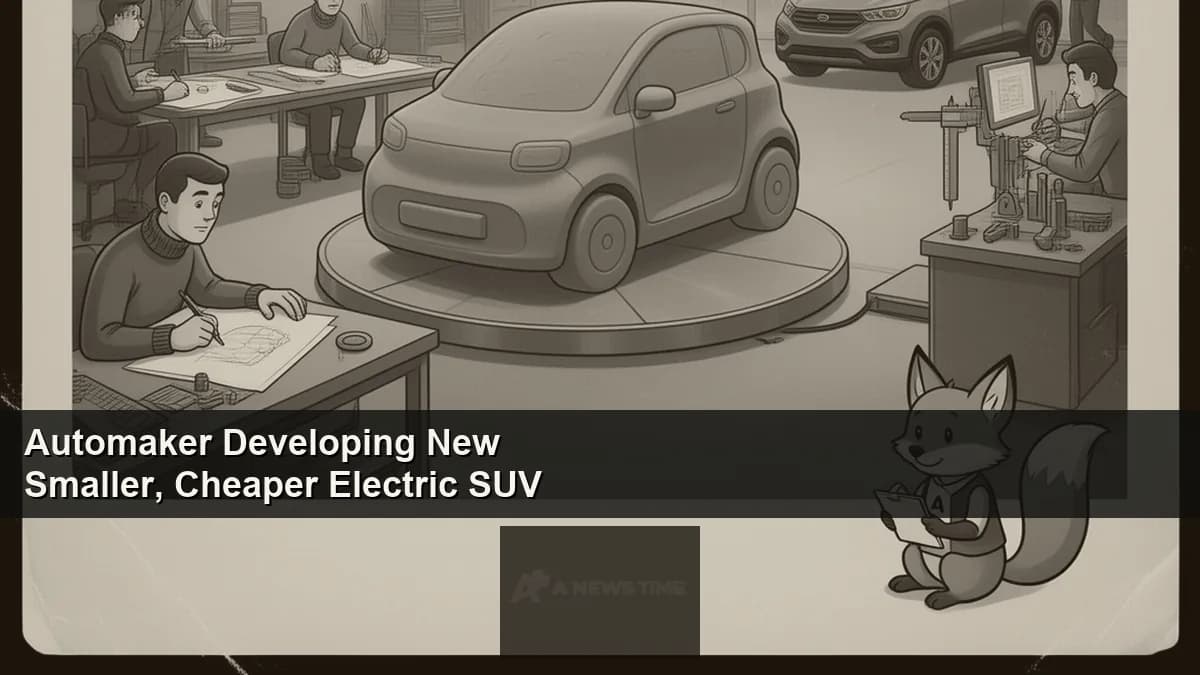
Four people with direct knowledge of Tesla's product development plans told Reuters on April 9 that the company is building an all-new compact electric SUV. Not a refresh. Not a trim variant. A ground-up new vehicle positioned below the Model Y in size, weight, and price. Reuters describes it as a smaller, cheaper EV aimed at entry-level buyers who currently find Tesla's lineup unaffordable.
The report lands in a peculiar moment for the company. Tesla spent most of 2024 and 2025 publicly pivoting away from mass-market cars, with Elon Musk calling affordable human-driven EVs "pointless" in favor of autonomous robotaxis and the Optimus humanoid robot. The fact that four independent sources are now describing active supplier conversations for a conventional SUV suggests the internal calculus has shifted materially. Tesla's sales declined for a second consecutive year in 2025, and the company needs volume that neither Cybercab nor Optimus can deliver in the near term.
What Four Sources Told Reuters
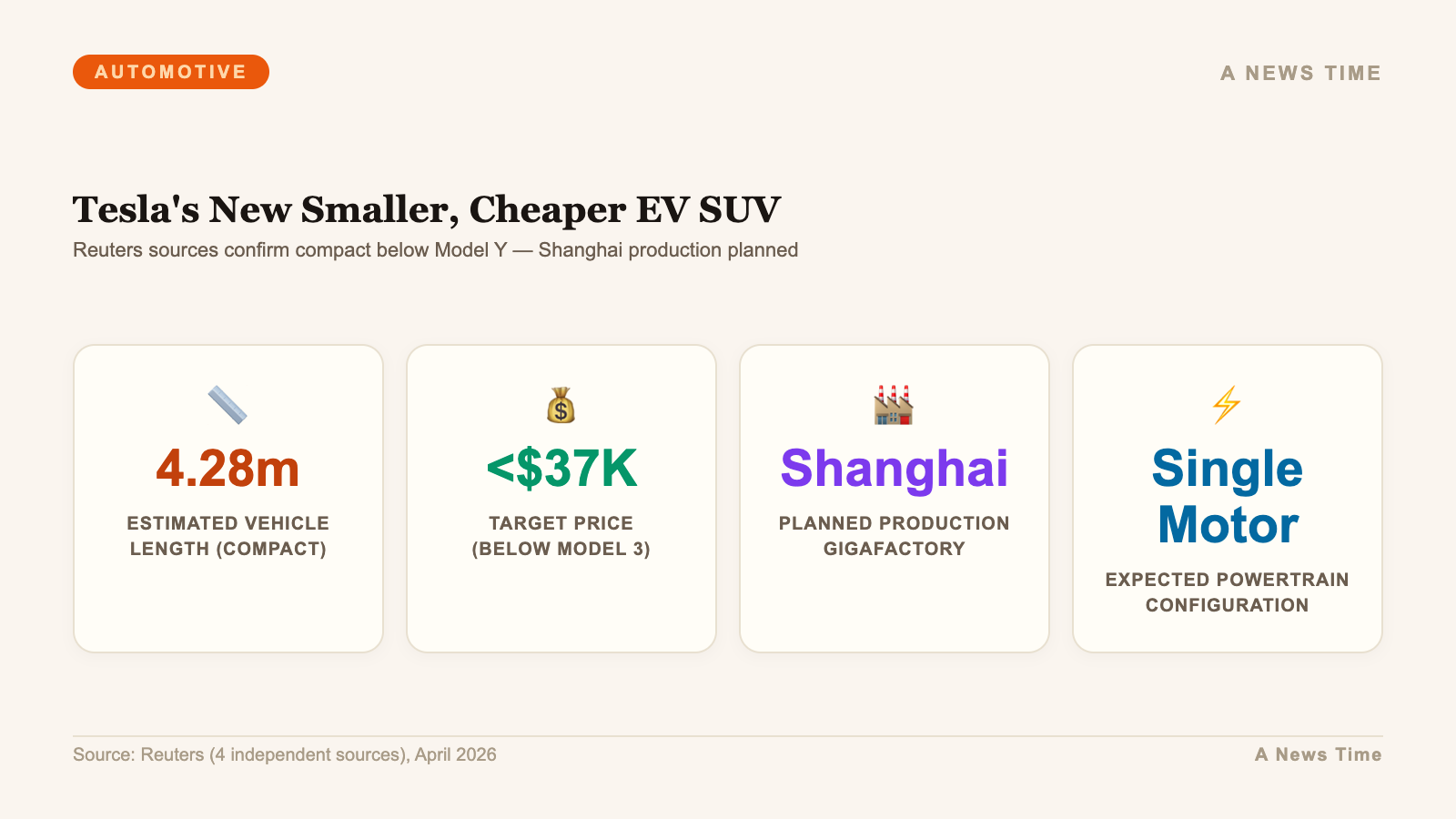
The Reuters reporting is based on confirmed sourcing from four independent individuals with direct knowledge of the project. Three confirmed the vehicle would be produced at Tesla's Shanghai Gigafactory, with one source adding that Tesla intends to eventually expand production to the United States and Europe. No timeline for that expansion was offered.
Two sources placed the vehicle's length at 4.28 meters, roughly 14 feet, making it meaningfully smaller than the Model Y at 4.79 meters. One source confirmed a single-motor powertrain rather than the dual-motor option available on higher-spec Teslas. Another reported a target curb weight of approximately 1.5 metric tons, about 500 kilograms lighter than the Model Y's roughly 2-ton weight. The battery would be downsized accordingly to achieve the weight target and hit the lower price goal.
Two sources confirmed Tesla's intention to price the new model below the Model 3, which currently starts at approximately $34,000 in China and $37,000 in the United States. No specific price target was disclosed. Production is not expected to begin in 2026; a more realistic earliest start would be sometime in 2027, the sources indicated.
Size, Weight, and Cost: The Engineering Case
The specifications describe a vehicle that is not just cosmetically differentiated from the Model Y but structurally cheaper to build at every level of the supply chain. Understanding why requires a brief look at the cost structure of battery electric vehicles.
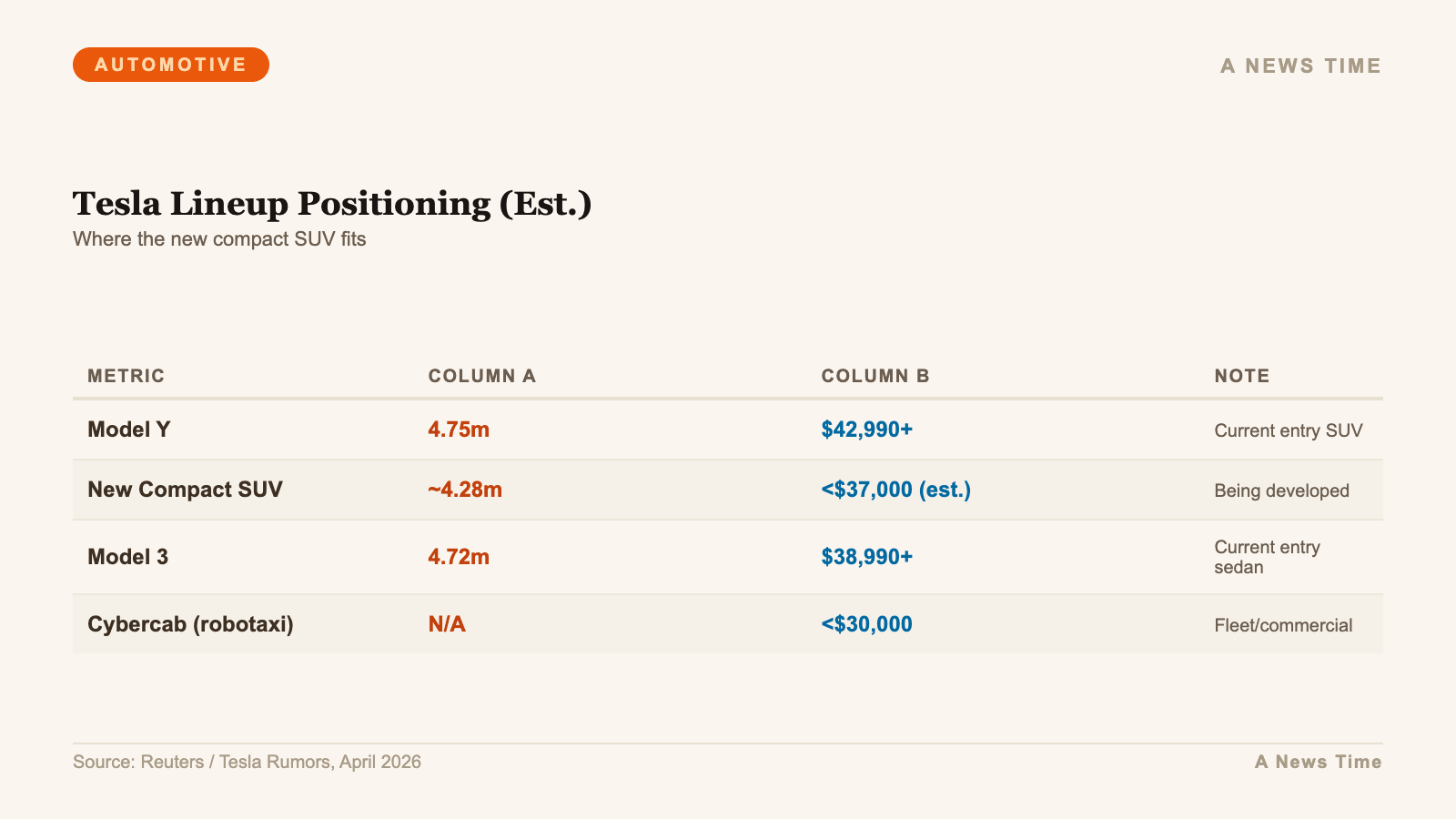
| Specification | Model Y (Standard RWD) | Compact SUV (Reported) | Delta |
|---|---|---|---|
| Length | 4,791 mm (15.7 ft) | 4,280 mm (14.0 ft) | -11% shorter |
| Curb Weight | ~2,003 kg (4,416 lbs) | ~1,500 kg (3,307 lbs) | -25% lighter |
| Motor Configuration | Single or dual | Single motor only | Fewer motors |
| Est. Battery Pack | 60-82 kWh (variant) | ~50-60 kWh (estimated) | ~20-25% smaller |
| EPA Range (est.) | 260-283 miles (Standard) | Below Model Y (smaller battery) | Lower range expected |
| US Starting Price | $39,990 | Below $37,000 (target) | At least $3,000 less |
Battery packs remain the single largest cost driver in any BEV, typically representing 30-40 percent of the vehicle's bill of materials. A 25 percent reduction in pack size, assuming similar cell chemistry, translates to roughly $4,000-$6,000 in materials savings at current cell prices. Add the structural savings from reduced vehicle length (smaller body stamping, shorter frame rails, less interior material) and the 500 kg weight reduction makes the economics of a sub-$37,000 price point at least plausible rather than aspirational.
For comparison, the Honda HR-V (4,330 mm, gasoline) and Hyundai Kona Electric (4,355 mm) occupy similar footprints. Neither delivers Tesla's software ecosystem, charging network, or over-the-air update capability. If Tesla hits a price of $28,000-$33,000 with competitive range, those are the displacement targets.
The Autonomy Angle: Driverless-Optional by Design
One detail in the Reuters report deserves careful attention. A Tesla employee with knowledge of current product philosophy told Reuters the company "now aims to build models that would be driverless but offer a human-driven option." The explicit reasoning: many global markets will not accept fully driverless vehicles for years, so building a vehicle that can function both with and without a driver keeps the factory utilization high and the addressable market broad.
This is a significant shift from Musk's stated position in 2024. At that time, Tesla's official line was that building a conventional human-driven affordable car was "silly" because full autonomy was imminent. The new product philosophy, captured by Reuters' source, accepts the reality that full autonomy is not imminent across all global markets and that Tesla needs to sell human-driven cars to maintain revenue, brand presence, and the data collection that ultimately powers FSD improvements.
Building a vehicle designed to accommodate both operational modes from the start does add cost. The wiring harness, sensor mounting architecture, and computing platform all need to support the full ADAS stack, even on versions that ship with basic driver assistance rather than Full Self-Driving. That design overhead works against the cost reduction mission. Tesla's engineering teams will need to solve that tension or accept a higher floor price than initially targeted.
Tesla's Track Record With Affordable EVs
Skepticism is earned here, not optional. Tesla's history with affordable-EV announcements is not encouraging. The third-generation Roadster was shown in 2017 and has not entered production as of 2026. The Semi exceeded its original 2019 timeline by years. Most directly relevant: Tesla announced a "$25,000 Model 2" project that Musk described as central to the company's mass-market mission, then Reuters itself reported in 2024 that the project had been canceled. Musk subsequently called building cheap cars for human drivers "pointless."
The "affordable" Tesla products that actually materialized in fall 2025 were Standard trim variants of the existing Model 3 and Model Y, priced at $36,990 and $39,990 respectively. These are not new vehicles. They are cheaper configurations of existing ones. Neither moved the needle on volume in any sustained way.
The difference between prior canceled projects and the current Reuters report is that the sourcing documents active supplier conversations about manufacturing processes and component specifications. Companies do not have those conversations with suppliers for projects that exist only as internal wish lists. Supplier engagement is a concrete step in the product development process that typically happens after internal approval, not before it. That is meaningful signal even if it does not guarantee delivery.
What Killed VW's Tennessee Plant
The same week Reuters published its Tesla compact SUV report, Volkswagen confirmed it is ending ID.4 production at its Chattanooga, Tennessee plant and retooling for the gasoline-powered Atlas. The sequence matters: the ID.4 grew 31 percent in U.S. sales in 2025 while the federal EV tax credit remained in effect. When the credit expired, ID.4 sales collapsed 62 percent in a single quarter.
VW's Chattanooga operation was partly constrained by its 2016 Dieselgate settlement with the Department of Justice, which required EV production. That legal obligation has been satisfied. With the settlement obligations met, the commercial case for building the ID.4 in Tennessee at current demand levels simply does not compute. The Atlas, VW's second-best-selling U.S. model, is a higher-margin, more-demanded product.
The exit creates a real gap. The ID.4 was one of the few affordable electric crossovers with reasonable range and an established service network in the United States. Tesla's sub-$37,000 compact, if it arrives in U.S. production by 2028-2029, would fill that gap. So would an expanded Chevrolet Equinox EV or a new Hyundai Kona EV variant. The question is who gets there first and whether incentives have returned by then.
See our detailed analysis of the VW pullback and broader EV market conditions: EVs Canceled or Delayed in 2026 as Automakers Pull Back.
China First: The Shanghai Gigafactory Strategy
All three sources who confirmed a production location named Shanghai Gigafactory as the primary site. That is not a surprise. Shanghai is Tesla's most cost-efficient manufacturing operation, benefiting from lower labor costs, deep local supply chain integration, and the proximity to Chinese battery suppliers including CATL and BYD's battery division.
A Shanghai-first strategy for the compact also means the vehicle would be initially built for Chinese domestic consumption and for export to Europe, not for the U.S. market. Chinese buyers are the most price-sensitive EV customers in the world, and a compact under $30,000 would compete directly with BYD's Dolphin and Atto 3 in China's ferociously competitive sub-200,000 yuan segment. Tesla would have to price aggressively to gain traction there, which compresses margins.
For European export, the Shanghai production base makes financial sense as long as existing EU tariffs on Chinese-made EVs remain manageable. The EU imposed provisional duties of 7.8-35.3 percent on Chinese-made EVs in late 2024, with Tesla's vehicles from Shanghai subject to an additional 7.8 percent on top of the standard 10 percent import duty. A $30,000 vehicle carrying an effective 18 percent import duty lands in Europe at roughly $35,400 before local dealer markup, which is still below most European compact EV alternatives.
For data on how the European EV market is absorbing Chinese-made vehicles: Used EV Sales Jump in Europe as Iran War Drives Up Petrol.
The Competitive Pressure Tesla Is Responding To
The single most uncomfortable reality for Tesla in 2026 is that BYD sells a credible electric vehicle, the Seagull, starting below $12,000 in China. The Seagull is not available in the United States due to 100 percent tariffs on Chinese-made vehicles, but it sells in Europe, Southeast Asia, Latin America, and Australia at prices that Tesla cannot remotely match. More relevantly, BYD's broader lineup, including the Atto 3 and Seal, competes directly with the Model Y and Model 3 in markets where Tesla's brand premium has eroded.
Tesla's response has been to cut prices on existing vehicles, which compresses margins without adding fundamentally new addressable customers. A sub-$37,000 compact built on a new, lighter platform with lower materials cost is structurally different from a price cut on the Model Y. It opens the funnel rather than discounting at the same price point.
The company has also faced consecutive years of volume decline in its human-driven EV lineup. Cybercab is in production but faces regulatory barriers to consumer sales in the U.S. and no clear EU timeline. Optimus is a multi-year commercial story at best. For Tesla to grow volume before 2028, the compact SUV is the most viable option on the table.
See our analysis of BYD's technological trajectory: BYD's Super-Fast Charging Battery Is a Wake-Up Call.
Buyer Guidance: What to Do Right Now
This report is not actionable for buyers in the near term. Production is not expected in 2026. U.S. availability is likely 2028-2029 at the earliest. If you need an affordable electric crossover today, the realistic options are the Chevrolet Equinox EV (starting around $34,995), the Hyundai Ioniq 5 (from $41,450), or the Kia EV6 (from $42,600). None hit the sub-$37,000 target Tesla is aiming at, but all are real, available vehicles with established service networks.
For those willing to buy used, the sub-$30,000 used EV market has expanded significantly as three-year leases from the 2022-2023 EV boom cycle return to market. A used Model 3 long range from 2022-2023 can be found for $22,000-$28,000, offering more real-world capability than the new compact Tesla is planning and with immediate availability.
For context on the used EV market opportunity: New EV Sales Drop 28% But Used EVs Surge to Record.
Sources
- Reuters: Tesla is developing a new smaller, cheaper EV, sources say (April 9, 2026)
- Reuters: Tesla's lower-cost EV plan seen boosting volume, risking margins (April 9, 2026)
- Car and Driver: Electric Car Range by Model (reference data)
- European Commission: Definitive countervailing duties on battery electric vehicles from China (October 2024)