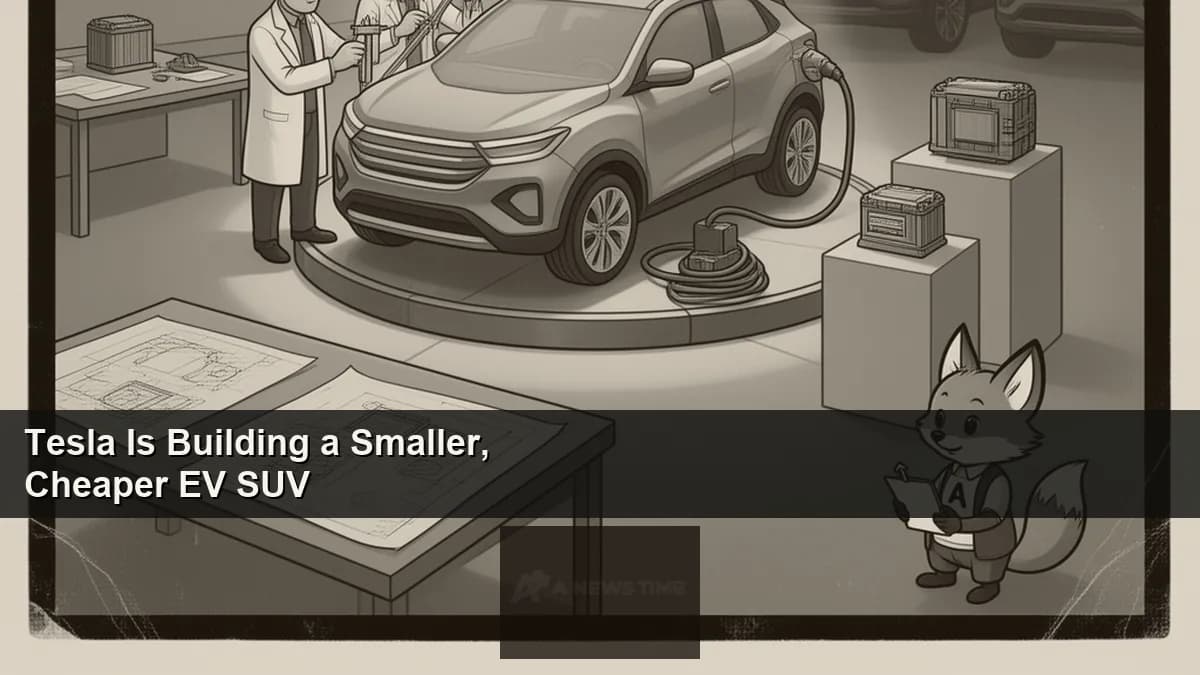
Tesla is working on a smaller, cheaper electric SUV, four people with direct knowledge of the project told Reuters this week in an exclusive report. The unnamed compact would be an entirely new vehicle, not a trim variant of the existing Model 3 or Model Y, and would sit below both in price. If it reaches production, it would represent Tesla's clearest attempt yet to crack the entry-level EV segment that rivals in China have owned for three years.
The disclosure lands at a peculiar inflection point for the industry. Gas prices in the United States have crossed $4 per gallon again, a level that historically drives shoppers toward fuel-efficient alternatives. Yet the federal EV tax credit that had subsidized mass-market adoption expired in 2025, leaving buyers without the $7,500 cushion that once made entries like the Volkswagen ID.4 viable. VW itself announced this week it is ending ID.4 production in Chattanooga, Tennessee. The timing of Tesla's development effort is either well-calibrated or simply coincidental with these structural shifts.
What Reuters Found: The Specifications
Tesla has been contacting suppliers in recent weeks to discuss manufacturing processes and component specifications for the compact SUV, according to the four Reuters sources. Three of them confirmed the car would be produced at Tesla's Shanghai factory. One source added that Tesla intends to eventually expand production to the United States and Europe, though no timeline for that was offered.
Two sources put the vehicle's length at 4.28 meters, roughly 14 feet. That makes it meaningfully smaller than the Model Y, which runs about 15.7 feet. For reference, that places it in the same footprint neighborhood as the Honda HR-V or Hyundai Kona, not the larger crossover segment the Model Y occupies.
On the powertrain and weight front, one source said Tesla would use a single electric motor rather than offering a dual-motor option. The battery would be smaller than current Tesla packs, which would reduce range below the 306-to-327 mile figures the Model Y delivers. The vehicle would weigh approximately 1.5 metric tons, compared to about 2 metric tons for the Model Y. These are not incidental numbers: a lighter car with a smaller battery is how you reduce the bill of materials enough to justify a substantially lower price.
Two sources confirmed the intent to price the new model below the Model 3, which currently starts at $34,000 in China and about $37,000 in the United States. Neither they nor Reuters specified a target price. Production is unlikely to begin before 2027 at the earliest, the sources indicated, and Tesla has not confirmed any of this publicly.
Model Y vs. New Compact: What the Numbers Suggest
| Specification | Model Y (Long Range) | Compact SUV (Reported) |
|---|---|---|
| Length | 4,791 mm (15.7 ft) | 4,280 mm (14.0 ft) |
| Curb Weight | ~2,003 kg (4,416 lbs) | ~1,500 kg (3,307 lbs) |
| Motor Configuration | Dual motor available | Single motor (reported) |
| EPA Range | 306-327 miles | Lower (battery downsized) |
| US Starting Price | $39,990 (Standard) | Sub-$37,000 (target) |
| Primary Production | Shanghai, Fremont, Berlin, Austin | Shanghai (initial) |
The weight delta is the most interesting figure here. A 500 kg reduction is not just an engineering achievement; it directly translates to a smaller battery requirement to achieve a given range target, which is the single largest cost driver in any BEV. If Tesla can hold to 1.5 metric tons, the battery pack for this vehicle would likely fall in the 50-60 kWh range rather than the 75-82 kWh units found in the Model Y, potentially saving $4,000-$6,000 in materials cost at current cell prices.
Tesla's Uncomfortable History With Affordable EVs
Skepticism is warranted. Tesla has a documented pattern of announcing affordable vehicles and then not delivering them on schedule, or at all. The Roadster was shown in 2017 and still has not entered production. The Semi took years beyond its original timeline. Most relevant here: Tesla announced a $25,000 "Model 2" project that Elon Musk famously described as central to the company's mission, then Reuters reported in 2024 that the project had been scrapped entirely.
Musk himself declared in late 2024 that building a $25,000 EV for human drivers would be "pointless" and "silly" because Tesla would soon offer driverless vehicles instead. The "affordable" models that arrived in fall 2025 were stripped-down Standard trims of the existing Model 3 and Model Y, priced at $36,990 and $39,990 respectively. Neither made a meaningful dent in Tesla's sales figures.
The Reuters sources note that even this new compact remains in early development with no production green light confirmed. A former Tesla manager told Reuters that an all-new cheaper traditional car would represent "a significant departure from the company's philosophy through mid-2025," when the company had pivoted away from entry-level cars toward robotaxis and humanoid robots.
That said, the supplier conversations Reuters documented are a concrete step beyond concept renderings or executive commentary. Companies do not discuss manufacturing processes and component specifications with external suppliers for projects that have no internal momentum.
The Autonomy Angle: Dual-Purpose from Day One
One detail in the Reuters report is worth examining carefully. A Tesla employee told Reuters the company "now aims to build models that would be driverless but offer a human-driven option." The explicit logic: many markets will not see regulatory acceptance of fully driverless vehicles for years, so building cars that can function both ways keeps factories running and expands the addressable market.
This is a meaningfully different product philosophy than either a pure robotaxi or a pure human-driven car. It also has cost implications. A vehicle designed to support optional autonomy needs the sensor mounting points, compute architecture, and wiring harness to accommodate the full ADAS stack even if some versions ship without it. That adds cost, which works against the sub-$37,000 price target.
The Cybercab, by contrast, was designed from the ground up as a robotaxi with no steering wheel or pedals, a choice that requires a federal exemption Tesla has not yet sought, according to the NHTSA. A compact SUV that can be sold with human controls does not carry that regulatory burden, which may partly explain why this vehicle is advancing while Cybercab's path to consumer sales remains unclear.
For more on the Cybercab's production status and regulatory situation, see our earlier coverage: Tesla's Cybercab Enters Production: No Wheel, No Pedals, Under $30K.
VW's Tennessee Retreat: What It Signals
The same week Tesla's compact SUV development surfaced, Volkswagen confirmed it is ending ID.4 production at its Chattanooga, Tennessee plant in mid-April 2026 and retooling for the gasoline-powered Atlas SUV. The shift reflects one of the starkest policy-to-demand feedback loops in recent U.S. automotive history.
The ID.4 grew 31 percent in sales during 2025, bolstered by the federal EV tax credit that made the vehicle price-competitive with gasoline alternatives. Then the credit expired. In the last three months of 2025 alone, ID.4 sales fell 62 percent. Volkswagen was legally required to produce EVs at Chattanooga as part of its 2016 Dieselgate settlement with the Department of Justice, but that obligation has now been satisfied. The second-generation Atlas, VW's second-best-selling U.S. model, is expected in dealerships by fall 2026 after the retooling.
"Volkswagen's decision to shift away from electric vehicles reflects the challenges automakers face in transitioning to EVs amid consumer preferences and policy changes. It highlights the continued dominance of larger, traditional vehicles in the American auto market."
National Today (Chattanooga), April 9, 2026
VW's retreat is not an indictment of EV technology so much as a clear demonstration of what happens when you remove the financial bridge that makes EVs cost-competitive for mainstream buyers. The ID.4's 62 percent sales collapse in a single quarter is not gradual; it is a cliff. Any automaker developing an affordable EV for the U.S. market has to make assumptions about whether incentives return, and currently that picture is opaque.
See also: Tesla Built 50,000 More Cars Than It Sold. Gas Just Hit $4. for our analysis of how VW's situation mirrors Tesla's Q1 2026 inventory pressure.
The Market Backdrop: 2026 EV Forecasts Are Getting Revised Down
The broader market context for Tesla's development work is mixed at best. According to the latest forecast from EV Volumes, reviewed by Autovista24, global EV deliveries are expected to grow only 5 percent in 2026, reaching approximately 22.7 million units. That is a sharp downgrade from the 21.9 percent growth achieved in 2025, and it comes after the previous 2026 forecast assumed a 2.7 percent rise in overall light-vehicle sales globally. The current revision expects just 0.4 percent total market growth.
Neil King, head of forecasting at EV Volumes, attributes the slowdown primarily to erosion of household purchasing power from rising oil and gas prices, combined with governments in major markets phasing out purchase incentives. Companies are delaying investments, vehicle renewal is being deprioritized, and the energy price environment is creating broad consumer hesitation rather than channeling it toward EVs.
| Region | 2026 EV Share (Forecast) | 2025 Actual Share | 2030 Projection |
|---|---|---|---|
| Global | 24.7% | ~23.5% | 40.4% |
| Europe (West/Central) | 31.3% | ~28% | 57.3% |
| Northern America | 8.9% | ~9.8% | 18.9% |
| China | 50.2% | ~51% | 72.1% |
North America's 8.9 percent projected EV share for 2026 is the number that should give Tesla pause. The U.S. market, without federal incentives and with gas prices elevated but not prohibitive, is not driving the kind of volume growth that would make a mass-market EV SUV an obvious near-term winner. Europe, at 31.3 percent projected EV share, is a better near-term bet, and Germany is already showing it: BEV registrations in Germany jumped 66 percent year-over-year in March 2026. That is the market environment in which a Shanghai-built compact Tesla could gain traction before domestic U.S. production begins.
For detailed data on the European market acceleration, see: Germany BEV Sales Surge 66% as Chinese Brands Explode.
What Chinese Rivals Have Already Figured Out
The implicit pressure behind Tesla's compact development is not subtle. Chinese automakers have been producing sub-$15,000 electric vehicles for years. BYD's Seagull starts well under $12,000 in China. Wuling's mini EVs dominate entry-level segments. None of these are available in the U.S. due to 100 percent tariffs on Chinese-made vehicles, but they are available in Europe, Southeast Asia, and Latin America, where Tesla competes.
A Tesla compact at, say, $28,000-$32,000 would not be competing with BYD's cheapest offerings on price, but it would represent Tesla's first genuine step down the price curve since the Model 3 arrived a decade ago. More importantly, it would be competing on brand, software ecosystem, Supercharger access, and the Full Self-Driving feature set that Chinese competitors cannot yet match globally.
Tesla's own analysts have flagged that the company faces a third consecutive year of declining sales in its traditional human-driven EV lineup. Adding a genuinely new lower-priced model is one of the few structural levers available to reverse that trend without cutting prices on existing vehicles to levels that compress margins further. A compact SUV produced at Shanghai's cost structure, shipped to Europe at competitive prices, could meaningfully change the volume picture by 2028.
What Buyers Should Actually Do With This Information
If you are in the market for an affordable EV SUV today, this development does not help you. The Reuters sources are clear: production is not expected to begin in 2026, and Tesla has not confirmed the project exists. Even if the project survives internal reviews and receives a production green light, the earliest realistic consumer availability would be 2027-2028 for Chinese and European markets, with U.S. production and sales on an even longer horizon.
The VW ID.4's effective withdrawal from the U.S. market (VW is expected to source whatever future ID.4 exists from European production rather than Chattanooga) removes one competitive option. The Chevrolet Equinox EV, starting around $34,995, and the Hyundai Ioniq 5 remain the primary options for buyers who want an affordable electric crossover with reasonable range today, without waiting for Tesla's potentially delayed entry.
For buyers in Europe, the picture is different. Competition is more intense, incentives are returning in key markets, and Chinese brands are genuinely available at lower price points. A Tesla compact entering that market in 2027-2028 would face real competition in ways the U.S. market, shielded by tariffs, does not currently present.
See our broader coverage on EV market conditions: Tesla China Sales Surge 87% Month-Over-Month in March 2026 for context on how Tesla's Shanghai factory is positioned to lead this new vehicle.
The Bottom Line
Four independent sources confirming active supplier conversations is not a press release, a concept car reveal, or a Musk tweet. It is the earliest credible signal that Tesla's long-stalled effort to build a genuinely affordable mass-market EV has resumed in a concrete form. The specifications reported, a 4.28-meter single-motor SUV weighing 1.5 metric tons at a sub-$37,000 price point, describe a vehicle that would be meaningfully different from anything in Tesla's current lineup.
The caveats are real: Tesla has canceled or indefinitely delayed prior affordable-EV projects, the company has not confirmed anything publicly, and the market environment in the U.S. is harder than it was even two years ago. The company's decision to build a vehicle that can support both human driving and future autonomy is sound strategy for a multi-year development cycle, but it also suggests this is not purely about selling cheap cars. It is about building infrastructure for a fleet that can eventually run itself.
Whether that fleet ever materializes at scale, and whether Tesla delivers on this project faster than it did on the Roadster or the Semi, are the questions that will determine whether this becomes a significant product launch or another entry in Tesla's long history of announced-but-delayed vehicles. Right now, it is at least a real project. That alone separates it from prior affordable-EV noise.
Sources
- Reuters: Tesla is developing a new smaller, cheaper EV, sources say (April 9, 2026)
- Autovista24 / EV Volumes: Market conditions impact 2026 EV forecast (April 9, 2026)
- National Today (Chattanooga): Volkswagen Shifts Focus from ID.4 EV to Atlas SUV in Tennessee (April 9, 2026)
- Reuters: Tesla's lower-cost EV plan seen boosting volume, risking margins (April 9, 2026)