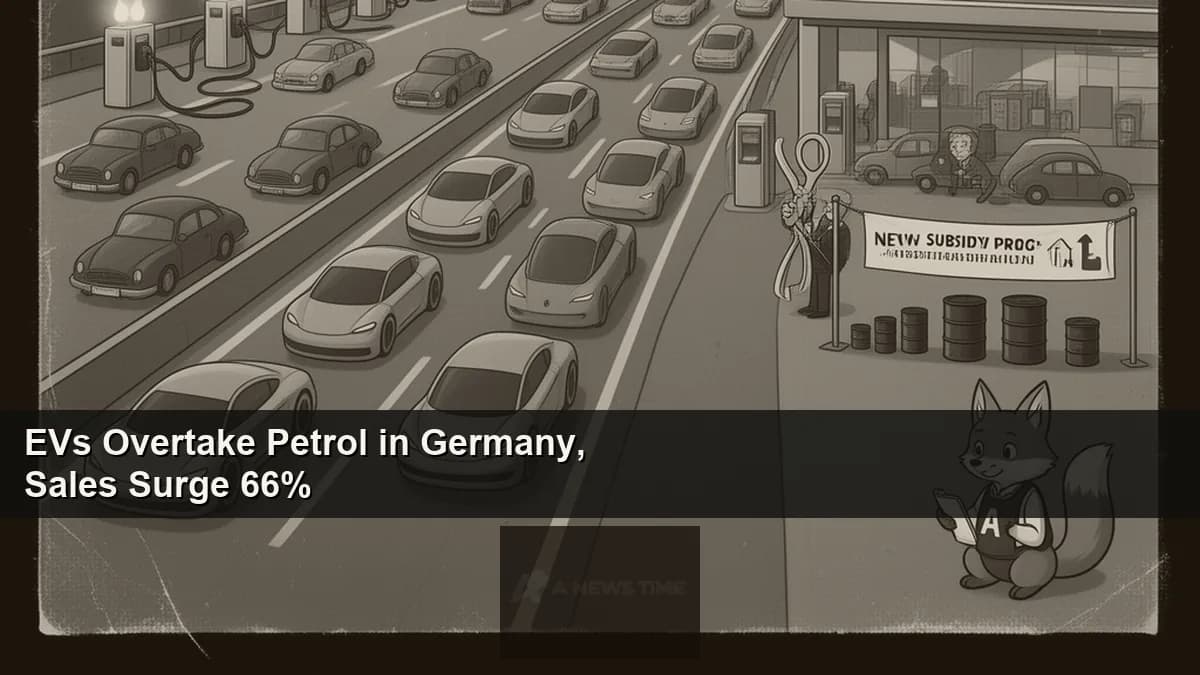
Electric vehicles overtook petrol cars in monthly new car registrations in Germany in , the first time that has happened in Europe's largest automotive market, according to data published by KBA, Germany's motor vehicle authority. EV registrations rose 66% year-over-year to nearly 71,000 units, capturing 24% of all registrations for the month. Petrol car registrations fell to approximately 67,000 units, dropping their market share below 23%. The numbers were reported by The Driven on , drawing on CLEW analysis of the KBA figures.
Two specific catalysts drove the March surge: Germany's new government subsidy program supporting lower-income households in buying or leasing EVs, and the oil price spike triggered by the ongoing Iran conflict, which has made petrol car ownership materially more expensive than it was 12 months ago. Neither factor was operating in isolation. The combination produced a month that Germany's EV advocates have been anticipating for years and that the industry will now use as a reference point for what a mature EV market looks like when the right policy and price conditions align.
Breaking Down the March Numbers
The 66% year-over-year increase in EV registrations is the headline, but the full picture of March 2026's German auto market is more complex. Hybrids, including plug-in hybrids, dominated the month with approximately 40% market share, or around 118,000 registrations, up 16% from March 2025. That figure reflects a pattern that has been consistent across European markets: consumers moving away from pure petrol but not yet ready to commit fully to battery-electric vehicles are landing on hybrids as a middle position.
Diesel fell sharply, dropping to fewer than 38,000 registrations and a market share of approximately 13%. Diesel's decline in Germany has been one of the more dramatic shifts in European automotive purchasing over the past five years. Following the Volkswagen emissions scandal of 2015 and subsequent government restrictions on diesel vehicles in urban areas, consumer confidence in the powertrain collapsed in a way that has proven irreversible. March 2026's diesel numbers continue that trajectory.
| Powertrain | March 2026 Registrations | Market Share | YoY Change |
|---|---|---|---|
| Battery Electric (BEV) | ~71,000 | 24% | +66% |
| Hybrid (incl. PHEV) | ~118,000 | 40% | +16% |
| Petrol | ~67,000 | <23% | -5% |
| Diesel | <38,000 | ~13% | Declining |
The overall market size in March 2026 was healthy relative to recent years, suggesting the EV surge was not a case of the total pie shrinking while EVs held a larger slice of less. The total registration count put March 2026 among the stronger months for German auto sales since 2023, which is notable given the broader pressures on European consumer spending from the Iran conflict and associated energy cost increases.
Tesla's Remarkable March Recovery
Perhaps the most unexpected element of the March 2026 data is Tesla's performance. Tesla registrations in Germany more than quadrupled compared to the same month in 2025, surpassing 9,000 units for the month. That recovery follows a period in early 2025 when Tesla sales in Germany collapsed amid consumer backlash against CEO Elon Musk's involvement in German domestic politics and his public support for the far-right AfD party.
The boycott effect that drove Tesla's 2025 Germany declines appears to have faded significantly. Several factors likely contributed to the recovery: the passage of time, price cuts that Tesla introduced in late 2025 across its German lineup, and the practical reality that for consumers seeking a premium all-electric vehicle above a certain capability threshold, the alternatives to Tesla remain limited. The Model Y is still the most capable battery-electric SUV in its price range by most objective measures, and consumer preference has historically shown a limited tolerance for sustained brand boycotts when the product advantage is large enough.
Tesla's recovery does not undo the political risk that the 2025 period illustrated. The company remains unusually exposed to the political positions of its CEO in a way that established automotive brands are not, because Tesla's brand identity is more thoroughly intertwined with Musk's public persona than most automotive brands are with their leadership. A second wave of controversy could produce a second decline. But March 2026's numbers demonstrate that the German market's appetite for EV technology can overcome at least one cycle of political discomfort.
The Policy Catalyst: Germany's New EV Subsidy
The March surge did not happen in a policy vacuum. Germany's new coalition government introduced a targeted EV subsidy program earlier in 2026 specifically designed to address criticism that previous subsidy programs disproportionately benefited higher-income buyers who were purchasing EVs they could already afford. The new program concentrates support on lower-income households, offering more generous purchase and lease assistance to buyers below specific income thresholds.
The design of the program reflects lessons learned from the previous German EV subsidy scheme, the Umweltbonus, which was suspended abruptly in late 2023 after the German Constitutional Court struck down the budget mechanism used to fund it. That suspension contributed to a sharp drop in German EV registrations in early 2024 as buyers who had been waiting for subsidies withdrew from the market. The new program is structured differently, with funding secured through conventional appropriations rather than the supplementary budget mechanisms that caused the earlier legal problems.
Buyers who qualified for the new subsidy and had been in the delivery queue for several months were a significant component of March's registration numbers. Electric car orders typically have lead times ranging from several weeks to several months, meaning March's registrations reflect purchasing decisions made in January and February, when subsidy availability was becoming clear. The bump from subsidy-eligible deliveries concentrated in March may moderate somewhat in April and May before establishing a new, higher baseline for the rest of 2026.
The Oil Price Factor: Iran's Shadow on European Auto Sales
The Iran conflict's effect on global oil prices has been a consistent background factor in European consumer decisions throughout early 2026. Fuel costs for petrol and diesel vehicles have risen materially from their 2024 baseline, changing the total cost of ownership calculation for new car buyers in ways that favor EVs on the operating cost side even when purchase prices remain higher.
The economic logic is straightforward. A petrol car buyer who expects fuel costs to remain elevated, as the current geopolitical situation suggests, needs to discount the ongoing fuel cost differential when evaluating a higher upfront EV purchase. When fuel prices are stable and moderate, that calculation often favors petrol cars because the upfront cost advantage is large and the fuel cost differential is small. When fuel prices spike, the math shifts.
Germany is more exposed to this dynamic than many European markets because it has historically been resistant to the kind of fuel taxation that buffers the impact of oil price movements in markets like France and the United Kingdom, where base fuel taxes are high enough that crude price swings have a proportionally smaller effect on at-the-pump prices. German drivers see more of the raw crude price movement in their fuel costs, which makes the EV cost-of-ownership comparison more sensitive to oil price changes.
For a detailed look at how the Iran conflict has been reshaping automotive industry economics across Europe, our recent analysis of the Iran war's impact on the global auto industry provides broader context for the supply chain and market dynamics that made March 2026's German numbers possible.
The Government's 2030 Target and Whether March Changes Anything
Germany's government has maintained a target of 15 million EVs on German roads by 2030. That target was set when the growth curve for German EV adoption looked more ambitious than it turned out to be, and it has remained aspirational rather than credibly achievable through most of the period since its announcement. March 2026 is the best single-month performance Germany has seen, but a single strong month does not change the arithmetic of getting to 15 million by 2030.
The current stock of EVs on German roads stands well below the trajectory that 15 million by 2030 would require. For the target to be met, the monthly registration pace established in March would need to hold or accelerate for most of the next four years, which would require sustained favorable policy support, infrastructure improvement, and either continued high oil prices or continued falls in EV purchase prices. None of those conditions is guaranteed, and the political risk around German EV policy, demonstrated by the 2023 Umweltbonus suspension, is real.
The practical significance of March's numbers is not that they make the 2030 target achievable in its original form. It is that they demonstrate Germany has the market depth to sustain monthly EV sales at the 70,000-plus level when conditions are right. Building the policy and commercial infrastructure to make those conditions consistent rather than occasional is the challenge the industry and government face going forward.
Charging Infrastructure: The Constraint That Remains
Germany's charging infrastructure has expanded significantly in recent years but remains unevenly distributed in ways that affect EV adoption, particularly in rural areas and older housing stock where home charging is difficult or impossible. Urban drivers with access to home or workplace charging have fundamentally different cost and convenience experiences than rural buyers dependent on public charging networks.
The public charging network has been growing. Germany added tens of thousands of public charging points between 2022 and 2025. But the network's reliability and the charging speed available at many public stations have been recurring complaints from EV owners. Fast charging infrastructure, the stations capable of delivering meaningful charge in 20 minutes or less, remains concentrated in highway corridors rather than distributed throughout urban and suburban areas in ways that would normalize EV use for buyers without home charging access.
Automakers have been investing in charging as a differentiator. Several major German OEMs have committed to expanding their proprietary charging networks and improving the experience at public charging stations through partnerships. Tesla's Supercharger network, now open to non-Tesla vehicles in Germany following the opening of the network required by EU policy, remains the benchmark for reliability and speed that other networks are measured against.
For a look at how European EV concepts and infrastructure innovation are evolving alongside the market growth, our earlier coverage of Hyundai's Earth and Venus EV concepts for 2026 provides useful context for where the technology is heading, which is relevant to understanding consumer confidence in EV purchasing decisions over multi-year time horizons.
What March 2026 Tells Us About European EV Transition
Germany's milestone matters beyond its borders because Germany is, by a significant margin, Europe's largest automotive market and the country with the most globally consequential domestic auto industry. What happens in German EV adoption sends signals that ripple through Volkswagen Group, BMW Group, Mercedes-Benz, and the broader European manufacturing complex.
A Germany that is confidently transitioning to EVs at scale provides these manufacturers with the domestic demand base and policy clarity they need to continue electrification investment without the anxiety that characterized the 2024-2025 period, when some manufacturers were publicly retreating from electrification commitments in the face of weak demand signals. March 2026's numbers are ammunition for the electrification case within German corporate boardrooms.
The broader European trajectory for EV adoption also depends on what happens when policy and market conditions align in the continent's major markets. March 2026 in Germany is one data point in that picture, alongside continued strong growth in Norway, the Netherlands, and Sweden, and developing EV markets in Southern and Eastern Europe. The continent is not moving to EVs at a uniform pace, but the direction is consistent, and Germany's March numbers are a significant marker in that journey.