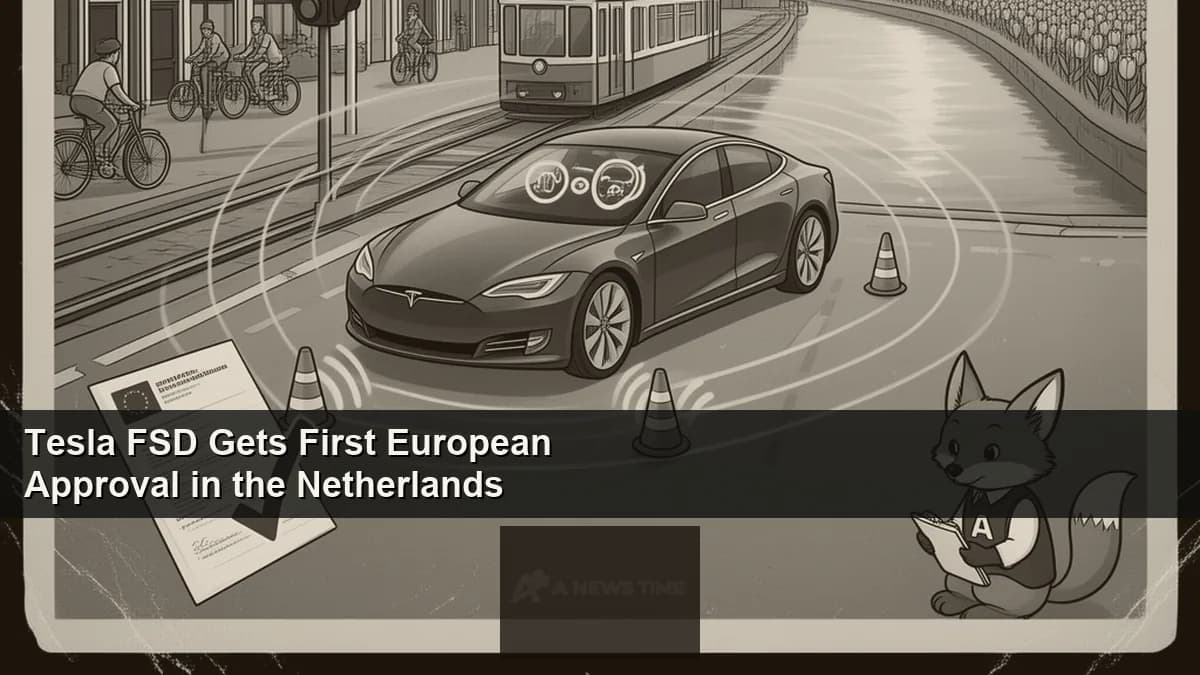
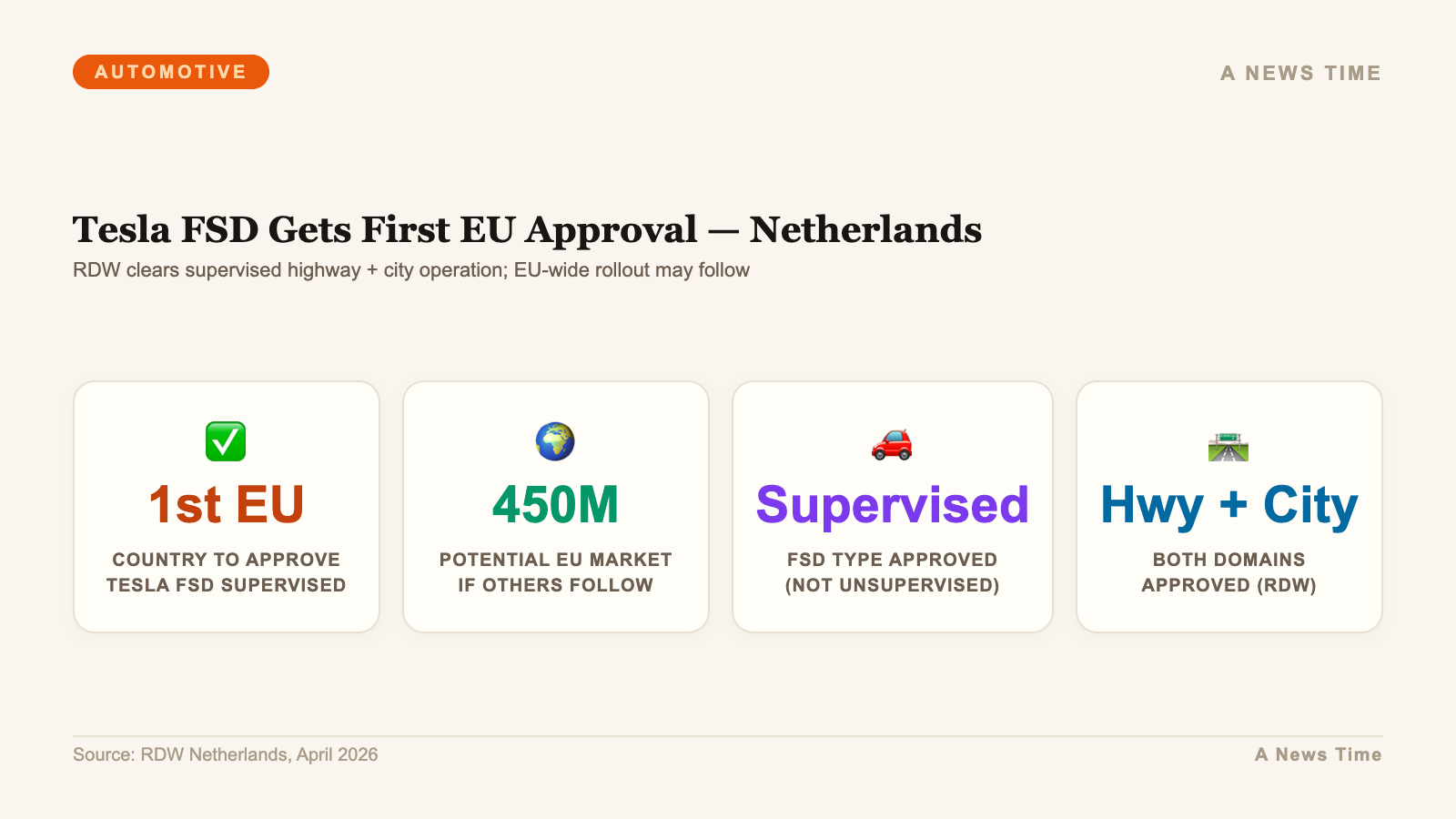
Tesla's Full Self-Driving Supervised system has cleared its first European regulatory hurdle. The Dutch vehicle authority RDW issued approval for the system to operate on Netherlands highways and city streets as of April 2026, making the Netherlands the first European Union member state to authorize Tesla's advanced driver-assistance technology for real-world use. For Tesla, the approval is not merely a win for one small country with 17 million people. It is a framework-setting event that could determine how quickly the other 26 EU member states process their own reviews.
FSD Supervised has been legal in the United States and Canada for years, but the European regulatory environment has been considerably more cautious. EU rules governing advanced driving automation systems (ADAS) require national-level type approval processes that differ country by country, even as the European Commission works toward a unified framework. The Netherlands, a country with high regulatory capacity and a track record of moving quickly on emerging mobility technology, was the logical first mover.
What the RDW Actually Approved
The scope of the approval matters. The RDW authorized FSD Supervised, not FSD Unsupervised. The distinction is substantive. Supervised means the driver must remain attentive, eyes on the road, with hands available to take control. The system can handle steering, acceleration, and braking across a wide range of conditions, but it does not operate without a responsible human in the loop. Tesla's own in-car documentation describes it as requiring "constant supervision and may do the wrong thing at the worst time."
The Netherlands approval covers both highway and city street operation, which is broader than some expected. Several EU regulators had signaled that a staged approach, highway-only first, was more likely as an initial authorization. Getting city street operation approved simultaneously suggests Tesla's technical documentation was sufficient to satisfy the RDW's requirements across both operational design domains from the start.
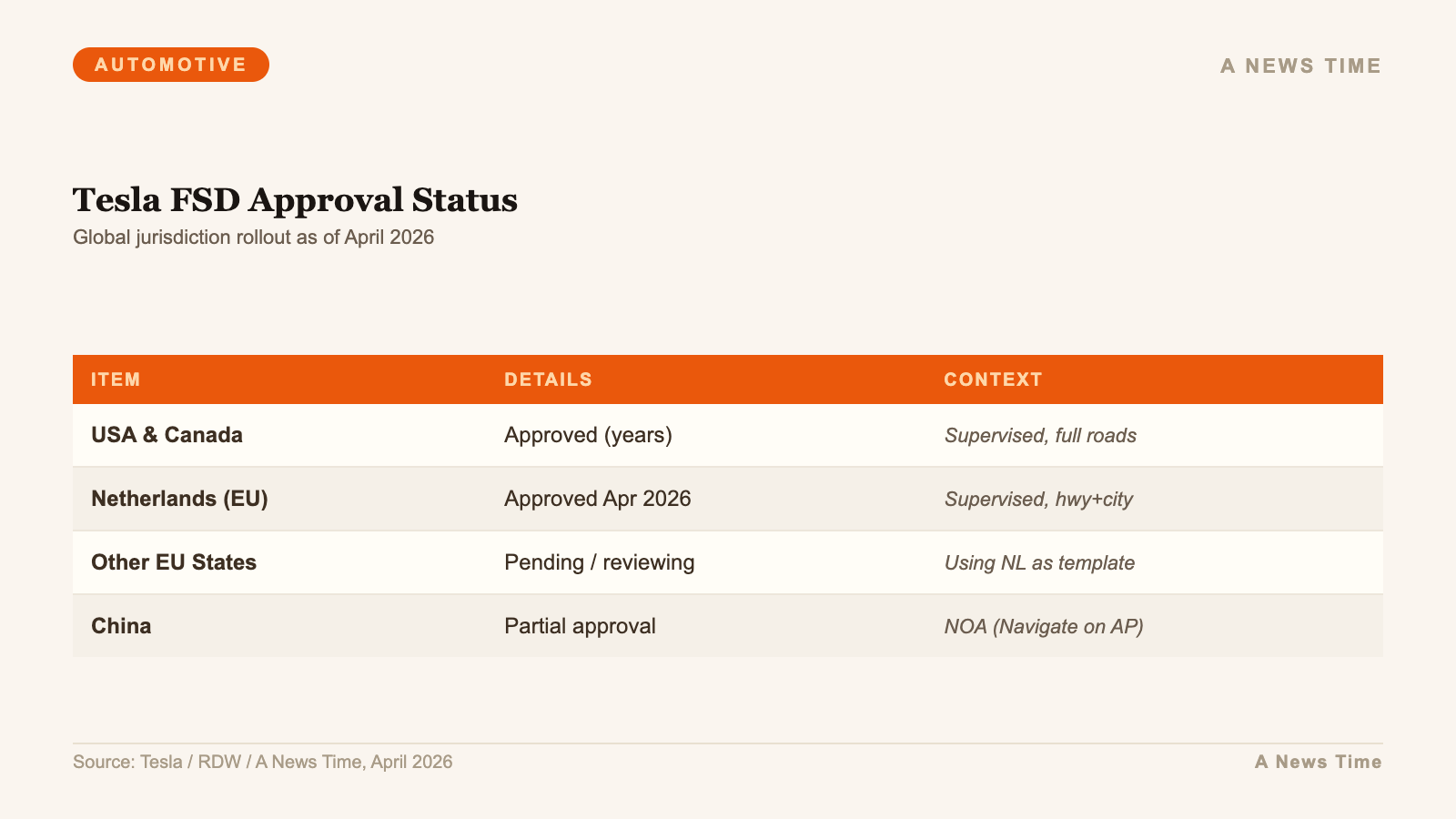
| Region | Status | Operational Domain | Approval Authority |
|---|---|---|---|
| United States | Approved | Highways + city streets | NHTSA (federal + state) |
| Canada | Approved | Highways + city streets | Transport Canada |
| Netherlands | Approved (April 2026) | Highways + city streets | RDW |
| Germany | Under review | TBD | KBA (Kraftfahrt-Bundesamt) |
| France | Not submitted | -- | UTAC |
| China | Limited testing only | Restricted zones | MIIT |
Tesla owners in the Netherlands with compatible hardware (HW3 and HW4 vehicles) will be able to activate FSD Supervised through a software update. Tesla has not published pricing for the European FSD subscription, though the U.S. rate of $99 per month is the likeliest reference point. The Full Self-Driving capability package currently costs $8,000 as an outright purchase in the U.S.
Why the Netherlands, and Why Now
The Netherlands has the highest per-capita Tesla ownership rate in continental Europe. Rotterdam and Amsterdam together rank among the top five European cities by absolute Tesla fleet density. The RDW has also been one of Europe's most proactive national vehicle authorities on autonomous and semi-autonomous technology approvals, having run testing frameworks for conditional automation systems since 2020.
The timing reflects the broader regulatory maturation of FSD's underlying technology. Tesla has logged well over a billion miles of FSD data in the United States, providing the statistical foundation that European regulators typically require for large-scale approval. The version approved in the Netherlands is believed to be FSD v13.x, the same generation running in North America, though Tesla has not publicly confirmed the exact software build evaluated by the RDW.
The Netherlands' action also comes as the European Commission is advancing its proposal for a unified autonomous vehicle regulatory framework, expected to produce EU-wide type approval rules by 2027-2028. Regulators in Brussels have signaled that early national approvals from respected member-state authorities will carry significant weight in shaping those rules. The RDW's stamp of approval for FSD Supervised is, in effect, a data point the EU Commission will reference when writing pan-European standards.
The Path to Wider European Rollout
The Netherlands approval does not automatically extend to other EU member states. Each country retains its own vehicle type approval authority under current rules, and Tesla must file separately with each national authority that it wants to activate FSD within. Germany, the largest automotive market in Europe, is the most strategically important next domino.
Germany's Kraftfahrt-Bundesamt has reportedly been reviewing Tesla's FSD documentation since late 2025. The German process is generally more thorough than the Dutch review, partly because Germany is home to BMW, Mercedes-Benz, and Volkswagen, all of whom have their own advanced driver assistance programs and a regulatory interest in not seeing Tesla gain an irreversible first-mover advantage. A German KBA approval in the second half of 2026 would be Tesla's most consequential European win after the Netherlands.
France, Italy, and Spain have not published timelines for FSD review. These markets collectively represent about 90 million additional addressable customers. A multi-country EU approval wave in 2026-2027, cascading from the Netherlands baseline, would give Tesla's FSD subscription revenue a step-change boost that North American growth alone cannot replicate.
Competitive Implications: Who Does This Hurt?
The competitive map here is more about what does not exist in Europe than what does. Waymo, the most capable deployed autonomous driving system in the world, has zero operational footprint in Europe. Its Phoenix, San Francisco, Austin, and Atlanta deployments are geofenced robotaxi services that have no near-term European expansion plan. Waymo's regulatory posture in the U.S. has been cautious and methodical, prioritizing safety documentation over speed. That strategy works in its home market but has left Europe entirely open for Tesla to shape the self-driving narrative.
Mobileye, whose EyeQ system powers lane-keeping and highway assist functions in most European vehicle brands, is not yet operating at FSD's level of capability in end-to-end neural-network-driven driving. Mobileye's SuperVision product, which provides hands-free highway driving, is available in the Zeekr 001 and a handful of other vehicles, but it has not received multi-domain approvals comparable to what Tesla just achieved in the Netherlands.
| Company | Product | European Status | ODD (Operational Design Domain) |
|---|---|---|---|
| Tesla | FSD Supervised | Approved (NL); Germany under review | Highways + city streets |
| Waymo | Waymo Driver | Not operating | Geofenced robotaxi only |
| Mobileye | SuperVision | Limited model availability | Highway hands-free only |
| Mercedes-Benz | Drive Pilot (SAE L3) | Germany + Nevada approved | Highway, <60 km/h, specific conditions |
| BMW | Personal Pilot L3 | Germany approval pending | Highway only |
Mercedes-Benz Drive Pilot is the only other system with an EU member-state Level 3 certification, but its operational design domain is constrained to German highways, speeds under 60 km/h, and specific weather and traffic conditions. Tesla's FSD Supervised is technically an SAE Level 2+ system (driver supervision required), which actually makes it easier to approve than L3 systems that assign legal responsibility to the vehicle. The regulatory strategy is deliberate: get into markets at L2+ first, accumulate data, and use that data in future L3/L4 applications.
Tesla's FSD Revenue Opportunity in Europe
Tesla sold roughly 195,000 vehicles in Europe in 2025, down about 45 percent from 2024 amid boycott pressure, brand controversy, and intensifying Chinese competition. Even accounting for that contraction, Tesla's active European fleet runs into the hundreds of thousands of HW3 and HW4 vehicles already on the road. Each new EU-country approval is an addressable install base for FSD subscription revenue, not future vehicle sales alone.
At $99/month, even a 10 percent take rate on Tesla's European fleet would generate over $200 million in annual recurring subscription revenue once approval extends across major EU markets. For comparison, Tesla's FSD-related revenue in North America, including both subscription and outright purchase, was estimated at roughly $1.5 billion annually as of early 2026. Europe represents a doubling opportunity if regulatory approvals cascade.
The Netherlands approval is the first real proof that cascading is possible. Whether it moves quickly enough to reverse Tesla's European sales decline is a separate question involving brand sentiment, Chinese competition, and price positioning. But the regulatory foundation now exists in Europe in a way it did not six months ago.
For context on Tesla's European sales environment, see our earlier coverage: EVs Canceled or Delayed in 2026 as Automakers Pull Back.
What This Means for FSD's Technical Credibility
European regulators do not approve things on trust. The RDW's review process involves independent technical evaluation, simulation testing, real-world validation drives, and incident reporting analysis. The fact that FSD Supervised cleared this process is a materially different signal than Tesla's own safety statistics, which the company controls and publishes selectively.
Tesla has consistently claimed that FSD-supervised miles have a lower accident rate than human-driven miles. Critics, including safety researchers at the Insurance Institute for Highway Safety and academic groups, have raised methodological questions about how those comparisons are constructed. An independent national regulatory body conducting its own evaluation and issuing approval carries more weight with the skeptical audience than Tesla's internal figures.
The approval also adds pressure to Tesla's NHTSA relationship in the United States. NHTSA has an ongoing investigation into FSD performance in low-visibility conditions, which has been open since 2023. A European country clearing the same system while a U.S. federal investigation drags on creates an awkward regulatory optics situation that NHTSA may feel pressure to resolve one way or another.
The Autonomy Race: Who Is Actually Ahead?
Defining "ahead" in autonomous driving depends entirely on your metric. Waymo has deployed the most thoroughly validated fully autonomous (no safety driver) robotaxi service in the world. Its accident and disengagement rates at scale in San Francisco and Phoenix are the most rigorous public dataset on real autonomous driving performance that exists. By that measure, Waymo is the technology leader.
Tesla has the most vehicles in the field running an advanced ADAS system and collecting data. Its fleet is orders of magnitude larger than Waymo's, and its end-to-end neural network approach to driving, which processes raw sensor data rather than relying on HD maps, theoretically generalizes to new environments more readily than map-dependent approaches. By the install-base and data-collection metrics, Tesla leads.
Regulatory approvals are a third metric. In this category, Tesla just moved ahead of everyone in Europe with the Netherlands clearance. No other company has a multi-domain approval for a city-streets-plus-highway system in an EU member state. The regulatory race in Europe is Tesla's to lose.
What the Netherlands approval does not settle is the fundamental safety question. Supervised systems have a documented pattern of users over-relying on them, a phenomenon researchers call automation complacency. The RDW's approval is for supervised use, and how European drivers actually use the system, attentively or not, will produce the incident data that determines whether approvals continue to expand or face reversal. The next 12 months of European FSD data will be scrutinized closely by every regulator on the continent.
For context on the broader self-driving talent and technology race: BYD, Nissan Adopt NVIDIA DRIVE Hyperion for Level 4.