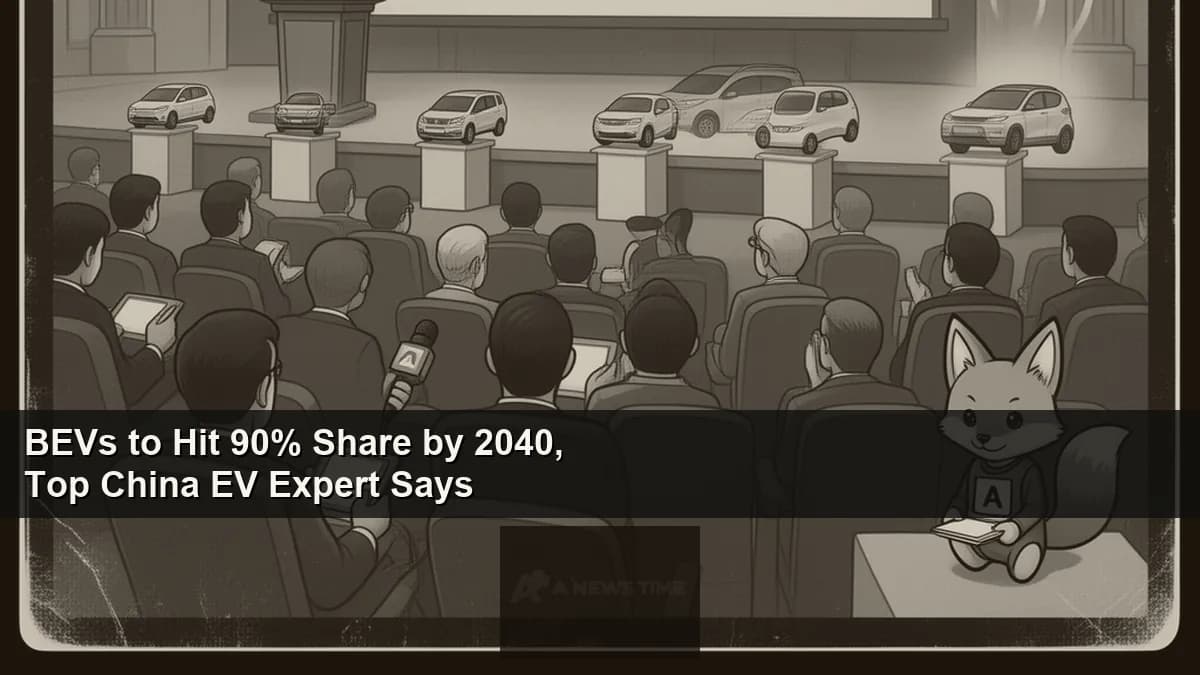
One of China's most influential electric vehicle academics laid out a bracing forecast for the global auto industry this weekend, telling attendees of the Intelligent Electric Vehicle Development Forum in Beijing that battery-electric vehicles will reach absolute dominance in the Chinese passenger car market by 2040 and that plug-in hybrids and extended-range models have already entered a downward trajectory they will not reverse. Professor Ouyang Minggao of Tsinghua University, a member of the Chinese Academy of Sciences and one of the most-cited researchers in the field, used the opening session to walk attendees through a roadmap that effectively ends what Chinese automakers have been calling the "route debate."
The forecast carries weight for two reasons. First, Ouyang's track record. He chairs Tsinghua's Advanced Powertrain System Team, leads research on lithium-ion safety and hydrogen powertrains, and serves as editor-in-chief of eTransportation. Second, the forum where he delivered it. The Intelligent Electric Vehicle Development Forum is the closest thing China's EV industry has to an annual policy gathering, and the projections that come out of it tend to find their way into provincial planning documents within months. CarNewsChina covered the speech in full.
The 2030, 2035, and 2040 numbers
Ouyang's projections move in three steps. By 2030, he expects new energy vehicle market share among Chinese passenger cars to exceed 70 percent, with the BEV-to-plug-in ratio sitting at 7 to 3. By 2035, the share stabilizes above 80 percent, and the BEV-to-plug-in ratio shifts to 8 to 2. By 2040, the overall NEV share remains around 80 percent but the BEV-to-plug-in ratio reaches 9 to 1, effectively making pure electric the only meaningful electrified passenger format.
The commercial vehicle path is steeper. Ouyang projected NEV market share for trucks and buses would clear 50 percent by 2030, 60 percent by 2035, and 70 percent by 2040. Total NEV ownership in China is forecast to reach 100 to 150 million units by 2030, 200 to 300 million by 2035, and 300 to 380 million by 2040. Green electricity, the share of grid power coming from renewables, is expected to top 50 percent by 2030 and reach 65 to 70 percent by 2035, which would finally let "new energy vehicles" earn the name in primary-source terms.
This means pure electric drive will completely end the route debate and occupy an absolute dominant position, leading Chinese automobiles to complete the final leap from 'big' to 'strong.'Professor Ouyang Minggao, Tsinghua University
The efficiency case for going pure electric
The reasoning Ouyang gave for the BEV bias is fundamentally about thermodynamics rather than chemistry. Pure electric drive, he argued, is roughly twice as efficient as hydrogen vehicles in turning green electricity into motion, and four times as efficient as synthetic fuel internal-combustion engines. Once renewable power becomes the primary input, the most efficient end-use wins by default.
That framing matters because it implicitly closes off the two routes still being debated in Western auto policy circles. Hydrogen fuel cell passenger vehicles, championed by Toyota and a handful of European OEMs, lose out on energy efficiency. Synthetic e-fuels, which Porsche and a few European luxury brands have pitched as a bridge for legacy ICE platforms, lose out by even more. Ouyang's view, shared by most of the Tsinghua research community, is that efficiency math like that does not stay hidden once electricity becomes the dominant feedstock.
The implication for plug-in hybrids and extended-range electric vehicles, the formats Chinese consumers have been buying in record numbers since 2024, is that their current dominance is a transitional artifact. They are popular today because they paper over charging infrastructure gaps and range anxiety. Once the infrastructure fills in, the efficiency penalty of carrying an engine becomes harder to justify.
The solid-state battery cold shower
The other notable section of Ouyang's speech was his attempt to slow the industry's solid-state battery hype. China's automakers and battery makers have spent the past 18 months talking up solid-state cells as the next inflection point, with multiple companies promising production-ready packs by the late 2020s. Ouyang said the science is not there yet.
All-solid-state batteries, he noted, still face unresolved challenges around interfacial side reactions affecting chemical, air, mechanical, and thermal stability. He predicted that all-solid-state cells achieving 300 watt-hours per kilogram of energy density would not appear until the end of 2030, and cautioned companies to avoid treating the technology as a marketing gimmick before the engineering catches up.
That said, China is moving fast on the supporting science. Ouyang noted that Chinese researchers accounted for 44 percent of newly published solid-state battery patent applications last year. Domestic production capacity for sulfide electrolytes, a key solid-state component, has exceeded 20,000 tons. Prices for those electrolytes have fallen from 20 million yuan per ton (about $290,000) to under 1 million yuan per ton (about $14,500), a 95 percent drop driven by scaling.
Three battery safety inflection points
Ouyang also walked the audience through what he sees as three turning points in battery safety. The first was 2014, when China's Ministry of Industry and Information Technology suspended ternary cathode batteries from use in buses after a series of thermal runaway incidents. The second was 2020, when BYD launched its blade lithium iron phosphate battery and ended the long-standing assumption that LFP cells could not deliver the energy density needed for passenger vehicles. The third, still upcoming, is the implementation of new battery safety standards that will require non-combustion and non-explosion performance under all foreseeable failure modes.
Ouyang noted that China still lacks an authoritative independent safety ranking system for batteries, which leaves consumers without a clear way to compare safety performance across brands. Some foreign markets have built lifecycle-based ranking frameworks where companies using ternary chemistries can still earn top marks through comprehensive battery management. China, in his view, is overdue for the same.
Five business models reshaping the industry
The second half of Ouyang's speech outlined five emerging business models he sees competing for dominance in China's automotive transformation. The first is vertical integration, led by companies like BYD that control batteries, chips, and assembly under one roof. The second is a dual-drive strategy combining ICE and EV production for both domestic and export markets, which describes most legacy Chinese OEMs. The third is the new automaker model practiced by Xiaomi, Nio, and others, where internet-thinking marketing and user ecosystems drive the brand. The fourth is horizontal integration, with focus on intelligence and brand. The fifth is state-owned enterprise reform, where institutional restructuring drives competitiveness.
The taxonomy is useful because it explains why Chinese automakers are not all converging on the same playbook. The five models are different bets about which capability matters most. Vertical integration is a bet on supply chain control. The new automaker model is a bet on software and brand. SOE reform is a bet that scale and policy alignment win. Ouyang's forecast applies to all of them, but the path to dominance looks different depending on which model wins out.
What this means for the global auto industry
For Western automakers, Ouyang's forecast is a problem. Most legacy OEMs in Europe and the United States have spent the past 18 months scaling back their EV timelines, citing softening demand, higher interest rates, and the political backlash that put new tariffs on Chinese EV imports. Their bet is that the BEV transition will take longer than initially modeled and that hybrids will dominate the late 2020s.
The Tsinghua roadmap calls that bet wrong. It says the BEV transition is accelerating, not slowing, and that the window for hybrid dominance closes by 2035. If Chinese automakers actually hit those numbers, they will be selling 200 to 300 million BEVs into a domestic market in which legacy Western brands have almost no presence, while also exporting at scale into Europe, Southeast Asia, and Latin America. Our coverage of BYD's super-fast charging breakthrough and the recent 66 percent surge in German BEV registrations suggests the export side is already moving faster than most boardrooms in Detroit and Wolfsburg expected.
The other implication is for the global battery supply chain. If China's BEV trajectory holds, the demand curve for cathode materials, separator film, and electrolyte volume will continue to outrun Western production by a factor of three or four through 2035. That gap is the structural reason analysts have been warning about a Chinese-dominated battery ecosystem for years.
What to watch through the year
Three things to track. First, how Chinese OEMs respond to the forecast in their next earnings cycles. If BYD, Geely, and Xiaomi start publicly de-emphasizing PHEV production in favor of pure BEV expansion, Ouyang's view becomes the consensus inside the industry, not just inside Tsinghua. Second, whether the all-solid-state battery announcements promised for 2026 actually deliver volume cells or remain pilot-line demonstrations. Third, the path of grid decarbonization in China, because the BEV efficiency case loses some of its bite if the marginal kilowatt-hour is still coming from coal.
For now, the takeaway from Beijing is that the industry inside China has stopped debating whether pure electric wins. The debate has shifted to when, by how much, and what to do about the legacy formats that are still selling in volume today.