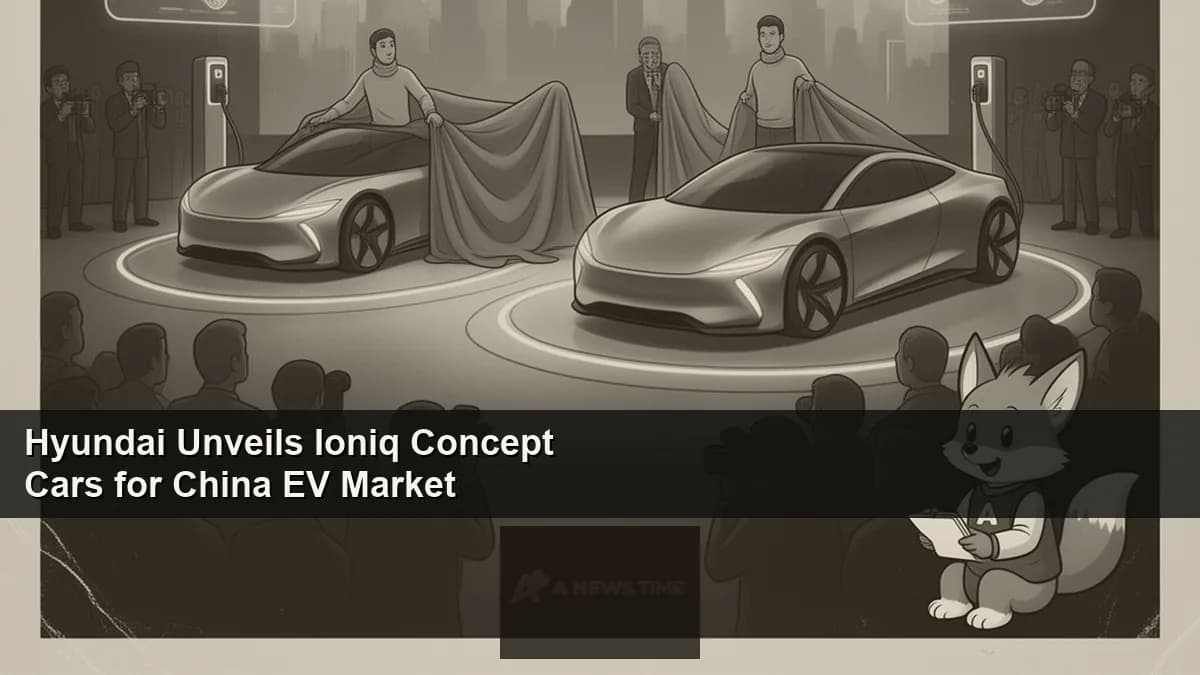
Hyundai brought two concept cars to Auto China 2026 in Beijing that you will almost certainly never be able to buy in the United States or Europe. That is not an accident. The South Korean automaker debuted a pair of futuristic Ioniq-branded vehicles specifically engineered for Chinese consumer tastes, Chinese road infrastructure, and the Chinese competitive environment where BYD, Li Auto, and a dozen other domestic brands have made imported design language feel foreign in the most literal sense.
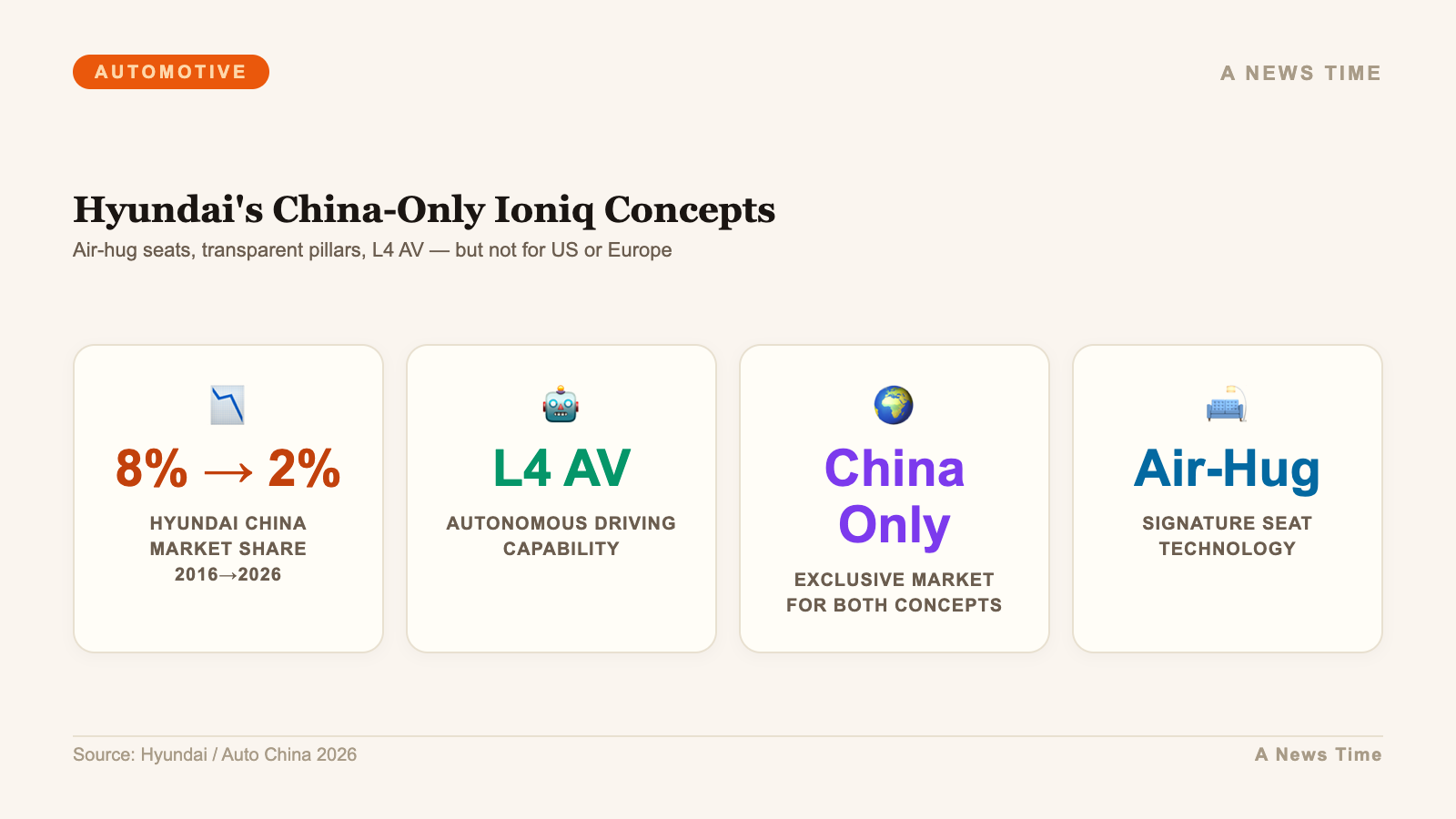
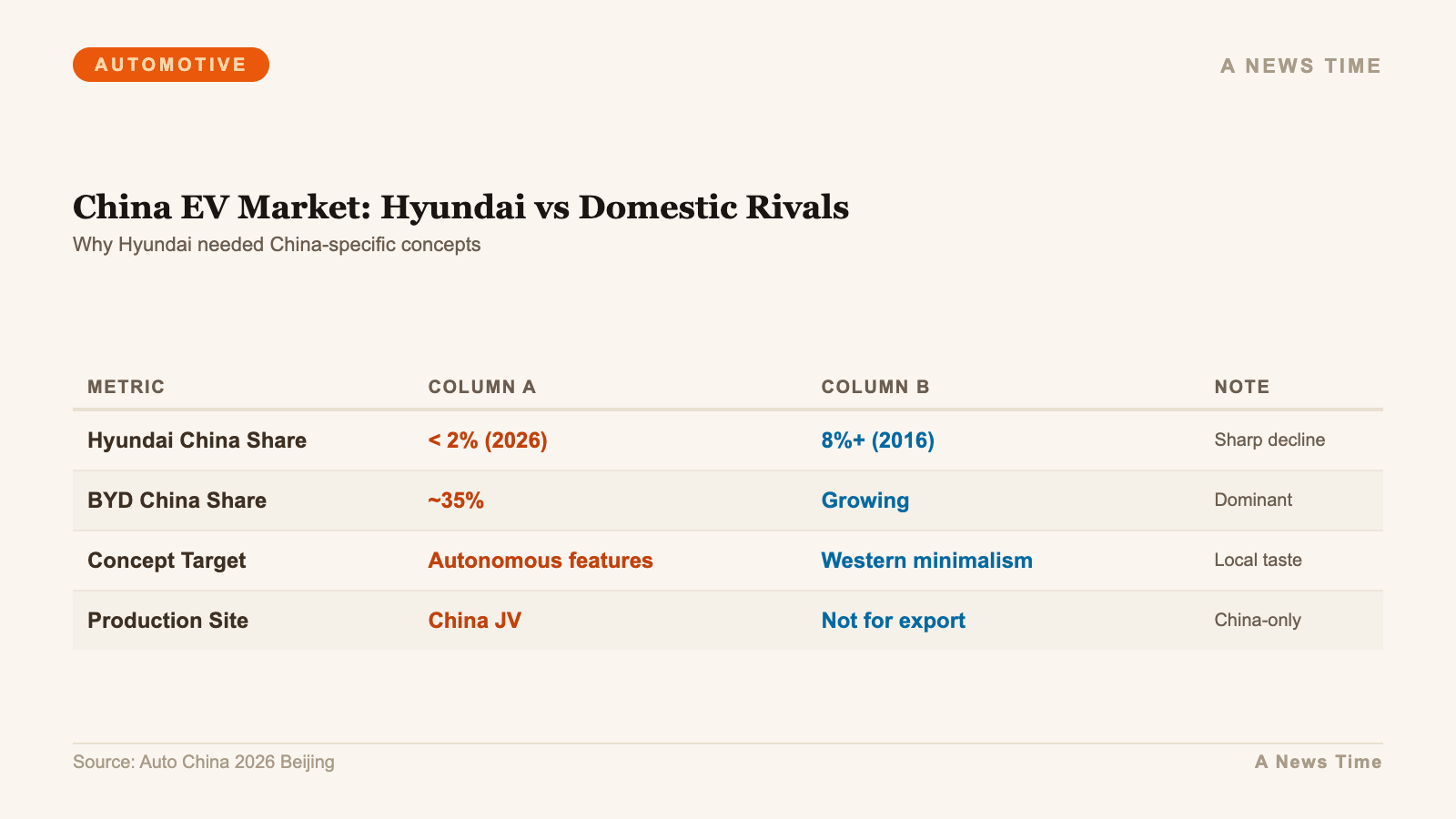
The concepts, whose production names have not been finalized, feature features that are directionally correct for what Chinese EV buyers in the premium-adjacent segment currently demand: maximalist interior technology, autonomous capability that actually works in the vehicle rather than living permanently in the demo video, and a visual design language that reads as futuristic to Chinese consumers rather than borrowing from European minimalism. Hyundai needed to show something substantive. Its China market share has fallen from over 8 percent a decade ago to below 2 percent today, a collapse that no amount of incremental refresh could reverse.
What the Concepts Actually Show
The headline feature from Hyundai's Beijing presentation is the air-hug seat system. The concept uses pneumatic seat bolsters that can dynamically adjust to the occupant's posture, providing active lateral support during cornering in manual mode and transitioning to a full-recline comfort configuration when the vehicle is in autonomous mode. In the autonomous sleep configuration, all four seats flatten and pivot inward, creating a lounge-like interior that is becoming table stakes for Chinese premium EV concepts.
Transparent pillar panels are the structural innovation that makes the interior light environment work. Hyundai has replaced the conventional A-pillar and C-pillar plastic trim with panels that incorporate embedded display elements alongside transparent sections, creating unobstructed sightlines from the interior while maintaining structural integrity through the underlying metal structure. The effect, in photographs from the Beijing show floor, is a cabin that feels considerably more open than the footprint suggests.
The autonomous driving integration in the concepts is more substantive than the typical auto show activation. Hyundai has integrated what appears to be a full sensor suite, including LiDAR mounted in the front fascia rather than on a roof turret, with in-cabin control interfaces that shift automatically between manual driving and supervised autonomous modes. The sleep mode configuration physically changes when the autonomous system is engaged, seat positions automatically adjusting as the driving interface retracts. This is not a toggle switch on the center console; it is a designed transition between operational states that changes the physical character of the cabin.
Why These Cars Cannot Come to America
Hyundai has not said these concepts are permanently US-excluded, but the practical and commercial reality makes US availability unlikely. The transparent pillar technology does not currently meet Federal Motor Vehicle Safety Standard 216 (roof crush resistance) requirements as configured in the concept, though Hyundai could engineer a solution. More fundamentally, the autonomous sleep mode that defines the concept's premium proposition requires Level 3 or Level 4 autonomous driving capability that is not approved for consumer use on US public roads.
The commercial logic is equally decisive. These vehicles are being positioned against Chinese domestic competitors in the $30,000-$50,000 yuan segment (approximately $42,000-$70,000 USD). In that segment, Chinese consumers are buying Li Auto L9s, BYD Han EV Maxes, and NIO ET7s. American consumers shopping in the equivalent USD price range are buying BMW 5-series, Tesla Model Y Long Range, and Cadillac Lyriq vehicles with very different feature expectations. A product optimized for the Chinese premium-adjacent market is not the same product that wins in the US premium market.
| Feature | Hyundai Ioniq Concept | Li Auto L9 | BYD Han EV Max | NIO ET7 |
|---|---|---|---|---|
| Air-adjust seating | Yes (concept) | Yes (4-zone) | Yes (front) | Yes (full) |
| Transparent pillars | Yes (concept) | No | No | No |
| Sleep/lounge mode | Yes (concept) | Yes (rear) | No | Yes (rear) |
| Integrated LiDAR | Yes (concept) | Yes | No (camera-based) | Yes (NIO AQUILA) |
| Approx. China price | TBD (concept) | 459,800 yuan (~$63,000) | 229,800 yuan (~$32,000) | 388,000 yuan (~$54,000) |
The table reveals Hyundai's challenge. In sleep mode and adaptive seating, the Chinese domestic competition already has production-ready solutions that Hyundai is presenting in concept form. Hyundai's transparent pillar technology is differentiated, but differentiated features alone do not recover market share in a market where brand trust and after-sales service ecosystems determine repeat purchase rates.
The Deeper Problem: How Hyundai Lost China
Hyundai peaked in China in 2016 with roughly 1.14 million vehicles sold and approximately 8.5 percent market share. In 2025, Hyundai and its Kia affiliate combined for fewer than 350,000 units and a combined share below 2 percent. The collapse preceded the EV transition and was compounded by it.
The initial decline came from a combination of the 2017 THAAD diplomatic crisis, which triggered a Chinese consumer boycott of Korean brands following South Korea's decision to allow a US anti-missile battery on its soil, and Hyundai's failure to refresh its China-specific product lineup quickly enough relative to both German and domestic Chinese competitors. Chinese consumers in the mid-2010s were trading up from domestic brands to Volkswagen and Toyota faster than Hyundai could differentiate on value.
Then the EV transition hit. Hyundai's Chinese joint venture partners were not positioned to pivot quickly. The Ioniq 5 and Ioniq 6, which are competitive products in Europe and the United States, landed in China with software ecosystems and human-machine interface designs that felt generic compared to what BYD and Li Auto were offering at similar or lower prices. Chinese consumers who had initially bought Korean because it was better than domestic brands had no reason to stay Korean when domestic brands became better than Korean.
Hyundai's Auto China 2026 presentation is an acknowledgment that recovering in China requires China-specific products, not Chinese-market adaptations of global products. The question is whether that acknowledgment comes with the product development resources and timeline to actually execute.
Auto China 2026: The Competitive Context
Hyundai's concepts did not appear in isolation at Auto China 2026. The show floor was dominated by Chinese domestic brands presenting production vehicles with technology that would have been concept-car material at a European show two years ago. BYD, SAIC, Geely, Chery, and NIO collectively unveiled over 40 new or updated production models with features including 800-volt charging architectures, AI-powered in-cabin assistants with genuinely natural language interfaces, and over-the-air software updates that visibly change the vehicle's character rather than patching security vulnerabilities.
Volkswagen brought its ID. series lineup to the show with aggressive pricing announcements for the Chinese market, including a sub-150,000 yuan ID.2 variant for urban buyers. Toyota debuted a bZ-series expansion aimed at recovering the hybrid credibility that Chinese buyers previously associated with the Corolla. Western automakers have collectively realized, most of them too late, that Auto China is no longer primarily a place to show global cars with Chinese badging. It is where the future of the automotive industry is being decided.
Hyundai's concepts fit this context as an aspirational statement rather than a production commitment. The company is signaling that it understands the direction Chinese consumers are going and intends to follow. That signal matters for investor and partner confidence even if the production timeline is 2027-2028 at the earliest for either concept.
For context on how other foreign automakers are approaching China's EV market: VW's Biggest-Ever EV Campaign Arrives at Beijing Auto Show.
What Production Versions Would Actually Look Like
Auto show concepts routinely shed features on the path to production. The transparent pillar technology, the most visually distinctive element of Hyundai's Beijing concepts, is the most likely candidate for simplification or removal in a production version. The engineering required to pass Chinese C-NCAP roof crush testing with structural pillars that include transparent elements is not trivial, and the cost premium for that technology at scale could push the vehicle above the target price point.
The sleep mode seat configuration and pneumatic bolster system are more production-feasible. Chinese suppliers including LEAR Corporation's Chinese operations and Yanfeng Automotive Interiors already produce adaptive seat systems at scale for domestic EV brands. Hyundai could source equivalent systems without developing them from scratch.
The autonomous driving stack is the most complex variable. Hyundai's existing China joint venture structure does not currently have an autonomous driving software platform competitive with what NIO's AQUILA system or Huawei's HarmonyOS-based ADAS delivers. Hyundai would either need to develop that capability internally, partner with a Chinese tech company, or license technology from an established provider. Each path has different competitive and regulatory implications.
Hyundai's Other China Cards
The Ioniq concepts are Hyundai's most visible China action at Auto China 2026, but they are not the only move. Hyundai has been restructuring its Chinese joint venture operations since 2022, reducing its factory footprint from five plants to two and repositioning from mass-market volume toward higher-margin, technology-differentiated products. This is the rational response to a market where competing on volume with domestic brands at their own price points is a losing proposition for a foreign brand.
Hyundai has also been building relationships with Chinese battery suppliers for its China-specific vehicles, moving away from reliance on its own battery supply chain for Chinese-market products. Using CATL cells in Chinese-market Hyundais reduces cost and positions the vehicles as locally integrated rather than imported technology in a Chinese shell.
The Genesis luxury brand, Hyundai's premium arm, is separately pursuing Chinese premium buyers against BMW and Mercedes. Genesis had some early success in China before the broader Korean brand headwinds hit, and the company is attempting to rebuild that position with locally adapted products and a direct-to-consumer sales model that bypasses the traditional dealership structure Chinese premium buyers have migrated away from.
The Bottom Line for Hyundai
Hyundai's Auto China 2026 Ioniq concepts are the right strategic conversation for the company to be having publicly in Beijing. They demonstrate that Hyundai's design and engineering teams understand what Chinese premium-adjacent buyers are paying attention to, and they signal a credible intention to compete with production products rather than surrendering the market to domestic brands.
The execution risk is significant. Concept cars that generate show floor buzz and production cars that generate actual sales are connected by an engineering, regulatory, and commercial process that Hyundai needs to compress faster than its typical development cycle allows. The Chinese EV market does not reward slow movers. BYD releases substantive new products or major updates on a six-to-nine month cycle. Hyundai's global development timeline is typically 36-48 months from concept to production.
If Hyundai can deliver a production Ioniq for China by 2028 that retains the transparent pillars, the air-hug seating, and a competitive autonomous driving suite at a price point below the Li Auto L9, it will have built something worth paying attention to. If the production version is a conventional Ioniq 6 with a Chinese-language touchscreen update, it will confirm that the Auto China 2026 presentation was marketing theater rather than strategic substance.
For broader context on EV market dynamics in the segment Hyundai is targeting: BEVs to Hit 90% Share by 2040, Top China EV Expert Says.