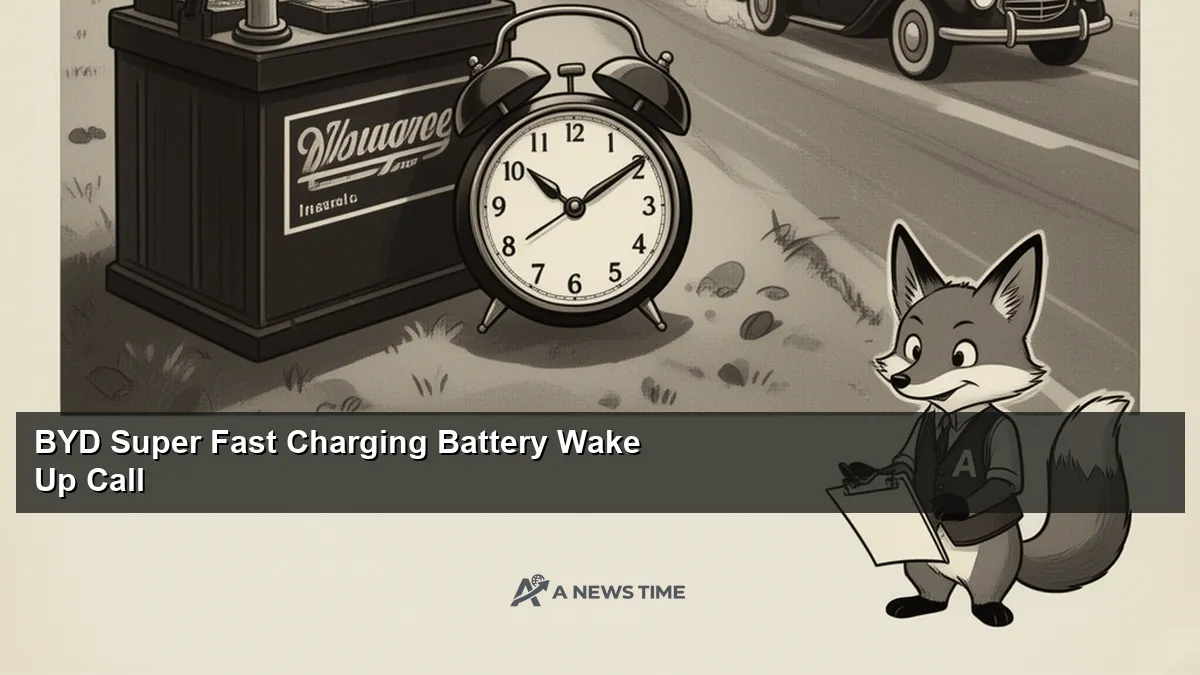
BYD, the Chinese automaker that has become the world's largest seller of electric vehicles, unveiled a new battery technology in March 2026 that it claims can add 250 miles of range in five minutes of charging, a figure that, if verified in real-world conditions, would effectively eliminate the charging speed gap between electric vehicles and gasoline refueling. The announcement, made at BYD's technology center in Shenzhen, included live demonstrations with third-party verification and immediate availability in two BYD production models shipping to customers in China. It was not a concept. It was not a prototype. It was a product, on sale now, at a price point that undercuts virtually every competing EV on the global market.
The Washington Post's editorial board responded within 48 hours with an opinion piece titled "America Is Losing the EV Race, and Washington Doesn't Seem to Care," arguing that BYD's battery advance represents a technological inflection point that American automakers and policymakers have failed to anticipate or match. The editorial, notable for its bluntness in a publication not known for alarmism on industrial policy, characterized the U.S. EV industry's competitive position as "deteriorating faster than any tariff or subsidy can repair."
That assessment may be harsh. It is not wrong.
What BYD Actually Built
The new battery, which BYD has branded the "Super e-Platform," is the latest evolution of the company's Blade Battery architecture, the lithium iron phosphate (LFP) cell design that BYD introduced in 2020 and has since refined through four generations. LFP chemistry has historically been viewed as a compromise: safer and cheaper than the nickel-manganese-cobalt (NMC) cells used by most Western automakers, but with lower energy density and slower charging speeds. BYD's new platform challenges both of those assumptions.
The Super e-Platform battery pack uses a cell-to-pack architecture (meaning the individual battery cells are integrated directly into the structural pack without intermediate modules, saving weight and space) combined with a new cathode formulation that BYD says enables sustained charging rates of up to 6C. The "C-rate" is a measure of how fast a battery can accept charge relative to its capacity: a 1C rate charges the battery from empty to full in one hour, a 2C rate in 30 minutes, and a 6C rate in 10 minutes. For context, most current-generation EVs from American and European automakers charge at peak rates of 1.5C to 2.5C.
| Vehicle / Battery System | Peak Charging Rate | Time for 10-80% Charge | Miles Added in 5 Min (Est.) |
|---|---|---|---|
| BYD Super e-Platform | 6C (est. 600 kW) | ~10 minutes | ~250 |
| Tesla Model 3 (V4 Supercharger) | ~2.5C (250 kW) | ~22 minutes | ~95 |
| Hyundai Ioniq 6 (800V) | ~2.8C (240 kW) | ~18 minutes | ~110 |
| Porsche Taycan (800V) | ~2.7C (270 kW) | ~22 minutes | ~100 |
| Ford Mustang Mach-E | ~1.5C (150 kW) | ~38 minutes | ~55 |
| GM Ultium (Equinox EV) | ~1.8C (150 kW) | ~34 minutes | ~60 |
The numbers in that table illustrate the scale of the gap. BYD's new system charges at roughly 2.5 times the rate of the fastest American EV currently on sale and approximately four times the rate of the Ford Mustang Mach-E and Chevrolet Equinox EV. In practical terms, a BYD driver could stop at a compatible fast charger, add 250 miles of range during the time it takes to use the restroom and buy a coffee, and be back on the road. A driver in a comparable American EV would still be waiting at the charger when the BYD driver was 200 miles down the highway.
There is an important caveat: BYD's claimed charging speeds require compatible charging infrastructure capable of delivering 600 kilowatts or more of power. That infrastructure exists in China, where BYD and other manufacturers have been building ultra-high-power charging stations aggressively, but it does not yet exist at scale in the United States or Europe. The fastest public chargers commonly available in the U.S. today top out at 350 kW, which would reduce BYD's charging speed to approximately 3.5C rather than 6C. Even at that reduced rate, the battery would still charge faster than any American competitor, but the headline 250-miles-in-five-minutes figure would not be achievable without infrastructure upgrades.
The Price Dimension
Charging speed is only part of the competitive equation. The other part is price, and this is where BYD's advantage becomes most uncomfortable for American competitors. The BYD Seal, a midsize sedan roughly comparable in size and feature content to the Tesla Model 3, starts at approximately $21,000 in China with the new Super e-Platform battery. The BYD Atto 3 (known as the Yuan Plus in China), a compact SUV comparable to the Chevrolet Equinox EV, starts at approximately $18,000.
Those prices are not directly comparable to U.S. market prices, because BYD's vehicles benefit from Chinese government subsidies, lower labor costs, and the scale economies of a domestic battery supply chain that China has spent 15 years building. But even after accounting for those factors, the cost structure gap is enormous. The Chevrolet Equinox EV starts at $33,000 in the United States. The Tesla Model 3 starts at $38,990. A BYD Seal, if it were sold in the U.S. (it is currently not available here due to the 100 percent tariff on Chinese EVs), would need to be priced at roughly $35,000 to $38,000 to cover tariff, logistics, and compliance costs, a price that would make it competitive with American offerings while still generating a healthy margin for BYD.
The 100 percent tariff on Chinese EVs, imposed in 2024 and maintained by the current administration, has effectively kept BYD out of the U.S. market. But tariffs are a policy tool, not a technology tool. They can prevent a product from reaching American consumers, but they cannot prevent the underlying technology from existing and being deployed in every other market where BYD sells vehicles. BYD's non-China sales grew 72 percent in 2025, with major expansions in Southeast Asia, Latin America, the Middle East, and Europe. The company is now the top-selling EV brand in Thailand, Israel, Brazil, and Hungary, markets where American automakers also compete.
The Washington Post's Argument
The Washington Post editorial board's argument, stripped to its essentials, is that the United States is pursuing an EV strategy built on protection rather than competition, and that protection without corresponding investment in technological competitiveness is a losing approach over the medium to long term.
"Tariffs can buy time. But time is only valuable if you use it to catch up. The evidence, from battery chemistry to charging infrastructure to manufacturing scale, suggests that American automakers are not catching up. They are falling further behind, and the tariff wall that shields them from the consequences of that gap will not stand forever."
Washington Post Editorial Board, March 2026
The editorial identifies three specific areas where the U.S. is losing ground. The first is battery cell manufacturing. China currently produces approximately 77 percent of the world's lithium-ion battery cells. The United States produces approximately 7 percent. The Inflation Reduction Act's battery manufacturing incentives have spurred significant investment (including new plants by LG Energy Solution, Samsung SDI, SK Innovation, Panasonic, and the GM-LG Ultium Cells joint venture), but those plants are still ramping up, and their combined output will not close the production gap with China within this decade.
The second area is raw material processing. The minerals that go into batteries (lithium, cobalt, nickel, manganese, graphite) must be refined to battery-grade purity before they can be used in cell manufacturing. China controls approximately 65 percent of global lithium processing capacity, 73 percent of cobalt processing, and 90 percent of graphite processing. Building comparable processing capacity in the United States requires not just capital investment but permitting, environmental review, and workforce development timelines that stretch into the late 2020s at the earliest.
The third area is software and integration. BYD designs and manufactures its own battery cells, battery management systems, electric motors, power electronics, and vehicle software. This vertical integration gives it the ability to optimize the entire system holistically in a way that American automakers, which typically source batteries from one supplier, motors from another, and software from a third, cannot easily replicate. Tesla is the notable exception among U.S. companies, having pursued vertical integration more aggressively than its domestic peers, but even Tesla sources a significant portion of its battery cells from Panasonic and CATL rather than manufacturing them entirely in-house.
What American Automakers Are Doing
The characterization of American automakers as standing still while BYD races ahead is not entirely fair. Significant investments are underway. General Motors has invested over $7 billion in its Ultium battery platform, with three cell manufacturing plants either operational or under construction in Ohio, Tennessee, and Michigan. Ford has committed $5.6 billion to a battery and assembly complex in Tennessee (BlueOval City) and additional battery capacity in Michigan and Kentucky through its SK Innovation joint venture. Stellantis has announced three planned battery plants in North America.
The issue is not the scale of investment. It is the pace. BYD iterated from its first-generation Blade Battery to the Super e-Platform in approximately six years, shipping four distinct generations of battery technology in that time. GM's Ultium platform has been in production for approximately three years and has not yet shipped a second-generation cell with meaningfully improved chemistry. Ford's BlueOval City is not expected to reach full production capacity until 2027. The American investments are real, but they are progressing at a tempo that reflects the traditional auto industry's product development cycles (four to five years per generation) rather than the compressed timelines that BYD and other Chinese automakers operate on (18 to 24 months per generation).
Tesla, as usual, occupies a unique position. The company's 4680 battery cell, developed in-house at its Gigafactory in Austin, Texas, represents a genuine technological advance in terms of energy density and cost per kilowatt-hour. But Tesla has struggled with manufacturing yield issues that have limited the 4680's deployment, and the cell's charging speed, while competitive with current-generation rivals, does not approach BYD's 6C claim. Tesla's next-generation platform, reportedly codenamed "Redwood" and expected to launch in 2027, may close the gap, but "may" and "2027" are not reassuring words in a race where BYD is shipping today.
The Infrastructure Question
Even if American automakers were to match BYD's battery technology tomorrow, the benefits would be limited without the charging infrastructure to support ultra-fast charging. The U.S. currently has approximately 195,000 public charging ports, of which roughly 42,000 are DC fast chargers. Of those 42,000 fast chargers, fewer than 5,000 can deliver 350 kW, the current maximum for most public networks. None can deliver the 600 kW or higher power levels that BYD's Super e-Platform requires for its peak charging speeds.
China, by comparison, has approximately 3.2 million public charging ports, including more than 900,000 DC fast chargers. BYD, along with other Chinese automakers and state-backed infrastructure companies, has been building ultra-high-power charging stations capable of 600 kW and above since late 2025, with a target of 50,000 such stations by the end of 2026. The infrastructure gap mirrors and amplifies the vehicle technology gap: even if an American buyer could purchase a vehicle with BYD-equivalent charging capability, they would have far fewer places to charge it at full speed than a Chinese buyer would.
The National Electric Vehicle Infrastructure (NEVI) program, funded by the 2021 Bipartisan Infrastructure Law at $7.5 billion, has been criticized for its slow deployment pace. As of March 2026, the program has funded the installation of approximately 12,000 new charging ports, well below its original trajectory. The bureaucratic requirements of the program (including Buy America provisions, ADA compliance, and specific spacing requirements) have slowed deployment relative to China's more centrally directed approach. A weakening economic outlook could further constrain both public and private infrastructure investment.
The Competitive Implications
BYD's Super e-Platform does not change the U.S. market overnight. The 100 percent tariff keeps BYD vehicles out of America for now, and even if that tariff were reduced, it would take BYD years to establish the dealer network, service infrastructure, and brand recognition necessary to compete seriously in a market that is notoriously difficult for new entrants. Hyundai, the most recent automaker to successfully enter the U.S. market at scale, spent 20 years building from a punchline to a premium brand.
But the competitive threat from BYD is not limited to the U.S. market. In every other major market where American automakers sell vehicles, BYD is arriving with products that charge faster, cost less, and are backed by a vertically integrated supply chain that no Western automaker can currently match. GM's international operations, Ford's European business, and Stellantis's global portfolio are all vulnerable to displacement by a competitor whose products are objectively better and cheaper, even if that competitor cannot yet reach American shores.
The deeper concern articulated by the Washington Post editorial, and shared by a growing number of industry analysts, is that the tariff wall has created a false sense of security. American automakers, shielded from the most formidable competitor they have ever faced, are not innovating at the speed the competitive landscape demands. When the protection eventually erodes, whether through trade negotiation, political change, or BYD's establishment of manufacturing capacity outside China (the company is building assembly plants in Thailand, Brazil, Hungary, and Turkey), American automakers may find themselves in the position of the domestic steel industry in the 1980s: protected for too long, innovated too little, and overtaken by competitors they were told they did not need to worry about.
BYD's five-minute, 250-mile charge is a technical achievement. It is also a strategic signal. The race is on, and one side is running faster.