
Infleqtion, a Chicago-based quantum computing firm known for its neutral-atom quantum processors, announced on Wednesday, , that it has been awarded a contract by the U.S. Defense Advanced Research Projects Agency to advance next-generation heterogeneous quantum software. The award is part of DARPA's broader push to make quantum, classical, and specialized computing systems interoperate, a problem that most industry observers consider the gating factor for practical quantum applications in national security, drug discovery, and materials research.
The contract adds to a growing list of federal investments in quantum software infrastructure, but its specific focus on heterogeneous computing is the detail that matters. Most of the funding that has flowed into quantum computing over the last five years has targeted the hardware problem: building qubits that are stable, scalable, and error-correctable. The Infleqtion contract is pointed at the adjacent problem of software orchestration across multiple computing paradigms.
What "Heterogeneous Quantum Software" Actually Means
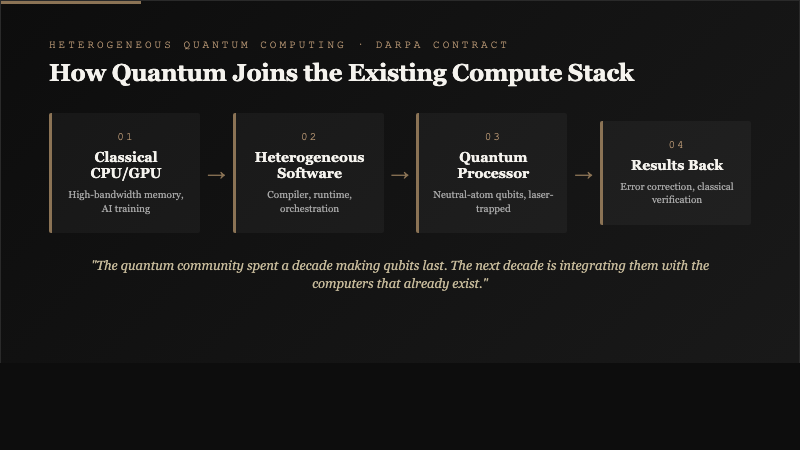
The term heterogeneous computing has a specific meaning in computer science. It refers to systems that combine different kinds of processors, each optimized for a different class of problem, working together on the same workload. A laptop with a CPU and a GPU is a simple heterogeneous system. Modern AI training clusters that mix CPUs, GPUs, tensor processing units, and high-bandwidth memory are a more complex example.
Heterogeneous quantum software extends that concept to include quantum processors as one of the compute fabrics. The challenge is substantial. A quantum processor operates on qubits that obey quantum mechanical rules, which means they cannot be simply copied, read freely, or programmed with the same abstractions that work on classical hardware. Software stacks that let a quantum processor coexist with a classical cluster have to handle scheduling, data movement, error correction, and result interpretation across computing models that are fundamentally different.
"The quantum community has spent the past decade learning how to build qubits that last long enough to be useful. The next decade is about learning how to integrate them into computing systems that already exist. Heterogeneous software is the bridge."
Infleqtion research leadership, as reported in the company's April 22 announcement
DARPA's interest in the problem is not purely academic. The agency has run quantum-focused programs including the Quantum Benchmarking Initiative and the Underexplored Systems for Utility-Scale Quantum Computing program, and most of that portfolio has been pointed at building quantum systems that can meaningfully contribute to defense-relevant computations alongside conventional supercomputing resources.
Why Neutral-Atom Quantum Computing Is Suddenly Getting Attention
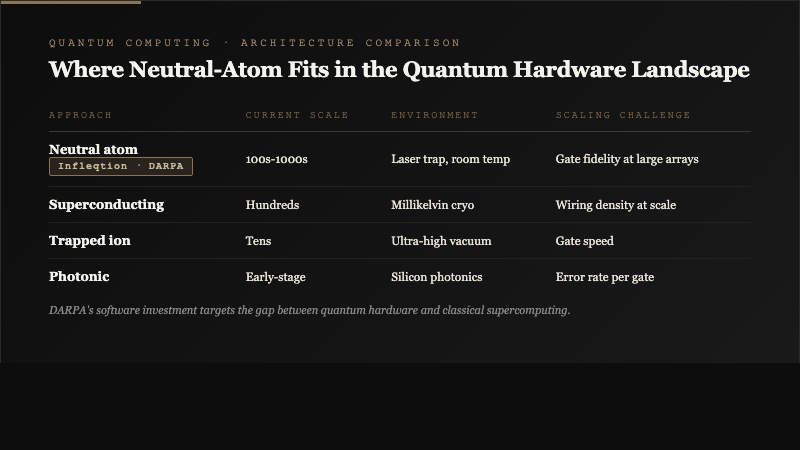
Infleqtion's underlying hardware architecture is worth understanding, because it explains why DARPA awarded the software contract to a neutral-atom specialist rather than a superconducting-qubit company. Most of the early commercial quantum computers, built by Google, IBM, Rigetti, and others, use superconducting circuits cooled to temperatures just above absolute zero. Superconducting qubits are fast, but they are also fragile and difficult to scale past a few hundred qubits without enormous engineering overhead.
Neutral-atom quantum computing uses laser-trapped atoms as qubits. The atoms are held in place by arrays of precisely focused laser beams, and computations are performed by shining additional lasers that manipulate the atoms' electronic states. Neutral-atom systems operate at room temperature (with the atoms themselves cooled by laser trapping), and they can in principle scale to thousands or tens of thousands of qubits in a single device.
| Approach | Current Scale | Operating Environment | Scaling Challenge |
|---|---|---|---|
| Superconducting (IBM, Google) | Hundreds of qubits | Millikelvin cryogenic | Wiring density at scale |
| Neutral atom (Infleqtion, QuEra) | Hundreds to thousands | Laser-trapped, room temp | Gate fidelity at large arrays |
| Trapped ion (IonQ, Quantinuum) | Tens of qubits | Ultra-high vacuum | Gate speed |
| Photonic (PsiQuantum) | Early-stage | Silicon photonics | Error rate per gate |
The gate fidelity of neutral-atom systems, meaning the accuracy of individual quantum operations, has improved substantially over the past three years. Published results from several neutral-atom research groups have shown two-qubit gate fidelities above 99.5 percent in multi-atom arrays, which puts the architecture in the competitive window with superconducting systems on this critical metric.
The Software Stack DARPA Is Funding
The specifics of what Infleqtion will build under the DARPA contract have not been fully disclosed, but the stated focus on heterogeneous quantum software implies several technical pieces. Compilers that can partition a computation across quantum and classical resources. Runtime systems that schedule quantum operations interleaved with classical operations. Libraries that express quantum algorithms in forms portable across different quantum hardware backends. And verification and testing tools that can check a quantum computation against a classical simulation during development.
What makes this challenging is that the "classical" side of a heterogeneous quantum system is no longer just a conventional CPU cluster. It increasingly includes GPU-based AI accelerators for machine-learned error correction, neuromorphic processors for specific pattern-matching problems, and high-bandwidth memory subsystems that have to move data between compute nodes at terabit-per-second rates. Software that unifies all of those resources, and adds quantum to the mix, is substantially more ambitious than a traditional quantum programming framework.
"The field is moving from a period where every quantum demo was a standalone hardware experiment to a period where quantum processors have to integrate with existing high-performance computing pipelines. That transition is primarily a software problem, and it has been underfunded relative to the hardware work."
Quantum computing research commentary, cited in HPCwire coverage
The Broader Pattern of Federal Quantum Investment
The Infleqtion contract fits inside a pattern of U.S. federal investment in quantum computing that has accelerated through 2025 and into 2026. The Department of Energy announced expanded funding for the Quantum Science Center and the C2QA center during the current budget cycle. The National Science Foundation extended its Quantum Leap Challenge Institute program. And DARPA's portfolio of quantum software contracts has grown to include multiple vendors across competing hardware architectures.
The strategic logic is clear. U.S. policymakers have identified quantum computing as a technology in which the United States has a scientific lead but an uncertain commercial lead, and the federal government has responded by funding the work that commercial markets would not yet pay for on their own. Software tooling is the textbook case. Enterprise customers are not yet buying quantum computers at the volumes that would justify private investment in a mature software ecosystem, which means the ecosystem either gets built by public funding or it does not get built at this stage at all.
For Infleqtion specifically, the contract is a validation of the company's technical approach and a revenue stream that supports continued hardware development. For the field, it is a sign that the federal government is willing to pay for the unglamorous but essential plumbing that quantum applications will eventually require. In either case, the outcome is more software infrastructure than would have existed otherwise, and that is the bottleneck the community has been complaining about for years.
What We Still Do Not Know
Several things are worth flagging as open questions. The announcement did not disclose the dollar value of the contract or its duration, both of which are ordinary details that would help assess how substantial the award is in practice. It also did not specify which defense applications the heterogeneous software will initially target, although DARPA's broader quantum portfolio points to cryptanalysis, optimization, and materials simulation as the usual candidates.
The longer-term question is whether the software architecture Infleqtion develops under this contract will be portable across quantum hardware platforms, or whether it will be tightly coupled to the company's own neutral-atom systems. DARPA has tended to favor portability in its software investments, because an ecosystem that works with only one vendor's hardware does not serve the agency's mission of maintaining U.S. leadership across the field. Infleqtion's own commercial interest points in a slightly different direction, and how that tension resolves will shape the usefulness of the resulting software to other quantum companies and research groups.
What to Watch Next
Two specific developments will indicate whether the DARPA contract is producing the kind of heterogeneous software infrastructure the field needs. The first is the publication of technical reports, either directly by Infleqtion or through DARPA program reviews, describing the software interfaces and benchmarks the team is building. The second is the appearance of third-party adoption: whether research groups and other quantum companies pick up the tooling and use it for their own work, which is the real test of whether the infrastructure is useful.
On a longer horizon, the interplay between federal quantum software investments and the commercial AI computing buildout is worth tracking. The same high-performance computing facilities that are running AI training workloads are the facilities that will host the first generation of genuinely heterogeneous quantum-classical systems, and the tooling that works for AI orchestration is often close cousins to the tooling that will be needed for quantum.
For related coverage, see our reporting on the broader quantum computing funding landscape, on NVIDIA's role in the high-performance computing stack that will host heterogeneous quantum systems, and on the alternative compute architectures entering the AI and scientific computing market.