Jimmy Kimmel devoted a segment of his Tuesday, late-night show to the ongoing U.S.-Iran war's effects on a supply chain most Americans were not thinking about: condoms. Karex, the world's largest condom manufacturer, had announced earlier in the week that it may raise prices by 20 to 30 percent because the Strait of Hormuz blockade had disrupted its shipping routes. Kimmel's punchline drew the obvious political metaphor.
"Is there any metaphor more fitting than Donald Trump screwing us without condoms because he won't pull out?" Kimmel said on the ABC late-night stage. The line circulated widely on social media through Wednesday and landed inside a broader cultural moment where mainstream late-night comedy is one of the few remaining venues willing to mock the administration directly on a national platform. The joke is sharp, the supply-chain connection is real, and the nine-day blockade's effects are now rippling into consumer-product categories that were not part of the administration's original war planning.
What Karex Actually Said
Karex is a Malaysian manufacturer that produces roughly one in every five condoms sold worldwide. The company supplies major international brands and owns several of its own. Its price increase announcement reflects two supply-chain pressures. The first is direct: rubber latex and other raw materials move through global shipping lanes that include Strait of Hormuz transit routes. The second is indirect: disrupted oil supplies drive up synthetic rubber and polymer input costs, which affect condom manufacturing economics even when the direct materials do not move through Hormuz.
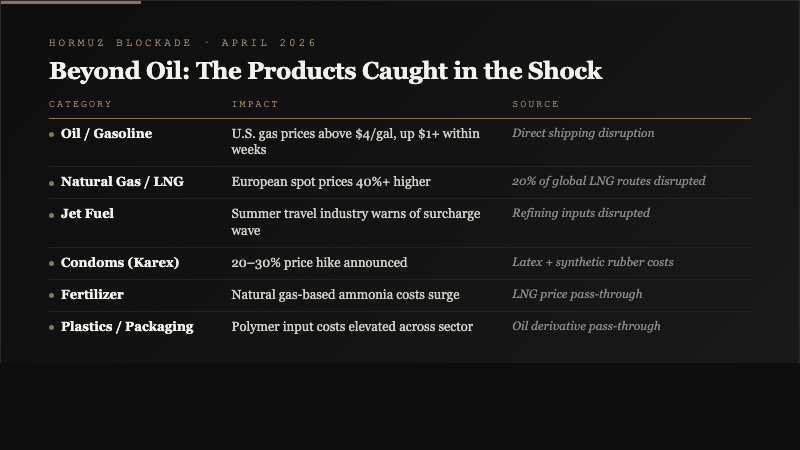
| Product category | Impact | Source |
|---|---|---|
| Oil / gasoline | U.S. gasoline above $4/gallon, up $1+ | Direct shipping disruption |
| Natural gas / LNG | European prices 40%+ higher than pre-war | 20% of global LNG flows disrupted |
| Jet fuel | Summer travel industry warns of shortages | Refining inputs disrupted |
| Condoms (Karex) | 20-30% price increases announced | Latex supply and synthetic rubber costs |
| Fertilizer | Natural gas-based ammonia inputs higher | LNG price pass-through |
| Plastics / packaging | Polymer input costs higher | Oil derivative pass-through |
The 20 to 30 percent price increase range is wide because actual costs depend on how long the shipping disruption persists. If Hormuz reopens within weeks, Karex can absorb some of the cost through inventory management and partial passthrough to retailers. If the disruption extends into the summer, the full cost flows to end customers at the pharmacy and grocery retail level. Consumers who buy condoms will pay roughly a third more beginning sometime in the second half of 2026.
Why the Joke Landed
Kimmel's bit worked on multiple levels simultaneously. At the most literal level, it is a supply-chain story most people had not heard. Condoms are not the first product category Americans associate with Persian Gulf shipping disruptions. The Karex news cuts through precisely because it makes the abstract cost of the war concrete and personal in a way that oil prices do not.
At the political level, the "won't pull out" framing maps the supply-chain disruption onto Trump's refusal to end the Hormuz blockade. Trump has extended the ceasefire indefinitely but has not lifted the naval blockade of Iranian ports. Iran has insisted that the blockade must end before any full ceasefire takes effect. The diplomatic stalemate is what sustains the supply disruption, and the joke maps that stalemate onto the product category.
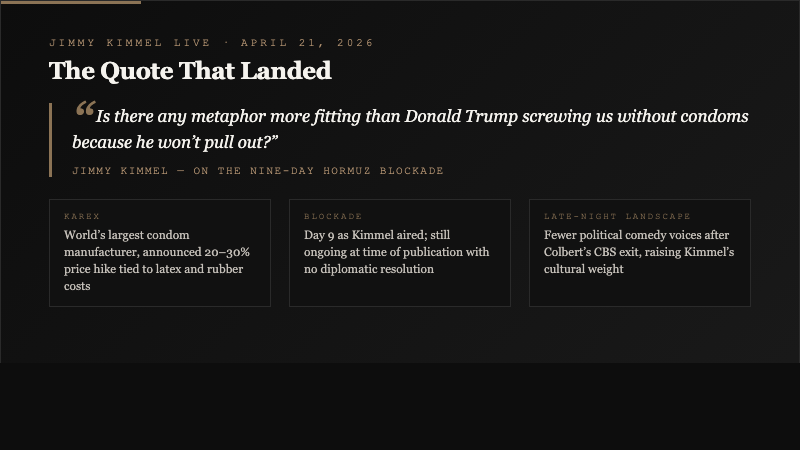
"Is there any metaphor more fitting than Donald Trump screwing us without condoms because he won't pull out?"
Jimmy Kimmel, Jimmy Kimmel Live, April 21, 2026
At the cultural level, the joke lands inside a late-night comedy landscape where the anti-Trump comedy voice has had fewer venues since Stephen Colbert's show ended and the broader late-night ecosystem contracted. Kimmel remains one of the most-watched late-night hosts willing to take on political material directly. His willingness to make the joke, and the fact that ABC allowed it on air, matters as much to cultural commentators as the joke itself.
The Broader War Context
The war entered its eighth week on Wednesday. Trump extended the ceasefire indefinitely on April 21, the same day as Kimmel's monologue. Iran acknowledged the ceasefire extension but stopped short of confirming it would attend another round of peace talks in Pakistan. Iran's Revolutionary Guard fired on three ships in the Strait of Hormuz on Wednesday, seizing two. U.S. forces boarded an oil tanker previously sanctioned for smuggling Iranian crude in Asia.
Human casualty figures are substantial. According to Express US reporting, at least 3,375 people have been killed in Iran since the war began. Lebanon has seen more than 2,290 deaths in the related regional fighting. A Lebanese journalist, Amal Khalil, was killed in an Israeli airstrike on southern Lebanon on Wednesday; she had been covering the Israel-Hezbollah war since it began in October 2023. Israel's military alleged that individuals in the village violated the ceasefire and denied that it targeted journalists.
The gap between the scale of the war's human costs and the comedy framing of its supply-chain effects is part of what Kimmel's bit captures. The show can land a joke about condom prices because the condom-price effect is a live consumer news item, but the broader humanitarian picture sits just off-camera. Late-night comedy has not historically been the right medium for the humanitarian framing, which is part of why Kimmel's work gets attention for connecting the consumer-product bit to the bigger policy question of why the blockade is still in place.
The Trump Response Question
Trump has a documented pattern of responding to late-night comedy personalities who take shots at him. Stephen Colbert's show was the most frequent target of Trump Truth Social posts during Colbert's final season on CBS. Saturday Night Live has drawn similar responses. Kimmel's segments have not consistently triggered presidential social media responses in recent months, but the specific "screwing us without condoms" line is the kind of material that historically has produced one.
"Jimmy Kimmel joked Tuesday that Trump was 'screwing us without condoms' as the nine-day Strait of Hormuz blockade drives up condom prices by up to 30%."
Daily Express US, April 22, 2026
Whether Trump responds at all is not the relevant measure of whether the joke mattered. The bit has already circulated well beyond the ABC late-night audience. Social media clips have made the rounds on X, Threads, and TikTok since Tuesday night. The penetration of the joke into the larger political conversation is the actual success metric.
The Late-Night Comedy Landscape
Jimmy Kimmel Live remains ABC's flagship late-night property. Its demographic performance has been softer than during peak late-night years, consistent with the broader contraction of linear late-night as streaming and social media absorb younger audiences. But Kimmel's political material has an outsized cultural footprint precisely because fewer competing voices are making similar material on mainstream broadcast.
The Stephen Colbert departure from CBS in 2025 removed the most consistent nightly political comedy voice from the late-night landscape. The Tonight Show with Jimmy Fallon has remained largely apolitical. Late Night with Seth Meyers delivers sharp material in its "A Closer Look" segments but in a different tonal register than Kimmel's monologue work. Comedy Central's Daily Show has been revolving through guest hosts. The net effect is that Kimmel's late-night voice carries more weight by default.
What to Watch
The Karex price increase is the first major consumer-product category to announce costs tied directly to the Hormuz blockade. Additional categories will follow if the shipping disruption extends through May and June. Categories at risk include pharmaceutical supply inputs, polymer-intensive packaging, certain industrial lubricants, and synthetic rubber products ranging from tires to medical gloves. Each category that joins the Karex list adds a consumer-visible data point that late-night comedy and political journalism will translate into public pressure.
On the late-night side, the next test is whether additional hosts pick up the condom-price angle. If Meyers, Fallon, or other late-night personalities work similar material into their monologues through the week, the story amplifies. If it stays primarily a Kimmel bit that circulates through social clips, the cultural half-life is shorter. Either way, the joke has already made the supply-chain connection in a way that policy briefings and economic reports have not.
For related coverage, see our reporting on the direct energy-price effects of the Hormuz blockade, on Trump's public interventions on Iran during the same week, and on the broader entertainment industry landscape in April 2026.