The top American technology companies, including Anthropic, OpenAI, NVIDIA, AMD, Google, Meta, and Amazon, are now spending millions of dollars on Washington lobbying in a sustained effort to shape federal AI policy, chip export controls, and the regulatory environment that will determine the pace of AI deployment across the U.S. economy. Times of India reported the lobbying surge on , capturing a trend that federal disclosure filings and policy-tracking organizations have been documenting for most of the past 18 months.
The pattern is not novel in kind. Technology companies have been increasing their Washington presence since the early 2010s. What is novel is the scale and the specific policy surface the spending is designed to shape. AI regulation, chip export restrictions, federal procurement of AI services, and the preemption of state-level AI laws have combined into a policy environment where the cost of an unfavorable outcome is measured in the billions rather than the millions.
Why the Spending Has Increased
Three structural shifts have driven the lobbying surge. The first is the pending federal AI regulatory framework. The Trump administration took office in January 2025 with an explicit deregulatory posture on AI, rolling back the Biden-era AI executive order within the first week. But deregulation has not translated into a stable federal framework. Instead, the administration has continued to issue executive orders and procurement guidance that each shape the competitive environment in specific ways, and each round of that guidance has drawn lobbying activity from the companies affected.
The second is chip export controls to China. NIST, the Commerce Department, and the Office of the Director of National Intelligence have all been involved in shaping export control rules that govern which AI chips NVIDIA, AMD, and adjacent suppliers can sell into Chinese markets. The stakes are enormous. NVIDIA's China revenue has been cut substantially by the existing controls. The contours of future controls could either restore some of that revenue or close off additional segments. Lobbying on this issue alone justifies multimillion-dollar annual spending for NVIDIA and its peers.
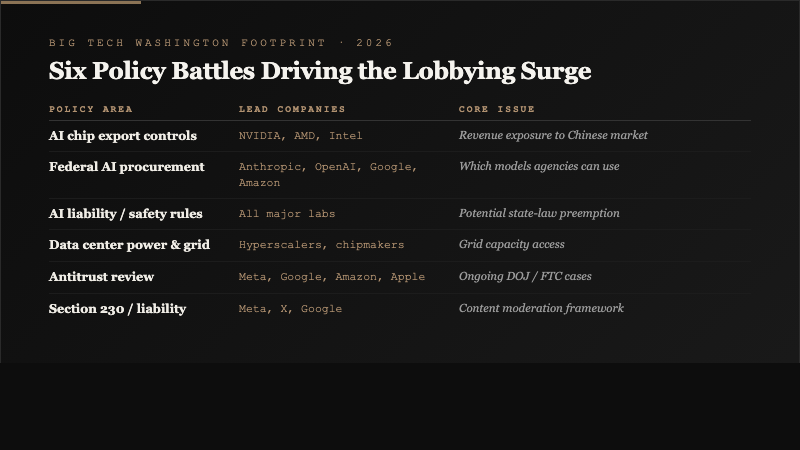
| Policy area | Primary companies engaged | Core issue |
|---|---|---|
| AI chip export controls to China | NVIDIA, AMD, Intel | Revenue exposure to Chinese market |
| Federal AI procurement | Anthropic, OpenAI, Google, Amazon | Which AI models federal agencies can use |
| AI liability and safety rules | All major AI labs and hyperscalers | Potential preemption of state AI laws |
| Data center power and grid access | Hyperscalers, chipmakers | Access to grid capacity and nuclear authorizations |
| Antitrust and M&A review | Meta, Google, Amazon, Apple | Ongoing DOJ and FTC cases and settlements |
| Platform liability (Section 230) | Meta, X, Google, TikTok parent | Content moderation legal framework |
The third is federal procurement. Agencies across the government are now actively deciding which AI models to deploy for internal use, which platforms to use for citizen-facing AI services, and how to structure the procurement contracts that will govern those deployments for years. Anthropic's Mythos deployment with federal agencies, Google's enterprise partnerships, OpenAI's government contracts, and Amazon's AI infrastructure offerings all depend on federal procurement decisions shaped by rules and guidance that lobbyists work to influence.
What the Companies Are Actually Asking For
The specific asks vary by company and policy area, but patterns are clear. NVIDIA and AMD want export control flexibility that preserves Chinese market access while maintaining the administration's national security posture. That trade-off is structurally difficult, and the companies have deployed lobbying activity to shape the specifics of licensing rules, entity list additions, and enforcement mechanisms.
Anthropic, OpenAI, and Google have been aggressive on federal procurement rules, particularly on the question of which AI models federal employees can use for sensitive work. Anthropic's Claude has been cleared for certain agencies. OpenAI's GPT models have different authorization profiles. Google's Gemini models occupy yet another regulatory bucket. Each of those authorization decisions is a policy surface lobbying activity works to shape.
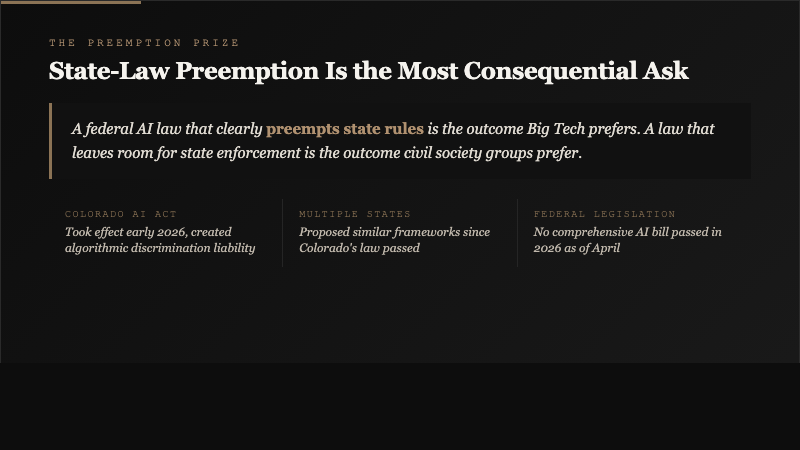
The most consequential single policy outcome in 2026 may be whether federal AI legislation preempts state-level AI laws. The Colorado AI Act, which took effect earlier in 2026, creates algorithmic discrimination liability that AI developers would prefer to have federally preempted. Other states have proposed similar frameworks. A federal AI law that clearly preempts state rules is the outcome Big Tech prefers. A federal AI law that leaves room for state enforcement is the outcome many civil society groups prefer.
The Anthropic Pattern
Anthropic is a particularly interesting case study in the lobbying surge. The company's public positioning has been as a safety-focused AI developer willing to accept thoughtful regulation. Its actual Washington behavior has been characterized by a rapidly growing lobbying footprint, substantial federal contracts including the JPMorgan and White House-level Mythos deployments, and a senior personnel roster that includes former executive-branch officials.
"Top US technology companies including Google, Meta, Amazon, OpenAI and Anthropic are now spending millions on lobbying."
Times of India report, April 22, 2026
The duality is not unique to Anthropic. Every major AI lab has a public-facing safety narrative and a private Washington presence calibrated to shape the regulatory environment favorably. The combination is durable because it serves both audiences: safety language builds trust with regulators and the public, while active lobbying protects commercial interests from specific rules that would meaningfully constrain development.
The Broader Pattern
Federal lobbying disclosure filings for 2026 show the trend clearly. The combined annual Washington spending of the top AI labs, hyperscalers, and chipmakers is now in the hundreds of millions of dollars. The growth trajectory has been steeper than the growth trajectory of the underlying businesses in percentage terms, which indicates that companies are spending more per dollar of revenue on Washington than they have historically.
The relationship to the Biden administration's 2023 AI executive order is instructive. When that order was in effect, it created specific compliance obligations for AI developers above certain model size thresholds. The Trump administration rescinded the order on day one. But the companies had already built the Washington lobbying infrastructure required to respond to the Biden rules. That infrastructure did not get torn down. It got repurposed to shape the new administration's AI policy framework.
The Political Economy Question
The question worth asking about the lobbying surge is who benefits and who loses. The direct beneficiaries are the companies, whose regulatory risk profiles are shaped by the policy outcomes lobbyists influence. The direct losers, at least on any individual policy question, are usually consumer protection groups, civil society organizations, and smaller AI developers who cannot match the Washington presence of the large incumbents.
The indirect effects are more interesting. When lobbying by AI incumbents shapes federal rules toward preemption of state AI laws, the result may be lighter regulation nationally. Whether that outcome serves consumers depends heavily on whether federal rules are genuinely adequate or whether they fall short of what state-level experimentation would have produced. The current Congress appears unlikely to pass comprehensive federal AI legislation in 2026, which means the state-level patchwork is the de facto regulatory framework regardless of industry preferences.
"Tech News News: Top US technology companies including Google, Meta, Amazon, OpenAI and Anthropic are now spending millions on lobbying."
Times of India, April 22, 2026
What to Watch
Three specific catalysts will determine how the lobbying surge translates into actual policy outcomes. The first is whether Congress takes up comprehensive AI legislation in the 2026 session. If it does, the specific contours of that legislation will reflect the balance of lobbying and civil-society pressure. If it does not, state-level rules will continue to accumulate and the compliance burden on national AI product deployment will grow.
The second is the next round of chip export control rules. NVIDIA and AMD have been working behind the scenes for more than a year on the specifics of how Chinese market access is governed. The outcome will show up in future NVIDIA earnings calls as an adjustment to Chinese revenue guidance. Whether that adjustment is positive or negative depends on how the lobbying has landed.
The third is federal procurement. Anthropic, OpenAI, Google, and Amazon are all competing for specific agency contracts that together determine how federal workers and citizens interact with AI systems. The rules governing those contracts are being written right now, and the lobbying surge is visible precisely because those rules are up for negotiation.
For related coverage, see our reporting on Big Tech's coalition behind Anthropic on Trump AI policy, on the Colorado AI Act that federal preemption would override, and on the GSA's AI safeguards clause now in every federal procurement contract.
Sources
- What Anthropic, OpenAI, Nvidia, AMD and other top American technology companies are spending millions on - Times of India
- Federal Lobbying by Computers/Internet Industry - OpenSecrets
- Lobbying Disclosure Act Database - U.S. Senate
- Artificial Intelligence at NIST - National Institute of Standards and Technology