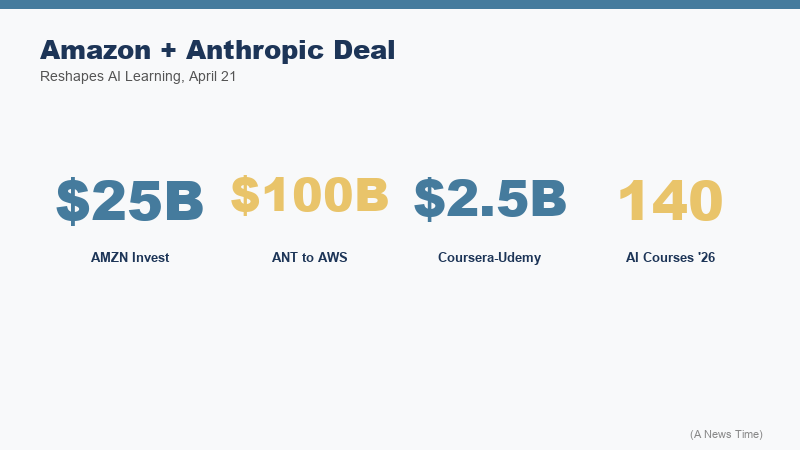
Amazon on Monday, April 21, 2026, committed as much as $25 billion in additional investment to Anthropic, the AI safety company behind the Claude family of models, while Anthropic committed in return to spending up to $100 billion on Amazon Web Services compute over the next several years. The deal, announced in Seattle at 6:38 am Pacific and filed with the SEC later that morning, is the largest single AI infrastructure commitment announced in 2026 and reshapes the hierarchy of skills that online learners, especially mid-career professionals, need to prioritize. For anyone working out which courses, certifications, and platforms to invest time in, the week of April 21 is a clarifying moment.
The practical effect is that the three dominant cloud platforms, AWS, Microsoft Azure, and Google Cloud, have now locked in distinct AI model partnerships that will shape enterprise adoption for years. AWS gets exclusive-at-scale access to Claude through Bedrock. Azure remains the primary path to OpenAI's GPT family. Google Cloud continues to lead with Gemini. Online learning platforms are racing to align their AI curriculum with those platform realities, and the alignment shows up in what they are releasing this month.
Why the April 21 Amazon-Anthropic Deal Matters for Learners
At the financial level, the deal is a vote of confidence from the largest cloud vendor in the world in a specific AI model family. For learners, it means that Claude, Bedrock, and AWS-native AI tooling are now structurally a priority skill for anyone working in cloud engineering, ML operations, or enterprise software. AWS's certification roadmap reflects the shift: the AWS Certified AI Practitioner and AWS Certified Machine Learning Engineer - Associate credentials, both expanded in late 2025, are now the fastest-growing certifications in the AWS portfolio.
Parallel movement is happening at Microsoft and Google. Microsoft's AZ-900, AI-102, and the newer AI-Engineer-Associate credentials have all seen enrollment spikes. Google Cloud's Professional Machine Learning Engineer and the new Generative AI Leader certification are the fastest-growing credentials on the Google Cloud Skills Boost platform.
The guidance for individual learners is clear but uncomfortable: pick a cloud platform, learn it deeply, then layer AI-specific skills on top, rather than studying AI in the abstract. A generalist AI course with no cloud anchor is now a weaker resume signal than a cloud-platform specialist with a credible AI certification on top.
The Coursera-Udemy Merger and Platform Consolidation
The online-learning platform side of the market is consolidating at pace. India's Competition Commission approved the $2.5 billion all-stock merger of Coursera and Udemy in late March, clearing the last major regulatory hurdle for a deal that first closed a letter of intent in 2025. The combined entity, which will retain both brand names as separate product lines, becomes the largest global edtech platform by course catalog size, instructor base, and enterprise customer count.
The practical implication for learners is reduced platform fragmentation. Where a Python-plus-AI pathway might previously have required courses across Coursera for university-backed theory, Udemy for project-based practice, and DataCamp for hands-on exercises, the merged platform will offer bundled pathway recommendations that pull from both catalogs. Enterprise subscribers, including companies offering Coursera licenses as a benefit, are expected to see unified dashboards by mid-2026.
"The strongest prediction we can make about online learning in 2026 is that the platform boundaries will keep blurring and the platform-plus-cloud specialization will keep sharpening. The students who finish this year with a cloud certification and a project portfolio will be better positioned than students who finish with twenty miscellaneous course completions."
David Malan, Professor of Computer Science, Harvard University (CS50 instructor)
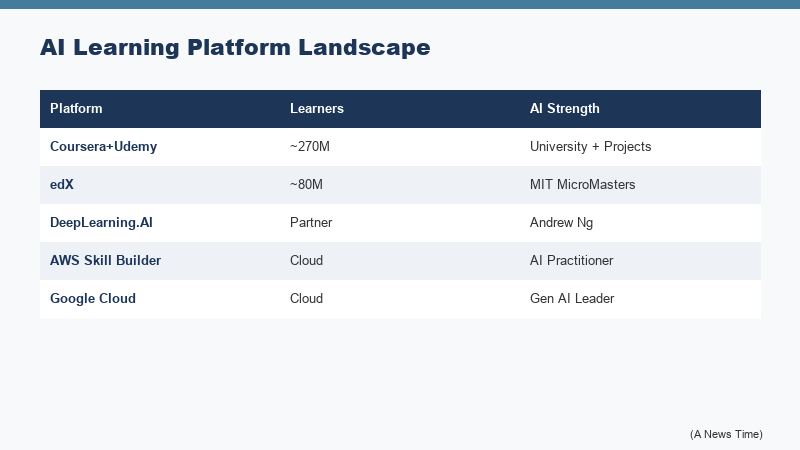
| Platform | Scale | Strongest AI Track | Price Range |
|---|---|---|---|
| Coursera (post-merger) | ~200M learners | Stanford/DeepLearning.AI specializations | $49-$99/mo |
| Udemy (post-merger) | ~70M learners | Project-based Python + LLM courses | $15-$30 per course |
| edX | ~80M learners | MIT MicroMasters, Harvard CS50 | $50-$300 per course |
| DeepLearning.AI | Stand-alone + Coursera | Andrew Ng's specializations | Free to $499 |
| AWS Skill Builder | Cloud-specific | AI Practitioner, ML Engineer | Free + $29/mo premium |
| Google Cloud Skills Boost | Cloud-specific | Generative AI Leader | Free tier + paid labs |
What New Courses Launched in the Last Week
The DQIndia 2026 AI Course Directory, updated April 21, confirms that 140 AI-specific courses and certifications are now available across Indian and global providers, up from 42 at the start of 2024. The fastest-growing cluster is prompt engineering and LLM application development, with 38 new programs in the past twelve months alone. Google's AI Essentials, Microsoft's Generative AI Fundamentals, and AWS's AI Practitioner are the three most-enrolled-in free courses on the directory.
For paid programs, the strongest signal-to-noise ratio is still in university-backed specializations on Coursera and edX. Stanford's Machine Learning specialization by Andrew Ng, MIT's MicroMasters in Statistics and Data Science, and Harvard's CS50 sequence are the three most-completed paid programs in the 2026 directory, the same three that led the directory in 2024. Learner completion data supports the ranking: Coursera's published median completion rate for the Stanford specialization is 34 percent, versus a sub-10 percent median for unaffiliated short-form AI courses.
The Anthropic Claude Angle for Individual Developers
Anthropic's $100 billion AWS commitment is a signal that Claude will be available through Bedrock at enterprise scale for the rest of the decade. For individual developers and learners, that translates into a specific practical question: should you learn Claude's API the same way you learned OpenAI's? The honest answer is yes for any developer working in an AWS-anchored enterprise stack, and optional for developers working in Microsoft or Google environments.
Anthropic's own developer documentation and free tier remain the fastest path to Claude-specific proficiency. AWS Bedrock's Claude integration course is the most efficient enterprise-oriented path. For a learner who already has cloud fundamentals, budgeting thirty to forty hours across both resources produces a credible portfolio of Claude projects inside a month.
For readers wanting related coverage, see our reporting on the Anthropic AI skills gap, why training alone is not closing the AI skills gap, and LinkedIn's 2026 skills-on-the-rise analysis where AI-related competencies now occupy eight of the top ten positions.
What to Watch This Quarter
The next major events on the online-learning calendar are the Coursera-Udemy integration launch, expected in July; Google Cloud Next on April 29, where Google is expected to announce new Gemini-linked certifications; and Microsoft Build on May 20, where the next update to the AI-102 and AI-Engineer certifications is expected. For any learner weighing where to put the next ten hours of study time, those three events will clarify the market considerably.
Frequently Asked Questions
What is the Amazon-Anthropic deal announced on April 21?
Amazon committed up to $25 billion in additional investment in Anthropic, while Anthropic committed up to $100 billion in AWS compute spending. The deal deepens the existing partnership that makes Claude the primary frontier model available through AWS Bedrock.
Is the Coursera-Udemy merger final?
India's Competition Commission approved the merger in late March 2026, clearing the last major regulatory hurdle. The deal closing is expected in Q2 2026, with full operational integration projected for mid-year.
Which AI certification should I pursue first?
For most learners, the AWS AI Practitioner is the strongest entry-level cloud-anchored credential. For those already in a Microsoft shop, AI-900 is the equivalent. Google Cloud's Generative AI Leader is the best starting point in Google-first environments. All three are foundational rather than engineer-level.
Are free AI courses worth the time?
Free courses from Google, Microsoft, AWS, and DeepLearning.AI are generally the highest-quality free offerings, because their providers have commercial incentives to produce accurate material. Shorter free courses on less-established platforms vary widely in quality.
How does the Amazon-Anthropic deal affect non-AWS learners?
The deal does not reduce the viability of Azure-OpenAI or Google-Gemini learning paths. Enterprise AI adoption is now tri-platform, and learners pursuing the Microsoft or Google tracks remain well-positioned. The main effect on non-AWS learners is higher demand for multi-cloud familiarity as enterprises adopt more than one AI model provider.