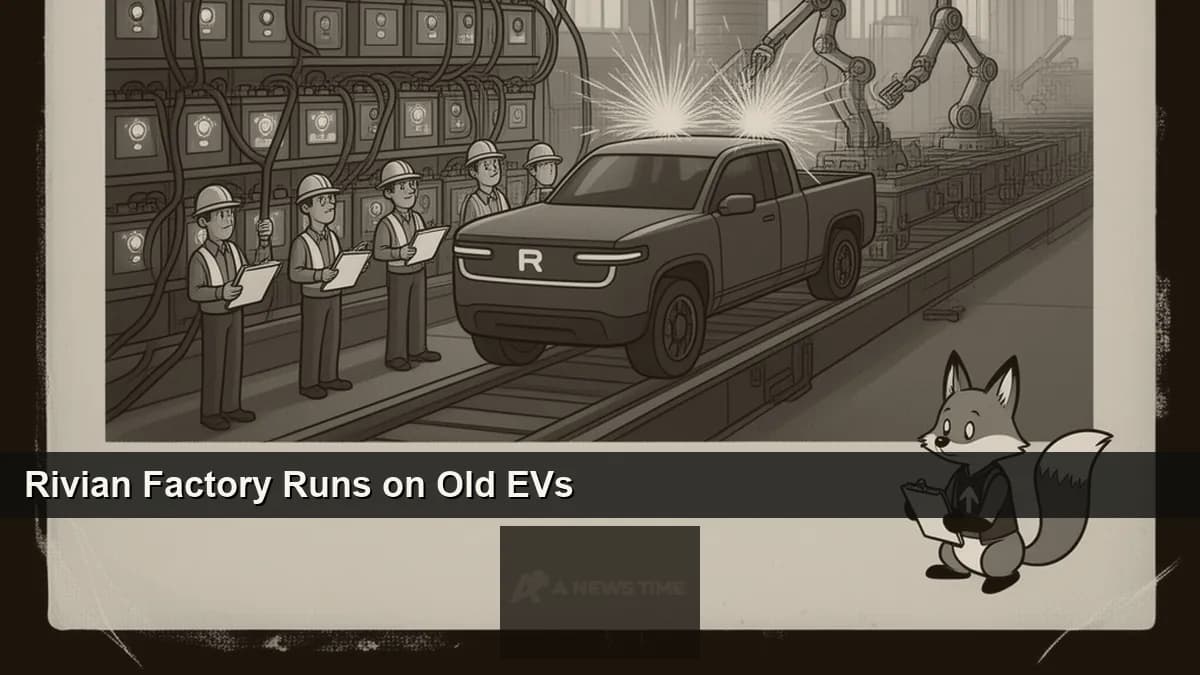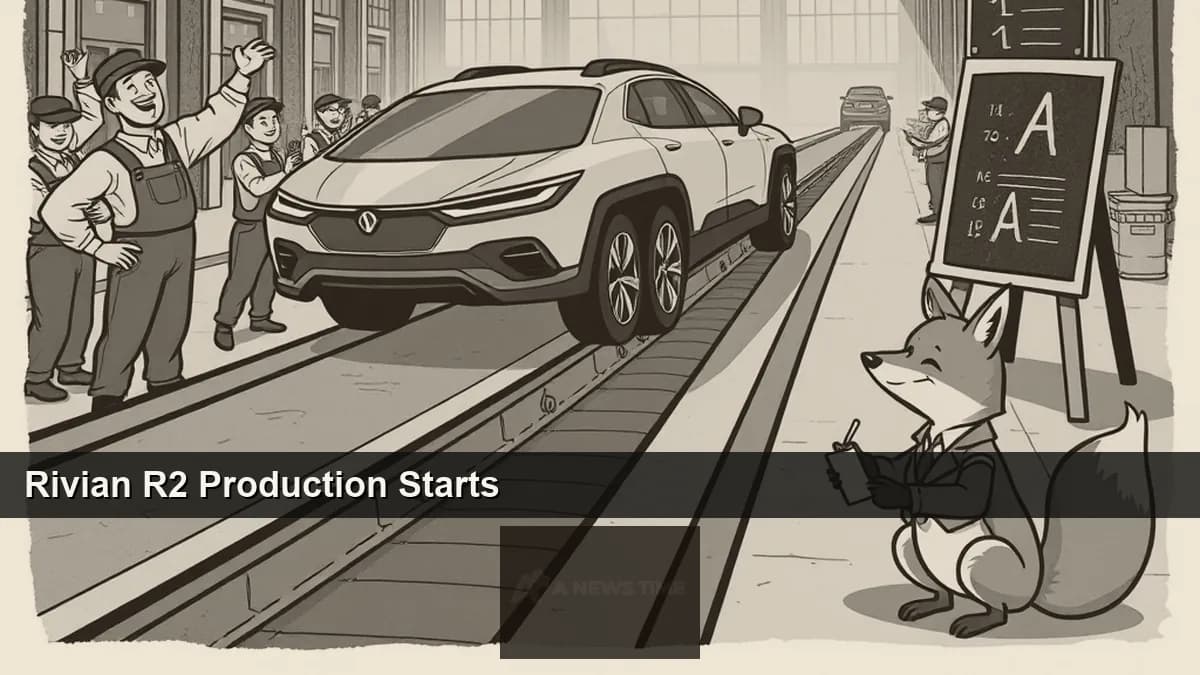
Rivian started production of its R2 electric SUV at its Normal, Illinois plant on Wednesday, , with first customer deliveries expected later in the spring. The start-of-production milestone comes just five days after an EF-1 tornado damaged the facility on , and it arrives at a moment when EV demand in the United States is visibly softening around the edges.
R2 is Rivian's attempt to move beyond the premium R1S and R1T price tier it has occupied since launch. Priced from the mid-$40,000s, the compact SUV is positioned against Tesla's Model Y, Kia's EV6, and the lower end of the Ford Mustang Mach-E lineup. It is the vehicle that must carry Rivian's volume case if the company is going to hit the scale required to reach sustainable gross margins on automotive sales.
What Start of Production Actually Means for Rivian
Announcing start of production is not the same as shipping cars. In Rivian's case, the April 22 milestone confirms that the body-in-white, paint, and general assembly lines at Normal are running the R2 platform through full-cycle builds, and that the vehicles coming off those lines are the ones that will enter the delivery pipeline in the second quarter. That is a narrower technical claim than the marketing language suggests, but it is a real one.
The tornado recovery matters as part of that technical claim. The EF-1 that struck the Normal plant on April 17 caused enough damage to require repairs before the line could be commissioned. Rivian's statement that deliveries remain "on track" for later this spring suggests the weather disruption cost days rather than weeks, though the company has not disclosed specific production volumes for the first month.
"Rivian's R2 is the vehicle the company has been building the balance sheet for since the IPO. Every quarter of negative gross margin on R1 has been, in some part, a down payment on getting R2 to the point where it can scale."
Automotive industry analyst commentary, cited in Reuters coverage of the launch
The R2 Spec Package
R2 is a two-row, five-seat SUV designed around Rivian's second-generation electrical architecture. The company has simplified the electronics stack compared with R1, cutting the number of ECUs substantially and moving more functions onto a smaller number of zonal compute nodes. That architectural shift is what gives Rivian the cost structure to hit the targeted mid-$40,000s starting price.
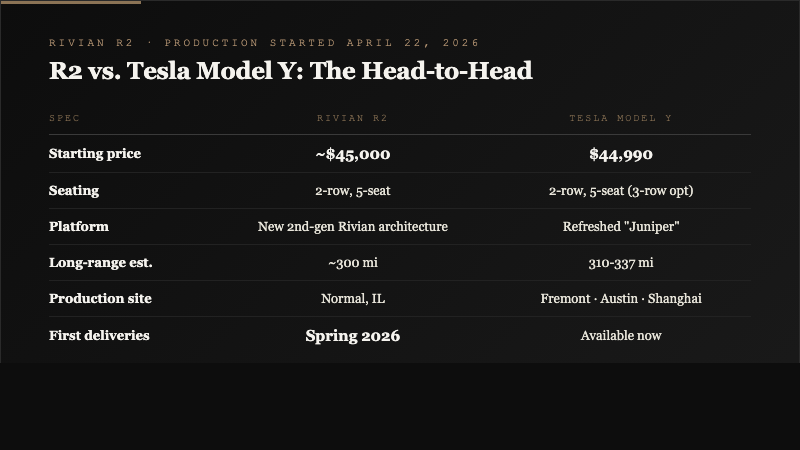
| Spec | R2 Value | Tesla Model Y (reference) |
|---|---|---|
| Starting price (est.) | $45,000 range | $44,990 |
| Seating | 2-row, 5-seat | 2-row, 5-seat (3-row optional) |
| Platform | New 2nd-gen Rivian architecture | Refreshed Model Y "Juniper" |
| Production site | Normal, Illinois | Fremont, CA / Austin, TX / Shanghai |
| Expected range (long range) | Approximately 300 miles | 310-337 miles (refreshed Model Y) |
| First deliveries | Later spring 2026 | Available now |
The pricing is the aggressive part of the spec. R1S, the three-row SUV that has been Rivian's flagship for volume since launch, starts in the high-$70,000s. Dropping to the mid-$40,000s doubles Rivian's addressable market at a moment when the EV tax credit landscape has shifted and the post-IRA incentive environment is less generous than the one Rivian originally modeled R2 against.
Range on the long-range trim is expected to land near 300 miles. That number puts R2 in the competitive window with the refreshed Tesla Model Y at the low end, and within range of the Kia EV6 and Hyundai Ioniq 5 for buyers cross-shopping the segment. Independent range testing will be a leading indicator of whether Rivian's efficiency claims translate, given the mixed track record most automakers have had between EPA-estimated and real-world range figures.
The EV Demand Picture That R2 Launches Into
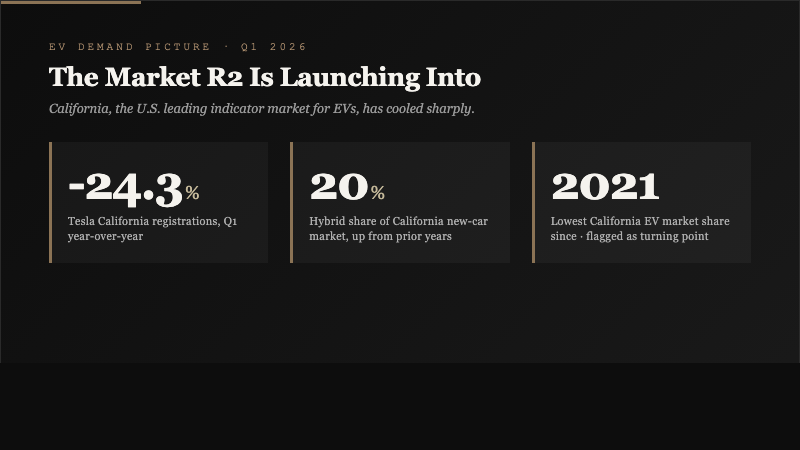
The market Rivian is entering with R2 is softer than the one it modeled when it announced the vehicle. Tesla's California vehicle registrations fell 24.3 percent in the first quarter of 2026 according to the California New Car Dealers Association, and the state's broader EV market share hit its lowest point since 2021. California is a leading indicator market for EV demand. If registrations there are sliding, national demand typically follows.
Hybrid vehicle registrations have taken up 20 percent of the California market share over the last year, which tells you where the incremental consumer dollar is going. Buyers who were on the fence between a hybrid and an EV are increasingly choosing the hybrid, and that is happening at the same time that federal and state EV incentives have been pared back.
Tesla itself reported Q1 2026 earnings that beat on revenue (up 15.8 percent year-over-year) but missed on vehicle deliveries. Analysts parsed the release as a mixed quarter in which one-time items boosted EPS even as the underlying automotive gross margin trended lower. For Rivian, Tesla's softness is both a competitive opening and a market-wide warning: the segment R2 is entering has lost momentum.
What Makes R2 Different
Rivian's pitch for R2 as a differentiated product rests on three pillars. The first is the simplified architecture and the associated cost curve, which the company argues gives it room to price aggressively while still moving toward gross margin break-even on a vehicle level. The second is brand equity built through the R1 lineup, which has cultivated an enthusiast customer base that cross-shops Rivian against Tesla and the legacy German luxury brands rather than against Ford, Chevrolet, or Hyundai.
The third is software. Rivian's second-generation software stack, developed alongside the R2 program, is meant to support over-the-air updates and feature additions on a cadence closer to Tesla's than to the legacy OEMs. That matters for resale value and for the feature-acceleration economics that have boosted Tesla's pricing power over its vehicle life cycles.
"The R2 pricing positions it directly against Tesla's Model Y. If Rivian can deliver the software experience they have been promising on a cheaper platform than R1, they have a real shot at taking Tesla volume at the edges of the Model Y's addressable market."
Seeking Alpha analyst commentary on Rivian's Q1 positioning
None of those pillars matter if Rivian cannot execute the production ramp. The company's history on ramps has been mixed. R1T's early production months were slower than Rivian's public guidance, and the company spent substantial engineering capital during 2023 and 2024 on running changes that brought cost of goods sold down on the original platform. R2 was designed from the start with manufacturing efficiency in mind, and the Normal plant has been reconfigured specifically for the new vehicle architecture, which should reduce the kind of unforced production losses that defined the earlier ramp.
The Broader Automotive Industry Signal
R2's launch also lands into a changing industry landscape on electrification timelines. Several legacy automakers have pulled back their stated EV-only targets for the 2030 decade, citing softer consumer adoption and the capital intensity of the ramp. Ford has adjusted its EV investment timeline. General Motors has delayed several specific EV programs. Toyota has doubled down on hybrids. The net effect is that a dedicated EV manufacturer like Rivian, committed to an all-electric product lineup, is now competing against a market in which the incumbents have slowed their own transition.
That is a good news, bad news scenario. The good news is that the direct EV competition set is smaller than the one Rivian originally projected for 2026. Tesla remains the dominant incumbent, but the flood of legacy EV products that was supposed to be hitting the market this year is arriving more slowly and in lower volumes than the plans from 2022 anticipated. The bad news is that softer adoption in the broader EV segment may pull the entire demand curve lower, and a smaller pie hurts Rivian as much as it hurts anyone.
What to Watch
Three specific data points will determine whether R2 meets its promise. The first is the Q2 delivery figure, which Rivian will report at its next earnings call. The second is independent range and quality reviews, which will either validate Rivian's spec claims or open the door for Tesla and Hyundai to take the marketing lead on the segment. The third is the trajectory of federal EV incentives under the current policy environment, because the economics of the mid-$40,000s sticker price depend meaningfully on whether the remaining credits survive.
For Rivian more broadly, R2 is the vehicle that must turn the company's capital structure into a self-sustaining business. The R1 program proved Rivian could engineer a premium EV. R2 has to prove it can scale one. Customer deliveries starting later this spring will be the first real data point.
For related coverage, see our reporting on Ford's Lightning production adjustment amid softer EV demand, on Tesla's Q1 2026 delivery picture and international headwinds, and on Tesla's broader business trajectory this spring.
Sources
- The Rivian R2 Just Officially Entered Production - Yahoo Autos
- Rivian starts production of R2 SUVs, deliveries expected later this spring - Reuters
- Tesla sputters as California EV sales, market share hit lowest since 2021 - Sacramento Bee
- Rivian Starts R2 SUV Production Following Illinois Factory Tornado - Harian Basis