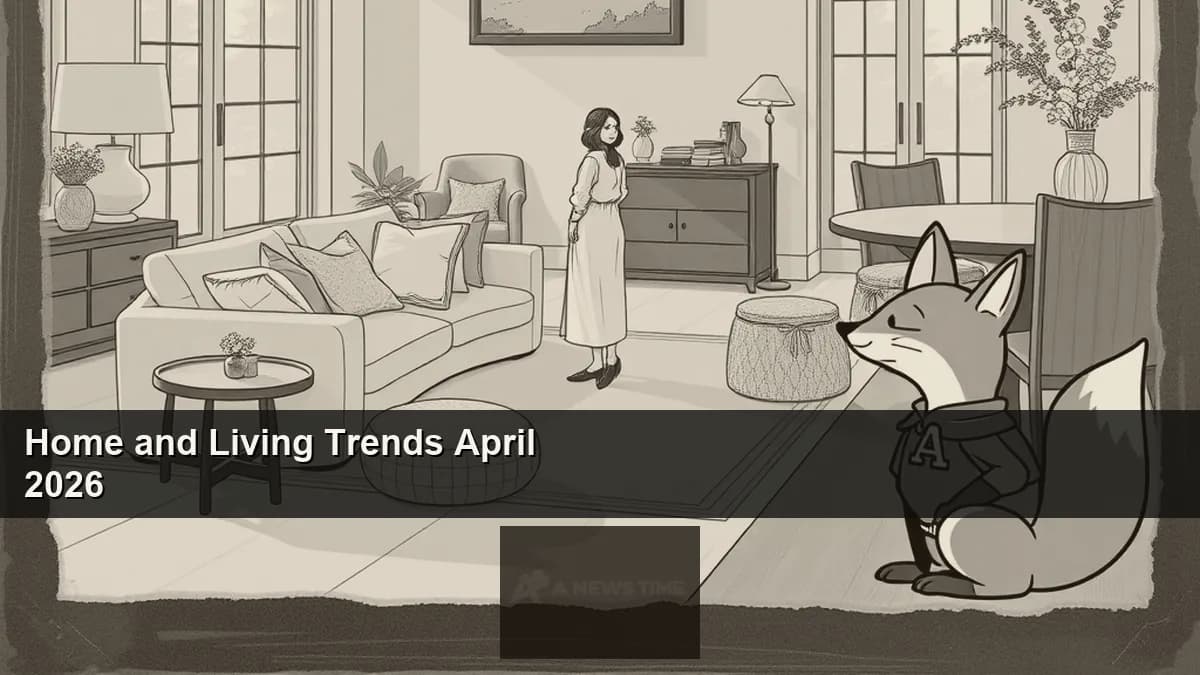
There is a specific kind of fatigue that comes from a room that is trying too hard. You walk in and feel the strain of a space that cannot decide what it wants to be: too much furniture, colors working against each other, technology that intrudes rather than recedes. By , that fatigue is being named in the interior design industry, and the response from designers, major retailers, and homeowners is coming into focus: spaces that breathe, that have purpose, and that take emotional well-being as seriously as square footage.
This is not the minimalism of the last decade, which was often cold and clinical. The emerging aesthetic is warmer, more personal, and deeply practical. It reflects how much the relationship between people and their homes changed after years of remote work, economic pressure, and a collective reassessment of what domestic life is actually for.
IKEA's 2026 Style Guide and the Four Trends Shaping Homes This Spring
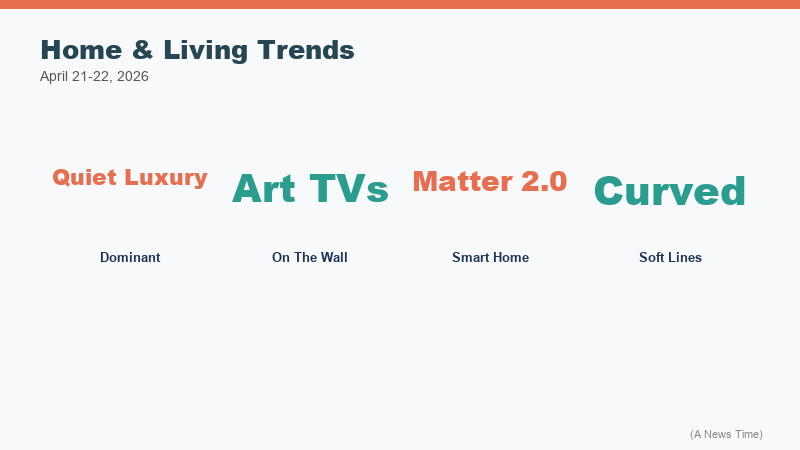
When IKEA released its 2026 Style Guide in January, the company identified four key trends it expected to dominate American interiors through the year. By spring, those trends are visible enough in retail traffic, social media, and design consultations to assess how they are landing.
Joycore is the most visually striking. It is a design philosophy that treats color not as decoration but as a mood intervention, and IKEA anchored the whole guide around a color of the year called Rebel Pink: playful, expressive, and deliberately cheerful in spaces that had been trending toward beige and gray for several consecutive years. The idea is that your home is allowed to make you happy in an immediate, uncomplicated way.
Floral Daydream brings botanical prints, organic curves, and textiles that evoke the natural world back into interiors that had been trending toward industrial and geometric. This connects to the broader biophilic design movement, which environmental psychologists have studied extensively: contact with natural forms, even rendered ones, measurably reduces cortisol levels and supports a sense of calm.
Lagom Living is the Swedish concept of "just the right amount" applied to interior design. Not maximalism, not stark minimalism, but a calibrated equilibrium between having what you need and not being overwhelmed by excess. It is the aesthetic version of what therapists sometimes describe as a "good enough" framework: perfectionism is not the goal, functionality and warmth are.
The Art of Storage is perhaps the most practically urgent of the four. With more Americans spending more time at home, the visible accumulation of objects has become a genuine source of stress. IKEA's storage trend is not about hiding everything behind closed doors; it is about making organization itself a design element, turning shelving systems, baskets, and modular units into objects worth looking at.
"Restorative design and emotional longevity are the two macro trends shaping interiors in 2026. People are asking their homes to do something they have not asked before: to actively support their mental health, not just shelter them."
IKEA U.S. 2026 Style Guide, Design Team Commentary
IKEA's design team points to two macro trends underlying all four specific styles: restorative design and emotional longevity. The former is about spaces that help people recover from stress. The latter is about designing homes that remain functional and meaningful as people age and change. Both represent a significant shift from a design industry that spent most of the 2010s focused on aesthetics for aesthetics' sake.
Smart Home Technology Meets Interior Design
The convergence of smart home technology with interior design has been discussed as a coming development for years. In spring 2026, it is arriving, and the form it is taking is significantly quieter and more integrated than the voice-assistant-dominated vision that dominated the previous decade's tech coverage.
The event making this visible in the design industry is CEDIA Expo's growing crossover with interior designers. CEDIA, traditionally a custom electronics trade show, is registering increasing interest from residential interior designers who see ambient lighting, climate control, acoustic management, and display technology as part of the spatial design problem, not a separate technical layer added afterward.
The shift matters because it changes what "smart home" means in practice. A smart home that was designed to be smart from the beginning has cabling in the walls, lighting fixtures selected for how they interact with dimmers, and audio systems that do not require visible speakers. A smart home that had technology bolted onto an existing space looks and feels different, and most homeowners can sense the difference even if they cannot articulate it.
Art-display televisions are one specific technology capturing this integration impulse. Products like Amazon's Ember Artline, which displays curated artwork when not in use, represent a design philosophy that treats the television screen as a canvas rather than a black void. When a living room is designed around this capability, the television stops being an intrusion into the aesthetic and becomes part of it.
Ambient lighting control is the technology having the broadest daily impact. Systems that shift color temperature through the day, moving from cool daylight tones in the morning toward warm amber tones in the evening, align with circadian biology in ways that affect sleep quality and mood regulation. What was once available only in high-end custom installations is now accessible through mid-range smart bulb ecosystems, and the awareness of why it matters is reaching a mainstream audience.
The Research Behind Restorative Spaces
The design industry's turn toward emotional well-being is not just a marketing pivot. There is a genuine body of environmental psychology research supporting the claim that physical spaces affect mental states, and that research has been growing steadily since the early 2000s.
Roger Ulrich's landmark 1984 study, replicated and extended many times since, demonstrated that hospital patients with window views of nature recovered faster than those with views of a brick wall. The mechanism involves attention restoration: natural forms, flowing curves, and organic patterns allow the directed attention systems of the brain to rest in ways that geometric and high-information environments do not.
More recent work by environmental neuroscientist researchers studying home design and modern living has extended these findings into residential contexts. Studies tracking cortisol levels and self-reported stress across different room configurations have found that clutter, poor lighting, and spaces without clear purpose or "psychological anchors" correlate with higher baseline stress. Conversely, rooms with natural light, tactile variety, and visible organization are associated with faster recovery from stressful events.
This is the science behind the Art of Storage trend. Visible clutter is not merely an aesthetic problem; it is a cognitive one. Every unresolved object in a visual field makes a small claim on attention, and in aggregate those claims accumulate into what researchers describe as "cognitive load." Designing storage so that objects are easily accessible but not constantly visible removes that load. IKEA's push toward visible, beautiful organization systems is, in this light, a form of stress reduction dressed as interior design.
"People are not consciously aware of how much their home environments are affecting their mood and stress levels on a daily basis. When we make changes to lighting, clutter, and the presence of natural materials, the effects on self-reported well-being can be substantial and fast."
Dr. Sally Augustin, environmental psychologist and author of Place Advantage
The biophilic design elements in IKEA's Floral Daydream trend and the broader move toward indoor plants, natural wood surfaces, and stone or ceramic textures connect directly to this research. The brain does not require literal nature to trigger restoration responses; patterns and materials that evoke natural environments produce measurable effects. That is why the trend toward warm wood tones, textured linens, and botanical motifs is not merely cyclical aesthetic preference. It reflects something more durable.
For those interested in how the longevity living movement is incorporating these design principles into residential architecture, our earlier coverage of longevity residences and disaster-ready design traces how this thinking is being embedded into high-end new construction. The overlap between restorative design and long-term livability planning is substantial.
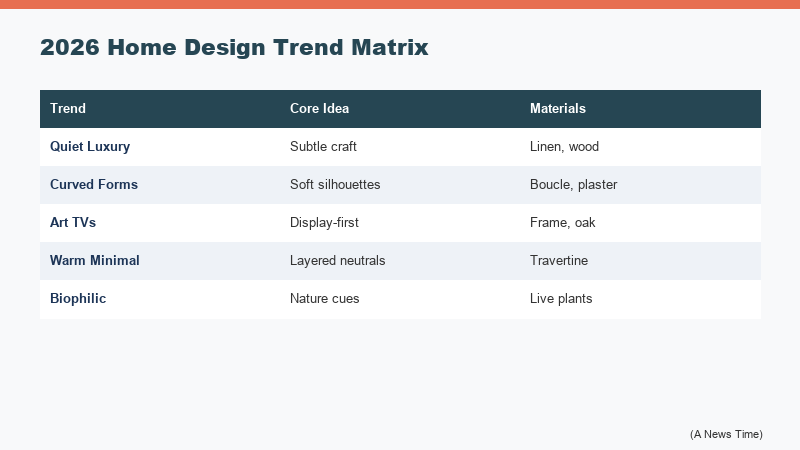
2026 Trending Aesthetics: A Comparison
| Trend | Core Principle | Key Materials | Smart Home Fit |
|---|---|---|---|
| Joycore | Color as emotional intervention | Bold textiles, accent furniture | Tunable ambient lighting |
| Floral Daydream | Biophilic pattern and texture | Botanical prints, natural fiber | Plant-sensing humidity systems |
| Lagom Living | Calibrated sufficiency | Mid-century wood, muted tones | Minimal-interface controls |
| The Art of Storage | Visible organization as design | Open shelving, modular systems | Inventory and lighting integration |
| Quiet Luxury | High-quality materials, no logos | Linen, marble, bespoke wood | Hidden, seamless integration |
| Warm Minimalism | Clean lines with earthy warmth | Terracotta, aged brass, stone | Voice-free ambient controls |
The Vogue Factor: Luxury Influences on Mainstream Homes
One persistent dynamic in interior design is the way luxury aesthetics eventually migrate into accessible price points, and that process is visibly underway in spring 2026. The "quiet luxury" aesthetic that defined high-end residential design in 2024 and 2025, characterized by subtlety, high-quality materials, and a studied avoidance of anything that reads as conspicuous, has been trickling into mid-market furniture collections and IKEA's own premium lines.
Our earlier analysis of Vogue's interior design trends for 2026 and the "organic fabulous" movement documented how editorial taste-makers were positioning natural materials and artisanal craft as the new aspiration. What was remarkable was not the prediction itself but how quickly the mass market responded: curved furniture, rounded mirrors, and arched doorways moved from architecture editorial to furniture retail faster than similar transitions had in earlier years.
Social media is the accelerant. A design idea that would previously have taken three to five years to travel from a high-end residential project in Los Angeles to a IKEA product line now makes that journey in closer to eighteen months. TikTok interior design accounts with millions of followers are creating consumer awareness of specific materials, configurations, and color combinations that previously required expensive design consultations to access.
The democratization is genuine, but it comes with a complexity: the pace of trend cycles has accelerated to the point where some homeowners feel chronically behind. Designers working with clients report a rising phenomenon: renovation fatigue, where the anxiety of not keeping up with trends becomes itself a source of the discomfort that restorative design is supposed to alleviate.
"The most important thing we can tell a client is that design trends are a reference point, not a mandate. A home that is livable, personal, and organized around how you actually move through your day will outlast any trend cycle."
Amber Lewis, interior designer and founder of Amber Interiors, in her Four Hands collection launch commentary, April 2026
What the Neurowellness Movement Is Adding to Home Design
The intersection of neuroscience and wellness has been reshaping everything from fitness culture to corporate office design, and in 2026 it is having a significant effect on how people think about their homes. As we reported in our coverage of neurowellness emerging as a top wellness trend, the central insight is that the brain's environment shapes its function in ways that are measurable, not merely anecdotal.
Applied to home design, this translates into specific, actionable choices. Acoustic management, reducing ambient noise through soft surfaces, acoustic panels disguised as art, and strategic furniture placement, is being taken more seriously in residential spaces. Color psychology, the documented effect of specific hues on arousal and mood, is influencing paint selection beyond the vague idea that blue is "calming." Thermal comfort, the relationship between temperature and sleep quality, is driving smart thermostat adoption in a more intentional way.
The Living by Design Virtual Showhouse, which opened its third annual edition on , featured several rooms explicitly designed around neurowellness principles: a home office with adjustable color temperature lighting and acoustic wall panels, a bedroom using circadian-aligned smart lighting on a sunrise-simulation protocol, and a living room with furniture configured to minimize visual noise from technology while maximizing natural sightlines to windows.
These are not fringe ideas. They are increasingly part of how architects, interior designers, and design-minded homeowners are thinking about what a home is supposed to do.
Frequently Asked Questions
What is "restorative design" and how does it differ from standard interior design?
Restorative design is an approach that draws on environmental psychology to create spaces that actively reduce stress and support mental recovery. It prioritizes natural light, biophilic elements, reduced visual clutter, and acoustic comfort. Standard interior design focuses primarily on aesthetics and function; restorative design adds the goal of supporting the psychological state of the people using the space.
What are the IKEA 2026 key design trends?
IKEA's 2026 Style Guide highlights four trends: Joycore (bold, joyful color and playful expression), Floral Daydream (botanical patterns and natural textures), Lagom Living (the Swedish concept of balanced sufficiency), and The Art of Storage (organization systems designed to be visible and beautiful). The guide's Color of the Year is Rebel Pink.
How does smart home technology fit with current interior design trends?
The most current approach treats smart home technology as part of the spatial design from the beginning rather than an add-on. Key technologies include tunable ambient lighting that shifts color temperature through the day, art-display screens that eliminate the black-void problem of televisions, and acoustic systems that do not require visible hardware. The goal is technology that serves the room rather than competing with it.
Is "quiet luxury" still relevant in 2026 or has it peaked?
Quiet luxury as a high-end aesthetic is still present, but it has been joined by warmer, more accessible interpretations in the mass market. The core principles, high-quality materials, restraint in decoration, and a preference for substance over logo recognition, remain influential. What has changed is that those principles are now available at more accessible price points through retailers including IKEA's premium lines and mid-market furniture collections.
What paint colors are trending for homes in spring 2026?
Based on current retail and design reporting, trending shades include warm terracotta, deep forest green, soft lavender, and charcoal grey for neutral foundations. IKEA's Rebel Pink is the breakout accent color of the year. There is also a notable movement toward dusty rose, clay, and warm ochre tones that bridge the gap between the cool neutrals of recent years and warmer, more expressive palettes.