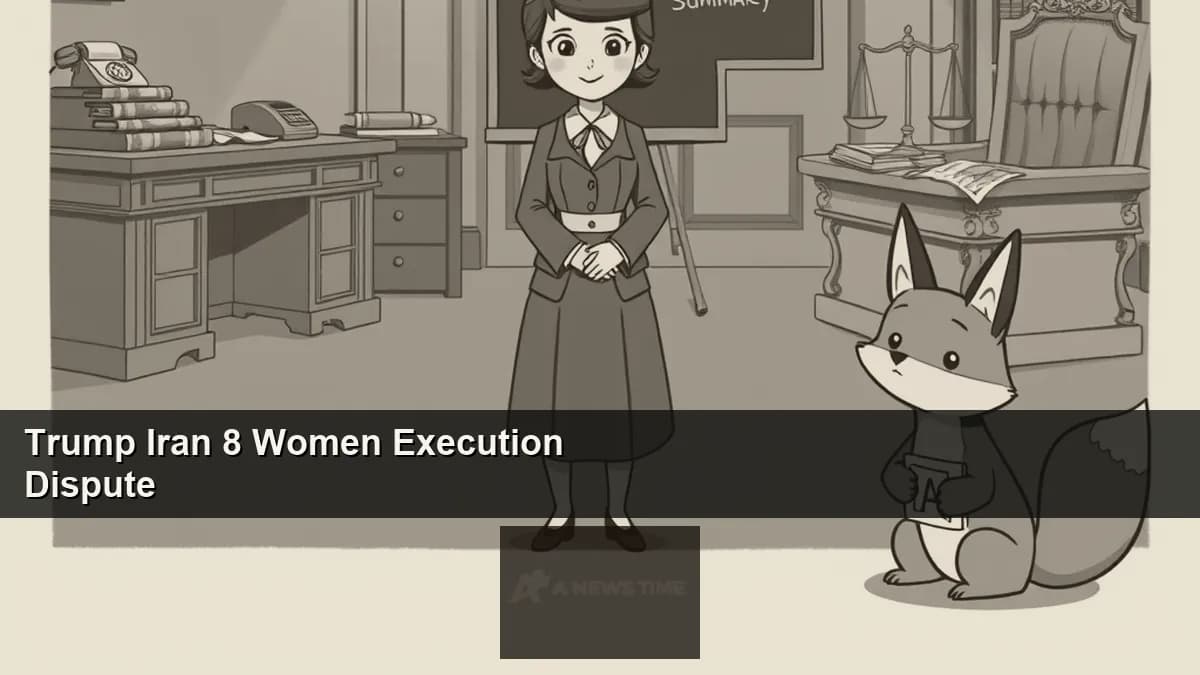
President Donald Trump announced on Truth Social on Wednesday, , that Iran had agreed to halt the planned executions of eight Iranian women accused of involvement in protests against the regime. According to Trump's post and subsequent confirmation from The Hill, four of the eight women were released immediately. The remaining four were sentenced to one month in prison. Iran's judiciary issued a separate statement calling the account "false news" and asserting that the women had never faced death sentences in the first place.
The episode lands at a moment of stalled U.S.-Iran diplomacy and extended war. Trump had publicly urged Iran to halt the executions one day earlier. The April 22 announcement followed. Iran's public dispute of the framing, combined with the actual outcomes for the women involved, creates a factual picture that does not fit neatly into either government's preferred narrative.
What Trump Said
"Very good news! I have just been informed that the eight women protestors who were going to be executed tonight in Iran will no longer be killed," Trump wrote in his Wednesday Truth Social post. "I very much appreciate that Iran, and its leaders, respected my request, as President of the United States, and terminated the planned execution."
The announcement came roughly 24 hours after Trump publicly appealed to the Islamic Republic to halt the executions, using similar language about requesting rather than demanding the intervention. The sequence, a public appeal followed by a public announcement of success, followed a pattern the president has used in other high-visibility foreign policy moments during his second term.
"I very much appreciate that Iran, and its leaders, respected my request, as President of the United States, and terminated the planned execution."
President Donald Trump, Truth Social, April 22, 2026
What Iran Said
Iran's judiciary rejected the framing. The judiciary characterized Trump's account as "false news" and said the eight women had never faced death sentences. The implication of Iran's statement is that the "halting" Trump described did not happen because the executions were never going to happen in the first place. That factual claim is difficult to verify independently given the opacity of Iranian judicial proceedings and the documented history of Iran issuing death sentences for protest-related charges that are sometimes commuted under international pressure without public acknowledgment.
Iran's framing is politically significant within the country. Acknowledging that a foreign leader's request changed domestic judicial outcomes would contradict the official position that the Islamic Republic does not adjust its legal system under external pressure. That position matters to the regime's domestic legitimacy narrative, particularly during a war in which Iran has cast itself as resisting Western coercion.
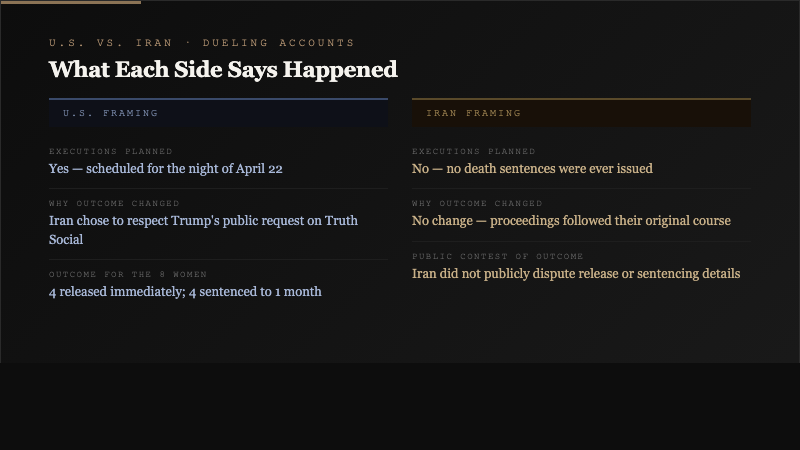
| Element | U.S. framing | Iran framing |
|---|---|---|
| Were executions planned? | Yes, for the night of April 22 | No death sentences ever issued |
| Why did outcomes change? | Respecting Trump's public request | No change, original path |
| Number released | 4 immediately | Not publicly contested |
| Remainder's sentence | One month in prison | Not publicly contested |
What the Women Were Charged With
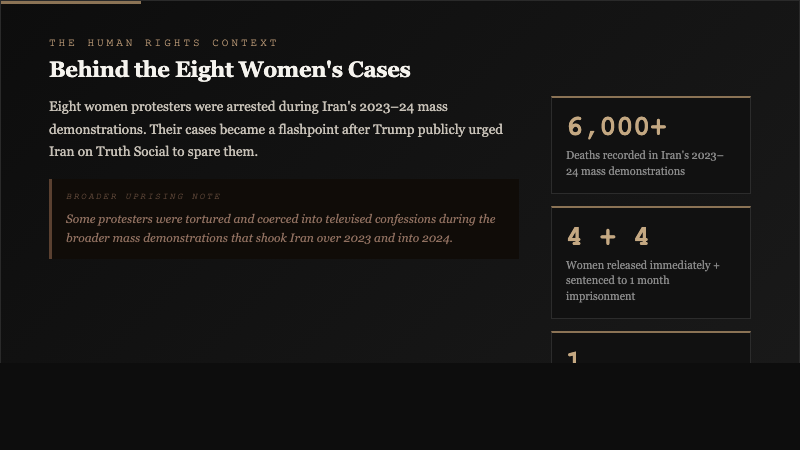
The eight women were charged with involvement in protests against the Iranian regime. According to international human rights organizations, the specific alleged acts included throwing objects during a January demonstration and providing assistance to protesters injured during broader uprisings. Bita Hemmati, reportedly the first woman sentenced to death for protest involvement under the regime's recent enforcement campaign, was among the eight named.
The broader context is Iran's handling of the mass demonstrations that began in 2023 and extended into 2024. According to Hill reporting citing international humanitarian sources, more than 6,000 people died in those demonstrations. Some of the dead were protesters killed during crackdowns. Others were subjected to torture and coerced into admitting crimes against the country on state television. The women named in the April 22 case came from this cohort of protest-related legal proceedings rather than from any single recent incident.
The Diplomatic Context
The announcement lands inside a stalled U.S.-Iran peace process and an extended ceasefire. Trump extended the ceasefire indefinitely on , removing a hard deadline that had been concentrating Iranian and U.S. negotiating attention. The next round of peace talks, which would be the second under the ceasefire framework, has not been confirmed by Iran. The framework for resuming normal shipping traffic through the Strait of Hormuz has not been established. Iran continues to demand that the U.S. lift its naval blockade of Iranian ports before a full ceasefire becomes operational.
Against that backdrop, the April 22 announcement served multiple functions. For the Trump administration, it offered a visible foreign policy win during a period when the primary war narrative has turned difficult, particularly on energy prices and the length of the conflict. For Iran's political leadership, the actual release of four women and sentencing of four others to one month was a real policy concession, but Iran's public denial of the framing preserved the domestic political position that the regime does not adjust under foreign pressure.
"The women's alleged crimes included throwing objects at a January protest against the regime and providing assistance to demonstrators injured during the large uprising, according to international humanitarian rights organizations."
The Hill, April 22 report
How to Read the Dual Framing
Both the U.S. and Iranian accounts are in some sense true and in some sense incomplete. Four women were released immediately. Four received reduced sentences. That reflects a real change from whatever the original trajectory was. Whether the change was driven by Trump's public request, by quiet diplomatic channels that used Trump's public request as cover, by Iranian judicial reconsideration unrelated to external pressure, or by some combination of the three is not publicly verifiable.
The pattern is consistent with past Iranian responses to international pressure on high-visibility human rights cases. Iran has at multiple points reduced sentences for protesters whose cases became internationally prominent, while publicly denying that the reductions were responsive to external pressure. The combination serves the regime's interest in maintaining flexibility without compromising its domestic political messaging.
For the Trump administration, the announcement serves a complementary interest. Visible humanitarian wins during a prolonged war offer political cover that the administration needs as energy prices rise and war fatigue grows domestically. Whether the administration's calculations extend to anticipated Iranian denials, which would allow both sides to claim a win in their respective domestic audiences, is a reasonable hypothesis to consider.
What to Watch
Two near-term developments will shape the next phase of this story. The first is whether any of the four women who were sentenced to one month in prison are actually released at the end of that term. A one-month sentence in the Iranian judicial system can be extended through follow-on charges, and international human rights organizations will monitor the outcome closely. The second is whether Iran permits independent verification of the four released women, either through international press access, family statements, or legal representation.
On the broader diplomatic picture, the next round of U.S.-Iran peace talks, if scheduled, will operate in an environment shaped partly by the April 22 episode. Trump has demonstrated that public appeals can produce at least nominal concessions. Iran has demonstrated that it can absorb those concessions without accepting the framing that its domestic policy is responsive to external pressure. Whether that pattern extends to larger issues, particularly the Strait of Hormuz blockade, is the open question.
For related coverage, see our reporting on the Hormuz blockade and its cascading effects on U.S. energy markets, on the market reaction to the extended ceasefire, and on parallel domestic political dynamics on civil liberties.
Sources
- Trump: 8 Iranian protesters won't be executed - The Hill
- Trump says eight Iranian women won't be executed, Iran disputes entire account - Al-Monitor
- Iran agrees not to execute eight women tied to anti-regime protests after Trump's public appeal - Fox News
- Trump says Iran will not execute eight women after his request - Arab News