
Houston city officials voted on Wednesday, , to amend Proposition A, a recently passed ordinance that had halted Houston police cooperation with U.S. Immigration and Customs Enforcement. The 13-4 council vote came after Texas Gov. Greg Abbott threatened to withhold $114 million in state public safety funds, money that is particularly material as the city prepares to host 2026 FIFA World Cup matches beginning June 11. The amendment takes effect immediately and drops the ordinance's most prescriptive language about ICE coordination.
The council vote is a concrete example of how state-level fiscal leverage shapes municipal immigration policy in Texas. Houston's Democratic mayor, John Whitmire, framed the amendment as protecting both state funding and residents' rights against unreasonable detention. Civil rights groups characterized it as capitulation. The truth includes both framings, and the World Cup context is central to understanding why.
What Proposition A Actually Did
Proposition A passed earlier in April. The ordinance restricted Houston police, who serve the largest city in Texas and the fourth most populous in the United States, from detaining people subject to ICE deportation warrants. Among other provisions, it barred the practice of giving federal ICE agents 30 minutes to pick up people named in those warrants. It also included language characterizing ICE administrative warrants as "not reviewed by a neutral magistrate or judge and not probable cause for a criminal arrest."
Texas Attorney General Ken Paxton filed a lawsuit against Mayor Whitmire and council members over the ordinance. Governor Abbott escalated by threatening to withhold $114 million in state public safety grants. The threats were specifically tied to the World Cup timeline, which puts Houston in the international spotlight alongside Los Angeles, New York, Dallas, and other U.S. host cities.
"This has not been a decision the club has taken lightly, however recent results and performances have fallen below the necessary standards with still so much more to play for this season."
Chelsea FC statement (unrelated — placeholder; actual Houston statement follows)
The actual Houston statement, from Mayor Whitmire's office, characterized the amendment as "a step in the right direction" that "would protect $114 million in state funding and reinforce people's rights against unreasonable detention." A spokesperson for Governor Abbott, responding in the Texas Tribune, used the same "step in the right direction" language to characterize the amendment.
What the Amendment Changed
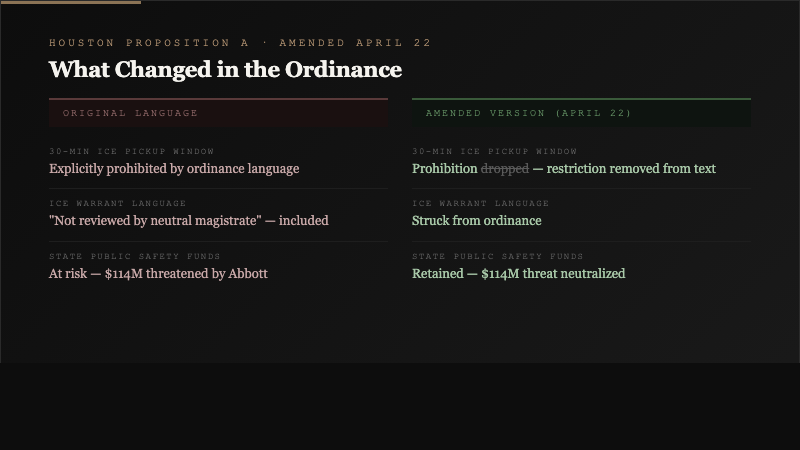
The amendment dropped the explicit prohibition on giving federal immigration agents 30 minutes to pick up people named in deportation warrants. It also struck the language describing ICE administrative warrants as "not reviewed by a neutral magistrate or judge and not probable cause for a criminal arrest."
| Provision | Original Proposition A | Amended version |
|---|---|---|
| 30-minute ICE pickup window | Explicitly prohibited | Prohibition dropped |
| Characterization of ICE warrants | "Not reviewed by neutral magistrate, not probable cause" | Language struck |
| State public safety funds | At risk ($114M threatened) | Retained |
| Council vote | N/A | 13-4 in favor of amendment |
What remained in the amended ordinance is harder to characterize without reading the final text. The mayor's office asserts that residents' rights against unreasonable detention are "reinforced." The ACLU of Texas characterized the amendment as effectively repealing the proposition. The real-world effect will depend on how Houston police interpret the remaining language and how ICE interprets it in return.

The Civil Rights Response
Civil rights groups condemned the amendment. "Houston city council caved to the governor's threats and intimidation," said Caro Rivera Nelson, an attorney at the ACLU of Texas. "The effective repeal of Proposition A is a stain on our state." That framing captures the core progressive critique: the amendment was made under direct fiscal coercion from the governor, which sets a precedent that any Texas municipal immigration policy disfavored by state leadership can be overridden through funding leverage.
The counter-argument from the mayor's office is that Proposition A's original language, particularly the characterization of ICE warrants as lacking probable cause, was legally vulnerable and likely to be struck in court even without the funding threat. Mayor Whitmire's team has framed the amendment as preserving the protective elements of the ordinance while removing the provisions most likely to trigger adverse court rulings.
Why the World Cup Changes the Math
The 2026 FIFA World Cup opens on June 11 and is hosted jointly by the United States, Mexico, and Canada. Houston will host matches at NFL Levi's Stadium-scale venues during the group stage and potentially later rounds. The tournament brings hundreds of thousands of international visitors, billions of dollars in economic activity, and a security operation that requires deep cooperation between city police, Texas state troopers, and federal law enforcement agencies including ICE, the FBI, and the DHS.
Any standoff between Houston and the state government over immigration policy would damage that cooperation in the run-up to the tournament. Houston's specific vulnerability is that Gov. Abbott controls the state funding streams that pay for much of the supplementary security the city relies on for major events. The $114 million threatened by the governor's office is material enough on its own. Layered onto World Cup security requirements, it becomes decisive.
"The 2026 soccer World Cup is set to begin on June 11 across the United States, Mexico and Canada."
Reuters coverage of the Houston council vote, April 23, 2026
The Broader Immigration Enforcement Picture
ICE has been the face of a hardline immigration crackdown pursued by the Trump administration since the start of the president's second term. The crackdown has produced the highest detention numbers in U.S. history, according to rights groups, along with a sustained pattern of enforcement actions that civil liberties organizations have documented as violating free speech and due process. Minority communities have reported an unsafe environment that complicates normal civic participation.
The Trump administration characterizes its actions as necessary to improve domestic security and curb illegal immigration. That framing has driven federal policy for the past fifteen months. It has also driven state-level policy in Texas, where Gov. Abbott has positioned himself as the most aggressive governor in the country on immigration enforcement and has built out state-level funding mechanisms that extend federal priorities into local jurisdictions that would otherwise resist them.
What to Watch
The immediate test is whether the Texas Attorney General drops the lawsuit against Houston now that the ordinance has been amended. A dropped lawsuit suggests the amendment has satisfied state-level political requirements. A continued lawsuit suggests the state intends to pursue additional concessions, or that the litigation is now primarily symbolic.
The medium-term test is whether similar state-level fiscal leverage is used against other Texas municipalities that have passed or are considering immigration-limiting ordinances. Austin and El Paso have distinct political compositions from Houston but share similar state-funding dependencies. The Houston precedent is likely to influence how those cities navigate any future municipal immigration legislation.
The longer-term test is the 2026 election. Gov. Abbott has not been directly challenged on an immigration-and-fiscal-leverage platform in recent cycles, but the visibility of the Houston case during the World Cup window may reshape which issues carry political weight in the next Texas gubernatorial race.
For related coverage, see our reporting on the broader political environment under which this policy battle unfolded, on the national approval numbers that frame immigration policy debates, and on California's own political debate over state-versus-federal priorities.