On the weekend of , local television stations across western Montana ran a short segment about a man named Adam Bruzza. The hook was simple. Bruzza got a DUI in the fall of 2024. Eighteen months later, he launched a free 24/7 designated-driver service called Big Sky Sobriety Shuttle LLC, operating out of his personal pickup truck, and partners with bars across Flathead County to make sure people who should not be driving get home safely. He runs it himself. He does not charge anyone. He does not want anyone making the same mistake he did.
The story is small by the standards of what counts as national news. It is also exactly the kind of story that reveals how American communities actually function when the safety nets of larger cities are not available. A rural Montana county does not have Uber Black or late-night taxis on every corner. What it has, as of this week, is Adam Bruzza's truck, his phone number, and a 24/7 promise that he will come get you.
The Math of Drunk Driving in Rural America
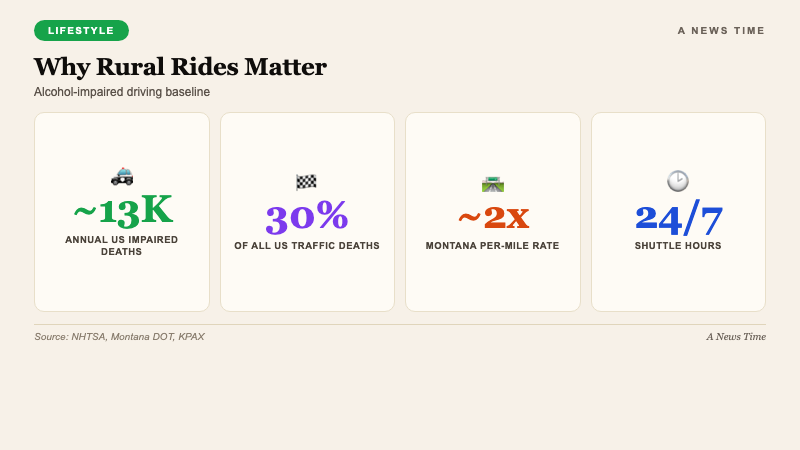
National Highway Traffic Safety Administration data on alcohol-impaired driving is grim even when averaged. Rural deaths make the average darker than the topline suggests. NHTSA has tracked roughly 13,000 alcohol-impaired driving fatalities per year in recent reporting, with rural states consistently overrepresented per capita. Montana's alcohol-impaired fatality rate, per the state's own Department of Transportation, runs roughly double the national average in per-mile-driven terms.
| Metric | Value | Source |
|---|---|---|
| US alcohol-impaired driving deaths (avg recent year) | ~13,000 | NHTSA |
| Share of all US traffic deaths | ~30% | NHTSA |
| Montana alcohol-related fatal crash rate | Roughly 2x national avg per mile | MDT |
| States with above-national-avg rural impaired fatality rate | Most western plains | NHTSA |
The rideshare gap explains part of the rural pattern. In Kalispell, Whitefish, and smaller Flathead County towns, Uber and Lyft drivers are available during standard demand windows but thin out after bar close, precisely when impaired driving risk peaks. A person leaving a bar at 1 a.m. with an option of a 45-minute Uber wait or a "quick drive home" does math that ends badly in a meaningful percentage of cases. Free-shuttle services eliminate the math by removing the variable.
How Big Sky Sobriety Shuttle Actually Works
Bruzza's service, according to the KPAX profile and subsequent local coverage, runs from his personal truck, 24 hours a day, seven days a week. Patrons call or text Bruzza directly. He drives out to the pickup location and takes them home, no fare, no tip expectation, no advertising on the side of the vehicle. He coordinates with bar staff who know to call him when a customer should not be behind a wheel.
"I got a DUI in October 2024. I know how close I came to something I could never take back. If I can keep one other person from making that same call, then the gas and the late nights are worth it."
Adam Bruzza, founder, Big Sky Sobriety Shuttle LLC, per local broadcast reporting
The service is legally structured as an LLC, which matters more than it first sounds. A formal business entity gives Bruzza a clean way to accept donations, reduces personal legal exposure in the event of an incident, and creates a pathway for local nonprofits, bars, or municipal agencies to partner with the service without the legal ambiguity that has complicated similar volunteer efforts elsewhere.
The National Pattern of DIY Free-Ride Programs
Bruzza's service is not unique. A loose network of individually founded free-ride programs has been operating in the US for roughly a decade, often started by people with their own DUI histories, by family members of drunk-driving victims, or by bar owners who absorbed the cost of legal settlements after serving intoxicated customers. The Tipsy Taxi program in Aspen, Colorado, founded in 1983, is one of the oldest continuously operating examples. More recent entrants like Safe Ride America and Safer Rides have taken the model into college towns and small cities.
The common design elements are consistent. Free or near-free rides. Nighttime hours focused on bar-close windows. Partnerships with bars, bartenders, and sometimes police. A single-operator or small-team structure that prioritizes availability over geographic coverage. The programs tend to cover a 15-to-30-mile radius from a central town and rely on word of mouth more than advertising.
The research literature on free-ride programs is limited by the scale of the interventions. A service that handles a few hundred rides per year is difficult to evaluate statistically against a baseline of countywide alcohol-impaired crashes. What the literature does suggest is that such programs work best as complements to enforcement, bar-staff training, and ignition-interlock programs rather than as substitutes.
The Community Side of the Story
Part of what makes Bruzza's story resonate locally is its specificity. He is not a nonprofit executive or a government program officer. He is a person who got a DUI, thought about it for eighteen months, and decided to spend his own time and gas money trying to prevent someone else from the same experience. The bars he partners with are places he knows. The people who call him are neighbors.
Flathead County has roughly 108,000 residents spread across an area slightly smaller than Connecticut. The bar-and-restaurant scene is concentrated in Kalispell, Whitefish, and Columbia Falls, with an outsized summer tourist population that expands the risk window around lake and ski recreation. Bruzza's geographic range, based on initial reporting, covers those three population centers and the surrounding rural roads between them.
What Comes After the Local Headline
Free-ride programs founded by single operators tend to face two stress points. The first is financial sustainability. Fuel, vehicle maintenance, and opportunity cost are real. Most programs that grow past the founder-operator phase do so by accepting donations, formal partnerships with local chambers of commerce, or small grants from state highway safety offices. Montana has a designated-driver grant program through its Department of Transportation that small services can apply to.
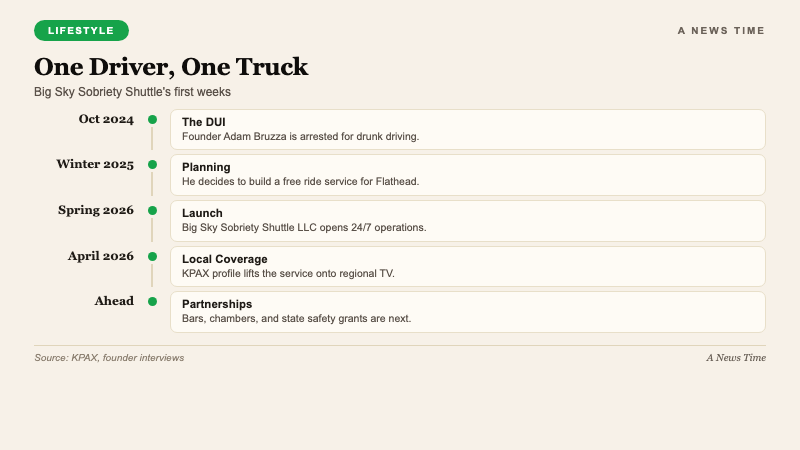
The second stress point is the founder. Running a free 24/7 service from a personal truck is not a sustainable lifetime commitment for any single person. Most programs that last beyond the first two years either recruit a volunteer driver pool, formalize into a community nonprofit, or hand operations to a local bar association or Rotary chapter. Bruzza's LLC structure and his partnership posture with local bars suggest an orientation toward that second pathway.
Why Stories Like This Matter
The national news cycle around was dominated by the US seizure of an Iranian cargo ship, by the collapse of the second round of peace talks in Pakistan, and by a Trump approval rating at a second-term low. Those are the stories that moved markets and reshaped the diplomatic calendar. They are not the only stories happening in the country.
The Big Sky Sobriety Shuttle is a reminder that most Americans encounter daily life not through the lens of diplomatic collapse but through the smaller, more practical question of whether the person next to them at the bar is going to drive home. One Flathead County resident decided to make that question less dangerous for his neighbors. The fact that the answer required a formal LLC, a pickup truck, and a willingness to give up his nights says something useful about what infrastructure looks like when national systems do not reach a particular place.
Frequently Asked Questions
What is Big Sky Sobriety Shuttle?
Big Sky Sobriety Shuttle LLC is a free 24/7 designated-driver service in Flathead County, Montana, founded in mid-April 2026 by resident Adam Bruzza. The service operates from Bruzza's personal pickup truck and coordinates with local bars to pick up intoxicated patrons and drive them home at no charge.
Why did Adam Bruzza start the service?
Bruzza received a DUI in October 2024. He launched the service in early 2026 to help prevent others from the same experience.
Where does the service operate?
Flathead County, Montana, primarily covering the Kalispell, Whitefish, and Columbia Falls population centers and the rural roads between them.
How do you request a ride?
According to local broadcast reporting, patrons call or text Bruzza directly, and bar staff can also call on behalf of customers who should not drive.
Are free designated-driver programs common in the US?
A loose network of free-ride programs has operated in the US for decades, including long-running services like Tipsy Taxi in Aspen, Colorado, founded in 1983. The programs tend to be concentrated in rural areas and college towns where rideshare coverage thins out at bar-close hours.
What to Watch
The near-term questions are practical. Whether local bar associations and the Flathead County Chamber of Commerce coordinate to provide fuel or vehicle-maintenance support. Whether Montana's state highway safety office reaches out with grant opportunities. Whether a volunteer driver pool forms to keep the service running when Bruzza needs a night off. The longer-term question, the one rural public health researchers will watch, is whether any measurable change in Flathead County's alcohol-impaired crash data appears over the next 18 to 24 months. The data does not move fast. The ride service has to be running long before the numbers shift. One night, one person, one avoided drive.