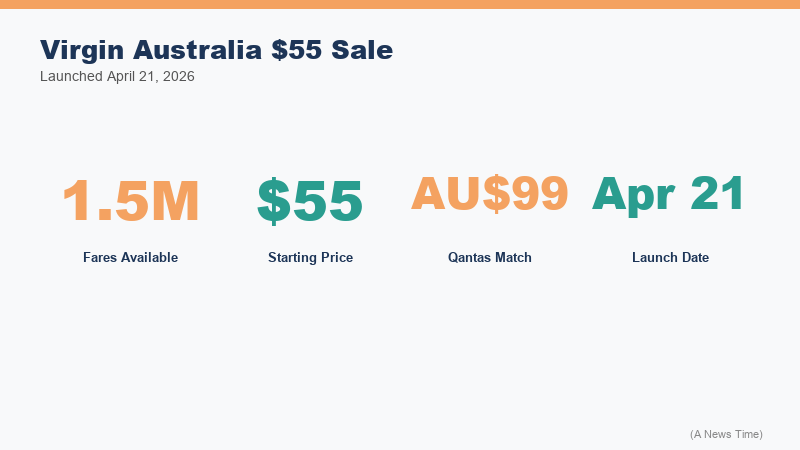
On , Virgin Australia opened what the carrier describes as a mega sale: more than 1.5 million discounted domestic fares, starting at AU$55 one-way on Economy Lite, with a booking window that closes on and travel available from through . It arrived within 24 hours of Qantas releasing its own round of discounted seats from AU$99, a parallel that is not coincidental. Both carriers are simultaneously navigating the most severe fuel cost shock Australian aviation has absorbed since the early 2020s, and both are using short-window sales to stimulate demand and keep load factors healthy while average fares trend upward.
For anyone with flexibility on dates and routes, the Virgin Australia sale is the most concentrated domestic deal available in Australia right now. For international travelers weighing summer itineraries to Europe or Asia, the timing is a reminder that the window for sub-premium fares on long-haul routes is narrowing fast.
What the Virgin Australia Sale Actually Covers
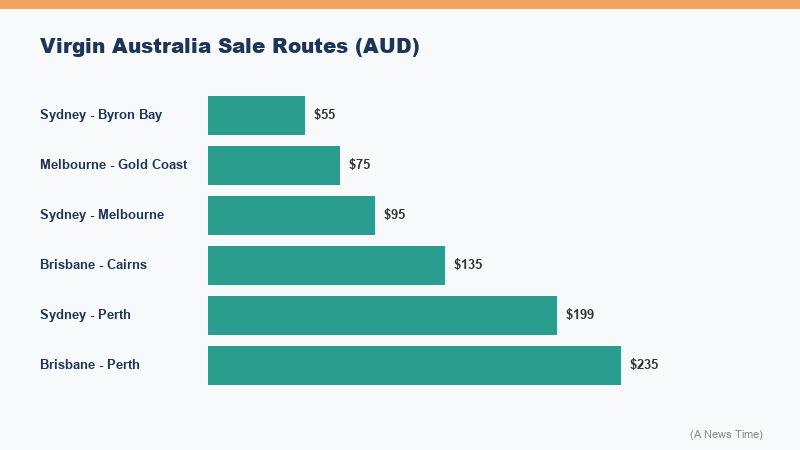
The headline fare of AU$55 applies to Economy Lite one-way tickets on shorter domestic routes. Sydney to Ballina (Byron Bay) opens at $55. Melbourne to Launceston is $59. Sydney to Hobart starts at $69. Melbourne to Gold Coast is available from $85. These are not placeholder fares that disappear the moment the sale goes live. According to Travel and Tour World, more than 1.5 million seats are included in the sale across the airline's full domestic network.
For those working with slightly longer distances, the pricing scales predictably. Melbourne to Sydney and Brisbane to Melbourne are both available at $95 one-way. Sydney to Perth, one of the longer transcontinental runs at roughly 2,700 kilometers, comes in at $230. Brisbane to Perth is $235. These are point-to-point fares, covering both directions, which makes return trip planning straightforward.
The sale also extends to an Economy X upgrade option: AU$15 per sector on selected routes for additional legroom, priority boarding, and preferred exit-row seating. That includes routes like Adelaide to Brisbane, where a small premium over the base fare unlocks noticeably better in-flight conditions for what is a roughly three-hour sector.
One structural caveat applies across the entire sale: Economy Lite fares do not include checked baggage or seat selection. Both are available as add-ons. Travelers who need a checked bag should factor that into their actual per-trip cost before comparing against a competing carrier's base fare that includes luggage allowances. The true cost gap may be smaller than the headline numbers suggest, but the base fare remains genuinely competitive.
Why Two Major Australian Carriers Are Running Sales Into Rising Fuel Costs
The concurrence of Virgin Australia and Qantas domestic sales against a backdrop of surging fuel costs requires some explanation, because on the surface it looks contradictory. Airline economics, however, make the logic clear.
Jet fuel prices in Australia, along with global markets, surged dramatically from late February 2026 after escalating tensions in the Middle East disrupted supply chain logistics through the Gulf and the Strait of Hormuz. According to analysis published April 21 on 2PAXfly, fuel prices have risen more than 100 percent within weeks in some markets, with the cost increase feeding directly into operating expenses. For airlines, fuel typically represents 20 to 35 percent of total costs. When that input price doubles, the pressure on yields is immediate.
"These sales are landing just days after both airlines warned of sharply higher fuel costs and rising fares. That contrast isn't accidental. It reflects a key tension in airline pricing right now. Fuel costs are pushing fares higher, but airlines still need to stimulate demand to keep planes full."
2PAXfly, aviation analysis published April 21, 2026
The fundamental rule of airline revenue management is that an empty seat on a departed flight represents permanently lost revenue. Even in a high-cost environment, filling those seats at a steep discount generates more marginal revenue than flying them empty. Domestic routes in particular provide relatively predictable, stable load factors compared with international routes, which are more exposed to geopolitical demand shifts. By running a sale now, Virgin Australia and Qantas are generating cashflow from a period of solid leisure demand before fuel cost increases work their way fully through to average selling prices later in 2026.
The industry analysis is blunt about trajectory. Airfares are not getting cheaper as a structural matter. Airlines are raising base fares in increments, releasing fewer discounted seats in advance, and on some international routes reintroducing fuel surcharges. The April 2026 domestic sales in Australia are a window, not a new floor.
The Global Budget Deal Landscape: Europe and Asia in Summer 2026
Zooming out from Australian domestic routes, the picture for international budget travelers in summer 2026 is more complicated. The fuel shock that is driving Australian domestic sales upward is having the same effect on long-haul international fares, particularly on routes that transit Gulf airspace or rely on kerosene priced against Middle East crude.
European destinations are facing dual pressure: airfare increases and the expanding layer of tourist taxes and entry fees that are now standard across the continent. Our earlier coverage of how summer 2026 airfares are tracking 18 percent above last year detailed the strategies that remain available for cost-conscious travelers. The core finding holds: booking 10 to 16 weeks in advance, staying flexible on departure airports, and targeting Tuesday-Wednesday departures still captures meaningful savings relative to peak Friday-Sunday fares.
Asia remains the most accessible long-haul value proposition for both Australian and American travelers. Tokyo Haneda continues to attract some of the lowest average fares for Asia arrivals, with search aggregator data showing one-way economy fares from major Australian gateways in the $500 to $700 range on non-peak travel dates. From the US, fares to Southeast Asia (Bangkok, Hanoi, Kuala Lumpur) have been relatively resilient compared to Europe, partly because those routes rely less on Gulf fuel logistics.
For travelers considering the intersection of budget travel and European summer itineraries, the practical guidance is to separate the airfare decision from the ground-cost decision. European airfares are elevated, but accommodation outside peak cities (Lisbon, Krakow, Tbilisi, Oporto) remains significantly cheaper than equivalent quality in Paris, Amsterdam, or Barcelona. The overtourism fees and tourist taxes that have proliferated across Europe's most popular destinations, detailed in our reporting on Europe's overtourism crackdown in 2026, add cost but are predictable and budgetable in advance.
| Route | Distance (approx.) | Sale Fare (AU$) | Economy X Upgrade |
|---|---|---|---|
| Sydney to Ballina (Byron Bay) | 725 km | $55 | From $15 extra |
| Melbourne to Launceston | 520 km | $59 | From $15 extra |
| Sydney to Hobart | 1,040 km | $69 | From $15 extra |
| Melbourne to Gold Coast | 1,380 km | $85 | From $15 extra |
| Melbourne to Sydney / Brisbane to Melbourne | 875 / 1,380 km | $95 | From $15 extra |
| Sydney to Perth | 2,700 km | $230 | Selected flights |
| Brisbane to Perth | 3,600 km | $235 | Selected flights |
Reading the Market: What Budget Travelers Should Do Now
The window between discount events and structural fare increases is narrow in 2026. Multiple signals point to the same direction: fuel costs remain elevated, global airline capacity on key routes is being trimmed, and demand for leisure travel remains strong enough that carriers can pass cost increases through without immediately collapsing load factors. That combination argues for locking in fares sooner rather than later.
For Australian domestic travelers, the Virgin Australia sale closes April 28, with Qantas's parallel sale running on a similar deadline. After those booking windows close, the next comparable sale event is unpredictable. Airlines have moved away from predictable seasonal sale schedules in recent years, substituting algorithmically driven pricing that responds to demand signals in near real time.
For international travelers targeting Europe or Asia in summer 2026, the calculus is different. Fares have already moved higher on most major corridors. The remaining levers are route flexibility (secondary airports, connecting itineraries through less congested hubs), travel date flexibility (shoulder dates in late August rather than peak July), and baggage strategy (many full-service carriers include baggage in base fare, making a direct price comparison against budget carriers more equitable than headline numbers suggest).
Australia's Virgin Australia specials page and Qantas's deals portal are the direct booking sources for the current sale. Both should be checked against price comparison tools, as sale fares sometimes appear at different rates through booking aggregators depending on how inventory is allocated.
What the April 2026 Australian domestic sale represents, at its structural level, is the last significant window of below-trend pricing before mid-year fare normalization. The 2PAXfly analysis published April 21 put it plainly: "Those $99 fares aren't a sign that flights are getting cheaper. But that shouldn't put you off buying them. At the moment, airfares are only heading in one direction, and that is up." The same logic applies to the $55 Virgin Australia fares. Book the trip. The window is real. It is also short.
Insider Tip: Economy Lite Fine Print That Changes the Math
Economy Lite, the fare class covering all Virgin Australia sale fares at the $55 to $235 price points, is a stripped-down ticket in a specific way that is worth understanding before purchasing. The fare includes a personal carry-on item (fitting under the seat or in overhead, depending on availability), the right to bring one small bag. It does not include a checked baggage allowance, seat selection at booking, or changes without a fare difference fee.
For a short hop like Sydney to Byron Bay where most travelers pack light, the Economy Lite terms are entirely manageable. For transcontinental routes like Sydney to Perth, where a checked bag might cost AU$30 to $50 as an add-on and seat selection another $15 to $25, the gap between the headline $230 fare and the actual travel cost for a typical passenger narrows. That is still competitive pricing for a 5.5-hour flight, but travelers who regularly check bags should factor the true cost before booking.
The Economy X upgrade at $15 per sector is genuinely well-priced for what it provides: exit-row or extra-legroom seating plus priority boarding. On routes above 90 minutes, that upgrade has historically delivered strong satisfaction value relative to its cost.
For related budget travel context, our deep-dive on the ten cheapest destinations for US travelers in 2026 covers the international value landscape in more detail, including where the strong-dollar advantage is still meaningful for outbound American travelers considering the same global budget market.
Frequently Asked Questions
When does the Virgin Australia sale end?
The Virgin Australia April 2026 mega sale booking window closes on . Travel on sale fares is available from July 22, 2026 through March 27, 2027, subject to availability on each route.
What does Economy Lite include?
Economy Lite fares include a carry-on personal item but do not include checked baggage, advance seat selection, or flexible changes. Checked bags and seat selection are available as add-ons at additional cost.
Why are airlines offering sales while warning fares will rise?
Airlines price to maximize revenue per available seat. Even in a high-cost fuel environment, filling seats at a discount generates more revenue than flying them empty. Short-window sales also stimulate demand and cashflow. The sales do not contradict the broader fare-increase trend; they are a temporary exception to it before pricing normalizes at higher levels.
Are international fares from Australia also on sale?
The Virgin Australia and Qantas April 2026 sales are focused on domestic routes. International fares from Australia are generally tracking higher in 2026 due to fuel cost increases and Middle East airspace disruptions affecting long-haul routes through the Gulf region.
Is the Economy X upgrade worth the extra cost?
On sectors longer than 90 minutes, the Economy X upgrade at AU$15 per sector provides extra legroom, priority boarding, and preferred seating. For travelers who value comfort without paying for a full business class product, it represents strong value at that price point, particularly on routes above two hours.