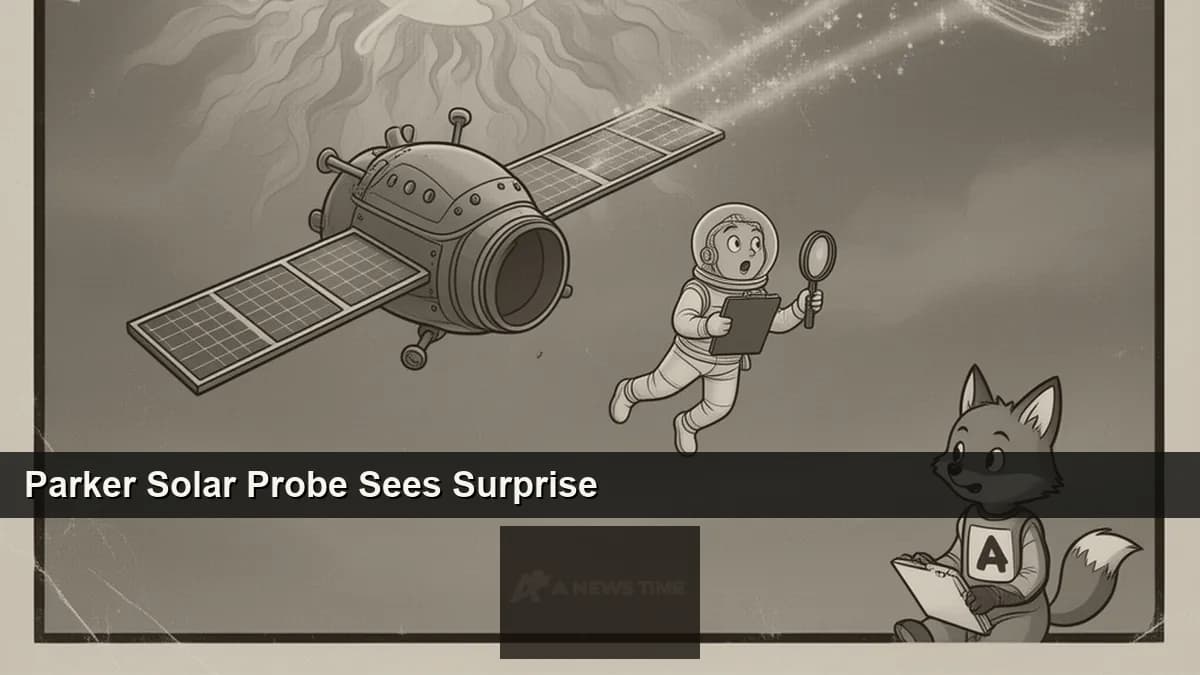
A magnetic explosion on the Sun that NASA's Parker Solar Probe flew through in 2022 has produced a result that contradicts what physicists thought they understood about how the Sun flings particles across the solar system. NASA announced the finding on , citing a peer-reviewed paper published in the Astrophysical Journal Letters. The research team, led by Dr. Mihir Desai of the SwRI and the University of Texas at San Antonio, found that during a magnetic reconnection event, protons and heavier ions accelerated in such fundamentally different ways that current theoretical models cannot explain the data.
What the Probe Actually Saw
Parker Solar Probe is the closest any spacecraft has ever come to the Sun. On a 2022 solar flyby, it threaded between the Sun and the site of a magnetic reconnection event happening in the solar wind, the continuous stream of charged particles and magnetic fields that the Sun sheds into space. That geometry was the key. Magnetic reconnection events are easier to model in lab plasmas or to infer from distant satellites, but catching one from the right side of the particle stream, close enough to measure the freshly accelerated output, is rare.
What the probe recorded was a jet of particles aimed back at the Sun, composed of two populations. The protons, which are the lightest and most abundant charged particles in the solar wind, behaved one way. The heavy ions, which are elements like oxygen, iron, and silicon stripped of several electrons, behaved another. Current reconnection theory predicts both groups should accelerate in broadly the same manner, scaled by mass and charge. They did not.
"The new data rewrite our understanding of reconnection. Protons and heavy ions show distinct spectra that contradict current models. Protons generate waves that scatter them more efficiently, while the heavy ions stay beam-like and retain their accelerated spectral shapes."Dr. Mihir Desai, Southwest Research Institute and University of Texas at San Antonio
NASA scientist Mara Johnson-Groh, who wrote the agency's announcement from Goddard Space Flight Center, described the behavioral split with an analogy: the protons spread out like the beam from a flashlight, while the heavier ions traveled in a straight line like a laser. That is a significant departure from the theoretical expectation that reconnection would accelerate all particles into a roughly coherent jet.
The Physics That Now Needs a Rewrite
Magnetic reconnection is one of the most important processes in astrophysics. It happens when magnetic field lines crossing in opposite orientations break and reconnect, converting stored magnetic energy into kinetic energy almost instantaneously. The same mechanism powers solar flares, coronal mass ejections, the aurora over Earth's poles, and the violent bursts seen around black holes and supernovae. Understanding how it accelerates particles is a precondition for understanding everything from space weather forecasts to high-energy astrophysics.
The textbook model of reconnection treats the accelerated particles as roughly interchangeable in their acceleration mechanics. Charge and mass modify the magnitude of the effect, but the process is supposed to be universal. What Parker saw breaks that assumption. Protons, being light, excite plasma waves as they accelerate, and those waves scatter the protons that follow behind them. That scattering is what produces the flashlight-like dispersed pattern. Heavier ions, less prone to exciting those waves at the same frequencies, keep their initial spectral shape and stay collimated.
| Particle Type | Acceleration Pattern | Theoretical Expectation | Parker Observation |
|---|---|---|---|
| Protons | Dispersed, flashlight-like | Coherent jet, same as ions | Waves scatter the beam |
| Heavy ions (O, Fe, Si) | Collimated, laser-like | Coherent jet, same as protons | Beam shape preserved |
| Energy spectrum | Different power-law slopes | Matched slopes across species | Species-dependent spectra |
That distinction matters because reconnection models feed directly into the space weather forecasts that NOAA's Space Weather Prediction Center and similar agencies issue to satellite operators, power grid managers, and airlines. If the energy distribution of a solar storm's particles depends on which species was accelerated in which way, then predicting the severity of a geomagnetic disturbance requires theory that can handle that divergence.
Why This Matters for Space Weather on Earth
Space weather is not an abstract concern. The March 1989 geomagnetic storm blacked out the Quebec power grid for nine hours, stranding six million people. A comparable event in 2003 damaged the power system in Malmo, Sweden and knocked out a Japanese science satellite. The February 2022 Starlink incident, in which 40 newly launched SpaceX satellites burned up after a geomagnetic storm increased atmospheric drag at their orbital altitude, was a $50 million lesson in what routine solar activity can do to modern infrastructure.
Forecasters today rely on a patchwork of satellite observations, ground-based magnetometers, and physics-based models that extrapolate from upstream conditions in the solar wind to ground effects on Earth. The particle energy spectrum is one of the inputs those models need to get right. If heavy ions carry a disproportionate share of the energy in a beam-like profile while protons scatter and lose coherence, the resulting geomagnetic impact at Earth will differ from what a single-species model predicts.
The practical implication is that space weather alerts may be over- or underestimating the severity of specific storm components, depending on the reconnection physics involved in a particular eruption. Desai's team frames the finding as a call to build reconnection models that track protons and heavy ions separately rather than treating them as a single particle population with a scaling factor.
The Sun as a Laboratory for Extreme Physics
Parker Solar Probe was designed to do exactly this kind of work. Launched in 2018, the spacecraft has been making progressively closer passes to the Sun, equipped with a heat shield that tolerates temperatures above 1,400 degrees Celsius at perihelion. The mission's goal was to observe solar phenomena that cannot be resolved from Earth orbit, including the fine structure of the solar wind and the heating mechanisms that give the corona its anomalous million-degree temperatures.
The reconnection measurement is a case study in why proximity matters. Magnetic reconnection events in the solar atmosphere are inaccessible to any current spacecraft, shielded by plasma densities and magnetic fields that would destroy hardware before useful data could be collected. Events in the solar wind, which occur farther from the Sun but involve the same physics, are the proxy. Parker happened to pass through one with its instruments oriented correctly.
"What we are learning is that the Sun's magnetic engine is far more complex than we imagined. This is incredibly exciting because it demonstrates that our own star acts as a local, accessible laboratory for the same high-energy physics that powers the most violent and mysterious phenomena in the Universe, from black holes to supernovae."Dr. Mihir Desai, lead author
That framing is important for mission justification. Parker Solar Probe is funded in part on the argument that observations at the Sun illuminate physics that shows up across the cosmos. Reconnection is the standard example. The same mechanism that powers a coronal mass ejection also fuels the jets from supermassive black holes at the centers of galaxies. Better data from the Sun constrains theory for everything else.
What We Still Do Not Know
The finding is a single reconnection event, which means the first follow-up question is whether the behavior generalizes. Not every reconnection event in the solar wind will involve the same plasma conditions, magnetic field geometry, or particle mix. Desai's team noted in the paper that the measured current sheet was near the heliospheric current sheet, the surface where the Sun's magnetic polarity flips, which is a specific and relatively well-studied environment. Reconnection in other contexts, such as the flare sites in active regions near the solar surface, may behave differently.
The second open question is the wave physics itself. The paper identifies wave-particle interactions as the likely cause of the proton scattering, but the specific wave modes and their saturation amplitudes are not yet characterized in detail. Theoretical plasma physicists will need to model the system end-to-end to confirm the interpretation.
The third is instrumentation. Future Parker perihelion passes may catch additional events, but the mission is approaching the end of its planned operational life. Follow-on missions including the European Space Agency's Solar Orbiter and proposed next-generation concepts will need to carry instruments optimized for multi-species particle measurements at high cadence, which is a different design target than earlier generations of solar monitors.
The Next Observations to Watch
The immediate next step is for theorists to test the Desai group's interpretation against alternative models. A reconnection event in the solar wind is a messy environment, and the clean separation between proton and ion behavior could have other explanations that emerge on closer analysis. The community tends to resolve these questions within a year or two of a surprising result as other groups reanalyze the public data and run simulations.
On the observational side, the heliophysics community will now be watching every upcoming Parker flyby and every Solar Orbiter encounter for similar events. The Sun is currently on the descending side of Solar Cycle 25, which means reconnection events and coronal mass ejections are less frequent than they were at solar maximum but still occur regularly. If another event with similar geometry gets caught, the theory will either be confirmed or revised.
For the broader heliophysics research program, the Parker result reinforces the value of direct, close-in measurements over remote observation. That argument matters politically: NASA's heliophysics division is not immune to the budget pressures facing the rest of the agency, and mission cost-benefit cases increasingly hinge on how often probes return results that rewrite theory rather than confirm it. This one rewrites theory.
Sources
- NASA's Parker Solar Probe Finds Surprises in an Explosion Near the Sun - NASA Science
- Proton and Heavy Ion Acceleration by Magnetic Reconnection at the Near-Sun Heliospheric Current Sheet - Astrophysical Journal Letters
- Closer Look at the Sun Reveals More Chaotic Magnetic Heart - Sci.News
- Southwest Research Institute